Walk-Behind Power Barrow or Ride-On Dump Hauler? Choosing the Right Form for Daily Work
Share
Many buyers compare load capacity first.
That makes sense. A power barrow, powered wheelbarrow, electric dump cart, or battery-powered dump hauler must be able to carry the materials the job requires.
But load capacity is not the only decision.
Before buying, the buyer should also ask a more practical question:
How will the operator move with the machine?
A walk-behind power barrow still asks the operator to walk behind the load. A ride-on dump hauler allows the operator to drive or ride with the vehicle across the work route.
That difference can change the entire workday.
For a short garden path, a walk-behind powered wheelbarrow may be enough. For repeated farm, horse stable, landscaping, nursery, ranch, or property maintenance routes, a ride-on battery-powered dump hauler may fit the work better.
The right choice depends on distance, route width, ground condition, number of trips, operator fatigue, storage space, and how often the same hauling job repeats.
A walk-behind power barrow still follows wheelbarrow logic
A walk-behind power barrow is a useful tool.
It gives power assistance to a familiar wheelbarrow-style format. The operator stands behind the machine, holds the handles, controls the movement, and walks with the load.
For some jobs, that form makes sense.
A walk-behind electric wheelbarrow or motorized wheelbarrow can work well in tight garden paths, residential side yards, small landscaping projects, backyard cleanup, short mulch routes, and places where the operator needs close control at slow speed.
It may also feel familiar to people who already use a traditional wheelbarrow.
The powered drive helps reduce some pushing effort, especially when moving soil, mulch, compost, gravel, firewood, or yard debris across short distances.
For light or occasional work, walk-behind equipment can be a practical upgrade.
But it does not remove the walking.
The operator still walks every trip
The biggest difference between a walk-behind power barrow and a ride-on dump hauler is not only machine size.
It is operator movement.
With a walk-behind machine, the operator still walks behind every load. The operator walks to the dump point, controls the turn, unloads the material, and walks back for the next load.
For one or two short trips, that may not matter.
For repeated daily hauling, it matters a lot.
A horse stable worker may repeat the same manure route many times. A farm worker may move compost, soil, feed bags, and bedding waste across the same yard. A landscaping crew may move mulch and yard debris across several properties. A property maintenance worker may travel between buildings, dumpsters, storage areas, and landscape beds.
In these situations, the hidden cost is not only the weight of the load.
It is the walking behind every load, every time.
A ride-on dump hauler changes the work rhythm
A ride-on dump hauler changes how the job feels.
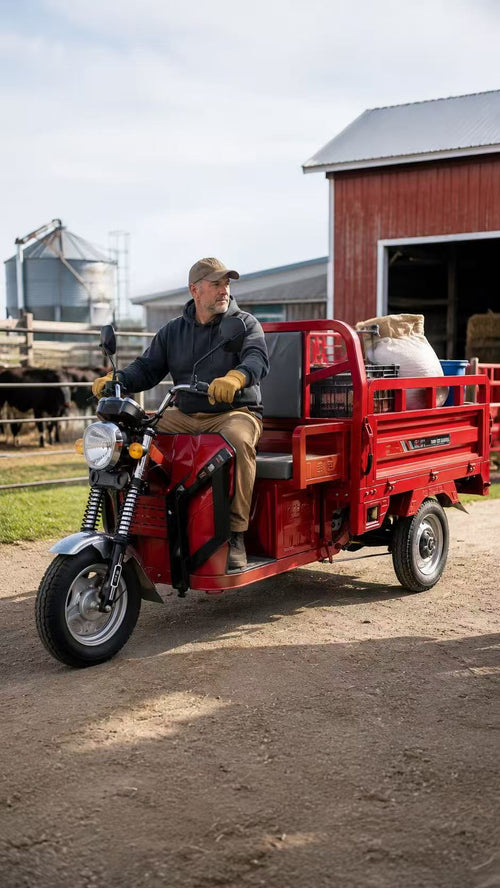
Instead of walking behind every trip, the operator drives the vehicle along the route. The cargo bed carries the material, and the operator moves with the vehicle.
This can make more sense when the route is repeated, the distance is longer, and the material movement is part of daily operations.
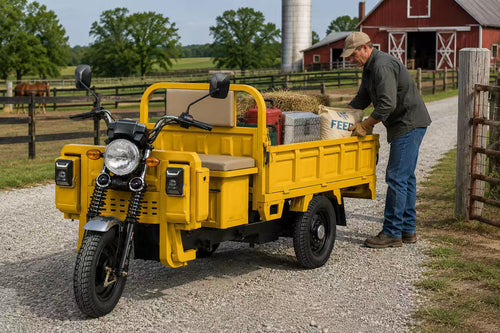
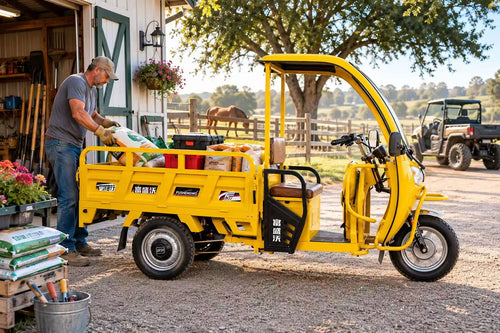
A ride-on electric dump hauler is not simply a larger wheelbarrow. It is closer to a compact electric utility hauler or driveable dump cart for short-distance work.
It can support repeated trips between a barn and compost pile, a nursery work area and soil station, a landscaping yard and mulch pile, an apartment maintenance shed and cleanup route, or a farm storage area and work zone.
The value comes from matching the operator’s movement to the job.
If the route repeats all day, driving may be more practical than walking behind every load.
Walk-behind machines can be better in very tight spaces
A ride-on hauler is not always the right choice.
Walk-behind power barrows can be useful in very tight spaces where a larger driveable machine may not fit comfortably. This may include narrow garden paths, tight residential gates, small side yards, raised-bed garden areas, narrow greenhouse corners, compact backyard projects, and places where the operator needs to guide the machine very closely.
Some walk-behind units may also be easier to store in a small garage, shed, or backyard corner.
For homeowners, gardeners, or crews doing occasional light landscaping, a walk-behind electric wheelbarrow may be enough.
It can reduce pushing effort without requiring a larger parking area, riding space, or wider turning route.
The key is to match the form to the route.
If the route is short and tight, walk-behind may fit better.
Ride-on haulers fit repeated property routes
A ride-on battery-powered dump hauler becomes more useful when the route is not only tight, but repeated.
This includes farm lanes, barn-to-compost routes, horse stable cleanup paths, nursery material routes, landscaping supply yards, HOA maintenance paths, apartment property service roads, ranch work areas, greenhouse service lanes, and large residential properties.
The route does not need to be long like a road.
Even a few hundred feet can become tiring when repeated many times every day.
A ride-on dump hauler can help reduce repeated walking across the same property. It can also make it easier to carry tools, small supplies, material, and loose bulk loads without forcing the operator to push, balance, and walk behind the machine each time.
For daily work, the form of the vehicle matters as much as the size of the cargo bed.
The question is not only “How much can it carry?”
Many buyers ask:
How much weight can it carry?
That is important, but incomplete.
A better question is:
How many times will the operator move this load, and how far?
A walk-behind powered wheelbarrow may carry enough material for a small job, but if the operator repeats the same route many times, the walking can still become the main burden.
A ride-on dump hauler may not be needed for every task, but it can make more sense when the work involves repeated trips across a farm, stable, landscaping property, nursery, or maintenance area.
The buyer should compare the whole cycle:
Load the material.
Move to the destination.
Unload the material.
Return for another load.
Repeat the route again.
If that cycle repeats often, a ride-on form may have a stronger advantage.
Horse stables are a good example
Horse stable work is often repetitive.
Manure, wet bedding, clean bedding, feed bags, buckets, tools, and compost may move every day. The work may happen between stalls, barn aisles, storage areas, waste piles, paddocks, and compost zones.
A walk-behind electric wheelbarrow may help reduce some pushing effort, especially in short barn routes.
But if the stable has repeated trips across a longer property path, a ride-on dump hauler can fit the routine better.
The operator does not need to walk behind every load. The cargo bed can carry stable waste or supplies. The vehicle can return to the barn, storage area, or compost route as part of the daily workflow.
For stables, the decision should consider distance, number of stalls, bedding volume, manure route, ground condition, and how many times the worker repeats the same trip.
Farms and ranches need flexible daily movement
Farm and ranch work often includes many small hauling tasks in one day.
A worker may move compost in the morning, feed bags later, tools after lunch, gravel for a small repair, and bedding waste before the day ends. Each job may be moderate, but together they create a repeated material handling pattern.
A walk-behind power barrow can help with short material movement close to one area.
A ride-on electric dump hauler can be more useful when the work spreads across a yard, barn, shed, feed area, greenhouse, compost pile, or equipment zone.
The ride-on form helps when the operator needs to move with the load instead of walking every route.
For farms and ranches, the best choice depends on whether the work is mostly close and narrow, or spread across repeated property routes.
Landscaping crews should think about job type
Landscaping work includes both tight spaces and repeated routes.
A walk-behind power barrow can fit narrow residential paths, side yards, garden beds, and smaller mulch jobs where close control is important.
A ride-on dump hauler may fit better for repeated mulch movement, soil delivery, branch cleanup, yard debris collection, tool transport, and property maintenance routes where crews move between supply piles, work zones, trailers, and disposal areas.
A landscaping company does not need to choose one form for every job.
The important question is what type of work happens most often.
If most jobs are small, narrow, and occasional, walk-behind may be enough. If crews often repeat short-distance hauling across larger properties, a ride-on battery-powered dump cart may save more walking and time.
The best tool is the one that fits the daily service pattern.
Nurseries and greenhouses need careful route planning
Nurseries and greenhouses often have tight paths, plant benches, soil stations, potting areas, compost piles, tray storage, and workers moving in shared spaces.
In very narrow aisles or crowded areas, a walk-behind electric power barrow may offer close control.
But in larger nursery yards, greenhouse service lanes, and outdoor plant handling areas, a ride-on electric hauler may be more practical for repeated material movement.
It can help move soil bags, potting mix, plant waste, mulch, trays, tools, and cleanup material across the property without asking the operator to walk behind every trip.
The decision should not be based only on whether the machine can fit through one aisle.
It should be based on the actual route: how wide it is, how often it is used, what materials move through it, and whether workers repeat the same movement many times a day.
Property maintenance teams may benefit from driveable hauling
Apartment communities, HOA properties, schools, resorts, parks, and large private properties often have repeated maintenance routes.
Workers may move tools, trash bags, branches, leaves, mulch, soil, cleaning supplies, repair parts, and debris between buildings, dumpsters, storage rooms, sidewalks, landscape beds, and service areas.
A walk-behind powered wheelbarrow may help in tight spaces.
But if the maintenance route stretches across a property, a driveable electric dump cart or compact ride-on hauler may make more sense.
The operator can move with the load, carry tools and materials, return to the maintenance area, and repeat the route without walking behind every trip.
For property maintenance, the value is not only hauling material.
It is helping workers cover the property more efficiently.
Operator fatigue is part of the buying decision
Many equipment comparisons focus on the machine.
But the operator matters too.
If a worker spends the day walking behind load after load, fatigue can affect speed, accuracy, and willingness to use the equipment. Even if the machine is powered, the operator still walks the distance.
A ride-on dump hauler can reduce that walking in suitable work areas.
This may matter for older operators, small crews, stable workers, maintenance teams, farm owners, and landscaping crews who repeat the same hauling route many times.
This does not mean a ride-on vehicle removes all labor.
Workers still load material, plan routes, operate carefully, unload properly, clean the bed, and store the vehicle.
But it changes the most repetitive part of the cycle: walking behind every load.
Turning space matters
A ride-on dump hauler needs enough space to turn and move safely.
Before choosing a ride-on form, the buyer should check gates, barn entrances, shed doors, greenhouse paths, nursery lanes, landscaping routes, sidewalks, material staging areas, and storage locations.
A walk-behind power barrow may turn in tighter areas and may be easier to reposition by hand.
A ride-on hauler needs a more planned route.
That does not make ride-on equipment worse. It simply means the buyer should walk the property before buying.
Ask:
Can the vehicle turn at the loading point?
Can it reach the dump point?
Can it pass through gates and narrow sections?
Can people or animals stay clear of the route?
Can it park without blocking doors, paths, or work areas?
If the route has enough space, ride-on hauling becomes more practical.
Ground condition still matters
Both walk-behind and ride-on machines need suitable ground.
Firm gravel, concrete, asphalt, compacted dirt, and stable farm lanes are usually better than soft mud, wet turf, loose edges, deep ruts, steep slopes, or uneven ground.
A walk-behind unit may be easier to guide slowly in very tight or uneven spots, but the operator still needs to manage the load. A ride-on hauler may be more comfortable on repeated firm routes, but it should not be treated as a solution for poor ground conditions.
The buyer should think about the normal route, not only the best part of the property.
If the job involves repeated movement on firm ground, a ride-on dump hauler may fit well. If the job happens mostly in tight, soft, fragile, or unpredictable areas, walk-behind may be easier to control.
Storage and charging affect the choice
A battery-powered machine needs a place to live.
Walk-behind equipment may require less storage space. Ride-on dump haulers may need a more practical parking area, covered storage, firm ground, and a clear charging routine.
Before choosing ride-on equipment, the buyer should know where it will be parked, where it will charge, and how it will leave the storage area each morning.
If the storage area is too tight or blocked, the hauler may become inconvenient.
If the buyer has a barn bay, equipment shed, carport, maintenance shop, covered work area, or protected outdoor storage spot, a ride-on battery-powered dump hauler becomes easier to manage.
A good storage plan helps the vehicle become part of daily work instead of another item in the way.
Do not buy ride-on only because it looks stronger
A ride-on dump hauler can look more serious than a walk-behind power barrow.
But that should not be the only reason to choose it.
The buyer should not choose ride-on simply because it feels larger or more impressive. The route, workload, and daily routine must justify it.
If the work is occasional, close, light, and tight, a walk-behind powered wheelbarrow may be enough.
If the work repeats many times, covers longer property routes, carries different materials, and affects daily labor, a ride-on dump hauler may be the better fit.
A good buying decision starts with the work pattern, not the appearance of the machine.
Do not choose walk-behind only because it is familiar
The opposite mistake is choosing walk-behind only because it feels familiar.
Many buyers understand wheelbarrows. A powered wheelbarrow seems like a simple upgrade. That may be true for some jobs.
But if the job has outgrown manual walking, the familiar format may not solve the bigger problem.
If the operator still walks hundreds of feet per trip, many times a day, the powered wheelbarrow may reduce pushing effort but not eliminate the travel burden.
That is where a ride-on dump hauler can change the work pattern.
The buyer should ask whether the problem is mainly load weight, or whether the problem is repeated distance and daily movement.
If the problem is repeated distance, ride-on may deserve serious consideration.
Compare the full work cycle
Before buying, compare both forms through the full job cycle.
For a walk-behind power barrow:
The operator loads the material.
The operator walks behind the machine.
The operator controls every turn by hand.
The operator unloads.
The operator walks back.
The cycle repeats.
For a ride-on dump hauler:
The operator loads the material.
The operator drives with the load.
The vehicle carries the operator and material along the route.
The operator unloads.
The operator drives back.
The cycle repeats.
Both forms still require work.
But the operator’s movement is different.
For one or two short trips, the difference may be small. For repeated daily hauling, the difference may decide which machine feels useful after the first week.
When walk-behind may be the better choice
A walk-behind power barrow may be the better choice when:
The route is very short.
The path is narrow.
The job is occasional.
The work happens in tight residential spaces.
The buyer has limited storage.
The load is moderate.
The operator needs close hand control.
The route includes many small turns.
The work does not require repeated long-distance trips.
In these situations, walk-behind equipment can be practical and efficient.
It may offer enough powered assistance without needing the storage and route planning of a ride-on hauler.
When ride-on may be the better choice
A ride-on battery-powered dump hauler may be the better choice when:
The route repeats many times.
The operator travels longer distances.
The property has firm paths or work lanes.
The work includes daily farm, stable, nursery, ranch, landscaping, or property maintenance tasks.
The hauler carries manure, bedding waste, mulch, compost, soil, gravel, feed bags, tools, branches, or debris.
The team wants to reduce walking behind every load.
The vehicle can be stored and charged properly.
The route has enough room for safe movement and turning.
In these situations, ride-on hauling may support the routine better than a walk-behind form.
The value is not only in carrying material.
The value is in reducing repeated operator travel across the property.
The best form depends on the daily route
Walk-behind and ride-on machines both have a place.
A walk-behind power barrow can be useful for tight, short, close-control jobs where the operator does not travel far. A ride-on dump hauler can be useful for repeated daily routes where the operator should not have to walk behind every load.
The buyer should not choose only by payload, price, or motor size.
The buyer should look at the work route.
How far is each trip?
How many trips happen each day?
How tight are the turns?
How firm is the ground?
How often does the same job repeat?
Can the vehicle be stored and charged?
Does the operator need close hand control, or does the operator need to reduce walking?
Those answers point to the right form.
If the work is occasional, close, and narrow, a walk-behind power barrow may be enough.
If the work repeats across a farm, stable, nursery, ranch, landscaping site, or property maintenance route, a ride-on battery-powered dump hauler may fit the daily routine better.