Before Buying an Electric Cargo Trike, Check Your Farm Tasks and Terrain First
Share
The wrong farm vehicle is usually chosen before the buyer ever looks at the motor.
It starts with a simple mistake: judging the vehicle only by price, wattage, range, or cargo bed size. But on a real farm, the better question is not “How powerful is this electric cargo trike?” The better question is “What work will it do every day, and what kind of ground will it travel on?”
That is why an electric cargo trike for agricultural use should be matched to two things first: the task and the terrain.
If those two questions are clear, the rest of the buying decision becomes much easier.
Start with the Job, Not the Vehicle
A small electric cargo trike can look useful in many farm photos, but not every farm uses a vehicle the same way.
Some buyers need to move feed from a storage shed to livestock pens. Some need to carry hand tools along fence lines. Some need to move harvest crates from garden rows to a packing area. Others need a simple vehicle for seed trays, buckets, fertilizers, small equipment, or daily property maintenance.
These are all agricultural uses, but they are not the same job.
Feed bags need a stable cargo bed and enough low-speed pulling power.
Harvest crates need a flat, easy-loading rear bed.
Tools and repair supplies need side access and simple loading.
Seed trays and nursery materials need smooth handling and controlled movement.
Wet soil, manure, compost, or gravel may need a hydraulic dump bed instead of a normal open cargo bed.
This is why the first buying question should be simple: what will be inside the cargo bed most often?
A buyer who mainly moves boxed produce may not need a dump bed. A buyer who mainly moves loose wet material may regret buying a normal cargo bed. The vehicle has to match the daily load, not just the product photo.
Why Terrain Changes the Decision
The second question is terrain.
A farm road may look simple, but the vehicle feels every part of it: gravel, grass, mud, narrow lanes, uneven ground, barn entrances, greenhouse rows, small slopes, and repeated turns.
For flat dirt roads and short barn routes, an open-bed electric cargo trike can be a practical daily hauler.
For uneven farm tracks, the buyer should pay more attention to tire size, suspension, braking, frame strength, and load balance.
For muddy paths or steep slopes, the decision becomes more serious. A light cargo trike may not be enough. The buyer may need a stronger motor, better tires, lower-speed torque, and a more stable rear axle setup.
This is also where many buyers make a mistake. They look at top speed, but farm work is rarely about top speed. It is about controlled movement while loaded.
A farm vehicle does not need to race. It needs to move slowly, carry safely, stop predictably, and turn without feeling unstable.
Where an Open Cargo Bed Works Well
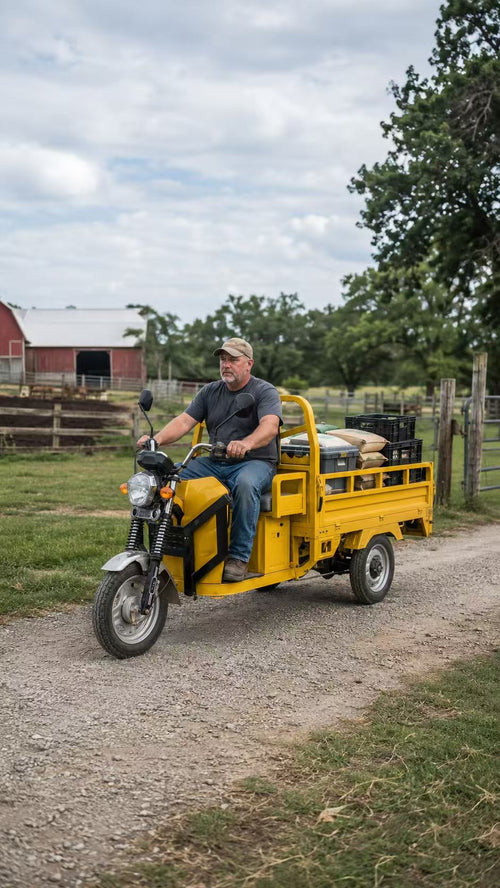
The blue open-bed electric cargo trike is best for farms that move mixed daily loads.
It fits work such as:
feed bags
produce crates
toolboxes
fence repair supplies
seed trays
buckets
small equipment
garden and nursery materials
light farm maintenance supplies
The open rear bed makes sense when the buyer needs to load from the side, stack items quickly, and unload by hand at different stops. It is not designed to dump loose heavy material. It is designed to carry useful farm cargo across short routes.
That makes it different from a recreational e-bike or a family cargo trike. The value is not only that it has three wheels. The value is that the rear bed is built for work.
When a Hydraulic Dump Model Makes More Sense
A normal open cargo bed is not always enough.
If the daily material is wet soil, manure, compost, gravel, mulch, or loose fertilizer, a hydraulic dump trike may be a better choice. The reason is not only convenience. It is labor.
Loose material becomes much harder to remove when it is wet, packed, or heavy. If the operator has to shovel it out after every trip, the vehicle only solves half the problem. The hauling becomes easier, but the unloading is still slow.
That is where a hydraulic dump bed becomes valuable.
For buyers comparing open-bed and dump-bed electric trikes, the question should be:
Do I mainly carry items, or do I mainly move loose material?
If the answer is items, crates, bags, and tools, an open cargo bed can be enough.
If the answer is wet soil, manure, compost, gravel, or mulch, a dump bed may save more time.
Electric Cargo Trike or Gas ATV?
Many farm buyers already use a gas ATV, UTV, pickup, tractor, or wheelbarrow. An electric cargo trike does not need to replace all of them. It only needs to replace the jobs where the old tool is too much, too loud, too slow, or too tiring.
A gas ATV or UTV can be useful for larger properties, rougher terrain, and heavier work. But for repeated short routes around barns, gardens, livestock areas, and storage sheds, gasoline equipment can feel excessive.
Electric cargo trikes are quiet. They are easier to start. They do not need fuel for every small trip. They can move around animals and work areas without the same noise, exhaust, and maintenance routine.
That is why the best use case is not “replace every farm vehicle.” The best use case is “handle the repeated small jobs that happen every day.”
What Motor Power Really Means
Google search results often show electric cargo trikes with 1000W to 1500W motors. That range makes sense for many agricultural short-distance jobs, but wattage alone does not answer everything.
A 1500W motor may be useful when the vehicle carries heavier loads, climbs mild slopes, or travels on uneven ground. A 1000W setup may be enough for lighter feed runs, tools, and flat routes.
But buyers should not judge motor power alone. The motor has to work together with:
battery voltage
controller setup
rear axle strength
cargo weight
tire traction
brake system
terrain
daily route distance
A farm buyer should not ask only “Is 1500W strong?” The better question is “Is this power setup suitable for my load, my route, and my ground condition?”
That question is closer to real farm use.
Range Should Be Judged by Route, Not Brochure Numbers
Range is another number that can mislead buyers.
A product page may show a long range, but farm use is different from smooth road riding. Range changes when the vehicle carries weight, stops often, drives on soft ground, climbs slopes, or moves slowly through work areas.
For agricultural use, buyers should think in routes:
How far is the storage shed from the barn?
How many trips happen in one morning?
Does the vehicle return to a charging point during the day?
Is the ground flat or rough?
Will it carry 100 lb, 300 lb, or more?
A small farm may not need a very long range if the vehicle mainly runs short loops. But it does need enough battery capacity to handle the real workday without constant charging anxiety.
What Buyers Should Check Before Choosing
Before buying an electric cargo trike for agricultural use, the buyer should answer these questions:
What do I move most often?
Is the load mostly bags, crates, tools, or loose material?
What is the normal daily load weight?
Will I drive on flat dirt, gravel, grass, mud, or slopes?
Do I need an open cargo bed or a hydraulic dump bed?
How narrow are the gates, barn paths, or greenhouse rows?
Will the vehicle be used near livestock?
How often will it run each day?
Do I need quiet operation more than high speed?
Is this replacing a wheelbarrow, a gas ATV, a pickup, or only hand carrying?
These questions are more useful than comparing vehicles only by price.
The Best Fit Is Usually a Specific Route
The best electric cargo trike is not the one with the biggest number on the product page. It is the one that fits a real route.
A farm buyer may need a vehicle for the morning feed route, the garden-to-shed route, the fence repair route, the livestock care route, or the harvest crate route. Once the route is clear, the right cargo bed, motor power, and tire setup become easier to choose.
For many small farms and rural properties, an open-bed electric cargo trike is useful because it handles repeated work without becoming a full-size machine. It can carry feed, tools, crates, and supplies while staying compact enough for tight farm areas.
But the buyer should be honest about the job. If the work is loose, wet, and heavy, choose a dump model. If the work is mixed daily carrying, an open bed may be more practical.
The right electric cargo trike is not chosen by the keyword.
It is chosen by the work it will do tomorrow morning.