Is a Quiet Electric Farm Utility Trike More Useful Than a Faster Gas Machine?
Share
Many farm buyers are trained to think about speed first.
A faster machine sounds better.
A stronger gas utility vehicle sounds more serious.
A machine that can run farther, tow more, and handle rougher ground may feel like the safer purchase.
That thinking is understandable.
Gas machines, UTVs, pickups, tractors, and larger utility equipment all have important roles on farms and ranches. If the job requires long-distance property travel, heavy towing, rough terrain, steep hills, or all-day hard use, a faster or stronger gas machine may be the correct choice.
But not every farm job is that kind of job.
Many daily chores are quiet, short, repetitive, and material-focused.
Feed bags need to move from storage to a barn.
Tools need to move from a shed to a repair area.
Nursery trays need to move between growing zones.
Crates, boxes, buckets, and supplies need to move across a private work area.
For this kind of daily movement, the real question may not be:
Which machine is faster?
The better question may be:
Is a quiet electric farm utility trike more useful for the work I do every day?
Speed Looks Powerful, But Daily Chores Are Different
Speed is easy to understand.
A faster machine feels more capable. It can cover more ground, respond quickly, and handle larger properties. On big ranches, wide farms, hunting land, or long private roads, speed may matter.
But many farm chores do not need high speed.
A worker moving feed from a storage area to a barn does not need to race.
A nursery worker moving plants and supplies between tables does not need high speed.
A greenhouse operator moving trays and tools through a work zone does not need a fast gas machine.
A small farm owner moving crates from a field edge to a packing area usually needs control more than speed.
In these jobs, low-speed movement can be an advantage.
The operator can move carefully around people, animals, gates, benches, pallets, crates, tools, and work areas.
That is where a quiet electric farm utility trike can make sense.
It is not trying to win on top speed.
It is trying to make daily short-distance work easier.
Quiet Work Has Real Value
Noise is one of the most overlooked issues in farm equipment choices.
Gas machines are familiar, but they can be loud.
That may not matter in an open field, but it can matter near barns, livestock areas, greenhouses, nurseries, horse properties, small farms, residential properties, hotels, campuses, and private work areas.
A quiet electric utility trike can be useful when work happens near people or animals.
It can move supplies without creating the same level of engine noise.
It can operate around barns without the same gas-engine sound.
It can support early morning or evening chores with less disturbance.
It can move through nursery or greenhouse areas in a calmer way.
This does not mean silence is more important than power in every situation.
It means quiet operation can be a practical advantage when the daily job is short, repeated, and close to living or working areas.
On some properties, the most useful machine is not the loudest or fastest one.
It is the one workers are willing to use often.
The Value of “Easy to Use Often”
A daily work machine should be easy to use often.
This matters more than many buyers realize.
If a machine is large, loud, fuel-dependent, or inconvenient for small jobs, workers may avoid using it for every short trip.
They may carry items by hand.
They may use a wheelbarrow.
They may make several walking trips.
They may wait until more materials pile up.
That creates wasted time.
A smaller electric farm utility trike can become useful because it is simple to use for repeated chores. The operator can load a few feed bags, tools, crates, boxes, or supplies and move them across the property at low speed.
The value is not one dramatic trip.
The value is repeated daily use.
A machine that gets used ten times a day for small chores may be more valuable than a faster machine that is only needed for bigger jobs.
That is why “useful” and “fast” are not always the same thing.
Gas Machines Still Have Their Place
This article is not saying electric is always better than gas.
That would be misleading.
Gas machines can be better when the job requires:
long-distance property travel
heavy towing
rough terrain
steep hills
deep mud
continuous heavy use
high ground clearance
larger ranch coverage
passenger carrying
snow pushing or heavy outdoor work
fast refueling
strong dealer support for UTV-style machines
In those conditions, a gas UTV, pickup, tractor, or larger machine may be the better tool.
A quiet electric farm utility trike should not be treated as a full replacement for every gas machine.
It is not a high-speed vehicle.
It is not a public-road machine.
It is not a heavy towing unit.
It is not a tractor.
It is not designed to replace a full-size UTV in demanding conditions.
The honest value is different.
Electric can be very practical when the work is private-site, low-speed, short-distance, and cargo-focused.
The Right Question Is Work Type
Before choosing between a faster gas machine and an electric farm utility trike, buyers should study their daily work.
What actually happens every day?
Do workers mostly move people, or materials?
Do they travel long distances, or short private routes?
Do they tow heavy loads, or carry feed bags and tools?
Do they need high speed, or careful low-speed control?
Do they work near barns, animals, greenhouses, nurseries, packing areas, or residential property?
Do they need a loud strong machine, or a quiet daily helper?
These questions change the buying decision.
A buyer who needs to patrol a large ranch may choose differently from a buyer who moves supplies around a small farm.
A buyer who tows trailers may choose differently from a buyer who moves crates and tools.
A buyer who works in rough mud may choose differently from a buyer who uses firm gravel, concrete, packed dirt, or greenhouse paths.
The machine should match the work type.
Why Electric Fits Many Daily Chores
An electric farm utility trike can fit daily chores because many chores are predictable.
They happen on the same routes.
They involve similar materials.
They are repeated often.
They happen inside a private or controlled work area.
They do not require public-road travel.
They do not require high speed.
They do not require passenger seating.
They do not require heavy towing.
For these conditions, an electric utility trike with cargo bed can be practical.
It can carry feed bags, tools, small crates, boxes, buckets, nursery trays, supplies, and daily work materials.
It can move slowly through work areas.
It can help reduce repeated walking and hand carrying.
It can support farm, nursery, greenhouse, warehouse yard, homestead, property maintenance, and market preparation work.
It is not meant to be the biggest machine on the property.
It is meant to be a useful machine for repeated small work.
That is a different kind of value.
Quiet Does Not Mean Weak
Some buyers may think quiet equipment is less serious.
That is not always true.
Quiet does not mean useless.
Quiet does not mean toy-like.
Quiet does not mean it cannot support practical daily work.
A quiet electric work trike can still move useful cargo when the load, route, and use pattern are suitable.
The buyer should not judge only by sound.
A loud engine can feel powerful, but sound does not always mean the machine is the best fit for daily chores.
A quiet electric machine may feel less dramatic, but it may be more convenient for the work that happens most often.
The better question is not whether the machine sounds powerful.
The better question is whether it solves the daily movement problem.
In many small farm situations, the daily problem is not noise, speed, or engine power.
The daily problem is too many small trips.
A quiet electric farm utility trike can help solve that problem.
Low-Speed Control Can Be More Useful Than Speed
In tight work areas, speed can become less important.
A barn entrance, nursery aisle, greenhouse path, packing area, warehouse yard, or small farm route may not allow fast driving anyway.
The operator needs to move carefully.
There may be people nearby.
There may be animals nearby.
There may be crates, pallets, tools, water lines, benches, gates, and parked equipment.
In those places, low-speed control matters.
A machine that moves slowly and predictably can be useful.
It helps the operator place the vehicle where the work happens.
It helps prevent rushing through busy work areas.
It makes cargo movement feel more controlled.
This is one reason a quiet electric utility trike can be practical for daily chores.
It supports careful movement rather than fast movement.
When Quiet Electric Work Makes the Most Sense
A quiet electric farm utility trike makes the most sense when the buyer needs:
daily short trips
private-site movement
low-speed control
material transport
less noise around work areas
simple cargo bed use
less fuel handling
repeated movement of small and moderate loads
work near barns, greenhouses, nurseries, animals, or people
a practical support tool rather than a heavy machine
These are the conditions where electric can feel very useful.
The buyer does not need to ask whether electric beats gas in every category.
It does not.
The buyer should ask whether electric is better for the daily chores that happen most often.
That is the practical test.
When a Faster Gas Machine Is Better
A faster gas machine may be better when the buyer needs:
long routes
rough terrain
heavy towing
deep mud
steep slopes
snow pushing
passenger carrying
large property patrol
continuous heavy operation
strong off-road suspension
fast refueling
larger all-purpose capability
These are real needs.
If those are daily requirements, the buyer should not force a small electric trike into the wrong job.
The low-speed electric trike belongs in a different role.
It is a practical material movement tool for private areas, not a full gas UTV replacement.
Understanding that boundary protects the buyer from disappointment.
It also helps the buyer see the real value of electric when the job is right.
The Cost of Using a Big Machine for Small Chores
Another issue buyers should consider is the cost of using a large gas machine for small chores.
The cost is not only fuel.
It can include noise, maintenance, storage space, operator effort, and convenience.
If every small trip requires a larger machine, the work may become less efficient than expected.
A worker may need only to move a toolbox, two feed bags, or several crates.
Using a large gas machine every time may feel like too much.
That does not mean the large machine is bad.
It means the daily chore may not require that much machine.
A quiet electric farm utility trike can fill the gap between hand carrying and larger equipment.
It gives the buyer a simple cargo tool for the jobs that are too frequent for manual work but too small for a gas utility machine.
That middle role is important.
Why This Matters for Small Farms and Private Properties
Small farms often need practical tools that fit real routines.
The daily route may be short.
The work may be repeated.
The budget may be limited.
The operator may work alone.
The cargo may be moderate.
The property may have barns, sheds, greenhouse areas, nursery tables, private lanes, or maintenance zones.
In this kind of environment, quiet electric work can be valuable.
It reduces the need to start a larger machine for every small job.
It supports daily chores without turning every task into a loud equipment movement.
It can help one worker move materials more efficiently.
That is why a quiet electric farm utility trike deserves attention.
It is not about being stronger than everything else.
It is about being useful for the work that happens every day.
How This Applies to OneClickChina Buyers
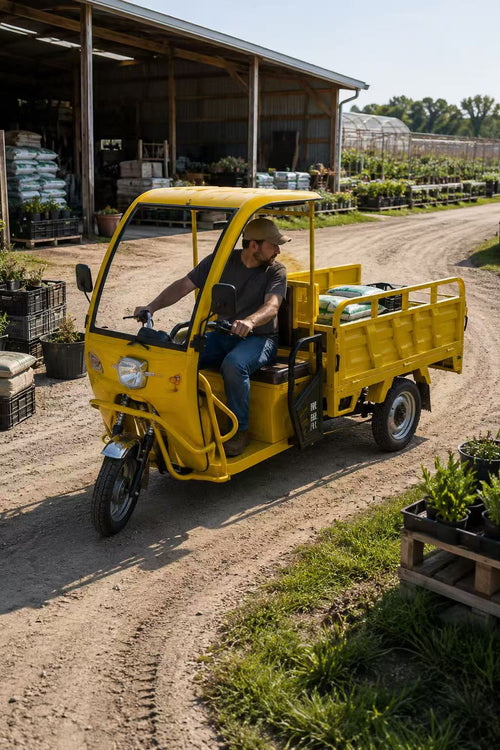
OneClickChina electric utility and cargo trike models are designed for low-speed private-site material movement.
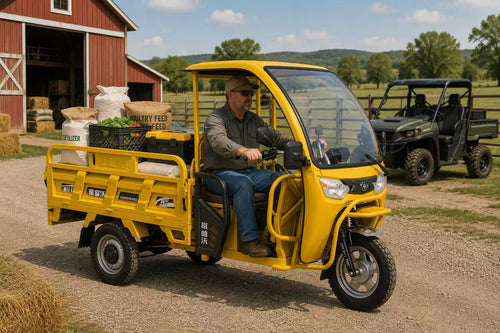
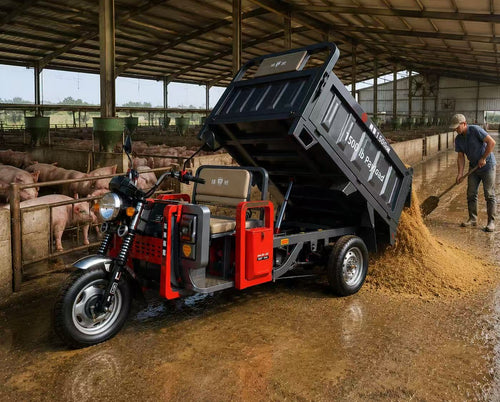
The open cargo model, canopy cargo model, cab utility cargo model, and hydraulic dump model each serve different daily work needs.
For buyers who want simple daily cargo movement, an open cargo model may be enough.
For buyers who want some sun or light weather coverage, a canopy model may be useful.
For buyers who want more operator protection, a cab model may be more suitable.
For buyers moving loose materials like soil, compost, mulch, manure, gravel, or sand, a hydraulic dump model may be the better match.
The key is not choosing electric because it sounds modern.
The key is choosing electric because the daily job fits electric work.
If the job is low-speed, repeated, private-site material movement, a quiet electric utility trike can be a practical tool.
If the job requires heavy gas-machine capability, buyers should choose the right larger machine.
Final Thought
A faster gas machine can be the right choice for demanding farm work.
But many daily chores do not require high speed.
They require quiet movement, easy use, cargo space, and repeated short-distance support.
If the work involves moving feed bags, crates, tools, boxes, nursery trays, buckets, and supplies around a private farm, greenhouse, nursery, warehouse yard, or property, a quiet electric farm utility trike may be more useful than buyers expect.
The best machine is not always the fastest one.
It is the one that gets used for the work that happens every day.