Can You Move It Between Job Sites? Planning Trailer, Ramp, and Tie-Down Transport for a Powered Dump Hauler
Share
A powered dump hauler is often judged by what it can do on one property.
Can it move mulch across a yard?
Can it carry manure from a horse stable?
Can it haul gravel on a ranch lane?
Can it move soil, compost, tools, branches, and maintenance supplies?
Those questions matter.
But for many American buyers, there is another question that comes before purchase:
Can this machine move between job sites?
A farm owner may keep one vehicle on the property. A horse stable may use it in the same barn every day. A nursery may keep it inside the same service area. But landscaping crews, property maintenance teams, small contractors, estate service workers, and mobile farm service crews often work in more than one location.
For them, a powered dump hauler is not only a material-handling machine.
It is part of a mobile work system.
If the vehicle cannot be transported safely, loaded properly, tied down correctly, and unloaded at the next site, it may not fit the daily business routine.
This is why buyers should think about trailer transport, loading ramps, tie-down points, empty transport, route access, and job site unloading before buying a powered dump hauler, electric dump cart, motorized wheelbarrow, or battery-powered utility cart.
A fixed-site machine and a mobile crew machine are different
Some buyers use a powered dump hauler in one location.
That may be a farm, ranch, horse stable, greenhouse, nursery, orchard, rural property, apartment complex, HOA community, school, park, or maintenance yard. In this case, the machine may stay on the property and work the same routes every day.
Other buyers need the machine to move with the crew.
A landscaping company may visit several properties in one week. A small contractor may move between repair sites. A property maintenance company may serve different communities. A nursery installation crew may deliver plants and soil to multiple locations. A ranch service worker may support different areas of a large property or nearby sites.
These two use cases are not the same.
A vehicle that works well on one farm lane may still need extra planning if it must be transported by trailer. A hauler that is useful in one stable may need different storage, loading, and tie-down habits if it moves between barns or job sites.
Before buying, the customer should decide:
Will this hauler live in one place, or will it travel with the work?
That question changes the buying decision.
Job site transport should be planned before purchase
Many buyers think about transport after they buy the machine.
That can create problems.
The vehicle may be too wide for the trailer. The ramp may not be rated for the load. The trailer deck may be too high. The tie-down points may not be obvious. The crew may not know whether the cargo bed should be empty before loading. The arrival site may not have enough firm ground for unloading.
These problems are easier to solve before purchase.
A buyer should think about the full movement cycle:
Where will the hauler be stored?
How will it be loaded?
Will it go on a trailer, truck bed, or enclosed equipment trailer?
Is the ramp long enough and strong enough?
Can the vehicle be tied down securely?
Will the cargo bed be empty during transport?
Where will it be unloaded at the next site?
Is there enough space to turn, stage, and begin work?
A powered dump hauler can be more valuable when it fits this whole cycle.
Trailer transport is often more realistic than pickup transport
Some buyers first imagine loading a powered dump hauler into a pickup truck bed.
In some cases, that may not be practical.
A heavy-duty dump hauler may be wider, longer, taller, and heavier than small garden tools or compact hand carts. The cargo bed, wheels, handlebar area, frame, and overall proportions all need to match the transport vehicle.
A pickup bed may have limited width between wheel wells. It may require a steep ramp angle. The tailgate may not be designed for that kind of loading. The vehicle may be difficult to tie down in a stable way. The operator may not have enough room to control loading safely.
For many crews, a small equipment trailer may be a more practical choice.
A trailer can offer a lower deck height, better ramp setup, more open space, and easier tie-down access. It may also allow the crew to carry other tools, ramps, bags, buckets, or maintenance supplies.
This does not mean a pickup can never work.
It means buyers should not assume pickup transport without checking real dimensions, weight, ramp angle, and tie-down needs.
Ramp capacity matters more than people think
A ramp is not just a board or a metal track.
It is part of the transport system.
When loading a powered dump hauler, the ramp must be strong enough, wide enough, stable enough, and suitable for the wheel layout. The buyer should consider the vehicle weight, any remaining cargo, the operator method, ramp rating, trailer height, ramp angle, and ground surface.
A common mistake is only thinking about the vehicle’s empty weight.
But the real loading situation may include mud on the tires, a small amount of leftover material, tools in the bed, or uneven ground at the loading point. Even if the vehicle is mostly empty, the ramp still needs enough rated capacity and proper support.
Buyers should never guess ramp capacity.
They should verify it.
The ramp should be rated for the expected load, match the wheel spacing, sit securely on the trailer or truck, and provide a controlled loading path.
A powered dump hauler should be loaded slowly, carefully, and without rushing.
Transporting with a full load is usually not the right plan
A powered dump hauler is made to carry material during work.
That does not mean it should be transported between job sites with a full cargo bed.
Moving the machine on a trailer with gravel, wet soil, mulch, manure bedding waste, compost, tools, or mixed debris still inside the bed can create extra problems. The load adds weight. It may shift. It may spill. It may affect tie-down. It may make the ramp loading heavier. It may also create a mess on the trailer or at the next property.
For job site transport, the better habit is usually simple:
Empty the cargo bed before loading the vehicle for transport.
If some small tools or supplies remain in the bed, they should be secured or removed. Loose cargo should not bounce, slide, spill, or block the vehicle during transport.
A dump hauler should arrive at the next job site ready to work.
It should not arrive with an unstable or messy leftover load.
Tie-down planning is part of buying
A powered dump hauler needs to be secured during trailer transport.
This sounds obvious, but many buyers do not think about tie-down until the first day they need to move the machine.
Tie-down planning should be part of the buying decision.
The buyer should ask:
Where can the vehicle be safely tied down?
What parts of the frame are suitable?
What parts should not be used?
Are the straps rated for the job?
Will the straps interfere with the handlebar, controls, hydraulic parts, cargo bed, dashboard area, wheels, or cables?
Can the machine stay stable during road transport?
A worker should not randomly strap the machine by the handlebar, dashboard area, wiring, hydraulic cylinder, thin side panels, or moving parts.
The tie-down should use stable structural points according to the vehicle design and the transport setup.
If the buyer is unsure, they should ask the supplier for guidance before using the hauler as a mobile job site tool.
Do not tie down to weak or moving parts
Not every visible part of a powered dump hauler is a tie-down point.
A handlebar may be used for operation, not for holding transport tension. A cargo bed may move or dump. A dashboard area may contain controls. Hydraulic parts may be connected to the dump system. Thin panels may not be designed for strap force.
Tying down to the wrong place can damage the vehicle or fail to secure it properly.
The safer mindset is to tie down to stable frame areas or proper anchor points that can handle transport forces. Straps should be placed so the machine cannot roll, shift, bounce, or lean during travel.
The wheels may also need to be positioned carefully. The brake or parking method should be considered. The trailer surface should be firm and not slippery.
A powered dump hauler is a work vehicle, not loose cargo.
It should be secured like equipment.
Loading angle affects control
Ramp angle affects how easy the machine is to load.
A steep ramp can make loading harder and less controlled. The operator may need more throttle, more braking, or more precision. A heavy vehicle on a steep ramp may feel uncomfortable, especially if the ramp surface is wet, dusty, muddy, or narrow.
A longer ramp can reduce the angle, but the ramp still needs proper rating and support.
The loading area should be level, firm, and open when possible. Gravel, dirt, grass, mud, or uneven surfaces near the ramp can make loading more difficult. The trailer should be positioned so the ramp sits securely and does not shift during loading.
The buyer should not only ask whether the vehicle fits on the trailer.
The buyer should ask whether it can be loaded and unloaded in a controlled way by the people who will actually use it.
Width and wheel spacing need to match the ramp
A powered dump hauler has a real wheel layout.
That layout must match the ramp system.
If the ramp is too narrow, the tires may not sit correctly. If two separate ramp tracks are used, the spacing must match the wheels. If the ramp surface is slippery, wet, or uneven, loading may become harder. If the ramp is not centered or aligned, the vehicle may approach at an angle.
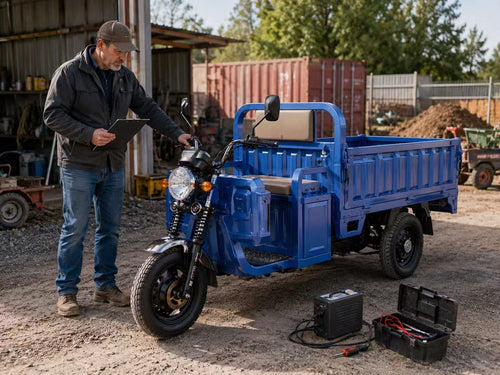
This is especially important for three-wheel and utility tricycle-style vehicles.
The buyer should confirm overall vehicle width, front and rear wheel positions, tire width, ramp width, and trailer deck width.
A ramp that works for one piece of equipment may not work for another.
Before buying the hauler, the buyer should think about whether their existing ramp and trailer setup can handle this specific vehicle shape.
Trailer deck space matters
A powered dump hauler needs enough room on the trailer.
The buyer should check overall length, width, height, wheelbase, cargo bed size, handlebar area, and space for tie-down straps. The vehicle should not barely fit in a way that makes tie-down impossible or unloading difficult.
The trailer may also need space for other items.
A landscaping crew may carry mowers, blowers, rakes, shovels, mulch bags, tools, ramps, and debris containers. A property maintenance team may carry cleaning supplies, ladders, toolboxes, and repair parts. A nursery installation crew may carry plant trays, soil bags, and irrigation supplies.
If the powered dump hauler takes up too much trailer space, the buyer should plan how it fits with the rest of the crew equipment.
A mobile work system is not only one machine.
It is the machine plus the tools around it.
Arriving at the job site needs planning too
Transport planning does not end when the hauler is tied down.
The arrival site matters.
The trailer needs a safe place to park. The ramp needs firm ground. The unloading area should be open enough for the vehicle to come down slowly and turn into the work route. The ground should not be deep mud, steep slope, loose gravel, soft turf, or crowded pedestrian space.
The crew should think before unloading:
Where will the trailer stop?
Is the ground firm enough?
Is there enough room behind the trailer?
Will the vehicle unload directly into the work path?
Can the operator turn around after unloading?
Where will ramps be stored during work?
Will the trailer block residents, workers, customers, animals, or vehicles?
A powered dump hauler can save time only if the unloading setup does not create a new problem.
Mobile crews should stage the hauler before loading material
Once the hauler is unloaded at the job site, it should not be filled immediately without checking the route.
A crew should first decide where the loading point is, where the unloading point is, and how the hauler will travel between them. This is especially important on landscaping jobs, apartment properties, HOA communities, schools, parks, farm service areas, and construction support sites.
The hauler may have arrived safely, but the job site still needs evaluation.
Can it reach the mulch pile?
Can it reach the planting bed?
Can it pass through the gate?
Can it cross the lawn without damage?
Can it turn near the trailer?
Can it dump from the rear in the right location?
Can it return without backing through a narrow path?
A mobile powered dump hauler should be staged like a work tool, not just unloaded and used blindly.
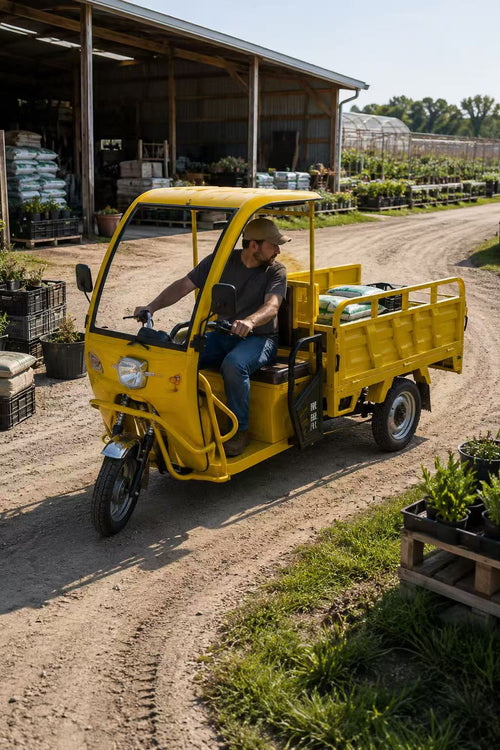
Landscaping crews can benefit from mobile dump hauling
Landscaping crews are one of the strongest use cases for job site transport.
A crew may need to move mulch, soil, compost, gravel, branches, leaves, tools, and yard debris across different properties. One day may involve a residential backyard. Another may involve an HOA entrance. Another may involve a school landscape bed or apartment property.
A powered dump hauler can reduce wheelbarrow trips when it can travel with the crew.
But the crew must be able to transport it efficiently.
If loading takes too long, if the ramp is difficult, if tie-down is awkward, or if the trailer becomes overloaded with equipment, the machine may not get used often enough.
For landscaping companies, the buying question is not only:
Can it move mulch?
The better question is:
Can we bring it to the jobs where it saves the most labor?
Property maintenance teams may use it across locations
Property maintenance teams may work across several buildings, sites, or communities.
An apartment maintenance team may serve multiple buildings. An HOA service crew may maintain several entrances or common areas. A school or park maintenance team may move between zones. A property service contractor may carry tools and debris between clients.
For these teams, a powered dump hauler can help with yard debris, tools, trash bags, soil, mulch, repair parts, and cleanup material.
But mobile use requires planning.
The vehicle must fit the trailer or transport setup. It must be easy to load and unload. It must be secured correctly. It must not take more time to move than it saves on site.
This is why job site transport belongs in the buying decision.
A hauler that works only in theory may not become part of the daily crew routine.
Contractors should think about mixed equipment transport
Small contractors and repair crews often carry many tools.
They may have generators, ladders, saws, toolboxes, bags, buckets, carts, materials, and safety equipment. Adding a powered dump hauler to the trailer or truck changes the transport layout.
The crew needs to think about weight distribution, loading order, tie-down sequence, ramp access, and unloading order.
If the hauler is buried behind other equipment, it may not be used. If the ramps are hard to access, unloading slows down. If tie-down straps must be removed from several tools just to unload the hauler, the setup may become frustrating.
For contractors, the vehicle should fit the workflow.
The best equipment is not only strong.
It is easy to bring, unload, use, reload, and secure again.
Farm and ranch service workers may need flexible movement
Some farms and ranches are large enough that equipment movement matters even inside the property.
A powered dump hauler may need to move between barns, feed areas, fencing projects, compost zones, gravel roads, water troughs, equipment sheds, and remote work areas. On larger properties, a trailer may still be useful for moving equipment quickly from one area to another.
The same applies to rural service workers who help with fence repair, small construction, barn maintenance, estate work, or seasonal cleanup.
A hauler that can be transported between zones may support more jobs.
But the same planning applies:
Is the trailer suitable?
Is the ramp suitable?
Can the machine be tied down?
Is the cargo bed empty before transport?
Is the unloading area firm?
Can the vehicle reach the actual work spot after unloading?
Mobile use should be planned, not improvised.
Do not treat transport as an afterthought
The value of a powered dump hauler depends on how often it is actually used.
If the machine is easy to transport, crews may use it on more jobs. If it is difficult to load, awkward to tie down, or hard to fit on the trailer, it may stay behind even when it could save labor.
That is why transport should be discussed before purchase.
A buyer should not only compare payload, dump bed, battery range, motor power, tires, and price.
The buyer should also ask:
How will this hauler get to the work?
For fixed-site buyers, that may not matter much. For mobile crews, it can decide whether the machine becomes useful or inconvenient.
Empty weight and working weight are different
Transport planning should distinguish between empty machine weight and working weight.
The empty machine is one number.
The working situation may be different.
There may be residual material in the bed. There may be mud on the tires. There may be tools placed in the cargo area. There may be accessories, straps, or small supplies. The ramp and trailer must be planned for realistic conditions, not only the clean showroom condition.
The best practice is to transport the hauler empty or nearly empty and keep loose items secured separately.
This reduces load shift, ramp stress, trailer mess, and tie-down difficulty.
A powered dump hauler should be moved between jobs as equipment, not as a loaded material container.
The cargo bed should be lowered for transport
A dump bed should be in its normal lowered position during transport.
The raised bed is for unloading, not for road transport. A raised bed changes the height, center of gravity, wind exposure, and tie-down situation. It may also stress parts that should not carry transport forces.
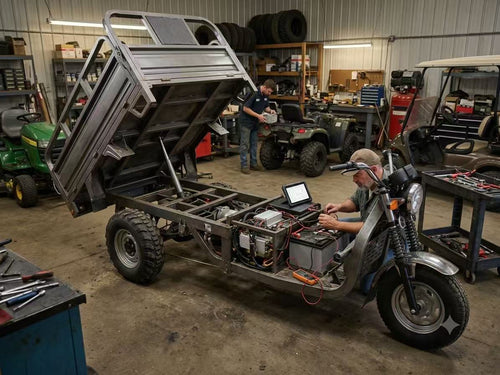
Before loading onto a trailer, the operator should make sure the dump bed is fully lowered and secured in its normal position.
The cargo bed should be empty or cleared of loose material. Any tools or supplies that remain should be removed or secured properly.
This small habit makes transport cleaner and more predictable.
Battery and controls should be protected during transport
A battery-powered hauler has electrical components.
Transport should avoid unnecessary exposure to water, loose debris, strap pressure, or impact around the battery, controller, dashboard, cables, and control area. Straps should not pull against delicate parts. Tools should not bang into the dashboard. Heavy items should not be stacked against wiring or switches.
If the hauler is transported in rain, dust, or rough road conditions, the buyer should think about protection.
This does not mean the machine cannot be used outdoors.
It means transport should respect the vehicle as electric equipment, not just a steel cart.
A clean, secured, covered, or properly staged setup can reduce avoidable problems.
The loading team should know the process
A powered dump hauler should not depend on guesswork.
The crew should know how to load it, who operates it, who watches the ramp, where the tie-down straps go, how the trailer is positioned, and how unloading happens at the next site.
This matters for landscaping crews, property maintenance teams, contractors, nurseries, ranch workers, and farm service teams.
A simple routine can save time:
Empty the bed.
Check the ramp.
Align the vehicle.
Load slowly.
Lower and secure the bed.
Tie down to stable points.
Secure loose items.
Check the trailer before leaving.
Unload on firm ground.
Stage the hauler before work begins.
A good routine helps the vehicle become part of the crew’s normal day.
Job site transport can increase the value of the machine
A powered dump hauler that stays in one place can still be valuable.
But a hauler that can move between job sites may create value across more work.
One machine may support multiple landscaping jobs. It may help on different apartment properties. It may serve several HOA areas. It may move between barn maintenance sites. It may support nursery installation work, estate maintenance, rural property cleanup, and small construction support.
The more places the machine can realistically be used, the easier it is to justify the purchase.
But that only works if transport is practical.
A machine that saves labor on site but is too difficult to move may not deliver its full value.
Questions to ask before buying
Before choosing a powered dump hauler for mobile work, buyers should ask practical transport questions.
Will the hauler stay on one property or travel between jobs?
Will it be transported by trailer, pickup, enclosed trailer, or another setup?
Does the transport vehicle have enough deck space?
Is the ramp wide enough and rated for the vehicle?
Is the loading angle manageable?
Can the hauler be loaded empty and controlled?
Where are suitable tie-down points?
Can straps avoid controls, hydraulic parts, wiring, and moving components?
Can the cargo bed stay lowered and secure during transport?
Will there be enough room to unload at the next site?
Will the route from the trailer to the work area be usable?
Will transport take more time than the hauler saves?
These questions turn the hauler from a product into a work system.
The right transport plan makes the hauler more useful
A powered dump hauler is not only about carrying material.
It is about reducing repeated labor in the real places where work happens.
For some buyers, that place is one farm, one stable, one nursery, or one property. For others, the work moves every day. A landscaping crew, property maintenance team, contractor, farm service worker, or mobile nursery crew may need the hauler to move with them.
That is why trailer, ramp, and tie-down planning matter.
A good powered dump hauler should match the load, the ground, the route, and the way the crew moves equipment.
Before buying, do not only ask whether the hauler can move mulch, compost, gravel, manure, soil, tools, and yard debris.
Ask whether it can get to the job site where that work needs to happen.