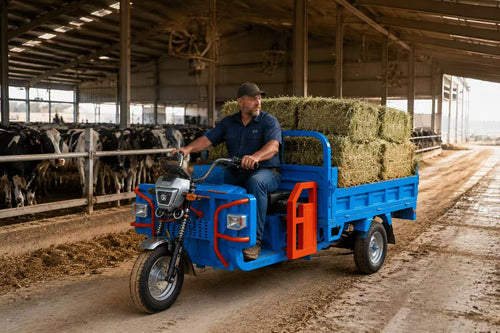
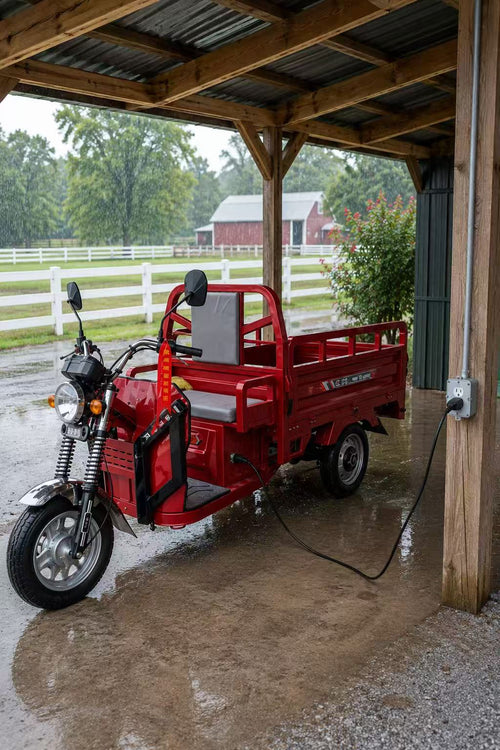
Do You Really Need a Lithium Battery in an Electric Farm Utility Trike?
Share
Many buyers now assume that every electric farm vehicle should use a lithium battery.
Lithium sounds newer.
It sounds lighter.
It sounds more advanced.
It is often promoted as the only serious choice for an electric UTV, electric golf cart, or electric farm utility vehicle.
But does every small farm, homestead, nursery, greenhouse, warehouse yard, or private property actually need it?
Not always.
For some buyers, lithium can be the better choice.
For others, a properly matched lead-acid battery system may still complete the real daily work without adding unnecessary cost.
The right question is not:
Which battery sounds more modern?
The better question is:
Which battery fits my route, workload, charging habits, storage conditions, and budget?
That is the question buyers should answer before choosing an electric farm utility trike.
Why Buyers Immediately Ask for Lithium
Many electric vehicle buyers have heard the same claims:
Lithium batteries are lighter.
Lithium batteries can last longer.
Lithium batteries can provide more usable energy.
Lithium batteries require less routine attention.
Lithium batteries are the future.
These points can be valid.
A well-designed lithium battery system can offer real advantages.
But the word “lithium” alone does not guarantee that a vehicle is right for farm work.
Battery quality matters.
The battery management system matters.
The charger matters.
The wiring matters.
The vehicle controller matters.
The seller’s support matters.
The actual daily route matters.
A low-quality lithium system is not automatically better than a properly matched lead-acid system.
Buyers should not choose based only on battery chemistry.
They should judge the complete vehicle and the work it must perform.
What Lithium Batteries Can Offer
A lithium battery system can be attractive for buyers who use an electric farm utility trike frequently.
Lithium batteries are generally lighter than a comparable lead-acid battery bank.
Lower battery weight may reduce overall vehicle weight.
Lithium batteries may also maintain steadier performance through more of the usable charge range.
For some buyers, this means the vehicle may feel more consistent during the workday.
Lithium batteries also commonly require less routine battery maintenance.
A buyer does not normally need to manage water levels in the same way required by some flooded lead-acid systems.
A properly designed lithium system may also provide a longer service life under suitable operating and charging conditions.
These advantages can matter when the vehicle is used:
every day
for longer routes
for repeated work cycles
with limited time between jobs
where total vehicle weight matters
where battery maintenance must be minimized
For a busy nursery, warehouse yard, greenhouse operation, farm, or commercial property, lithium may be worth the higher initial cost.
But those advantages only create value if the buyer actually uses them.
A Battery Upgrade Has No Value If the Work Does Not Need It
Many small farms and homesteads do not use a utility vehicle continuously.
The vehicle may move feed bags in the morning.
It may carry tools to a fence line.
It may transport nursery trays or garden supplies.
It may move boxes between a shed and a work area.
Then it may sit for the rest of the day.
The normal route may be short.
The property may be flat.
The load may be moderate.
The vehicle may return to the same covered charging area after every job.
For that buyer, the most expensive battery option may not produce a meaningful daily advantage.
An electric cargo trike for farm work should be matched to actual use.
If a lead-acid battery system can complete the normal route with reserve capacity remaining, then the buyer should consider whether paying more for lithium is necessary.
The buyer is not purchasing a battery label.
The buyer is purchasing a work result.
Can the vehicle move the normal cargo?
Can it finish the normal route?
Can it be recharged after use?
Can replacement batteries be sourced later?
Can the buyer maintain the system correctly?
If the answers are yes, a lead-acid system may still be practical.
When Lead-Acid Batteries Can Make Sense
Lead-acid batteries are older technology, but older does not automatically mean useless.
They remain common in golf carts, low-speed utility vehicles, floor-cleaning machines, material-handling equipment, and other work applications.
A lead-acid system may fit a buyer whose work is:
short-distance
low-speed
private-site
light to moderate in load
not continuous all day
close to a charging location
not dependent on maximum range
sensitive to initial purchase cost
For example, a small homestead owner may use an electric farm utility trike to move feed bags, tools, buckets, crates, and garden materials over short private routes.
A nursery may use it for moving trays and supplies between work areas.
A greenhouse may use it to carry boxes and tools.
A property maintenance worker may use it for short trips between buildings.
A warehouse yard may use it to move small parts and equipment.
In these situations, the vehicle may return to a covered outdoor charging area after each work session.
If the battery is charged correctly and not repeatedly left deeply discharged, lead-acid may be enough for the task.
The buyer should not reject it simply because lithium is newer.
The real question is whether the system meets the daily job.
The Lower Purchase Price Can Matter
Battery choice affects the total vehicle price.
Lithium systems often cost more at the beginning.
For a commercial buyer using the vehicle heavily, that additional cost may be justified.
For a small farm or occasional user, it may not be.
A buyer should compare the higher initial cost with the actual operating pattern.
Will the vehicle be used every day?
Will it complete several work cycles each day?
Will lower battery weight create a real benefit?
Will longer battery life offset the higher price?
Will the buyer keep the vehicle long enough to receive that benefit?
Will replacement lithium batteries be available and correctly matched later?
These questions matter.
A buyer who only uses the vehicle for short weekly jobs may prefer a lower initial purchase cost.
A buyer running the vehicle throughout the day may value lithium more.
Neither choice is automatically correct.
The value depends on the work.
Lead-Acid Is Not Maintenance-Free
Choosing lead-acid does not mean the buyer can ignore the battery.
Proper charging and storage are important.
The buyer should avoid leaving the battery deeply discharged for long periods.
The battery should be recharged according to the charger and vehicle instructions.
Battery terminals, cables, and connections should remain clean and secure.
If the battery type requires water-level inspection, that schedule must be followed carefully.
The charging location should be dry, ventilated, protected from rain, and suitable for the charger.
A covered outdoor charging area can be appropriate when:
the charger and plug stay dry
the outlet is protected
the ground does not collect water
the cable is not exposed to vehicle traffic
the area is ventilated
the battery and charger instructions are followed
Lead-acid batteries can provide useful service when treated correctly.
They can also fail early when repeatedly over-discharged, undercharged, neglected, or stored improperly.
The buyer must be honest about maintenance habits.
If the buyer does not want to perform any battery checks, lithium may be more attractive.
When Lithium Becomes the Stronger Choice
Lithium can make more sense when the work pattern is demanding.
A buyer should consider lithium more seriously when the vehicle will be used:
for longer daily routes
for repeated trips throughout the day
with limited charging time between jobs
where lower battery weight matters
where maintenance time must be reduced
where the buyer expects long-term frequent use
where consistent performance through the work cycle is important
A busy farm, nursery, warehouse, or property operation may use an electric farm cargo trike many times each day.
The vehicle may carry tools, feed, crates, packages, and supplies from morning until evening.
In that situation, the battery is not supporting occasional convenience.
It is supporting daily productivity.
The higher initial cost of lithium may then be easier to justify.
But the battery must still be properly matched to the vehicle.
Lithium Is a Complete System, Not Just a Battery Box
A lithium conversion is not always a simple battery swap.
The voltage must match.
The controller must be compatible.
The charger must be correct.
The battery management system must protect the cells.
The wiring and connectors must handle the system safely.
The battery must fit securely inside the vehicle.
The charging behavior must match the battery manufacturer’s requirements.
A buyer should not assume that any lithium battery can replace any lead-acid battery bank.
An incorrect conversion can create charging problems, controller faults, poor performance, or safety risks.
Before upgrading, the buyer should confirm:
system voltage
battery dimensions
continuous current capability
peak current capability
charger compatibility
battery management system protection
connector type
mounting method
low-temperature charging protection
seller or technician support
If these details are unclear, the buyer should not perform a random conversion.
A qualified technician familiar with electric vehicles, motors, batteries, or small equipment should review the system.
Cold Weather Can Change the Decision
Cold weather is an important part of battery choice.
Both lead-acid and lithium systems can lose useful performance in low temperatures.
However, some lithium battery systems should not be charged below certain temperatures unless they include suitable protection or internal heating.
A battery management system may prevent charging when the battery is too cold.
This protection is useful, but it can surprise a buyer who expects to plug in immediately during freezing weather.
Lead-acid batteries also require care in cold conditions.
A discharged lead-acid battery is more vulnerable to freezing than a properly charged battery.
Cold temperatures can also reduce available capacity and vehicle performance.
Therefore, buyers in cold climates should ask specific questions before ordering:
Can the battery be charged in freezing conditions?
Does the lithium battery include low-temperature charging protection?
Does it have internal heating?
Will the vehicle be stored under cover?
Can the charging area remain dry and reasonably protected?
How will the battery be maintained during long winter storage?
A buyer should not choose lithium or lead-acid without considering local winter conditions.
Battery Replacement Availability Matters
A work vehicle should not become unusable because replacement batteries are difficult to source.
Before purchasing, buyers should ask:
What battery type is installed?
What is the system voltage?
How many batteries are used?
Are the battery dimensions standard?
Can suitable replacements be sourced locally?
Does the replacement require special programming?
Does the charger need to be replaced at the same time?
Can a local technician install the battery?
Lead-acid systems may be easier to understand for some local battery shops and golf-cart technicians.
Lithium systems may provide better performance, but replacement must still match the original electrical system.
A buyer should consider future service before focusing only on the first day of ownership.
The best battery is not only the one that performs well when new.
It is also the one that can be supported when service or replacement is eventually needed.
Do Not Compare Battery Chemistry Without Comparing the Route
A battery discussion becomes meaningless when the buyer does not describe the route.
A short private route on firm ground is different from a long route across rough land.
One trip each morning is different from continuous operation.
Moving tools and boxes is different from carrying maximum loads all day.
A buyer should record the real route before choosing a battery.
Questions should include:
How far is one normal round trip?
How many trips happen each day?
What is the normal load?
What is the heaviest regular load?
Is the route flat or sloped?
Is the surface concrete, gravel, packed soil, grass, mud, or loose ground?
Can the vehicle return to the charging area between jobs?
How many hours must it operate before charging?
Is the vehicle used every day or only a few times each week?
These answers are more valuable than simply asking:
Is lithium better?
Lithium may be better for one route.
Lead-acid may be enough for another.
The route decides the value.
Do Not Use Battery Type to Hide a Poor Vehicle Choice
Some buyers focus so heavily on lithium that they ignore the rest of the machine.
A lithium battery does not correct:
an undersized cargo bed
poor brakes
weak frame construction
unsafe loading
incorrect route selection
lack of replacement parts
poor after-sales support
unrealistic load claims
inappropriate use on steep or muddy terrain
A farm utility trike should be judged as a complete work vehicle.
The buyer should inspect:
cargo bed dimensions
vehicle load rating
motor system
braking system
frame and body structure
tire type
turning space
route suitability
charger specifications
battery type
replacement support
warranty terms
A strong battery cannot make the wrong vehicle suitable for the job.
The buyer must choose the vehicle first, then choose the battery system that fits the vehicle and workload.
What About an Electric UTV?
Some buyers compare an electric farm utility trike directly with an electric UTV.
That comparison can be useful, but the machines serve different work levels.
An electric UTV may offer:
four wheels
greater terrain capability
passenger seating
higher speed
more towing capacity
larger overall structure
more complex suspension
higher purchase cost
An electric utility trike with cargo bed is a simpler machine.
It is intended for low-speed, short-distance, private-site cargo movement.
It can fit farms, homesteads, nurseries, greenhouses, warehouses, markets, and property-maintenance routes where the work does not require a large UTV.
The battery decision should reflect that difference.
A buyer using a trike for short cargo routes may not need the same battery capacity expected in a larger electric UTV.
A buyer should not automatically copy UTV battery expectations onto a smaller work vehicle.
The job is different.
The energy requirement may also be different.
A Simple Buyer Decision Guide
A lead-acid system may be practical when:
the daily route is short
the vehicle is used at low speed
the load is moderate
the vehicle returns to the same charging area
the buyer values lower initial cost
the buyer accepts routine battery care
the vehicle is not used continuously all day
replacement lead-acid batteries are locally available
A lithium system may be more attractive when:
the vehicle is used frequently
the daily route is longer
the buyer needs more usable energy
lower battery weight matters
the buyer wants less routine battery attention
the buyer expects many repeated work cycles
the higher purchase price fits the budget
proper lithium service and replacement support are available
Neither list creates an automatic answer.
It helps the buyer understand which questions matter.
Questions to Ask the Seller Before Ordering
A buyer should ask for clear battery information before payment.
What battery chemistry is included?
What is the complete system voltage?
What is the rated battery capacity?
What charger is included?
What input voltage does the charger require?
Can the vehicle charge in a covered outdoor area?
What temperature range is suitable for charging?
Does the lithium version include a battery management system?
Does it include low-temperature charging protection?
What routine care does the lead-acid version require?
What is the estimated replacement process?
Can batteries be replaced locally?
Will changing battery chemistry affect the warranty?
Is the charger covered by the warranty?
These questions can prevent confusion after delivery.
The buyer should receive answers that match the actual model, not generic electric vehicle claims.
The Battery Should Match the Buyer, Not the Trend
Lithium is becoming more common.
That does not mean every buyer must choose it.
Lead-acid is older.
That does not mean every lead-acid vehicle is a poor purchase.
The correct choice depends on:
work frequency
route length
cargo load
charging access
storage environment
winter temperature
maintenance habits
replacement availability
budget
expected ownership period
A buyer who needs frequent daily operation may benefit from lithium.
A buyer who needs short private-site cargo trips may find that lead-acid is enough.
The decision should be based on work, not fashion.
Final Thought
Do you really need a lithium battery in an electric farm utility trike?
Sometimes yes.
Sometimes no.
Lithium can offer lower weight, less routine battery maintenance, and stronger value for frequent or longer daily use.
Lead-acid can still be practical for short routes, moderate loads, low-speed private-property work, and buyers who want a lower initial purchase cost.
The most important step is to define the work before selecting the battery.
Do not buy lithium only because it sounds more advanced.
Do not choose lead-acid only because it costs less.
Choose the battery that can complete the normal route, support the normal load, fit the charging environment, and remain serviceable over time.
A battery is not the work tool by itself.
It is one part of the electric farm utility trike.
The best system is the one that matches the real job.