Moving Bricks, Sand, and Farm Supplies Without a Full-Size Machine
Share
Many farm properties and small construction sites have the same problem: materials are heavy, but the transport distance is short.
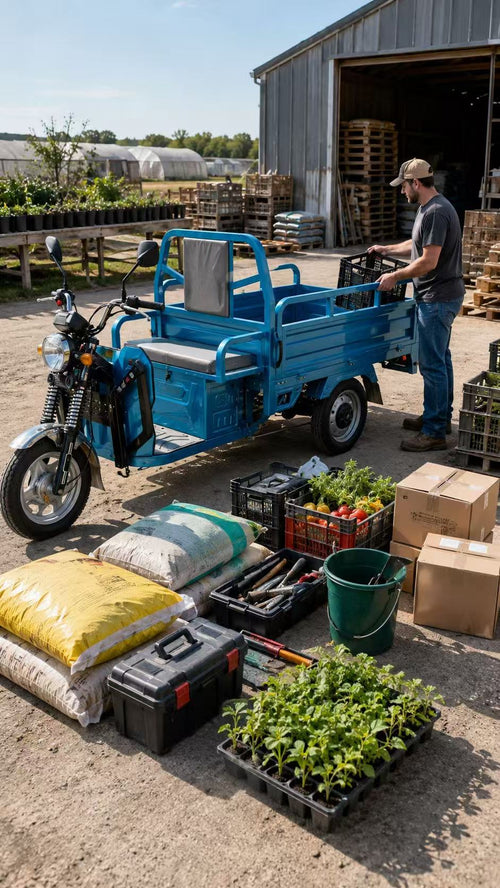
Workers may need to move bricks, sand bags, gravel, small stone pieces, cement bags, lumber, tools, soil, compost, feed, fencing supplies, or repair materials across a farm yard, private property, barn area, ranch service zone, or small building site.
A full-size truck, skid steer, tractor, or forklift may be too large, too costly, or unnecessary for every short trip. A wheelbarrow may be too slow and tiring when the work is repeated many times during the day.
This is where low-speed electric work equipment can make sense.
An electric work trike should not be understood as a mining machine, quarry vehicle, highway vehicle, or replacement for heavy construction equipment. It is better understood as a low-speed electric transport work tool for moving materials inside private sites and controlled work areas.
The real question is not whether it can replace large equipment.
The better question is whether it can reduce repeated short-distance carrying, pushing, and small material transport inside the place where the work is happening.
Why Farm and Small Construction Work Often Needs Short-Distance Transport
On many farms and small job sites, the hardest part is not always the distance. It is the repetition.
A worker may need to move materials from a storage area to a barn, from a driveway to a building site, from a shed to a fence line, or from a supply pile to a repair area.
The trip may not be far, but the load may feel heavy.
Common materials may include feed bags, compost, mulch, soil, tools, buckets, crates, bricks, sand bags, cement bags, gravel, small stone pieces, lumber, hardware, and repair supplies.
When this work is done once, a wheelbarrow may be enough.
When it is repeated many times, the labor adds up.
A compact electric work trike can help move these materials in small batches, especially when the route is short, the work area is controlled, and the buyer does not need a full-size machine for every trip.
This is the practical use case.
It is not about extreme off-road work. It is not about mining. It is not about high-speed travel.
It is about low-speed material movement where workers already operate every day.
What Type of Work Fits This Equipment?
This type of electric transport work equipment can fit jobs such as:
moving feed bags around a farm
carrying tools between work areas
moving soil, compost, or mulch in small batches
transporting bricks or sand bags on a small building site
carrying cement bags or repair materials across private property
moving lumber, hardware, and maintenance supplies
transporting crates, buckets, or farm supplies
supporting fence repair, shed repair, barn work, and property maintenance
moving materials between storage areas and work zones
The important point is that the work should be matched to the rated working load of the equipment.
If the equipment is designed for a certain working load, the buyer should use it within that range. Carrying heavy-feeling materials is different from overloading the equipment beyond its rated capacity.
Bricks, sand, gravel, soil, and cement can become very heavy quickly. Buyers should load in reasonable batches instead of treating a compact electric work trike like heavy construction machinery.
Why It Can Be Better Than a Wheelbarrow for Repeated Jobs
A wheelbarrow is simple and useful, but it depends on human effort.
For one or two trips, it may be fine. For repeated trips, the worker may spend more time walking, pushing, balancing the load, unloading, and returning for the next load.
This becomes harder when the materials are dense.
Sand is heavy.
Wet soil is heavy.
Bricks are heavy.
Cement bags are heavy.
Stone pieces and gravel are heavy.
Feed and farm supplies can also become tiring when moved repeatedly.
A low-speed electric work trike does not remove all labor, but it can reduce the amount of carrying and pushing. It can help the worker move a useful load from one place to another without using a full-size machine for every small task.
This is especially useful on private properties where the route is repeated and predictable.
Why It Is Not a Replacement for Heavy Construction Equipment
It is important to set the right expectation.
An electric work trike is not a loader, dump truck, skid steer, forklift, tractor, or heavy construction machine.
It should not be used for mining work, quarry hauling, extreme off-road routes, large rock transport, excavation loads, or heavy industrial hauling.
It should not be overloaded beyond its rated working load.
It should not be treated as a machine for unlimited weight just because the material is common.
The correct role is smaller and more practical:
short-distance material movement
farm internal work
private-property hauling
small construction support
maintenance area transport
controlled worksite movement
repeated small-batch transport
When buyers understand this boundary, the equipment becomes easier to evaluate.
The value is not that it replaces every larger machine.
The value is that it can handle many smaller trips that do not require a larger machine.
Farm Use: Heavier Daily Materials Without Oversized Equipment
Farm work often includes repeated movement of materials that are not always large, but still feel heavy.
Examples include feed, tools, soil, compost, mulch, fencing supplies, water containers, repair parts, harvest crates, and barn supplies.
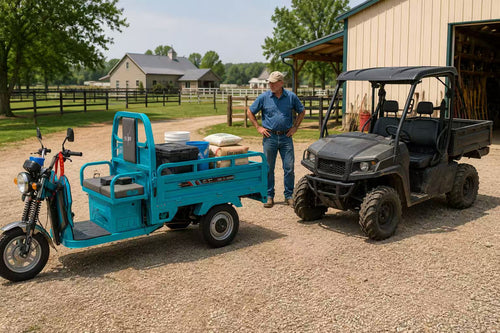
A truck or tractor may already exist on the property, but it may not be convenient for every short trip. A larger machine may take more space, cost more to run, or be unnecessary for small daily movement.
An electric work trike can fill the middle position.
It is stronger than hand carrying and more efficient than repeated wheelbarrow trips, but simpler and lower-cost than many large machines.
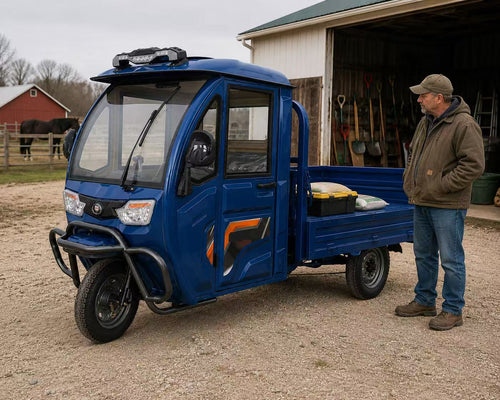
For farms, ranches, horse stables, nurseries, orchards, and private properties, this middle position can be useful.
Small Construction Use: Bricks, Sand, Tools, and Supplies
Small construction sites also have repeated transport needs.
A homeowner building a shed, a small contractor working on a private property, a farm owner repairing a barn, or a maintenance team moving materials around a site may need to move bricks, sand bags, cement bags, gravel, lumber, tools, fasteners, and repair supplies.
The key is to think in small batches.
This equipment can help move construction materials across short internal routes, but it should not be used as a heavy construction replacement.
If the job requires moving large volumes of stone, heavy excavation material, pallets of block, or industrial loads, larger equipment is more appropriate.
But for repeated small loads inside a controlled site, a compact electric work trike can reduce walking and manual effort.
Route Conditions Still Matter
Even if the material type is suitable, the route must also make sense.
This equipment is best for private-site routes such as gravel yards, firm dirt paths, barn areas, farm lanes, ranch work zones, small building sites, warehouse yards, nursery paths, and maintenance routes.
The route should be controlled and predictable.
Buyers should avoid using compact electric work equipment in conditions that exceed its intended use, such as deep mud, extreme slopes, unstable ground, large rocks, unsafe traffic areas, or uncontrolled public-road environments.
The better the route is planned, the better the equipment can perform.
Buyers should ask:
Is the route mostly firm and controlled?
Is the transport distance short?
Is the material loaded in reasonable batches?
Is the work repeated enough to justify powered transport?
Is the load within the rated working capacity?
Is the unloading area safe?
Is the operator trained to load and drive carefully?
These questions are more useful than simply asking whether the equipment is powerful.
Do Not Overload the Equipment
Overloading is one of the biggest reasons work equipment fails early.
If a unit is designed for a 1000 lb working load, but the buyer repeatedly loads 1500 lb or 2000 lb, the equipment is being pushed beyond its intended use.
That can increase stress on the motor, motor controller, battery, brakes, tires, bearings, frame, and cargo bed structure.
Heavy materials can be deceptive.
A few bags of sand, wet soil, bricks, stone pieces, or cement can become heavy quickly. Buyers should not judge only by how full the cargo bed looks. They should consider actual weight.
Responsible use protects the equipment.
It also protects the operator and the worksite.
A compact electric work trike can be valuable for heavier daily materials, but only when used within its rated working range.
Why Electric Work Equipment Makes Sense for These Jobs
Electric work equipment is useful in these environments because many jobs are short-distance and repetitive.
The operator does not need high speed.
The operator does not need road travel.
The operator does not need a full-size machine for every trip.
The operator needs a practical way to move materials inside the work area.
Electric operation can also be easier for many users because there is no gasoline engine, no exhaust, no fuel storage, no oil change system, and less noise compared with many gas-powered machines.
For private-site material movement, simplicity can be an advantage.
The equipment can be charged, loaded, used for short trips, and parked near the work area.
This makes it practical for farms, ranches, small construction sites, barns, sheds, nurseries, warehouses, and private maintenance areas.
How to Decide If This Equipment Fits Your Work
Before choosing an electric work trike for farm or small construction material transport, buyers should make a simple checklist.
What materials do you move most often?
How heavy are those materials?
How many trips do workers make in a normal day?
Is the route short and controlled?
Is the surface firm enough?
Is the load within the rated working capacity?
Do you need a standard cargo bed or a hydraulic dump bed?
Are you moving organized items, loose bulk material, or both?
Will the equipment be used on private property or controlled work areas?
Do you need a compact support tool, or do you really need heavy equipment?
These questions help buyers choose correctly.
If the work is mainly short-distance movement of farm supplies, tools, bricks, sand bags, soil, compost, mulch, lumber, or repair materials in small batches, this type of equipment may be a good fit.
If the work requires industrial hauling, mining, quarry work, public-road transport, high-speed travel, large equipment replacement, or extreme terrain performance, buyers should choose a different category.
Final Thought
Farm and small construction work often requires moving materials that feel heavy, but not always far.
That is the exact problem low-speed electric work equipment can help solve.
An electric work trike is not a mining machine, quarry vehicle, highway vehicle, or replacement for heavy construction equipment.
It is a practical transport work tool for private sites, farms, small building areas, maintenance yards, and controlled work environments.
When used within its rated working load, it can help move feed, tools, bricks, sand bags, soil, compost, gravel, lumber, and supplies more efficiently than repeated manual carrying or wheelbarrow trips.
The best way to judge it is simple:
Do not ask whether it can replace every large machine.
Ask whether it can reduce repeated short-distance material movement inside your work area.