Electric Ranch Utility Trike: Open Bed, Enclosed Cab, or Dump Setup for Daily Ranch Work?
Share
An electric ranch utility trike should be chosen by the kind of ranch work it needs to support. Some ranch owners need a simple open cargo bed for feed, tools, fencing supplies, and repair parts. Some need an enclosed or covered setup for all-weather chores. Others need a dump-style cargo bed for loose material, bedding, manure, soil, gravel, or cleanup work.
The word “utility” matters. A ranch utility vehicle is not only about carrying one type of cargo. It must support repeated daily work across ranch roads, barn areas, livestock zones, equipment sheds, fencing lines, and private-property routes.
For ranch use, the best electric utility trike is not always the largest, fastest, or most expensive model. The right choice depends on payload, cargo type, terrain, weather exposure, operator comfort, and how the vehicle will be used every day.
Why Ranch Utility Work Is Different
Ranch work is not the same as city delivery or family cargo biking. A ranch utility trike may need to carry feed bags, mineral blocks, water buckets, fencing tools, rope, small equipment, repair parts, bedding, shavings, compost, and other supplies.
The routes may include gravel lanes, packed dirt, barn-side paths, rutted tracks, pasture edges, equipment yards, and livestock working areas. These routes are usually private property, but they are not always smooth.
This is why ranch buyers should not judge an electric trike only by appearance. A ranch utility trike should be judged by whether it can handle repeated work, loaded movement, and practical cargo access.
Open Bed Utility Trike
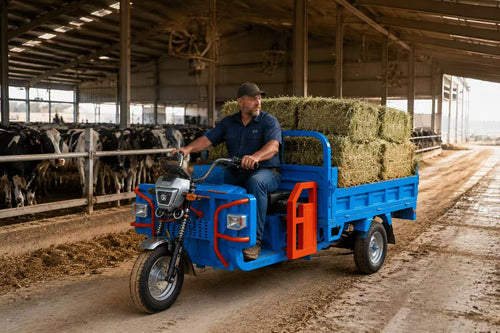
An open bed electric ranch utility trike is often the most flexible choice for daily work.
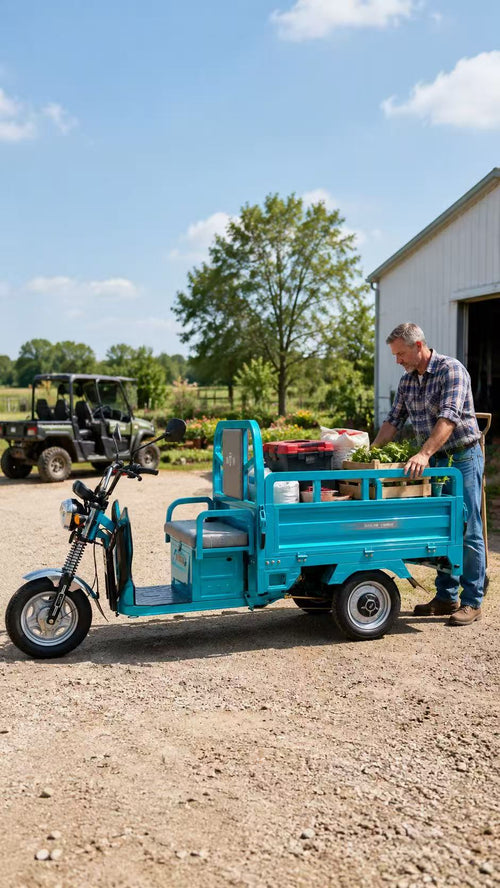
It can carry feed bags, hand tools, buckets, fencing supplies, small crates, hoses, ropes, and repair parts. Workers can load from the side or rear, and the cargo area can handle mixed materials during the day.
An open bed setup is useful when the ranch mainly needs general hauling. It works well for trips such as:
Moving feed from storage to barn areas.
Carrying fencing tools to a repair location.
Transporting buckets and livestock supplies.
Moving small equipment between sheds.
Carrying produce, boxes, or property maintenance tools.
The open cargo bed is simple, easy to see, and easy to clean. For many ranches, this is the most practical everyday setup.
Enclosed Cab or Covered Utility Trike
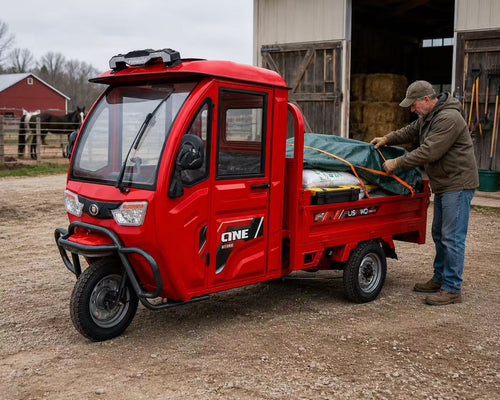
Some ranches need operator protection more than a fully open vehicle. An enclosed cab or covered utility trike can help when the vehicle is used in wind, cold weather, light rain, dust, or long daily routes.
Search results around ranch utility trikes often show enclosed 3-wheel electric utility vehicles with stronger power systems, larger batteries, and driver protection. This shows that some buyers are not only thinking about cargo. They are also thinking about daily comfort and all-weather chores.
An enclosed or covered setup may be useful when:
The ranch has long internal routes.
The operator uses the vehicle many times per day.
Weather protection matters.
The route includes dusty or windy areas.
The vehicle supports regular chores in different seasons.
However, an enclosed cab is not always necessary. It can add cost, size, and weight. If the ranch only uses the vehicle for short fair-weather trips, an open bed may be more practical.
Dump Setup for Loose Material
A dump-style electric ranch utility trike is useful when the ranch often moves loose materials.
This may include:
Manure.
Bedding.
Wood shavings.
Compost.
Soil.
Mulch.
Gravel.
Cleanup loads.
Loose materials are harder to unload by hand than bags or tools. A hydraulic dump bed can reduce labor and make repeated cleanup work easier.
But a dump setup should not be chosen only because it looks heavy-duty. If the ranch mainly moves feed bags, tools, and fencing supplies, a standard open cargo bed may be enough. If the work involves manure, bedding, compost, or gravel, the dump function becomes more important.
The buyer should match the cargo bed to the material, not the photo.
Payload and Real Ranch Loads
Payload is one of the most important ranch utility questions.
Some electric utility trikes are built for light to medium work. Others are designed for demanding commercial tasks with stronger motors, reinforced frames, and heavier load ratings. Search results often mention ratings such as 550 lb, 1,100 lb, 1,700 lb, or even higher for larger work trikes.
The buyer should not choose by the largest number alone. The better question is: what does the ranch carry most often?
A few feed bags, tools, buckets, fencing supplies, and repair parts can become heavy. Bedding, manure, soil, and gravel can become heavier very quickly.
A ranch owner should list the common loads:
Feed bags.
Fence repair tools.
Buckets and water containers.
Mineral blocks.
Small equipment.
Bedding or shavings.
Manure or compost.
Gravel or soil.
The correct payload range depends on the normal daily load, not only the maximum possible load.
Motor and Battery for Ranch Routes
Electric ranch utility trikes may use different power systems. Some are smaller utility vehicles for moderate chores. Others use stronger motors and higher voltage systems for heavier loads and tougher routes.
For ranch work, the motor should support loaded low-speed movement. The vehicle may need to start with cargo, cross gravel, move through rutted tracks, turn near a barn, and stop safely near animals or equipment.
Speed is not the main standard. Torque, control, and stability matter more.
A buyer should ask:
Will the trike carry heavy feed or loose material?
Will it travel on flat gravel or rutted ranch tracks?
Will it climb small slopes with cargo?
Will it be used many times per day?
Will it need a larger battery for repeated trips?
A stronger motor and battery may be useful when the route is longer, heavier, or rougher. A lighter system may be enough for short barn-to-shed work.
Rutted Tracks and Rough Ranch Roads
Ranch routes are often rougher than simple pavement. Even when the property is organized, the vehicle may still cross gravel, packed dirt, muddy patches, pasture edges, and rutted service lanes.
An electric ranch utility trike should not be treated like a city tricycle. It needs enough stability, braking, frame strength, and tire support for the route it will actually use.
If the ranch has deep mud, steep slopes, large rocks, or very uneven trails, a UTV, ATV, tractor, or four-wheel utility vehicle may be better. A three-wheel utility trike can be useful, but it has limits.
The safest buying approach is to match the vehicle to the route:
Smooth barn lanes and gravel roads may fit well.
Moderate dirt and property tracks may work with the right setup.
Deep mud and extreme off-road conditions may require heavier equipment.
This keeps expectations realistic.
All-Weather Ranch Chores
One reason buyers consider enclosed or covered ranch utility trikes is weather.
On a ranch, chores do not stop because the weather changes. Feed still needs to move. Tools still need to be carried. Livestock areas still need attention. Repairs still happen.
A covered or enclosed setup may help when the operator makes repeated trips in wind, cold, light rain, or dust. It can protect the driver and make the vehicle more comfortable for frequent use.
But weather protection should be balanced with cargo needs. If the main job is loading bulky feed bags, tools, or loose material, the cargo bed design is still critical.
The best setup depends on whether the ranch values cargo flexibility, operator protection, or dump unloading the most.
Not a Gas Tractor Replacement for Every Job
Some ranch utility trike results compare these vehicles with gas tractors or larger machines. That comparison is useful, but it must be handled honestly.
An electric ranch utility trike can reduce the need to start a larger gas vehicle for small daily chores. It can help move feed, tools, supplies, bedding, and maintenance items without using a tractor or full UTV every time.
But it should not be presented as a full tractor replacement.
A tractor is still better for heavy towing, field work, loader work, large attachments, deep mud, and major material movement. A UTV or ATV may still be better for rough off-road riding and longer ranch routes.
The ranch utility trike fits the smaller daily work between those machines.
Private-Property Use
Most electric ranch utility trike applications are best understood as private-property use. The vehicle may operate around barns, sheds, livestock areas, internal ranch roads, equipment yards, and fenced property routes.
Public road use is a different question. Rules may vary by state, county, local road classification, lighting, speed, registration, and vehicle type.
For ranch buyers, the clearest use case is internal ranch transport. If the vehicle needs to run on public roads, the buyer should check local rules before purchasing.
This is especially important because search results may show mixed vehicle categories, including electric trikes, cargo trikes, utility trikes, and electric tricycle cars. Private-property positioning avoids confusion.
How to Choose the Right Setup
A ranch buyer should choose the setup by the main job.
Choose an open bed utility trike if the main work is general hauling: feed bags, tools, buckets, fencing supplies, small crates, and repair parts.
Choose an enclosed or covered utility trike if the operator needs weather protection, the route is longer, or the vehicle is used frequently in dust, wind, cold, or light rain.
Choose a dump setup if the ranch often moves loose material such as bedding, manure, compost, soil, mulch, or gravel.
The buyer should also check:
Payload.
Motor strength.
Battery range.
Frame durability.
Tire type.
Braking control.
Cargo bed access.
Route surface.
Charging location.
Daily trip frequency.
These details matter more than color or headline speed.
Ranch Work Examples
An electric ranch utility trike may be used to carry fence repair tools along a property line. It may move feed bags from storage to livestock areas. It may carry buckets, ropes, mineral blocks, or medicine supplies between barns. It may help clean up bedding or move compost around a stable area.
On a larger ranch, it may not replace the main UTV or tractor. But it can handle smaller daily trips so larger equipment is used only when truly necessary.
That is the practical value.
Conclusion
An electric ranch utility trike can be a useful work vehicle when the setup matches the ranch’s daily tasks. An open bed is flexible for feed, tools, and supplies. An enclosed cab can help with all-weather chores. A dump bed can reduce labor when moving loose material.
The best choice depends on payload, cargo type, route, terrain, weather, and how often the vehicle will be used.
For private ranch work, the goal is not top speed. The goal is steady, quiet, practical transport across the property. When chosen carefully, an electric ranch utility trike can support daily chores without forcing the ranch to use a tractor, UTV, or gas vehicle for every small job.