The 300-Foot Hauling Problem: Why Short Farm Trips Waste More Labor Than You Think
Share
Many farms, ranches, horse stables, landscaping sites, and property maintenance teams do not lose time because materials need to travel far. They lose time because the same short trip is repeated again and again.
A worker may move manure from stalls to a compost pile, carry feed waste from a barn to a disposal area, transport mulch from a storage pile to a planting bed, move gravel from a pile to a driveway repair area, or haul soil between a shed and a garden section. Each route may be only a few hundred feet. But when that route is repeated ten, twenty, or thirty times in one workday, the labor cost becomes much larger than it first appears.
The problem is not the distance of one trip. The problem is repeating the same short trip all day.
What is the 300-foot hauling problem?
The 300-foot hauling problem describes a common short-distance material handling challenge. The distance may be 100 feet, 300 feet, or 500 feet. The exact number is not the main issue. The issue is that workers repeatedly move loose or heavy materials across the same short route using manual tools, small carts, or equipment that does not unload efficiently.
On a small farm, this might mean moving compost from a pile to several garden beds. On a ranch, it may mean carrying fencing supplies from a shed to a repair point. In a horse stable, it may mean transporting manure and bedding waste from stalls to a compost area. On a landscaping site, it may mean moving mulch, soil, gravel, or branches from a staging area to different parts of the property.
Each trip looks small. The full day does not.
Why do short farm trips waste so much labor?
A short hauling trip is not just travel time. Every cycle includes loading, positioning, moving, stopping, unloading, turning around, returning empty, and starting again. When workers use a wheelbarrow, manual cart, or small non-dump carrier, the unloading step often becomes the slowest part of the cycle.
This is why short-distance hauling can waste more labor than expected. A worker may feel like the job is simple because the destination is close, but the body still repeats the same pushing, lifting, tipping, walking, and returning motions all day. The shorter the route, the easier it is to underestimate how many times the work will be repeated.
Which jobs create repeated short-distance hauling?
Repeated short-distance hauling appears in many daily operations. Common examples include manure hauling from horse stalls, bedding removal from livestock areas, moving compost to garden beds, carrying gravel for driveway repair, transporting mulch for landscaping work, clearing branches after trimming, moving soil between storage and planting areas, and hauling construction debris to a disposal point.
The same pattern appears in property maintenance and commercial sites. Apartment maintenance teams may move tools, soil, plants, debris, and repair supplies between buildings. Wholesale markets may move waste, crates, packing material, and cleanup loads between stalls, storage rooms, and loading docks. Warehouses and small industrial yards may need short internal transport between work zones.
These jobs are not long-distance logistics. They are repeated local hauling tasks. That is where a compact electric dump hauler can create value.
Why does manual hauling feel manageable at first?
Manual hauling often feels acceptable when the job begins. The first few loads may not seem difficult. A wheelbarrow, hand cart, or small trailer can handle light materials such as dry leaves, empty containers, small tools, or a few bags of supplies.
The problem appears when the load becomes wet, dense, loose, or repetitive. Wet soil, manure, compost, gravel, sand, mulch, clay, firewood, and debris require more effort to move and unload. Even if each load is manageable, the repeated cycle creates fatigue. As fatigue increases, the work slows down, cleanup becomes messier, and the operator may avoid filling the cart to an efficient level.
Manual tools are useful, but they depend heavily on the strength and stamina of the worker.
How does a compact electric dump hauler change the workflow?
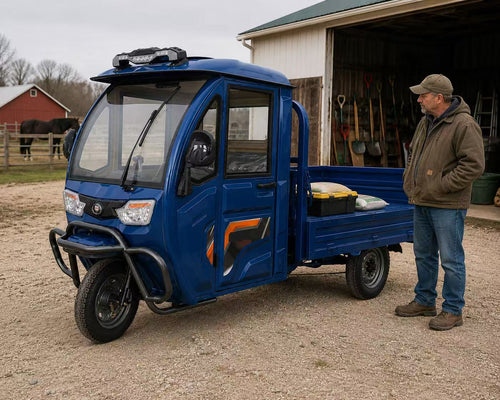
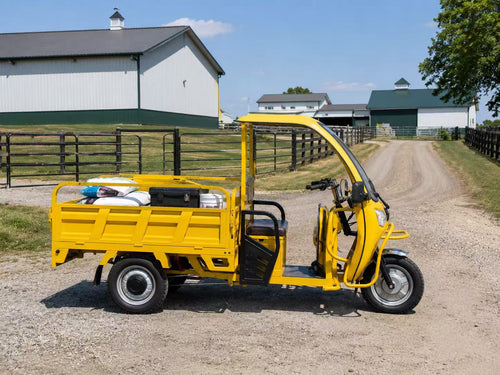
A compact electric dump hauler changes the short-distance hauling workflow by combining powered movement with easier unloading. Instead of pushing every load by hand, the operator uses battery power to move materials across the farm, ranch, stable, landscaping site, or property.
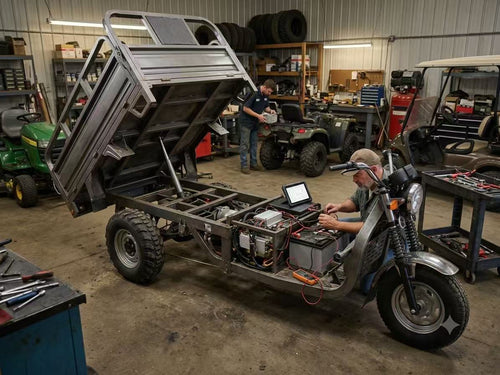
A hydraulic dump utility vehicle adds another layer of efficiency. Loose materials such as soil, gravel, manure, mulch, compost, wood chips, and bedding waste can be unloaded from the rear of the cargo bed with less manual effort. This reduces repeated lifting and tipping, especially when the same material has to be moved many times in one day.
The vehicle does not remove every part of the job. Workers still need to load correctly, choose safe ground, and control the unloading area. But it can reduce the most tiring parts of the repeated cycle.
Why is hydraulic dumping important at the end of each trip?
In short-distance hauling, unloading happens often. If unloading is slow, every trip becomes slow. A hydraulic dump bed helps reduce that bottleneck by allowing loose bulk materials to exit from the rear of the cargo bed instead of requiring repeated hand tipping or shoveling.
For suitable materials, the raised bed lets gravity do much of the work. In real farm, ranch, and landscaping use, the vehicle may move forward very slowly while the dump bed is raised, allowing the loose material to slide from the rear and form a more even line or pile. This movement should always be slow, controlled, and safe. The material should not spill from the sides, leak under the chassis, or cover the wheels.
The benefit is not only one faster dump. The benefit is a faster dump repeated across many trips.
Is a battery powered dump cart useful for small farms?
A battery powered dump cart or electric dump utility vehicle can be especially useful for small farms because many small farms have short but repeated routes. A full-size tractor may be too large for every small task. A pickup truck may not fit into narrow work areas. A wheelbarrow may be too slow for daily heavy materials.
A small electric work vehicle can fit between these categories. It is not designed to replace every machine. It is designed to make repeated short-distance material handling easier. For small farms, orchards, horse stables, nurseries, greenhouses, and ranch properties, this middle role can be very practical.
What makes short-distance hauling different from road transport?
Short-distance hauling is not about speed. It is about workflow. The vehicle may move slowly, stop often, carry uneven materials, turn in tight areas, and unload repeatedly. This is different from road transport, where the goal is to move a load from one distant point to another.
A farm hauling vehicle, ranch utility vehicle, or electric material handling cart should be judged by how well it handles repeated local routes. Cargo bed size, turning ability, load stability, hydraulic dumping, battery endurance, and operator comfort may matter more than high travel speed.
For many real work sites, a vehicle that moves slowly and unloads efficiently can save more time than a faster vehicle that is harder to load, harder to maneuver, or harder to unload.
When should a team upgrade from manual hauling?
A team should consider upgrading when the same short-distance hauling route becomes part of the daily schedule. If workers are repeatedly moving manure, soil, gravel, mulch, compost, wood chips, feed waste, or debris across the same work area, the hidden labor cost may be significant.
A few warning signs are easy to recognize. Workers make many trips with partially loaded carts because full loads are too heavy. Unloading takes longer than expected. Manual dumping creates extra cleanup. The same route is repeated every morning or afternoon. Larger equipment is available but too inconvenient for small jobs. Workers become tired before the main task is finished.
When these signs appear, the issue is no longer just material transport. It is workflow efficiency.
Can one vehicle serve different short hauling routes?
Yes, one electric dump utility vehicle can often serve several short-distance routes on the same property. It may move manure in the morning, carry tools for fence repair later, transport mulch in the afternoon, and help with general cleanup before the end of the day.
This flexibility is one reason compact electric haulers are useful for farms, ranches, stables, nurseries, landscaping crews, property maintenance teams, and construction cleanup. The value increases when the vehicle is used across multiple repeated tasks rather than for one occasional job.
The best use cases are not always the heaviest loads. They are often the most repeated routes.
What should buyers look for in a short-distance hauling vehicle?
Buyers should look beyond maximum payload. A practical short-distance hauling vehicle should match the route, material, unloading method, and daily trip count. It should handle common working surfaces such as gravel roads, packed dirt lanes, barn areas, ranch paths, warehouse yards, or landscaping sites.
The cargo bed should fit the materials being moved. The vehicle should be easy to operate in tight areas. The dump bed should unload loose materials smoothly from the rear. The battery should support repeated start-stop movement throughout the workday. The vehicle should help the operator complete the same route more efficiently, not simply carry a large number on paper.
Why does this matter for buying decisions?
Many equipment decisions are made by comparing specifications. But short-distance hauling is not only a specification problem. It is a repetition problem. The buyer needs to understand where time is being lost inside the daily cycle.
If the job requires only one small trip per week, a manual cart may be enough. If the same 300-foot route is repeated all day with manure, gravel, soil, compost, mulch, or debris, a hydraulic dump utility vehicle can become a practical productivity tool.
The value is not in one trip. The value is in reducing wasted effort across many trips.
A farm, ranch, stable, landscaping site, or property team should not ask only, “How far do we need to move material?” The better question is, “How many times do we repeat this route, and how much labor does each cycle consume?”
When that question is answered honestly, the 300-foot hauling problem becomes easy to see. Short trips may look small, but repeated short trips can quietly consume hours of labor. A compact electric dump hauler helps turn those repeated trips into a more controlled, efficient, and productive workflow.