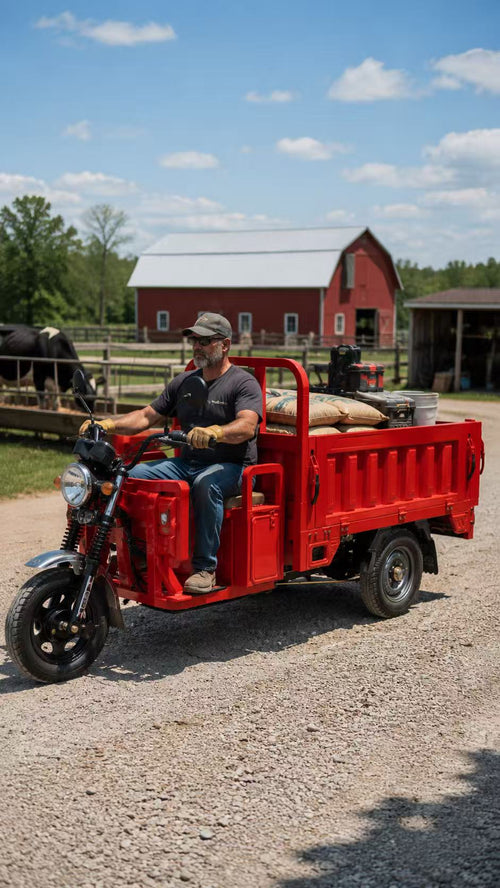
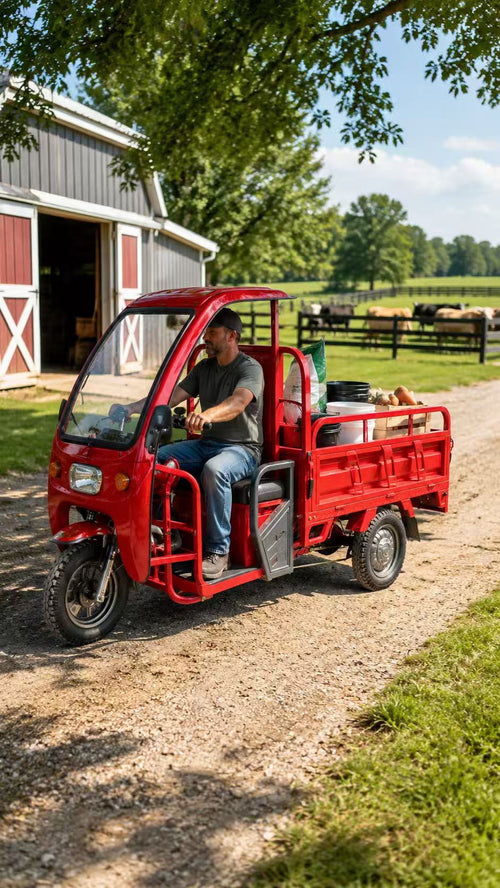
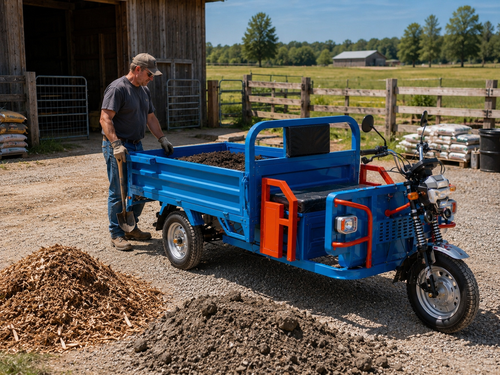
Do You Need Passenger Seats, or Just an Electric Utility Trike with Cargo Bed?
Share
Many farm buyers start by looking at utility vehicles with passenger seats.
That makes sense.
A UTV or side-by-side looks useful because it can carry people, move supplies, travel across a property, and handle different farm tasks. For some farms and ranches, passenger seating is important. A buyer may need to move workers, family members, guests, repair crews, or property staff across a large area.
But many small farms, homesteads, nurseries, greenhouses, market farms, warehouses, and private work areas should ask a more direct question before buying:
Do you really need passenger seats, or do you mainly need an electric utility trike with cargo bed?
This question matters because passenger seats and cargo bed space solve different problems.
Passenger seats help move people.
A cargo bed helps move work materials.
If the daily job is mostly feed bags, crates, tools, boxes, nursery trays, buckets, fencing supplies, and farm materials, then the buyer may not need to start with a larger passenger-focused machine.
The buyer may need a practical cargo-focused work tool.
Passenger Seats Look Useful, But Are They Used Every Day?
Passenger seats feel valuable because they make a machine look more capable.
A two-seat or four-seat UTV looks like it can do more. It can carry people, travel around a property, and serve many roles. For larger farms, ranches, hunting properties, resorts, campuses, and wide private land, that can be a real advantage.
But the important question is daily use.
How often do you actually move people?
How often do you move cargo?
If a machine carries passengers only occasionally, but moves feed, crates, tools, boxes, and supplies every day, then the cargo function may matter more than the passenger function.
Many buyers overvalue seating because it is easy to imagine future use.
But real daily work may tell a different story.
A farm may not need more seats every morning.
It may need a cargo bed every morning.
That is why the buyer should look at the daily work pattern, not only at the most impressive equipment layout.
What Does the Work Really Require?
Before choosing between a passenger utility vehicle and an electric utility trike with cargo bed, the buyer should list the real daily tasks.
Do you move feed bags from storage to a barn?
Do you move produce crates from a field edge to a packing area?
Do you carry tools to repair fences, gates, pumps, or irrigation lines?
Do you move nursery trays between growing areas?
Do you carry small boxes and supplies around a warehouse yard?
Do you move buckets, cartons, parts, and farm materials between buildings?
Do you support market setup, greenhouse work, orchard work, or property maintenance?
If the answer is mostly cargo, then the machine should be judged by cargo usefulness.
Passenger seats may still be nice to have.
But they may not be the part that solves the daily problem.
The Cargo Bed Is Where Work Happens
For many small operations, the cargo bed is more important than extra seats.
The cargo bed is where the actual daily materials go.
Feed bags go there.
Crates go there.
Tools go there.
Boxes go there.
Buckets go there.
Nursery trays go there.
Fencing supplies go there.
Small farm equipment and repair parts go there.
A machine with extra passenger seats may look more complete, but if the cargo space becomes smaller or less convenient, the buyer may lose practical work value.
That is why cargo bed design should not be treated as a secondary feature.
For many buyers, the cargo bed is the reason to buy the equipment.
An electric utility trike with cargo bed is focused on that role. It is not trying to carry a crew across a large ranch. It is trying to help one operator move daily materials across private or controlled work areas.
That narrower purpose can be an advantage when the daily job is simple and repeated.
Bigger Is Not Always More Practical
A larger passenger vehicle may offer more functions, but it also brings trade-offs.
It may cost more.
It may take more storage space.
It may be less convenient for small internal trips.
It may be harder to maneuver near barns, packing tables, greenhouse lanes, nursery benches, or warehouse corners.
It may be more machine than the daily job requires.
This does not mean larger UTVs are bad.
They are useful when the buyer needs passenger seating, towing, longer property travel, rougher routes, or more all-around capability.
But when the main job is moving materials, a smaller cargo-focused machine can sometimes be more practical.
A buyer should not assume that more seats automatically mean more value.
The value depends on what is used every day.
When Passenger Seats Matter
Passenger seats are important in the right situation.
A UTV or passenger utility vehicle may be the better choice if the buyer regularly needs to move people across a property.
It may be better for:
large ranches
large farms
property tours
moving multiple workers
transporting guests
longer private-road routes
hunting properties
wide maintenance areas
rougher terrain
jobs that combine people, tools, and towing
In these situations, passenger capacity is not just a comfort feature.
It is part of the daily work.
If the buyer truly needs to move people often, then an electric utility trike with cargo bed may not be the right first tool.
The buyer should choose equipment that matches the people-moving requirement.
The point is not to reject passenger vehicles.
The point is to ask whether passenger seats are actually needed every day.
When Cargo Bed Space Matters More
Cargo bed space matters more when the daily task is material movement.
This is common in small farms, nurseries, greenhouses, homesteads, barns, warehouses, private lots, market farms, and property maintenance areas.
The operator may work alone.
The route may be short.
The speed may be low.
The materials may be practical and repetitive.
The need may be to move feed, tools, crates, boxes, supplies, trays, and small work items from one place to another.
In this situation, the buyer should ask:
Is the cargo bed easy to load?
Can it carry the materials I move most often?
Can the load stay low and balanced?
Can I unload quickly?
Can the operator move through the work area safely?
Does the machine reduce repeated hand carrying?
Will this tool be used every day?
If the answer is yes, then an electric utility trike with cargo bed may be a better match than a larger passenger-focused machine.
Do Not Buy Seats You Rarely Use
One common buying mistake is paying for features that are rarely used.
Extra seats can look valuable in the showroom or product photo.
But if those seats sit empty most of the time, they may not help the daily work.
A small farm buyer may imagine carrying another person often, but in practice the operator may usually work alone.
A nursery owner may imagine a larger utility vehicle, but daily tasks may only require moving trays, tools, soil bags, and supplies.
A warehouse yard may not need passenger movement at all. It may need short internal cargo movement.
A homestead may not need a full passenger vehicle for every chore. It may need a simple work trike that is easy to use frequently.
The buyer should not ask only:
What can this machine do?
The buyer should ask:
What will I actually use every day?
That question often changes the purchase decision.
The Wrong Tool Can Slow Down Simple Work
A larger passenger utility vehicle may be useful, but it may also be inconvenient for small jobs.
If the task is only to move a few tools or boxes, the operator may not want to use a large vehicle every time.
If the route is short, starting and moving a larger machine may feel unnecessary.
If the work area has tight turning space, a smaller cargo tool may fit better.
If the job happens many times per day, convenience becomes important.
This is where an electric utility trike with cargo bed can make sense.
It is not built around passenger capacity.
It is built around short-distance cargo movement.
That can make it more useful for the daily jobs that larger machines may be too much for.
Cargo Work Is Not Always Heavy Work
Some buyers assume that if a machine is cargo-focused, it must be a heavy-duty machine.
That is not always true.
Many daily cargo jobs are moderate, not extreme.
They may include:
several feed bags
a toolbox
a few produce crates
small boxes
nursery trays
light farm supplies
buckets
repair parts
greenhouse materials
property maintenance items
These loads are important, but they do not always require a full-size UTV or truck.
The goal is not to carry the maximum possible load.
The goal is to reduce repeated short trips with safe, practical loads.
An electric utility trike with cargo bed can be useful when the work is frequent, moderate, and private-site based.
It becomes a daily helper, not a heavy machine replacement.
Where an Electric Utility Trike with Cargo Bed Fits
An electric utility trike with cargo bed fits best in private or controlled work areas.
Good examples include:
farm yards
barn lanes
greenhouses
nurseries
orchard work areas
packing zones
small warehouse yards
private lots
market preparation areas
logistics parks
property maintenance routes
These areas usually involve low-speed movement and repeated short trips.
The equipment should not be treated as a public-road vehicle, highway vehicle, high-speed UTV, or tractor replacement.
It should be used where the route, load, and work pattern fit the machine.
When the context is right, the cargo bed can be more important than passenger seating.
When the context is wrong, a larger vehicle may be necessary.
Open Cargo Bed, Canopy, Cab, or Dump?
Different buyers need different configurations.
An ordinary open cargo model may be best for simple daily loading and unloading.
A canopy cargo model may help when the operator wants some sun or light weather coverage.
A cab utility cargo model may provide more operator protection.
A hydraulic dump utility model may be better when the daily work includes loose materials such as soil, compost, mulch, manure, gravel, or sand.
These choices matter because cargo work is not all the same.
A buyer moving crates and tools may not need a dump bed.
A buyer moving loose bulk material may benefit from hydraulic dumping.
A buyer working in exposed weather may consider canopy or cab coverage.
The correct choice depends on the daily job, not just the equipment photo.
That is why buyers should start with work type.
Then choose the model.
A Buyer Should Count Trips, Not Seats
A simple way to decide is to count trips.
How many times per day does someone move cargo?
How many times per day does someone move passengers?
If cargo trips happen many times and passenger trips happen rarely, the buyer should prioritize cargo usefulness.
If passenger trips happen often, the buyer should consider a passenger utility vehicle.
This sounds simple, but many buyers skip this step.
They buy for imagined versatility instead of real use.
A machine that does many things occasionally may not be as valuable as a machine that solves one daily problem very well.
For small farms and work areas, that daily problem is often material movement.
This is where an electric utility trike with cargo bed becomes worth considering.
The Real Debate: People Moving or Material Moving?
The real debate is not whether UTVs are useful.
They are.
The real debate is whether the buyer’s first need is people moving or material moving.
A people-moving buyer should look for passenger seating, comfort, ride quality, longer property travel, and all-around utility.
A material-moving buyer should look at cargo bed access, load stability, route fit, operator convenience, and repeated daily use.
These are different buying priorities.
If the buyer confuses them, the purchase may feel wrong later.
A machine with extra seats may not solve cargo movement well enough.
A cargo trike may not solve passenger movement at all.
The right choice depends on the primary job.
How This Applies to OneClickChina Buyers
OneClickChina electric utility and cargo trike models are positioned as low-speed private-site transport work equipment.
They are designed for moving materials such as feed bags, tools, crates, boxes, nursery trays, supplies, and farm or property maintenance items.
They are not built to replace every UTV.
They are not passenger carriers for large crews.
They are not public-road vehicles.
They are not high-speed farm machines.
Their value is in practical short-distance cargo movement.
For buyers who mainly need to move work materials, this can make sense.
For buyers who need to move people often, a different vehicle category may be better.
A good buying decision starts by being honest about which job matters most.
Final Thought
Do not buy passenger seats if the daily problem is cargo movement.
And do not buy a cargo trike if the daily problem is moving people.
The right machine depends on the work.
If a buyer needs to carry workers or passengers across a large property, a UTV or passenger utility vehicle may be the better choice.
If the buyer mostly moves feed, tools, crates, boxes, supplies, and daily farm materials inside a private or controlled work area, an electric utility trike with cargo bed may be the more practical tool.
The question is simple:
Are you buying seats, or are you buying a cargo bed you will use every day?