What Is the Best Utility Vehicle for Infrequent Farm Use? Electric vs. Gas
Share
A farm utility vehicle does not always work eight hours a day. On many small farms, ranches, orchards, homesteads, and rural properties, it may sit for several days and then be needed for a series of short jobs: hauling feed, carrying tools, checking fences, moving supplies around a barn, or transporting a load across the property.
That changes the buying decision.
The best utility vehicle for farm use is not necessarily the machine with the most horsepower, longest range, or highest towing capacity. For infrequent farm use, the better question is whether the vehicle matches how often it will run, how far it must travel, what it must carry, the terrain it will cross, and what happens while it sits unused.
For some farms, an electric farm utility vehicle or electric utility trike can be a practical alternative to a conventional gas UTV. For others, especially where deep mud, steep terrain, long working days, or heavy towing are routine, a gas or diesel 4x4 utility vehicle can still make more sense.
The important point is to choose around the work rather than the powertrain alone.
What Does “Infrequent Farm Use” Actually Mean?
Infrequent use does not necessarily mean light-duty work.
A farmer may use a vehicle only a few times each week but still need to carry feed bags, fencing materials, tools, produce, soil, firewood, or other cargo. Another property owner may make several short trips in one morning and then leave the vehicle parked for days.
Typical occasional farm tasks can include:
• hauling feed and supplies
• carrying tools for fence checks and repairs
• moving materials between barns, sheds, greenhouses, or fields
• transporting produce or small farm loads
• yard and property maintenance
• short, repeated stop-and-go trips
This is why usage frequency alone should not determine the vehicle.
Before comparing an electric utility vehicle with a gas UTV, consider six factors: daily distance, terrain, payload, towing requirements, charging access, and how long the vehicle normally sits between jobs.
Why Electric Can Make Sense When a Farm Vehicle Sits Often
One of the less obvious problems with an infrequently used gas utility vehicle is that an internal-combustion engine still has a maintenance system even when the machine is not accumulating many working hours.
Fuel can age during extended storage, and the vehicle still has engine oil, filters, spark plugs, belts, and other mechanical components that require attention over time.
An electric utility vehicle eliminates many of those engine-related service items. There is no gasoline to store and no engine oil to change. For a vehicle that performs short farm chores and then spends significant time parked, that simpler mechanical system can be attractive.
Electric drive also works particularly well for repeated short trips and frequent stops. Immediate low-speed response is useful when moving between a barn, storage area, fence line, greenhouse, or other nearby work locations.
This does not mean an electric vehicle is maintenance-free.
Battery condition becomes especially important when the vehicle is used infrequently. The correct charging and storage procedure depends on the battery system. A vehicle that may sit for weeks should be stored and charged according to the battery manufacturer's requirements rather than simply parked and forgotten.
That distinction matters: electric vehicles can reduce routine mechanical maintenance, but responsible battery care is still part of ownership.
Quiet Operation Can Matter More Than Speed
Farm utility vehicles often operate close to people, animals, barns, greenhouses, workshops, or neighboring properties.
In those environments, quiet operation can be a practical working advantage rather than simply a comfort feature. An electric farm utility vehicle produces no engine exhaust at the point of use and substantially less powertrain noise than a conventional gas vehicle.
For short-distance chores around livestock or enclosed and semi-enclosed working areas, these characteristics may matter more than maximum speed.
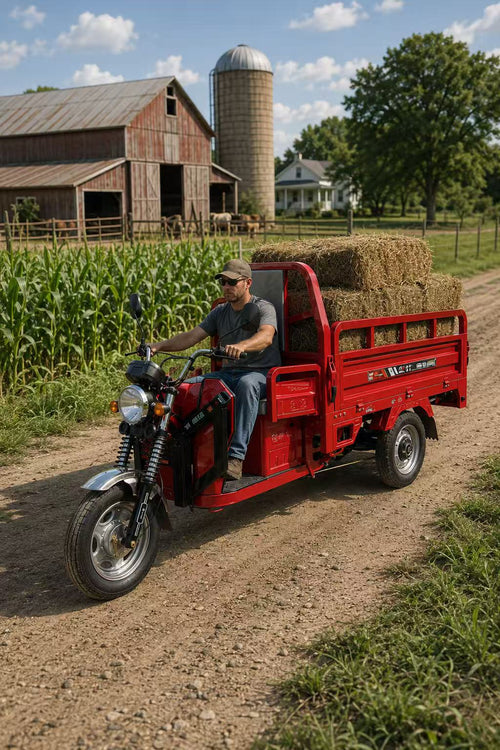
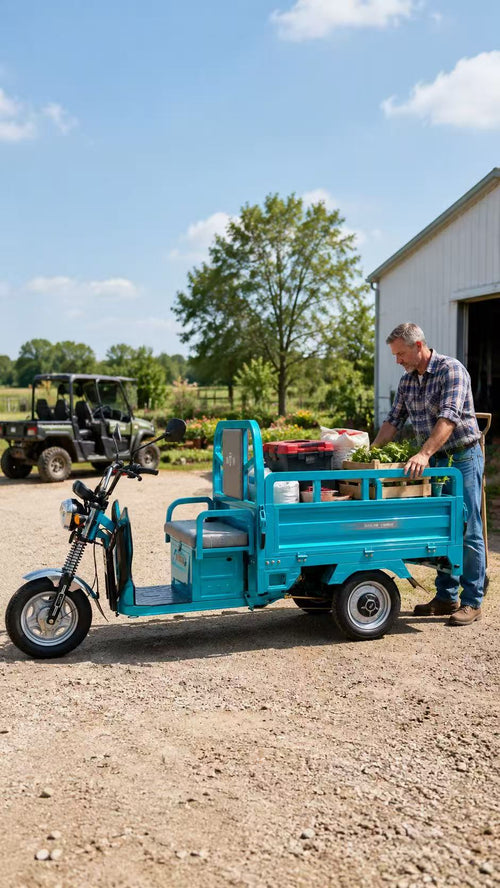
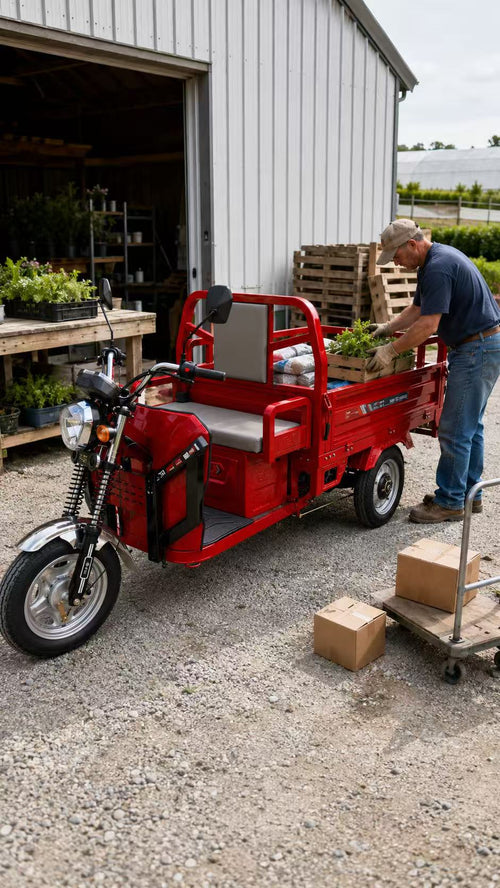
This is also one reason a compact electric utility trike can fit a different role from a full-size side-by-side. If the primary job is moving cargo through relatively compact working areas rather than carrying several passengers or crossing extreme terrain, a smaller cargo-focused vehicle may be sufficient.
When a Gas Utility Vehicle Still Makes More Sense
Electric is not automatically the best choice simply because a vehicle is used occasionally.
A conventional farm UTV remains the stronger option when the work requires capabilities that a smaller electric utility vehicle or cargo trike is not designed to provide.
Gas or diesel deserves serious consideration when the farm routinely involves:
• deep mud or very rough terrain
• steep hills requiring strong off-road traction
• heavy trailer towing
• long distances away from charging
• continuous all-day operation
• rapid refueling followed by immediate continued use
• work that specifically requires a true 4x4 drivetrain
This is an important distinction when comparing vehicles.
A compact electric cargo vehicle should not be evaluated as though it were a direct replacement for every Polaris Ranger, Kawasaki Mule, John Deere Gator, or other heavy-duty 4x4 UTV. Those machines serve a different part of the farm utility market.
If the job genuinely requires that capability, buying a smaller electric vehicle merely to reduce fuel or maintenance costs would be the wrong trade-off.
Start With Daily Distance, Not Advertised Maximum Range
Range figures attract attention, but daily working distance is usually the more useful number.
Ask how far the vehicle actually travels on a normal working day.
If most jobs consist of short runs between buildings, fields, barns, storage areas, or nearby sections of a property, an electric utility vehicle may have far more usable range than the farm actually needs.
If the vehicle routinely travels across a very large ranch, works for long shifts, or cannot return to a reliable charging point, the calculation changes.
This is why “How many miles will I actually drive in a day?” is a better purchasing question than simply asking which vehicle has the longest advertised range.
Terrain Comes Before Powertrain
The same principle applies to terrain.
Flat farm lanes, hard-packed dirt, gravel paths, yards, greenhouses, nurseries, and relatively firm field routes create a very different requirement from steep hills, deep mud, loose ground, or severe off-road conditions.
A three-wheel electric utility vehicle can be useful for cargo movement on suitable farm routes, but it should not be presented as a substitute for a four-wheel-drive UTV in terrain that genuinely requires 4x4 traction and greater ground clearance.
Matching the machine to the ground is more important than choosing electric or gas first.
Payload and Towing Can Change the Answer
Infrequent use can still involve heavy work.
A vehicle that runs only twice a week may carry substantial cargo every time it moves. Therefore, payload and towing requirements should be evaluated separately from usage frequency.
Consider what actually goes into the cargo bed:
feed, tools, fencing supplies, produce, soil, equipment, firewood, maintenance materials, or other farm loads.
A cargo bed or dump bed can make loading and unloading much more efficient when material transport is the primary job. However, if the farm regularly pulls heavy trailers or implements, towing capacity and drivetrain capability may become more important than cargo-bed convenience.
This is where the right vehicle category begins to become clear.
Electric Utility Trike or Full-Size Farm UTV?
For farms that mainly need one person to move materials over short or moderate distances, a compact electric utility trike can avoid paying for capabilities that are rarely used.
Its role is straightforward: practical cargo transportation with a relatively simple electric drivetrain.
A full-size farm UTV makes more sense when the vehicle must carry multiple people, tow substantial loads, negotiate difficult terrain, or remain in operation for extended periods.
Neither category is universally better.
They solve different problems.
For occasional farm work, the most economical vehicle is often the one whose capabilities are actually used—not necessarily the one with the longest specification sheet.
A Simple Decision Checklist
Before choosing an electric farm utility vehicle, electric utility trike, gas UTV, or diesel utility vehicle, answer these questions:
1. How many days per week will the vehicle actually be used?
2. How far will it normally travel on a working day?
3. What is the heaviest load it needs to carry?
4. Does it need to tow a trailer or farm implement?
5. Are the normal routes flat and firm, or steep, muddy, and rough?
6. Is reliable charging available where the vehicle is stored?
7. Will the vehicle regularly sit unused for weeks at a time?
8. Is quiet operation important around livestock, barns, greenhouses, or workers?
9. Is a cargo bed or dump bed more important than passenger seating?
10. Does the work genuinely require 4x4 capability?
If the answers point toward short trips, frequent stops, manageable cargo, suitable terrain, convenient charging, and long periods between uses, an electric utility vehicle deserves serious consideration.
If they point toward heavy towing, difficult terrain, long continuous shifts, or work far from charging, a conventional gas or diesel farm UTV may still be the better tool.
Choose for the Farm You Actually Operate
The best utility vehicle for farm work is not determined by whether electric or gas wins a general comparison.
It is determined by the farm.
For infrequent use, electric vehicles have a meaningful advantage when they replace unnecessary engine maintenance and fuel storage with a simpler drivetrain suited to short, repeated working trips. But battery care, terrain, payload, towing, and charging access still have to be considered.
For demanding off-road work, heavy towing, or continuous long-distance operation, a traditional 4x4 gas or diesel UTV can remain the more appropriate choice.
For smaller farms and properties where the main requirement is moving tools, feed, supplies, produce, or other cargo over suitable routes, a compact electric utility trike can occupy the practical space between a hand cart and a much larger utility vehicle.
The right decision is therefore not “electric or gas?”
It is: what is the smallest, simplest vehicle that can reliably complete the work your farm actually needs?