Farm Utility Vehicle Under $3,000: What Can It Actually Do?
Share
A farm utility vehicle does not have to be a large, expensive UTV to be useful.
For many small farms, orchards, nurseries, greenhouses, homesteads, and rural properties, the daily transportation problem is much simpler: moving feed, tools, produce, fertilizer, fencing supplies, harvest crates, and other materials over relatively short distances.
That raises a practical question for buyers working with a limited budget:
What can a farm utility vehicle under $3,000 actually do?
The answer depends less on speed or recreational capability and more on the work you need to complete every day.
What Does a Small Farm Actually Need From a Utility Vehicle?
When people search for the best utility vehicle for a small farm, the results often focus on traditional UTVs and side-by-sides from major manufacturers.
Those machines can be excellent choices. They may offer four-wheel drive, passenger seating, substantial towing capacity, higher ground clearance, and better performance over rough terrain.
But not every small farm needs all of those capabilities.
For routine farm work, the more useful questions are often:
How much material needs to be moved?
How far does it need to travel?
How narrow are the gates, barn aisles, greenhouse lanes, or orchard rows?
Does the vehicle need to tow heavy implements?
Does it need to carry several passengers?
Will it regularly operate on steep or difficult terrain?
Or is its main job simply hauling cargo around the property?
For a small farm utility vehicle used primarily for daily chores, cargo capacity, operating cost, maneuverability, and ease of loading may matter more than speed or recreational features.
Typical Daily Farm Chores
A compact work vehicle can support many repetitive jobs that otherwise require a wheelbarrow, hand cart, pickup truck, or repeated walking.
Typical farm hauling tasks include moving:
Feed bags and animal supplies
Hand tools and repair equipment
Harvest crates and produce
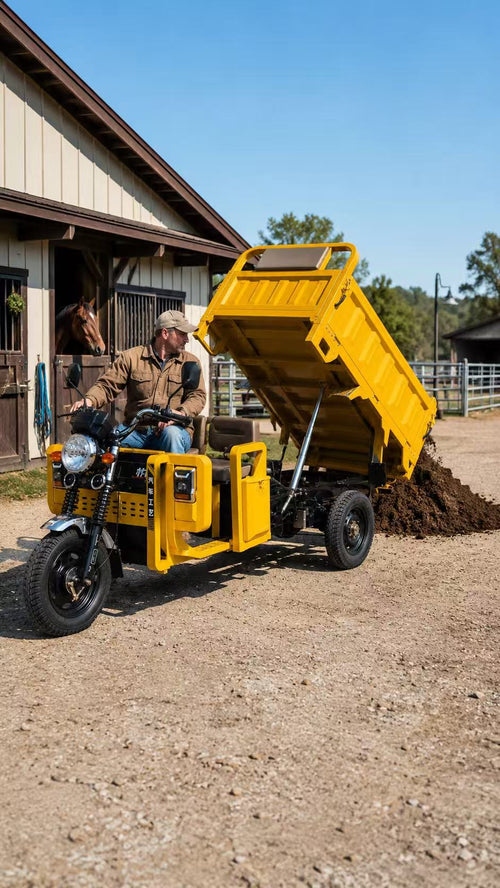
Seed, fertilizer, and soil amendments
Fencing materials
Irrigation supplies
Nursery plants and containers
Small equipment and maintenance supplies
These jobs may involve relatively short routes, but repeating them several times each day consumes labor and time.
For this type of short-distance transport, a compact cargo vehicle can become a practical mobile work platform rather than simply another vehicle parked on the farm.
How Much Do UTVs and Side-by-Sides Cost?
Price is one reason small-property owners may look beyond a conventional UTV.
Buyers researching UTV price, UTV cost, or side-by-side price quickly discover that these vehicles cover a very broad market. New work-oriented models can cost many thousands of dollars, while larger machines with four-wheel drive, enclosed cabs, higher towing capacity, and additional features can cost substantially more.
The same issue appears when buyers ask, “How much does a UTV cost?” or “How much is a side-by-side?”
There is no single price because a UTV can range from a relatively basic work machine to a sophisticated multi-passenger off-road vehicle.
That makes the purchase decision important. A farmer who genuinely needs heavy towing, difficult-terrain capability, four-wheel drive, or multiple seats may have good reasons to pay for a traditional UTV.
A farmer who mainly needs to move cargo between a barn, greenhouse, field, storage area, livestock area, or packing shed may be paying for capabilities that are rarely used.
What Does a $3,000 Budget Change?
At a budget around $3,000, buyers generally should not expect a new full-size 4x4 farm UTV with the capabilities of much more expensive machines.
Instead, the useful comparison shifts toward smaller work-focused vehicles.
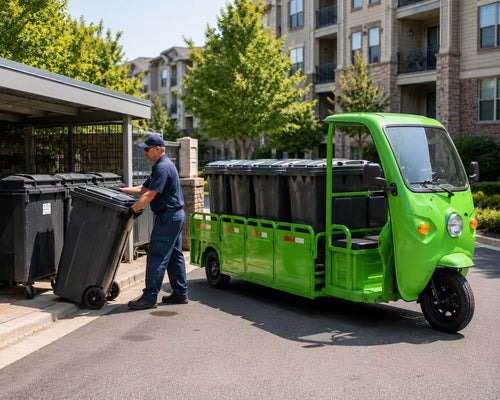
A small electric utility vehicle or electric cargo trike can provide a lower-cost solution when the primary requirement is carrying materials rather than towing heavy implements or transporting several passengers.
This is where the distinction between “best vehicle” and “best vehicle for the job” becomes important.
For some farms, the best farm utility vehicle may be a conventional UTV.
For others, particularly small properties with frequent short-distance cargo movement, a compact electric work vehicle may perform the jobs that actually consume the most labor each day.
What Can an Electric Cargo Trike Actually Carry?
A work-focused electric cargo trike is built around its cargo bed rather than passenger seating or recreational performance.
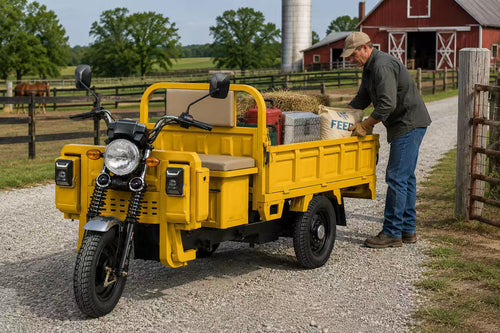
Depending on configuration, it can be used to transport feed, tools, produce crates, plants, fertilizer, soil, fencing supplies, and general farm materials.
For example, US-Electric Utility Vehicles 1000W / 60V electric cargo trike is designed for loads up to approximately 1,000 lb and has a cargo bed measuring approximately 1.50 × 0.95 × 0.45 m.
Its intended role is straightforward: repeated material movement around farms and other private work properties.
The practical advantage is not that it replaces every capability of a UTV. It is that it can replace many small hauling trips that do not require a full-size UTV in the first place.
Where Does a Compact Electric Utility Vehicle Work Best?
A compact electric utility vehicle makes the most sense when the work is repetitive, relatively local, and cargo-oriented.
Consider a small livestock operation where feed, bedding, buckets, tools, and fencing materials need to move between a storage building and animal areas several times a day.
Or consider a market garden where harvested produce needs to move from growing areas to a wash-and-pack station.
In a nursery or greenhouse operation, workers may repeatedly transport plants, pots, soil, fertilizer, and tools through relatively narrow working areas.
These are not necessarily jobs that require high speed, aggressive suspension, or recreational off-road capability.
They require dependable movement of useful loads from one work point to another.
Compact dimensions can also matter. Narrow gates, greenhouse lanes, barn aisles, orchard rows, and crowded storage areas may favor a smaller vehicle over a wider side-by-side.
Electric operation can add another practical advantage for repetitive work around buildings. There is no gasoline engine idling during frequent stops, and routine operation is relatively simple.
Where Is a Traditional Farm UTV the Better Choice?
A compact electric cargo vehicle should not be presented as a universal replacement for a UTV.
If the property requires regular heavy trailer towing, high-speed travel, deep mud operation, steep rough terrain, four-wheel-drive traction, or transportation of several workers, a traditional farm UTV or another larger utility vehicle may be the appropriate investment.
The same applies to farms where one vehicle must perform many demanding jobs across a large property.
A conventional UTV is designed around a broader capability envelope.
The compact electric alternative makes the strongest case when the job is narrower: carrying cargo repeatedly over manageable distances and terrain.
Cargo Capacity Matters More Than Vehicle Size for Some Jobs
One common mistake is evaluating a farm vehicle primarily by its physical size.
For material-handling work, usable cargo capacity can be more important.
A vehicle carrying feed bags, produce boxes, tools, plants, or supplies needs a cargo area that is easy to load and appropriate for the material being transported.
Before buying, compare the expected daily load with the rated capacity of the vehicle. Do not select a vehicle based only on the maximum number printed in a specification sheet.
The better question is whether the vehicle can comfortably handle the normal working load without being routinely overloaded.
This is particularly important for farms where the vehicle will make several trips every day.
Electric Utility Vehicle or UTV: Start With the Workload
Choosing the best utility vehicle for a farm should begin with the workload rather than the vehicle category.
If your daily work requires:
Heavy towing
Four-wheel-drive traction
Rough-terrain capability
Higher travel speeds
Multiple passengers
A conventional UTV may justify its higher cost.
If your daily work mainly requires:
Moving feed and supplies
Carrying tools
Transporting produce and harvest crates
Moving plants and nursery materials
Traveling between nearby work areas
Operating through relatively narrow spaces
A small farm utility vehicle focused on cargo may be enough.
This distinction can prevent a small farm from spending substantially more money for capabilities that are rarely needed.
Operating Cost Is Part of the Buying Decision
Purchase price is only one part of farm vehicle cost.
Fuel, routine maintenance, replacement parts, and the amount of work the vehicle actually performs should also be considered.
For farms using a vehicle primarily for repeated short trips, electric power can simplify the operating pattern. Charging replaces routine gasoline purchases, while the drivetrain has fewer conventional engine-service requirements.
That does not mean an electric vehicle has no maintenance requirements. Tires, brakes, batteries, electrical components, and other wear items still require inspection and service.
The relevant question is total usefulness relative to total cost.
A lower-priced vehicle that handles the farm’s most frequent transportation jobs every day may provide more practical value than a more capable machine that spends much of its time parked.
Can a Farm Utility Vehicle Under $3,000 Be Enough?
Yes, for the right type of work.
A farm utility vehicle under $3,000 can make sense for a small farm when its main purpose is short-distance hauling rather than heavy towing, high-speed travel, or difficult off-road operation.
The key is matching the machine to the work.
A compact electric cargo vehicle can be particularly useful for moving feed, tools, produce, plants, fertilizer, fencing supplies, and other cargo between frequently used areas of a property.
But buyers should not choose solely because the price is lower.
Property size, terrain, route conditions, daily workload, cargo requirements, towing needs, and passenger requirements should all be considered before deciding.
What Is the Best Utility Vehicle for a Small Farm?
There is no single best utility vehicle for every small farm.
For a property that needs heavy towing and four-wheel-drive performance, a traditional UTV may be the better choice.
For a small farm where the dominant task is moving materials over short working routes, a compact electric utility vehicle may provide the capability that matters most without requiring the cost of a larger side-by-side.
The best choice is therefore not necessarily the vehicle with the most features.
It is the vehicle whose capabilities most closely match the jobs performed every day.
Frequently Asked Questions
How much does a UTV cost?
UTV prices vary widely according to size, drivetrain, towing capability, seating, brand, and equipment. Buyers comparing a UTV with a vehicle under $3,000 should recognize that they are usually comparing different classes of machines rather than equivalent vehicles.
What is the best utility vehicle for a small farm?
It depends on the work. Farms requiring heavy towing, rough-terrain performance, four-wheel drive, or multiple passengers may benefit from a traditional UTV. Farms mainly performing short-distance cargo hauling may find a smaller electric utility vehicle more economical and practical.
Can an electric utility vehicle handle everyday farm work?
For suitable terrain and loads, it can handle many routine chores such as moving feed, tools, produce, plants, fertilizer, and farm supplies. Rated load capacity and operating conditions should always be matched to the actual job.
Is a farm utility vehicle under $3,000 a replacement for a UTV?
Not in every application. It is better viewed as a lower-cost work solution for farms whose primary requirement is cargo movement rather than the full towing, passenger, speed, and off-road capabilities of a conventional UTV.
The Bottom Line
The search for an affordable farm utility vehicle should start with the jobs that consume the most time on the property.
If those jobs involve moving cargo repeatedly between nearby locations, a compact electric work vehicle can offer a practical alternative to both manual hauling and a much more expensive utility vehicle.
If the farm requires heavy towing, challenging terrain, four-wheel drive, or passenger transportation, invest in the machine designed for those requirements.
Under $3,000 does not buy every capability.
But when the job is defined correctly, it can buy a useful work vehicle that handles a meaningful part of daily small-farm transportation.