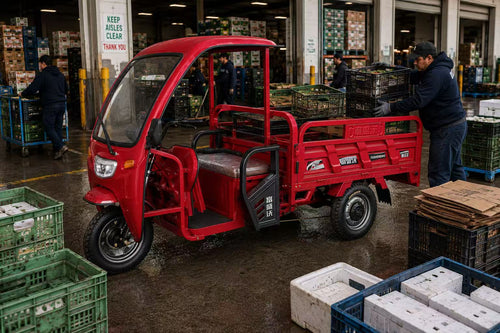
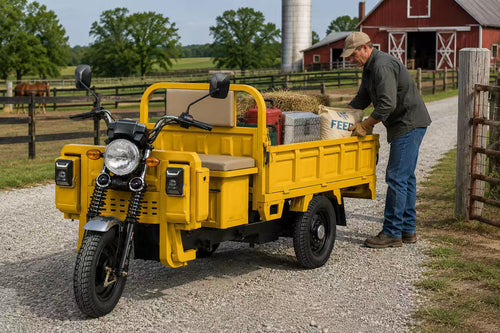
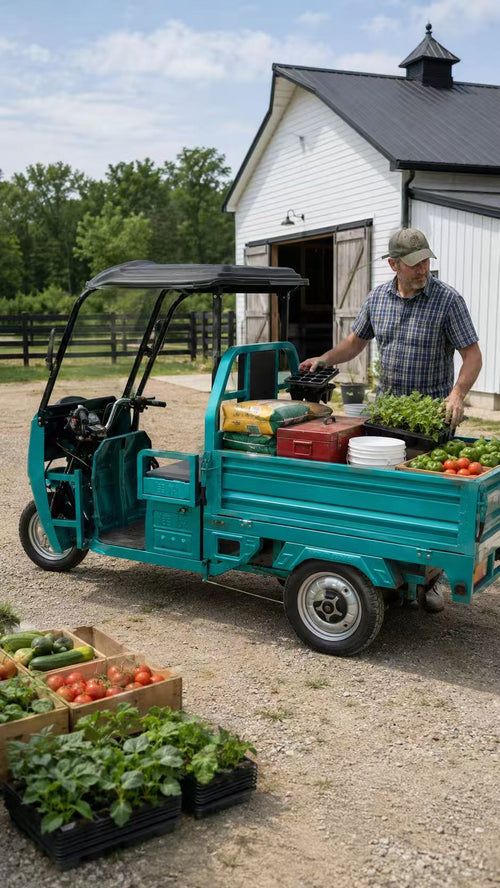
Electric Farm Utility Vehicle System for Modern Farms, Ranches, Livestock Operations, Orchards and Greenhouses
Share
Modern farms are becoming more efficient, but one challenge remains constant: moving materials quickly and efficiently throughout the property. Feed, tools, fertilizer, harvested crops, fencing supplies, irrigation equipment, livestock materials, greenhouse inventory, and daily maintenance items all require frequent short-distance transportation.
An electric farm utility vehicle is not designed to replace tractors, pickup trucks, or heavy agricultural machinery. Instead, it fills the operational gap between manual labor and larger equipment, providing a practical transportation layer for everyday farm operations.
Whether managing a cattle ranch, dairy farm, poultry operation, orchard, greenhouse, nursery, or mixed-use agricultural property, the goal is always the same—reduce unnecessary labor, improve workflow, and keep daily operations moving efficiently.
⸻
Why Farm Transportation Is Changing
Modern agriculture has changed dramatically during the past decade.
Today’s farms are no longer limited to growing crops or raising livestock. Most operations combine multiple responsibilities including equipment maintenance, irrigation management, fencing repairs, greenhouse production, orchard harvesting, livestock care, storage management, and internal logistics.
Although modern farms continue to adopt advanced technology, one challenge remains largely unchanged.
Every day, workers still spend significant time transporting tools, materials, replacement parts, harvested products, feed, fertilizers, repair equipment, irrigation supplies, and maintenance inventory across the property.
These transportation tasks rarely involve highway travel.
Instead, they happen inside the farm.
From barns to workshops.
From feed storage to livestock areas.
From orchards to packing stations.
From greenhouses to shipping areas.
From fence lines to equipment sheds.
These short-distance movements occur hundreds of times every week.
Individually, each trip appears insignificant.
Collectively, they become one of the largest hidden labor costs on many farms.
This is where a modern Farm Mobility System becomes valuable.
Rather than asking,
“What vehicle can replace every machine?”
A better question is,
“What transportation tool makes everyday work easier?”
That is exactly where an electric farm utility vehicle fits.
⸻
The Hidden Cost of Daily Farm Transport
Many farm owners focus on fuel costs, machinery prices, or labor wages.
However, one of the least visible expenses is repeated small transportation.
Consider a typical working day.
A maintenance technician walks back to the workshop because one wrench was forgotten.
A livestock worker drives a full-size pickup truck simply to move several bags of feed.
A tractor is started to transport a few fence posts.
An employee carries irrigation fittings by hand because “it’s only a short walk.”
None of these tasks appear expensive.
But together they consume hundreds of working hours every season.
The real problem is not distance.
The problem is repetition.
Every unnecessary trip interrupts productive work.
Workers stop repairing.
Stop harvesting.
Stop maintaining.
Simply because they need to retrieve equipment that should have been transported together.
This hidden transportation loss rarely appears on financial statements.
Yet it directly affects operational efficiency.
A practical utility vehicle reduces these repeated interruptions by allowing workers to carry everything required for multiple jobs during one continuous trip.
The value is measured not by maximum speed.
It is measured by how often the vehicle eliminates unnecessary movement.
⸻
A Typical Farm Workday
Imagine a mixed agricultural operation during the growing season.
At sunrise, feed is delivered from storage to livestock pens.
The electric utility vehicle carries feed bags, buckets, mineral supplements, and veterinary supplies in one trip.
Later that morning, fencing repairs are needed on the far side of the property.
Instead of walking back several times, the worker transports fencing tools, replacement wire, posts, hardware, batteries, and hand tools together.
Near noon, greenhouse irrigation requires maintenance.
The same vehicle moves replacement valves, irrigation fittings, hoses, pipe connectors, toolboxes, and plant trays directly to the greenhouse entrance.
During the afternoon harvest, orchard workers continuously move fruit crates between collection points and packing stations.
The vehicle becomes part of the harvesting workflow rather than simply another machine parked nearby.
Before finishing the day, maintenance supplies, cleaning equipment, and replacement parts are transported back to storage.
Throughout the entire day, the vehicle rarely performs one dramatic task.
Instead, it completes dozens of ordinary jobs.
That is exactly why it becomes one of the most frequently used machines on the farm.
Its greatest value is consistency.
Not occasional heavy work.
But continuous daily support.
⸻
Why One Vehicle Cannot Do Every Farm Job
One of the biggest misunderstandings in farm equipment purchasing is believing that one machine should perform every transportation task.
Real farms do not operate that way.
Different equipment exists because different jobs require different solutions.
A wheelbarrow remains useful for extremely small jobs in confined spaces.
A pickup truck is ideal for highway transportation, towing trailers, and moving large loads over long distances.
A tractor remains essential for heavy field work, implements, cultivation, and high-power agricultural operations.
A UTV provides excellent off-road mobility while carrying workers and moderate cargo across rough terrain.
Each machine has strengths.
Each machine also has limitations.
An electric farm utility vehicle is not intended to replace these machines.
Instead, it fills the transportation gap between them.
It handles the daily jobs that are too large for manual labor but too small to justify operating larger equipment.
This middle layer of transportation is often overlooked.
Yet it represents some of the most repetitive work performed on every farm.
Choosing the Right Transport Tool for the Right Job
Successful farms are built around choosing the right equipment for the right task, not expecting one machine to solve every problem.
When a task requires heavy pulling power, field cultivation, or operating large agricultural implements, a tractor remains the correct solution.
When materials must be transported between farms, delivered to customers, or moved over public roads, a pickup truck continues to be the most practical choice.
When workers need to travel quickly across rough terrain while carrying passengers, a UTV provides excellent mobility.
When the task is extremely small and confined to one work area, a wheelbarrow or hand cart still performs well.
However, modern farms contain hundreds of jobs that fit none of these categories.
These jobs involve moving useful loads repeatedly within the property.
Feed.
Fertilizer.
Toolboxes.
Plant trays.
Harvest crates.
Repair materials.
Water pumps.
Fence supplies.
Livestock equipment.
Cleaning materials.
Replacement parts.
These jobs rarely require tractor horsepower.
They rarely justify starting a pickup truck.
They are too repetitive for manual labor.
This is exactly where an electric farm utility vehicle becomes valuable.
It fills the operational gap between hand tools and heavy machinery.
⸻
Electric Farm Utility Vehicle vs Traditional Farm Equipment
Instead of asking which machine is “better,” farm owners should ask which machine is most suitable for a particular workflow.
A wheelbarrow offers simplicity and low purchase cost, but it relies entirely on physical effort. As loads become heavier or transportation distances become longer, productivity declines quickly.
A pickup truck provides outstanding road transportation and towing capability. However, repeated short trips inside a farm often create unnecessary fuel consumption, equipment wear, and wasted time.
A tractor delivers unmatched agricultural power. Yet using a large tractor to transport several toolboxes or a few bags of feed is often inefficient.
A UTV combines off-road mobility with passenger transport and moderate cargo capacity. It performs well across many farms, especially where workers travel long distances throughout the property.
An electric farm utility vehicle focuses on something different.
Its primary purpose is not transportation speed.
Its primary purpose is transportation frequency.
It is designed for the jobs that happen repeatedly every day.
Moving supplies.
Moving equipment.
Supporting maintenance.
Supporting harvest.
Supporting livestock care.
Supporting greenhouse operations.
Supporting everyday agricultural work.
When evaluated from this perspective, the vehicle becomes part of the farm’s workflow rather than simply another piece of equipment.
⸻
Farm Applications Across Different Agricultural Industries
Dairy Farms
Dairy farms require constant movement between barns, feed storage, maintenance workshops, milking facilities, and livestock housing.
Workers frequently transport bedding materials, cleaning supplies, feed supplements, veterinary equipment, repair tools, replacement parts, and maintenance inventory.
Most of these tasks occur dozens of times each day.
An electric farm utility vehicle helps simplify these movements while reducing unnecessary walking and repeated trips.
Where manure, wet bedding, compost, or loose agricultural materials must be unloaded regularly, a hydraulic dump utility vehicle may provide additional advantages.
⸻
Ranches and Livestock Operations
Large ranches involve continuous inspection of fencing, water systems, feeding areas, livestock handling facilities, and property boundaries.
Daily transportation often includes fencing supplies, mineral blocks, veterinary equipment, portable tools, repair materials, feed buckets, and maintenance inventory.
Because these jobs occur over wide areas with relatively small loads, a compact utility vehicle often becomes one of the most frequently used machines on the ranch.
Rather than replacing tractors, it supports daily livestock management between larger agricultural tasks.
⸻
Poultry Farms
Modern poultry farms depend on organized internal logistics.
Feed.
Egg trays.
Cleaning equipment.
Disinfecting supplies.
Repair materials.
Waste containers.
Lighting equipment.
Ventilation components.
These items move constantly between poultry houses and service buildings.
Compact transportation becomes especially important where multiple buildings operate simultaneously.
An electric utility vehicle allows maintenance teams and production staff to transport necessary equipment efficiently while minimizing unnecessary walking.
⸻
Orchards and Vineyards
Fruit production creates a unique transportation challenge.
Harvest materials move continuously throughout the day.
Workers require ladders, picking containers, harvesting tools, irrigation equipment, pruning supplies, replacement parts, and fruit crates.
Most transportation occurs between tree rows, collection points, packing areas, and storage buildings.
Large equipment often cannot operate efficiently in these spaces.
A compact utility vehicle supports harvesting operations without interrupting workflow.
Instead of replacing specialized harvesting equipment, it improves internal logistics throughout the production process.
⸻
Greenhouses and Nurseries
Greenhouses and nurseries operate in environments where maneuverability is often more important than raw carrying capacity.
Plant trays.
Pots.
Growing media.
Soil.
Fertilizer.
Irrigation equipment.
Labels.
Packaging materials.
Small tools.
These materials move constantly throughout growing areas.
Because working space is limited, vehicles must remain compact while still providing useful cargo capacity.
For many greenhouse operators, transportation efficiency directly influences labor productivity during planting, maintenance, and shipping seasons.
⸻
Mixed Agricultural Properties
Many family farms do not specialize in one agricultural activity.
A single property may combine livestock, orchards, vegetable production, greenhouses, equipment maintenance, fencing, and seasonal crop harvesting.
These operations benefit from equipment capable of supporting multiple workflows throughout the day.
Rather than purchasing separate transportation equipment for every task, a versatile electric utility vehicle becomes a shared work platform supporting many departments across the property.
Return on Investment: Why Daily Efficiency Matters
Many buyers compare electric utility vehicles by motor power, battery capacity, maximum load, or purchase price.
Those specifications are important.
However, they rarely determine whether the vehicle becomes one of the most valuable machines on the farm.
Real value comes from daily use.
If one worker can complete maintenance work without walking back for forgotten tools, productivity improves.
If feed, fencing supplies, irrigation equipment, repair parts, and harvest crates can all be moved in fewer trips, unnecessary labor is reduced.
If a pickup truck or tractor no longer needs to be started for every small transportation task, operating costs and equipment wear can also decrease over time.
The return on investment does not come from one large job.
It comes from hundreds of small jobs completed more efficiently throughout the year.
For many farms, improving workflow produces greater long-term value than simply increasing vehicle specifications.
⸻
The Future of Farm Mobility
Agriculture will continue to evolve.
Battery technology will improve.
Electric drivetrains will become more efficient.
Charging systems will become faster.
Future battery technologies, including next-generation lithium and solid-state batteries, may significantly extend operating time and overall performance.
However, one thing is unlikely to change.
Farms will always need to move people, materials, equipment, harvested products, feed, tools, irrigation supplies, maintenance inventory, and repair parts throughout the property.
The technology may change.
The daily transportation challenge will remain.
For this reason, an electric farm utility vehicle should not be viewed simply as another machine.
It should be viewed as part of a long-term Farm Mobility System supporting the everyday operation of modern agriculture.
⸻
Continue Exploring Farm Transportation Solutions
Every agricultural operation has different transportation requirements.
Explore our specialized guides for different working environments:
• Dairy Farm Utility Vehicle Solutions
• Ranch & Livestock Transport Systems
• Poultry Farm Material Handling
• Orchard Harvest Transportation
• Greenhouse & Nursery Logistics
• Farm Hydraulic Dump Applications
• Small Farm Utility Vehicle Buyer’s Guide
• Electric Farm Utility Vehicle vs UTV Comparison
Each guide focuses on one specific agricultural workflow while connecting back to this Farm Utility Vehicle System Hub.
⸻
Is This Type of Vehicle Right for Your Farm?
An electric farm utility vehicle may be a practical solution for:
• Small farms looking to reduce unnecessary labor.
• Ranches transporting feed, fencing supplies, and maintenance equipment.
• Dairy farms moving bedding, cleaning tools, and repair materials.
• Poultry farms handling feed, egg trays, and daily maintenance.
• Orchards transporting harvest crates and pruning equipment.
• Greenhouses and nurseries moving plants, irrigation parts, and growing supplies.
• Rural properties requiring frequent short-distance transportation.
The best choice always depends on daily workflow rather than vehicle specifications alone.
Understanding how work is performed each day is more important than choosing the largest machine available.
⸻
Frequently Asked Questions
Is an electric farm utility vehicle the same as a UTV?
No.
Although both can transport people and cargo, a utility vehicle designed for farm work focuses more on carrying materials, tools, supplies, and daily work equipment rather than recreational or passenger transportation.
Can it replace a tractor?
No.
A tractor remains essential for heavy agricultural work, field operations, and powered implements.
The electric utility vehicle complements the tractor by handling everyday transportation tasks.
Can it replace a pickup truck?
Not completely.
Pickup trucks remain the best choice for highway transportation and towing.
Utility vehicles are designed for repeated short-distance movement within the property.
Is a hydraulic dump bed always necessary?
No.
For transporting tools, feed bags, crates, irrigation equipment, and maintenance supplies, a standard cargo bed is usually sufficient.
Hydraulic dump beds become more valuable when handling loose materials such as soil, gravel, mulch, manure, compost, or firewood.
⸻
Final Thoughts
Modern agriculture is becoming increasingly efficient, but everyday transportation remains one of the most overlooked areas of farm management.
An electric farm utility vehicle is not intended to replace every machine on the property.
Instead, it fills the operational gap between manual labor and larger equipment.
By reducing repeated walking, minimizing unnecessary vehicle use, improving workflow, and supporting daily transportation across farms, ranches, orchards, greenhouses, nurseries, dairy farms, and livestock operations, it becomes an important part of a modern agricultural mobility system.
The most valuable machine is not always the biggest one.
Often, it is the machine that helps workers complete hundreds of small jobs more efficiently every single day.