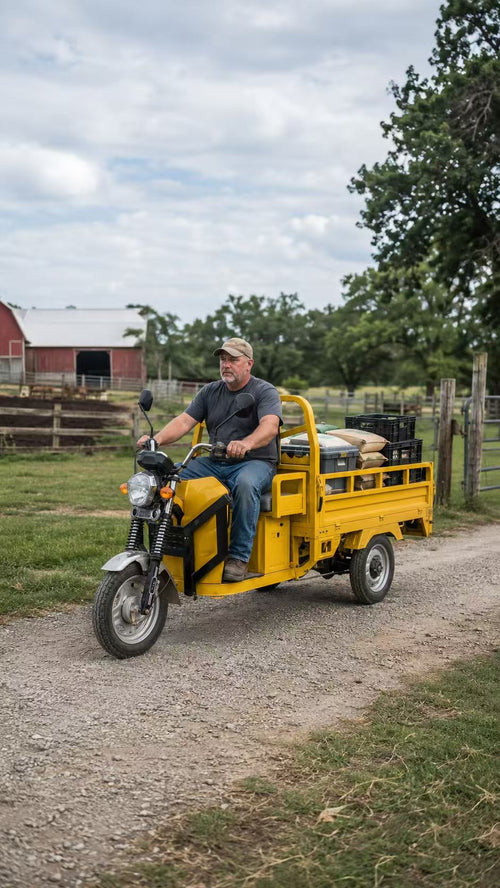
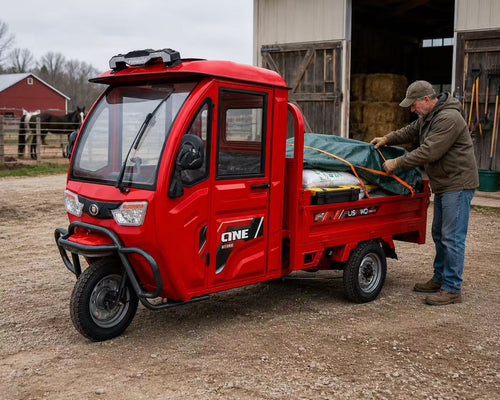
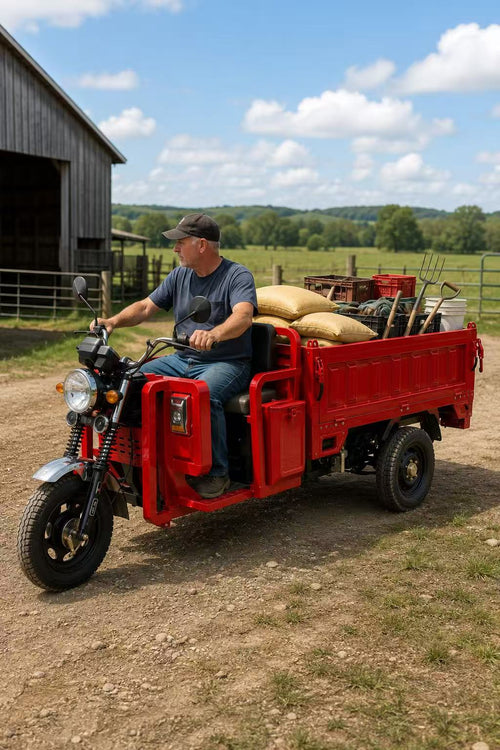
Electric Utility Vehicle for 50KM Industrial Mobility System – Low-Cost Solution for Agricultural, Livestock, and Rural Transport Operations
Share
The Missing Layer of Modern Industry
Modern industries have become increasingly efficient over the past several decades. Manufacturing has become more automated. Warehouses have adopted advanced inventory systems. Farms rely on precision agriculture. Construction projects use digital planning. Property management is becoming smarter, and commercial horticulture continues to modernize.
Despite these improvements, one operational challenge remains surprisingly consistent across nearly every industry.
Every working day, people, tools, materials, products, spare parts, maintenance equipment, harvested crops, parcels, supplies, and operational resources must continuously move from one location to another.
These movements rarely receive much attention because they happen constantly.
Workers carry tools across apartment communities.
Maintenance staff transport repair equipment between buildings.
Warehouse employees move cartons between storage areas and loading docks.
Farm workers deliver feed, fencing materials, fertilizers, irrigation equipment, and harvested products across daily operating areas.
Construction crews transport building materials, power tools, cable reels, hardware supplies, and maintenance equipment throughout active job sites.
Greenhouse employees relocate seedlings, plant trays, fertilizers, irrigation supplies, and harvested vegetables between growing zones and packing stations.
Wholesale market operators repeatedly transport seafood containers, produce crates, flower carts, and packaging materials throughout busy trading facilities.
Although these activities belong to different industries, they all share one common characteristic.
They are repetitive.
They are short-distance.
They occur continuously throughout the working day.
These movements are not simply transportation.
They are an essential part of everyday operations.
Without them, production slows, maintenance stops, deliveries become delayed, and overall productivity declines.
Surprisingly, this operational layer has rarely been discussed as an independent management system.
Most businesses focus on production.
Others focus on logistics.
Some optimize supply chains.
Very few examine the repeated short-distance movement that connects every stage of daily operations.
This is the missing operational layer.
We define this layer as the 50KM Industrial Mobility System.
It is not defined by one vehicle.
It is not limited to one industry.
It represents the continuous movement of people, tools, materials, products, and equipment within the normal operating radius of modern industrial, agricultural, commercial, and municipal environments.
The concept of 50KM does not describe maximum driving range.
Instead, it represents the practical operating radius where most daily work is completed.
For the majority of farms, warehouses, factories, apartment communities, hotels, schools, construction sites, wholesale markets, nurseries, and commercial facilities, daily operations are concentrated within a relatively limited working area.
Improving efficiency inside this operating radius often delivers greater operational value than increasing long-distance transportation capacity.
Industrial mobility is therefore not a vehicle category.
It is an operational system.
Understanding this system provides the foundation for improving labor productivity, reducing repetitive manual transportation, lowering operating costs, and creating more efficient workflows across multiple industries.
Why Industrial Mobility Is Moving Toward Electrification
Industrial mobility has never been static.
For decades, businesses relied on manual carts, gasoline utility vehicles, pickup trucks, forklifts, tractors, and other conventional equipment to move people, tools, materials, and products.
Each solution continues to play an important role.
Forklifts remain essential inside warehouses.
Pickup trucks are indispensable for highway transportation.
Tractors are irreplaceable in field operations.
Heavy-duty trucks continue to move freight across long distances.
However, none of these machines was specifically designed to optimize the repetitive short-distance movement that occurs hundreds of times every day inside modern operating environments.
This is where industrial mobility is changing.
Rather than replacing existing equipment, businesses are introducing a new operational layer that improves efficiency between production, maintenance, storage, loading, harvesting, inspection, and delivery.
Electric industrial mobility is becoming part of this transition.
The reason is not simply environmental protection.
The reason is operational efficiency.
Electric drive systems provide instant torque for frequent stop-and-go work.
They eliminate idling fuel consumption during repeated loading and unloading.
They simplify routine maintenance because there are fewer moving mechanical components compared with traditional internal combustion systems.
For businesses operating every working day, lower routine maintenance requirements can reduce downtime and improve equipment availability.
Another important factor is operating cost.
Industrial mobility often involves hundreds of short trips within the same property.
Reducing energy consumption during these repetitive movements can significantly lower long-term operating expenses.
As energy infrastructure continues to improve, electrification is becoming an increasingly practical solution for local industrial operations.
Noise reduction also plays an important role.
Hotels, apartment communities, schools, hospitals, resorts, parks, commercial campuses, and greenhouse facilities all benefit from quieter equipment that allows maintenance and transportation activities to continue with less disruption.
Environmental responsibility is another long-term consideration.
Many businesses are working toward lower emissions, improved sustainability, and more efficient resource management.
Electric industrial mobility supports these objectives while helping organizations modernize their daily operations.
Most importantly, industrial mobility should never be viewed as a competition between electric and fuel-powered equipment.
Each has a different purpose.
Heavy trucks remain the preferred solution for regional freight.
Pickup trucks continue serving public-road transportation.
Forklifts specialize in pallet handling.
Tractors dominate heavy agricultural work.
Electric utility vehicles occupy a different position.
They improve the repeated short-distance workflow that connects every stage of daily industrial operations.
This complementary relationship is the reason industrial mobility continues moving toward electrification.
The goal is not to replace every machine.
The goal is to improve the operational layer that keeps every industry moving efficiently, every hour, every day.
One Mobility Theory, Multiple Industry Systems
The 50KM Industrial Mobility System is not limited to one vehicle, one business, or one industry.
It is a common operational framework that explains how short-distance movement supports the daily workflow of modern organizations.
Although every industry has different products, customers, and production methods, they all rely on the continuous movement of people, tools, materials, equipment, maintenance supplies, and finished products within their normal operating environment.
The movement is different.
The theory is the same.
This is why the 50KM Industrial Mobility System can be applied across multiple industries.
Instead of organizing knowledge around individual products, we organize it around operational systems.
Each industry has its own workflow.
Each workflow has its own transportation challenges.
Each transportation challenge requires different solutions.
For this reason, the Industrial Mobility System is divided into specialized industry systems.
⸻
Farm Utility System
Modern farms, ranches, dairy operations, poultry farms, and livestock facilities depend on continuous internal transportation.
Feed, fencing materials, veterinary supplies, harvested products, maintenance equipment, irrigation components, and daily operational tools move constantly throughout the property.
Improving these repetitive movements increases productivity while reducing unnecessary labor.
⸻
Logistics & Material Flow System
Warehouses, factories, distribution centers, and local delivery operations all depend on fast internal movement.
Receiving, sorting, storage, replenishment, picking, staging, and loading are connected through continuous material flow.
Efficient industrial mobility improves operational speed without changing the existing logistics system.
⸻
Construction Material Flow System
Construction projects involve the constant movement of building materials, electrical supplies, plumbing equipment, concrete tools, safety equipment, repair materials, and maintenance resources.
Efficient movement inside active job sites helps contractors reduce delays and improve workflow.
⸻
Property & Facility Maintenance System
Apartment communities, hotels, campuses, hospitals, office parks, municipalities, and commercial properties perform maintenance every day.
Cleaning equipment, landscaping tools, repair materials, plumbing parts, electrical supplies, irrigation equipment, and safety equipment move continuously between work locations.
Industrial mobility improves daily facility operations by reducing unnecessary transportation time.
⸻
Hydraulic Dump Material Handling System
Many industries handle loose materials rather than packaged products.
Sand, gravel, soil, mulch, compost, landscaping materials, demolition debris, agricultural waste, and construction materials all require specialized short-distance movement.
Material handling therefore becomes an important branch of industrial mobility.
⸻
Wholesale Market Transportation System
Wholesale seafood markets, produce markets, flower markets, meat markets, and agricultural trading centers all operate through rapid internal transportation.
Products arrive, are sorted, displayed, transferred, packaged, and loaded within the same operating area.
Fast and efficient movement directly supports daily market operations.
⸻
Commercial Horticulture System
Greenhouses, orchards, vineyards, nurseries, tree farms, and garden centers depend on continuous plant movement.
Seedlings, irrigation equipment, fertilizers, growing media, harvested crops, flowers, containers, and maintenance equipment move repeatedly throughout every production cycle.
Efficient plant flow is one of the foundations of modern horticulture.
⸻
Warranty, Maintenance & Lifecycle Support
Industrial mobility does not end after equipment is delivered.
Long-term reliability depends on preventive maintenance, replacement parts, battery management, operator training, charging practices, inspections, and after-sales support.
An efficient mobility system includes the complete equipment lifecycle.
⸻
Building a Complete Industrial Mobility Knowledge System
The purpose of this website is not simply to introduce electric utility vehicles.
Its purpose is to build a complete Industrial Mobility Knowledge System.
Every article belongs to one operational system.
Every operational system belongs to the 50KM Industrial Mobility framework.
Together they form a connected knowledge network that helps businesses understand how modern industrial mobility improves efficiency across different industries.
As this knowledge base continues to grow, additional industries and specialized applications will become part of the same framework.
The theory remains consistent.
The workflows become more specialized.
The practical solutions become more refined.
This is the long-term vision of the 50KM Industrial Mobility System—a unified operational framework that connects modern industries through efficient, sustainable, and intelligent short-distance mobility.