Feed, Tools, or Harvest Crates: What Can an Electric Cargo Trike Carry on a Farm?
Share
Before choosing an electric cargo trike for farm work, one of the most important questions is simple:
What do you need to carry most often?
Many buyers start by asking about motor power, range, or price. Those details matter, but they should not be the first decision. For daily agricultural use, the cargo itself often decides what kind of vehicle makes sense.
A farm that mainly moves feed bags has different needs from a farm that moves harvest crates. A greenhouse moving seed trays does not load the vehicle the same way as a ranch carrying tools, buckets, and fence repair supplies.
That is why the primary cargo type should be one of the first things to check before buying an electric cargo trike.
Start with the Three Most Common Loads
A practical way to begin is to list the three things you carry most often.
For many farms, those loads may include:
feed bags
toolboxes
produce crates
harvest boxes
seed trays
fertilizer bags
buckets
small equipment
fencing supplies
nursery materials
packing supplies
daily maintenance tools
This list matters because each load has a different shape, weight, and unloading method.
A long cargo bed may be useful for crates and trays. Higher side rails may help keep loose items in place. A flat open bed may be easier for loading tools and bags from the side. A roof canopy may help the operator work more comfortably under sun or light rain.
The right electric cargo trike is not only about how much weight it can carry. It is also about how easily the farm worker can load, secure, move, and unload the cargo throughout the day.
Feed Bags and Fertilizer Bags
Feed bags and fertilizer bags are common farm loads because they are heavy enough to become tiring when moved by hand, but not always large enough to justify using a pickup, tractor, or gas UTV.
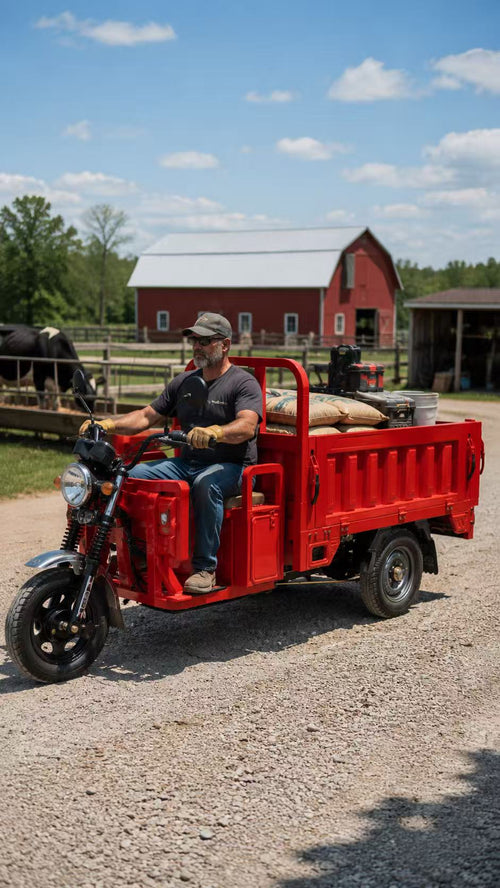
An open-bed electric cargo trike can make sense for these loads because bags can be stacked low and evenly in the rear cargo area.
For bagged cargo, buyers should pay attention to:
cargo bed length
side rail height
floor strength
load balance
easy side access
low-speed control
braking when loaded
A mistake is stacking bags too high. Even if the motor can move the load, a tall stack can affect balance, visibility, and unloading safety.
For farm use, a low and balanced load is usually better than a tall and overloaded cargo bed.
A canopy can also be useful during repeated feed runs because the operator spends less time exposed to direct sun or light rain. The canopy does not replace a fully enclosed cab, but it can make short-route farm work more comfortable.
Tools and Repair Supplies
Many farms do not only need a vehicle for harvest or feed. They also need a small work vehicle for daily repair tasks.
A farm worker may need to carry:
hand tools
electric tools
toolboxes
fence repair supplies
water hose parts
small pumps
battery chargers
animal care supplies
gloves and buckets
For this type of cargo, an open cargo bed is practical because tools can be loaded quickly and removed at different stops.
A covered cargo van box may protect tools better from weather, but it can also make loading and unloading slower if the worker needs frequent access from different sides.
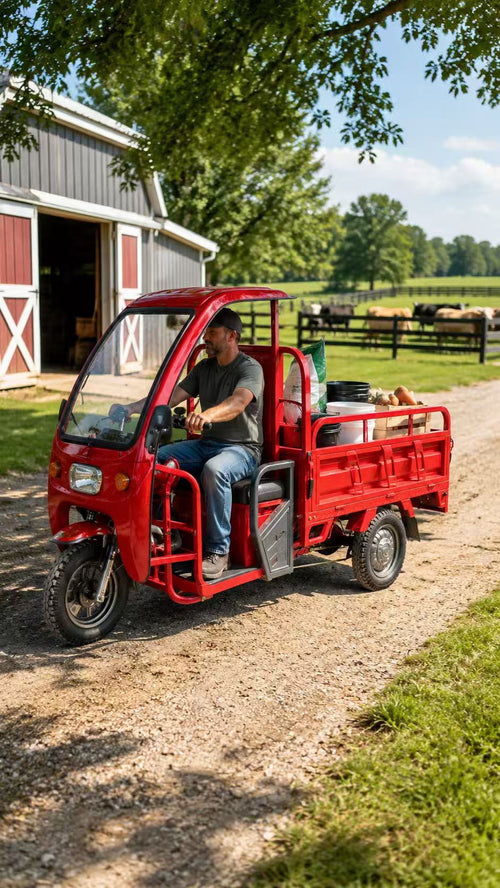
That is why an open-bed trike with a canopy can be a useful middle option. The cargo bed stays open and easy to access, while the operator has basic overhead protection during daily work.
For farms with many short stops, access can be more important than full enclosure.
Harvest Crates and Produce Boxes
Harvest crates and produce boxes create a different buying question.
The issue is not only weight. It is also shape and stacking.
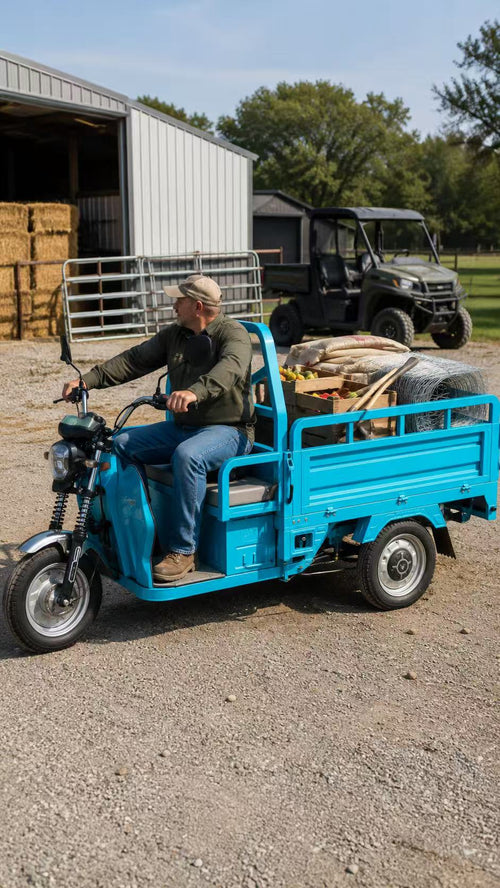
Produce crates often need a flat bed, enough length, and stable side rails. If the vehicle moves from a field, orchard, greenhouse, or garden row to a packing area, the cargo bed should allow crates to sit evenly without shifting too much.
For harvest work, buyers should think about:
how many crates fit per trip
whether crates can stack safely
whether the bed is long enough
whether the route is smooth or uneven
whether the vehicle can enter narrow rows
whether unloading happens by hand at the packing area
A small electric cargo trike may not replace a large farm vehicle during peak harvest. But it can help with repeated short trips, especially when a worker needs to move smaller loads many times during the day.
This is where an electric cargo trike can reduce walking, pushing, and small pickup trips around the farm.
Seed Trays, Nursery Supplies, and Greenhouse Loads
Seed trays, nursery pots, and greenhouse supplies are usually lighter than feed bags, but they require careful handling.
For these loads, the value of an electric cargo trike is not only power. It is control.
A worker may need to move slowly through narrow paths, greenhouse aisles, nursery rows, or garden areas. A compact three-wheel vehicle can be easier to maneuver than a pickup or large utility vehicle.
For nursery and greenhouse work, the buyer should consider:
cargo bed height
side rail design
turning space
low-speed movement
smooth braking
path width
protection from sun or light rain
A roof canopy can be useful in outdoor nursery work because the operator may spend hours moving between growing areas, storage, and packing zones.
This kind of farm work does not always need the heaviest machine. It needs a practical daily transport tool.
Small Equipment and Farm Supplies
Some farms use a cargo trike for mixed daily loads instead of one single cargo type.
One trip may carry tools. The next may carry feed. Later in the day, it may carry crates, buckets, or small equipment.
This is where an open-bed electric cargo trike becomes flexible.
Mixed cargo works best when the cargo bed is easy to access and not too specialized. A fully enclosed box can protect goods, but it may be less convenient for irregular loads. A hydraulic dump bed may be useful for loose material, but it may not always be necessary for bags, tools, and crates.
For mixed farm cargo, the key question is:
Do you need flexibility more than specialization?
If the answer is yes, an open cargo bed is often easier to use for daily farm transport.
When an Open Cargo Bed Is Enough
An open cargo bed can be enough when the farm mainly moves solid items that can be lifted by hand.
This includes:
feed bags
fertilizer bags
toolboxes
produce crates
harvest boxes
seed trays
buckets
small farm supplies
repair materials
packed goods
In these cases, the vehicle does not need to dump the load. The worker can load and unload by hand at each stop.
The open bed also makes it easier to see the cargo, arrange different items, and use the vehicle for many types of farm work.
For farms that handle many small jobs in one day, this flexibility can be more useful than a specialized body.
When a Dump Bed Makes More Sense
Not every farm load is right for an open cargo bed.
If the main cargo is loose, wet, heavy, and difficult to unload by hand, a hydraulic dump model may be better.
A dump bed makes more sense for:
manure
wet soil
compost
mulch
gravel
loose fertilizer
landscaping material
farm cleanup loads
The important difference is unloading.
If a worker must shovel out the load after every trip, the vehicle may save travel time but not unloading labor. For loose material, the dumping function can become more important than the open cargo space.
So the buyer should not ask only, “Can the trike carry it?”
The better question is:
How will I unload it?
Open Bed or Covered Box?
Some buyers also compare open cargo beds with covered van boxes.
A covered box can be useful when cargo needs protection from weather, dust, or theft. It may fit packaged goods, delivery routes, or farm-to-market transport where the cargo should stay enclosed.
But for daily farm work, a covered box is not always better.
An open bed can be faster for loading bags, crates, tools, and mixed supplies. It can also handle irregular cargo shapes more easily.
A canopy over the operator is different from a covered cargo box. The canopy mainly improves operator comfort. It does not fully enclose the cargo.
That is why this type of vehicle fits farms that want open-bed flexibility while giving the operator some protection from sun and light rain.
Payload Is Only One Part of the Decision
Payload numbers are important, but they should not be the only buying standard.
A vehicle may have enough rated load capacity, but the cargo may still be awkward if it is too tall, too long, too loose, or difficult to secure.
For farm use, buyers should think about:
weight
shape
stacking height
loading method
unloading method
route surface
number of trips per day
operator comfort
cargo stability
For example, ten bags of feed and several empty produce crates may weigh differently, load differently, and affect the vehicle differently. The same cargo bed may work well for one load but not another.
That is why matching cargo type is more useful than only comparing payload numbers.
Why a Canopy Can Matter for Daily Farm Work
A roof canopy may look like a small detail, but it can matter in daily agricultural use.
Farm work often happens under direct sun, light rain, or changing weather. A canopy can help the operator stay more comfortable during repeated short trips between barns, storage areas, fields, greenhouses, and packing areas.
It does not turn the vehicle into a fully enclosed cab. Wind, rain, dust, and cold air can still reach the operator.
But for farms that need open-air visibility and easy entry, a canopy can be a practical middle choice.
It is especially useful when the vehicle is used many times per day rather than only once or twice.
Where This Type of Electric Cargo Trike Fits Best
A canopy-equipped open-bed electric cargo trike fits best for farms that move mixed solid cargo on short daily routes.
It is suitable for:
small farms
produce farms
orchards
greenhouses
nurseries
ranch properties
livestock areas
rural homes
farm maintenance work
farmers market preparation
It works best when the job involves repeated movement of manageable loads, not extreme off-road towing or very heavy loose material.
It can reduce walking, wheelbarrow use, small pickup trips, and unnecessary gas vehicle starts.
The strongest value is not one large load. It is repeated daily movement.
A Simple Buying Rule
Before buying an electric cargo trike for agricultural use, write down the three loads you move most often.
Then ask:
Are they bags, crates, tools, trays, or loose material?
Can they be loaded by hand?
Can they be unloaded by hand?
Do they need weather protection?
Do they need a dump bed?
Will the route be flat, gravel, muddy, narrow, or slightly sloped?
Will the operator use the vehicle many times per day?
If the main loads are feed bags, tools, harvest crates, seed trays, and farm supplies, an open-bed electric cargo trike with a canopy can be a practical daily work vehicle.
If the main loads are manure, wet soil, compost, or gravel, a hydraulic dump model may be the better choice.
The right vehicle starts with the cargo.
Not the catalog.
Not the biggest motor.
Not only the payload number.
For farm use, the best choice begins with what you carry every day.