Moving Produce Crates Faster Inside Busy Market Areas
Share
Produce markets are busy places. Workers need to move crates, boxes, packaging supplies, tools, and fresh produce between stalls, storage areas, loading zones, cool rooms, and customer pickup points.
The distance may not be long, but the work is repeated all day.
A worker may move vegetables from a truck to a stall, fruit crates from storage to a display area, empty boxes back to a packing zone, or supplies across narrow market lanes. When this is done by hand, by cart, or by repeated walking, the labor adds up quickly.
This is where a compact electric cargo trike can make sense.
It is not meant to replace every truck, forklift, or large warehouse machine. Its value is in short-distance movement inside busy market areas where space is limited and repeated trips slow workers down.
Why Produce Markets Need Smaller Transport Tools
Produce markets are different from open farms or large warehouses.
The work area is often crowded. There may be narrow lanes, parked trucks, vendor stalls, pallets, hand carts, workers, customers, water on the ground, and products that must be moved carefully.
A full-size truck may be too large for short internal movement. A forklift may not be practical for every small load. A hand cart may be too slow when the same route is repeated many times.
A compact electric cargo trike fills a smaller role.
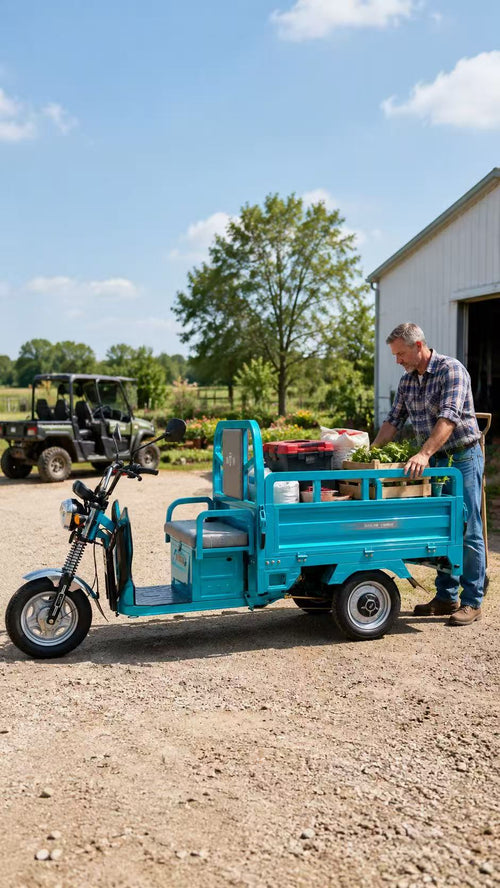
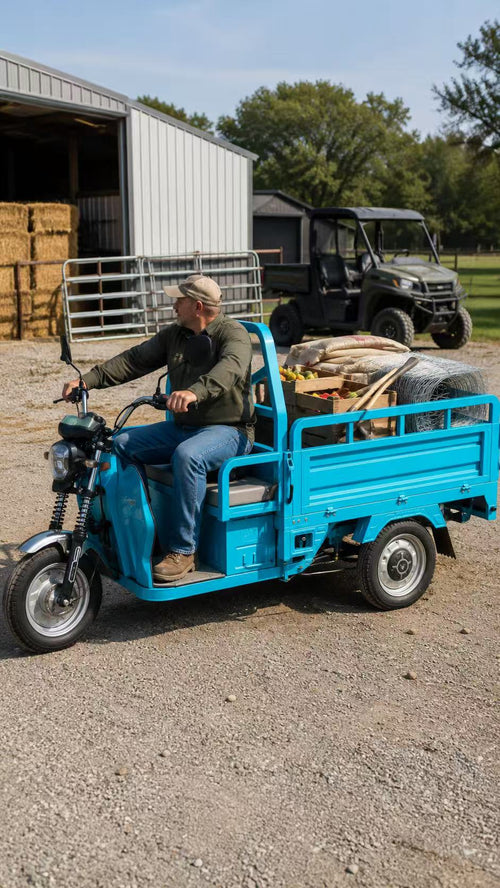
It can help move produce crates, empty boxes, packaging materials, cleaning supplies, tools, and small market loads across short internal routes.
The goal is not high speed.
The goal is faster movement inside a controlled market area.
The Real Problem Is Repeated Short Trips
Many produce market jobs are not difficult because of one single heavy load. They become difficult because the same task is repeated again and again.
One trip may be simple.
Ten trips may slow down the whole morning.
Twenty trips may take time away from selling, packing, cleaning, and serving customers.
This is why powered short-distance transport can be useful.
A compact electric cargo trike can help reduce repeated hand carrying and cart pushing. It can keep supplies organized in the cargo bed and help workers move from one work zone to another with less effort.
For fruit vendors, vegetable sellers, wholesale produce teams, farmers market vendors, and small distributors, this can make daily movement smoother.
What Can Be Moved in a Produce Market?
A produce market transport setup may be used for many practical items, such as:
fruit crates
vegetable boxes
empty cartons
plastic bins
packaging supplies
scales and small tools
cleaning supplies
ice containers
market display materials
farmers market supplies
fresh produce moving from storage to stall areas
The cargo should be loaded in a balanced way. Produce crates should not be stacked too high or loaded beyond the rated working capacity of the equipment.
Fresh products can be damaged by careless loading, sudden movement, or overstacking. Buyers should think about both transport efficiency and product protection.
A good setup should make movement easier without damaging the products being moved.
Why Narrow Market Lanes Matter
Many markets do not have wide open space.
A worker may need to move through narrow internal routes between stalls, storage areas, and loading zones. Large equipment can be difficult to use in these areas.
A compact electric cargo trike may be easier to position in tight spaces than a full-size truck or large utility machine. It can support short internal movement without taking up too much space.
This is especially useful in:
produce wholesale markets
farmers markets
fresh food markets
small distribution yards
market storage areas
packing and sorting areas
vendor loading zones
private commercial work areas
The key is controlled use.
The equipment should be used where the route is predictable, the speed is low, and workers can manage loading and unloading safely.
Not a Public-Road Product
Buyers should not think of this equipment as a public-road vehicle.
For produce market use, the better way to understand it is as low-speed electric transport work equipment for private-site material movement.
It is most suitable for controlled work areas such as market lanes, storage yards, private loading areas, warehouse-adjacent zones, and farmers market support spaces.
If a buyer plans to use any equipment outside private property or controlled work areas, they should check local rules before purchase and operation.
The best fit is internal movement, not road transportation.
Why It Can Be Better Than Hand Carts for Some Work
Hand carts are useful and low-cost. But they depend on human effort.
When produce crates, boxes, and supplies need to move all day, a hand cart may become slow and tiring. Workers may spend too much time pushing, pulling, turning, unloading, and walking back for the next load.
A compact electric cargo trike can reduce some of that repeated effort.
It can help workers carry a moderate load in the cargo bed, move across short distances, and return for the next task more efficiently.
This does not mean every produce market needs powered equipment. A small stall with only a few boxes may still use hand carts. But when movement is repeated every day, powered short-distance transport becomes easier to justify.
When a Compact Electric Cargo Trike Makes Sense
This type of electric transport work equipment may make sense when:
workers move produce crates many times per day
the market route is short but repeated
the work area is private or controlled
large trucks are too much for internal movement
hand carts are becoming too slow
the cargo bed can hold the typical load safely
the operator can load and unload carefully
the business wants a lower-cost support tool for daily movement
It is especially useful when the work involves many small and medium loads rather than one very large load.
A compact electric cargo trike is not a heavy machine. It is a practical support tool for repeated movement.
Where Buyers Should Be Careful
Produce market buyers should avoid overloading the equipment.
Fresh produce can be dense. A few crates of vegetables or fruit can become heavy quickly. Buyers should consider actual weight, not only cargo volume.
They should also avoid stacking unstable loads too high. A stable, balanced load is safer for the operator and better for the produce.
Wet areas should also be handled carefully. Produce markets may have water, cleaning areas, ice, mud, or slippery surfaces. Operators should drive slowly, avoid sudden turns, and keep the equipment clean after use.
If the work area includes steep slopes, deep mud, public traffic, extreme loads, or uncontrolled movement, a different type of equipment may be needed.
Why Electric Power Fits Market Work
Electric transport work equipment can fit produce market environments because the work is usually short-distance and repetitive.
The operator does not need high speed.
The operator does not need long-range travel.
The operator needs simple movement between loading, storage, stall, and packing areas.
Electric operation also avoids gasoline fumes in crowded work areas and can reduce noise compared with many gas-powered machines.
For markets, small warehouses, produce distributors, and farmers market support teams, this can be useful.
The equipment can be charged between work periods and used for repeated internal trips during the day.
What Buyers Should Compare Before Ordering
Before buying a compact electric cargo trike for produce market transport, buyers should ask:
What materials will be moved most often?
How many trips happen in a normal day?
Are the routes narrow or crowded?
Is the surface firm enough?
Is the work area private or controlled?
How heavy are the typical crates or boxes?
Does the cargo bed size fit the normal load?
Can workers load and unload safely?
Will this reduce repeated walking or cart pushing?
Is a compact electric tool enough, or is a larger machine needed?
These questions help buyers avoid choosing the wrong equipment.
The right choice depends on daily movement, not just product photos or maximum specifications.
Final Thought
Produce markets do not always need larger machines for every short trip.
Many daily tasks involve moving crates, boxes, tools, supplies, and fresh products across short internal routes.
A compact electric cargo trike can help make that movement faster and less tiring when the work is repeated throughout the day.
It should be understood as low-speed electric transport work equipment for private-site and controlled market movement, not as a public-road vehicle or heavy machine.
For produce vendors, farmers market teams, small distributors, and wholesale market operators, the question is simple:
Are workers spending too much time carrying, pushing, and walking inside the market?
If the answer is yes, a compact electric cargo trike may be a practical tool for moving produce crates faster inside busy market areas.