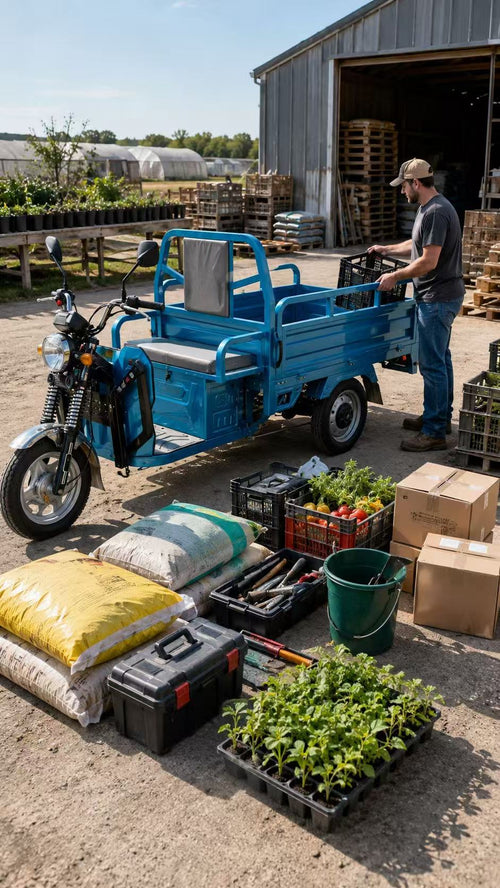
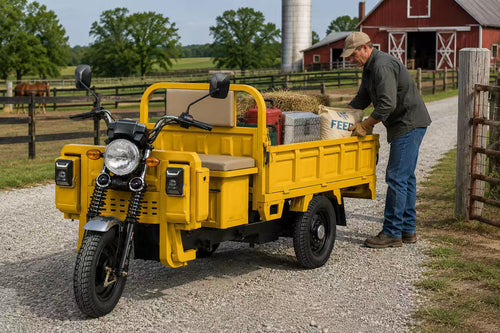
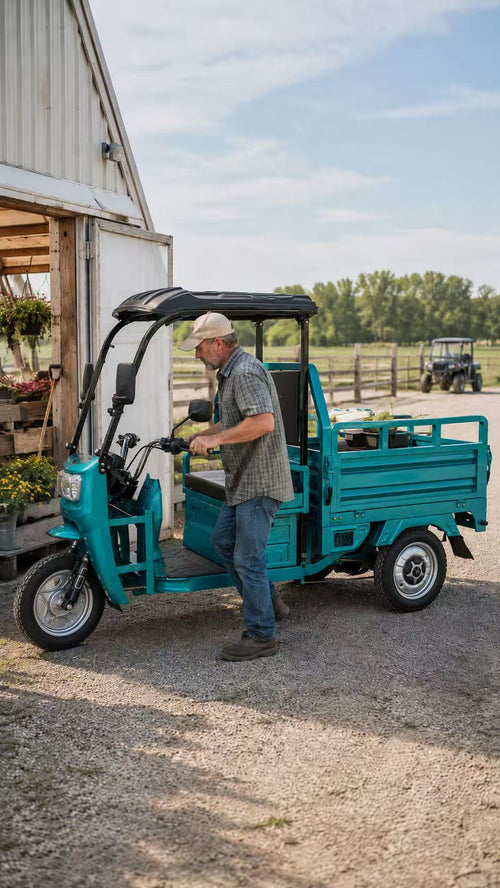
Can a Local Repair Shop Service an Electric Cargo Trike?
Share
For many buyers, the biggest concern is not whether an electric cargo trike can carry tools, feed, produce, packages, or building materials. The real concern is what happens after the purchase:
Can a local repair shop service an electric cargo trike?
In most cases, the answer is yes.
An electric cargo trike is not built like a modern electric car with highly integrated computer systems, specialized body electronics, and manufacturer-only diagnostic equipment. Most electric utility trikes use relatively straightforward components, including a battery pack, charger, motor, controller, throttle, brake cutoff switches, wiring harness, lights, tires, brakes, bearings, and mechanical cargo-bed parts.
This means many routine repairs can be handled by a local e-bike repair shop, golf cart repair shop, electric scooter technician, motorcycle repair shop, farm equipment technician, small equipment mechanic, or qualified electrical technician.
The most important factor is not whether a repair shop has worked on the exact same brand before. The more important question is whether the technician understands low-voltage electric vehicle systems, mechanical brakes, wiring connections, battery charging systems, and component replacement.
For buyers searching online for “electric cargo trike repair near me” or “electric tricycle repair near me,” the best local option may not be listed under the exact words “cargo trike repair.” A nearby golf cart service center, e-bike repair shop, utility cart technician, or farm equipment mechanic may already have the skills needed to complete the work.
This guide explains which repairs can usually be completed locally, what type of repair shop to contact, how common electrical problems should be diagnosed, and how a responsible seller should support both the customer and the local technician.
Is an Electric Cargo Trike as Complicated to Repair as an Electric Car?
No. An electric cargo trike is generally much simpler than a road-going electric car.
Electric cars often contain high-voltage battery systems, complex cooling circuits, computerized modules, proprietary software, advanced safety systems, and manufacturer-controlled diagnostic tools. Repairing them may require special training and dedicated equipment.
An electric cargo trike usually has a simpler electrical and mechanical layout.
Its main systems normally include:
Battery pack
Battery management system, commonly called the BMS
Battery charger
Electric motor
Motor controller
Throttle
Brake cutoff switches
Main wiring harness
Lighting system
Mechanical or hydraulic brakes
Suspension, wheels, tires, bearings, and frame components
Cargo box, tailgate, and hydraulic dump system where equipped
Because these systems are relatively independent, a technician can often inspect one section at a time. If a vehicle has no power, the technician can test the battery, main fuse, ignition switch, connectors, brake cutoff switches, controller input, and motor output in a logical sequence.
This makes electric cargo trike repair closer to servicing an e-bike, golf cart, electric utility cart, mobility vehicle, or light farm machine than repairing a modern passenger car.
The technician may not immediately recognize every connector or controller model. However, the seller can provide wiring diagrams, replacement part specifications, photographs, testing instructions, and compatible components.
What Type of Local Repair Shop Should You Contact?
When buyers search for “where to repair an electric cargo trike” or “who repairs electric cargo trikes,” they often assume they must find a shop dedicated exclusively to three-wheel cargo vehicles.
That is usually unnecessary.
The best repair option depends on the type of problem.
E-Bike Repair Shops
A well-equipped e-bike repair shop may be able to handle:
Throttle replacement
Brake sensor adjustment
Wiring inspection
Connector repair
Display replacement
Basic controller diagnosis
Charging-port replacement
Lighting problems
Mechanical brake service
Tire and tube replacement
Some e-bike shops may be hesitant to work on a large commercial cargo trike because of its size or weight. Before transporting the vehicle, send photographs, specifications, and a short description of the problem.
Golf Cart and Electric Utility Cart Repair Shops
A golf cart repair shop can be one of the best choices for electric utility cart repair near you.
Golf cart technicians regularly work with:
Battery-powered vehicles
Chargers
Controllers
Motors
Solenoids
Low-voltage wiring
Throttle systems
Brake systems
Wheel bearings
Suspension parts
Utility vehicle accessories
Although an electric cargo trike is not a golf cart, many of the diagnostic principles are similar. A technician familiar with electric carts can often test the battery voltage, controller signals, motor continuity, wiring connections, and charger output.
Motorcycle and Scooter Repair Shops
A motorcycle, moped, or electric scooter repair shop may be suitable for:
Brake repair
Tire replacement
Wheel alignment
Steering components
Throttle replacement
Lighting systems
Bearings
Suspension
Mechanical frame components
Some motorcycle technicians also have experience with electric conversions and low-voltage controllers.
Farm Equipment and Small Equipment Technicians
For electric work vehicles used on farms, nurseries, warehouses, construction sites, or private property, a farm equipment technician or small machinery mechanic may be a practical choice.
These technicians often understand:
Utility vehicle frames
Cargo beds
Hydraulic systems
Wheel hubs
Bearings
Brakes
Steering systems
Electrical connectors
Switches and relays
Mechanical welding and reinforcement
For a hydraulic dump utility vehicle, a farm equipment or hydraulic technician may be more suitable than a bicycle shop when the issue involves the lifting cylinder, hydraulic pump, hoses, switches, or cargo-bed hinge system.
Mobile Mechanics and Independent Electrical Technicians
A mobile mechanic may be useful when the vehicle is difficult to transport.
A qualified electrical technician can often assist with:
Voltage testing
Continuity testing
Damaged connectors
Loose wiring
Corrosion
Fuse replacement
Switch testing
Charging-port problems
Controller input and output checks
Before hiring any technician, explain that the vehicle is a low-speed electric cargo trike intended for work on farms, warehouses, private properties, markets, facilities, or similar controlled environments.
What Routine Repairs Can Be Handled Locally?
Most everyday maintenance and wear-related repairs do not require the vehicle to be returned to the factory.
Local technicians can usually perform the following work.
Tires and Inner Tubes
Tire wear, punctures, damaged valve stems, and inner-tube replacement are routine mechanical jobs.
A motorcycle, scooter, utility vehicle, or e-bike repair shop can often complete this work. The technician should confirm the tire size, load rating, tread pattern, and valve type before ordering replacements.
Brake Adjustment and Brake Pad Replacement
Brakes require periodic inspection, especially when the vehicle carries heavy loads or operates on slopes.
Typical brake service includes:
Brake cable adjustment
Hydraulic brake bleeding where applicable
Brake pad replacement
Drum or disc inspection
Brake lever adjustment
Parking-brake adjustment
Brake cutoff switch testing
A brake problem may also affect the electrical system. Many electric trikes use brake cutoff switches that stop motor power when the brake lever is activated. If one of these switches sticks in the active position, the motor may not run even though the mechanical brake appears normal.
Wheel Bearings, Hubs, and Axles
A local mechanic can normally inspect and replace:
Wheel bearings
Hub bearings
Axle hardware
Seals
Spacers
Wheel nuts
Damaged rims
These components should be checked more frequently when the vehicle operates with heavy loads, on uneven ground, or in wet and dusty environments.
Lights, Switches, and Connectors
Headlights, brake lights, turn signals, horns, ignition switches, and control switches are generally replaceable components.
Many electrical failures are caused by:
Loose plugs
Damaged terminals
Pinched wires
Water inside connectors
Corrosion
Blown fuses
Broken switches
A technician should inspect the connector and wiring before replacing the entire component.
Throttle and Brake Sensor Replacement
A faulty throttle can cause intermittent acceleration, no response, or unstable motor power.
However, the throttle should not be replaced until the technician confirms that it is receiving the correct voltage and sending the correct output signal.
Brake sensors should also be tested because an active brake cutoff signal can prevent the controller from powering the motor.
Cargo Bed, Tailgate, and Frame Repairs
A welding shop, fabrication shop, farm mechanic, or utility vehicle technician can often repair:
Tailgate hinges
Cargo-bed latches
Side panels
Mounting brackets
Frame hardware
Protective rails
Welded joints
Minor structural damage should be inspected promptly, especially when the vehicle regularly carries dense or shifting loads.
Hydraulic Dump System Service
On a hydraulic dump electric cargo trike, local hydraulic or farm equipment shops may be able to repair:
Hydraulic switches
Wiring to the pump
Loose terminals
Pump motors
Hydraulic hoses
Cylinder seals
Hinge points
Mounting pins
Low hydraulic fluid
The technician should first determine whether the problem is electrical, hydraulic, or mechanical.
A dump bed that does not lift may be caused by a weak battery, blown fuse, damaged switch, loose cable, failed relay, pump problem, hydraulic leak, overloaded cargo bed, or binding hinge.
Does Loss of Power Always Mean the Controller Has Failed?
No.
“Electric trike controller problems” is a common search because the controller is often blamed whenever a trike loses power. In reality, many no-power conditions are caused by something outside the controller.
Before replacing the controller, a technician should check:
Battery voltage
Battery state of charge
Main fuse or circuit breaker
Ignition switch
Emergency stop switch if equipped
Battery connector
Main wiring harness
Throttle signal
Brake cutoff switches
Motor connectors
Display error codes
Controller power input
Ground connections
Signs of water entry or overheating
A loose connector can interrupt power to the motor. A corroded terminal can create resistance and heat. A damaged brake sensor can continuously tell the controller that the brakes are applied. A weak battery may show voltage without maintaining sufficient voltage under load.
The controller should only be replaced after the technician confirms that it receives correct battery voltage and control signals but does not provide the correct output to the motor.
Common Signs of a Possible Controller Problem
Possible controller symptoms include:
The battery is charged, but the motor does not respond
The throttle signal is correct, but there is no motor output
The vehicle cuts out repeatedly under normal load
The controller becomes unusually hot
There is a burning smell or visible electrical damage
The controller has water damage
An error code points directly to the controller
Even then, the wiring and motor should be checked before installing a replacement controller.
Why Correct Controller Matching Matters
A replacement controller must match the vehicle’s electrical system.
Important specifications may include:
System voltage
Motor power rating
Motor type
Current limit
Throttle voltage
Brake cutoff type
Display communication
Reverse function
Speed settings
Connector configuration
Installing a controller with the wrong voltage, current rating, communication protocol, or wiring layout can damage the controller, motor, display, or battery system.
The seller should provide the correct replacement part rather than expecting a local technician to guess.
Does a Motor That Will Not Run Always Need Replacement?
No.
When someone searches “electric trike motor not working,” the actual problem may be located in the battery, controller, brake sensor, throttle, wiring, connector, fuse, or BMS.
A motor should not be replaced until the surrounding electrical system has been tested.
A useful diagnostic sequence is:
Confirm that the battery is charged.
Measure battery voltage at rest.
Measure battery voltage while the throttle is applied.
Inspect the main fuse and power switch.
Check whether a brake cutoff switch is active.
Test the throttle input and output signal.
Inspect the controller power supply.
Check motor cable connections.
Inspect connectors for heat, corrosion, loose pins, or water.
Test motor phases and sensor wires where applicable.
Check the controller output.
A weak battery may power the lights and display but fail when the motor demands current. This can make the motor appear defective even though the battery is the actual problem.
A loose phase-wire connector may cause jerking, vibration, noise, or complete loss of drive. A hall-sensor issue may create difficult starting, uneven power, or error codes. A damaged brake sensor may stop the controller from sending power to the motor.
Possible Signs of a Motor Problem
A motor problem becomes more likely when:
The motor has visible physical damage
There is a burnt smell from the motor
The motor becomes excessively hot under light use
Internal grinding or scraping is present
Motor windings fail electrical tests
Hall sensors fail testing
The motor cable is damaged at the axle
The motor receives correct controller output but does not turn
The wheel is mechanically locked
Some motor failures can be repaired. In other cases, complete motor replacement may be more practical because it reduces labor time and provides a more predictable result.
Does a Battery That Will Not Hold a Charge Always Need Replacement?
No.
“Electric trike battery not holding charge” can describe several different conditions.
The battery may not be receiving a charge.
The battery may charge but lose energy quickly.
The charger may be defective.
The charging port may be damaged.
A connector may be loose or dirty.
The BMS may have entered protection mode.
Cold or hot temperatures may temporarily reduce performance.
The battery cells may be aging.
The first step is to identify the exact symptom.
The Charger Does Not Turn On
The wall outlet
Power strip or extension cord
Charger input cable
Charger output plug
Charger fuse if equipped
Indicator lights
Visible cable damage
A failed outlet or charger can be mistaken for a failed battery.
The Charger Turns On but the Battery Does Not Charge
Check:
Charging-port condition
Connector alignment
Dirty or corroded pins
Loose wires behind the port
Battery switch position
Battery fuse
Charger output voltage
BMS protection state
Battery temperature
A local technician should measure charger output and battery voltage before recommending replacement.
The Battery Charges Fully but Range Has Decreased
A reduction in range may result from:
Normal cell aging
Frequent deep discharge
Heavy loads
Low tire pressure
Cold weather
Steep terrain
Repeated hard acceleration
Brake drag
Wheel-bearing resistance
Long storage at a very low charge
High storage temperatures
Aging batteries usually lose capacity gradually. The vehicle may continue operating, but usable distance becomes shorter.
Battery life cannot be predicted only by calendar age. It depends on charging cycles, storage temperature, discharge depth, operating load, charger quality, and maintenance habits.
The Battery Shows Voltage but the Vehicle Shuts Down Under Load
This condition may indicate:
Weak battery cells
A BMS protection event
A loose high-current connector
Excessive voltage drop
Battery overheating
A controller current issue
A technician should compare resting voltage with voltage under load. A battery may look normal without load but drop sharply when the motor draws current.
When Is Battery Replacement Appropriate?
Replacement becomes more practical when:
The battery cannot reach its normal charging voltage
Capacity has fallen below the customer’s working requirement
The battery repeatedly shuts down under normal load
The battery case is swollen or damaged
There are burnt connectors or internal damage
The BMS or cells cannot be safely repaired
Water has entered the battery enclosure
A qualified technician confirms significant cell imbalance or degradation
Damaged lithium batteries should not be opened or repaired by an untrained person. Battery work should be handled by qualified technicians with appropriate tools and safety procedures.
When Is Component Replacement More Practical Than Repair?
Electric cargo trikes are often designed around replaceable modules.
Instead of rebuilding a severely damaged controller, charger, throttle, display, switch, or motor, it may be faster and more reliable to install a compatible replacement part.
Component replacement is often practical when:
The part is sealed and not designed for field repair
Labor cost would exceed replacement cost
The component has water or heat damage
Internal electronics are burnt
The part cannot be repaired reliably
The seller has an exact compatible replacement
The vehicle needs to return to work quickly
This modular repair approach is common in e-bikes, golf carts, electric utility vehicles, warehouse equipment, and light electric work vehicles.
The technician still needs to diagnose the original cause. Installing a new controller without repairing a shorted wire, damaged motor cable, or incorrect battery connection may damage the new controller.
What Support Should the Seller Provide to the Local Technician?
A local technician may understand the repair process but still need vehicle-specific information.
A responsible seller should provide:
Vehicle model identification
System voltage
Motor power rating
Battery specifications
Charger specifications
Controller label and connector information
Wiring diagrams where available
Photographs or videos showing component locations
Testing steps
Error-code information
Replacement part identification
Installation guidance
Technical communication during diagnosis
Warranty confirmation where applicable
The customer should not be expected to explain a complicated electrical problem alone.
The seller can communicate directly with the local repair technician, review photographs and test results, identify the likely component, and arrange the correct replacement part.
This creates a practical service model:
The customer finds or recommends a trusted local technician.
The seller provides technical information.
The technician performs inspection and diagnosis.
The seller confirms warranty coverage.
The seller supplies an approved replacement part when required.
The local technician completes the repair.
The vehicle returns to service without being shipped long distances.
How OneClick China Coordinates Local Repair and Warranty Support
OneClick China uses a local repair coordination model for electric cargo trikes and electric work vehicles sold to customers in the United States.
Because customers may live in different states, agricultural areas, small towns, or industrial regions, it is not always practical to rely on one centralized repair location.
Instead, the service process is designed around local support.
Step 1: The Customer Reports the Problem
The customer provides:
Vehicle model
Photographs
Short videos
Description of the symptoms
When the problem started
Whether the vehicle still powers on
Any error code
Battery and charger behavior
Recent operating conditions
Clear information helps avoid unnecessary part replacement.
Step 2: Initial Remote Troubleshooting
Many problems can be identified through basic checks, including:
Loose connectors
Brake cutoff activation
Blown fuses
Charging-port problems
Damaged switches
Incorrect operating sequence
Low battery voltage
Visible wiring damage
Minor adjustment issues
The customer should not dismantle high-current components unless qualified to do so.
Step 3: A Local Technician Is Selected
The customer may recommend a nearby technician they already trust.
Suitable service providers may include:
Golf cart repair shops
E-bike repair shops
Motorcycle or scooter repair shops
Farm machinery technicians
Small equipment mechanics
Utility vehicle service centers
Hydraulic repair shops
Mobile mechanics
Electrical technicians
Welding and fabrication shops
The best choice depends on whether the issue is electrical, mechanical, hydraulic, or structural.
Step 4: Technical Information Is Shared
OneClick China can provide the technician with available diagrams, component photographs, part specifications, testing guidance, and installation information.
This is especially important for controller, motor, battery, charger, throttle, wiring, and hydraulic system diagnosis.
Step 5: Warranty Responsibility Is Confirmed
Warranty coverage depends on the product, component, cause of failure, operating conditions, and applicable warranty terms.
For covered failures, OneClick China can coordinate the required replacement parts and approved repair work.
Normal maintenance and wear items are generally the owner’s responsibility. These may include tires, brake pads, routine adjustments, bulbs, damage caused by accidents, improper use, overloading, water exposure, unauthorized modifications, or neglected maintenance.
Step 6: The Vehicle Is Repaired Locally
Once the problem and required part are confirmed, the local technician completes the repair.
This approach reduces unnecessary transportation, shortens downtime, and allows customers to work with a nearby service provider.
How to Help a Local Technician Diagnose the Vehicle Faster
Before contacting a repair shop, prepare the following information:
A photograph of the full vehicle
A photograph of the product label
A photograph of the battery label
A photograph of the controller label
A photograph of the charger label
A short video showing the problem
Any display error code
Battery voltage if safely measured
Details of any recent impact, water exposure, overload, or wiring work
A description of sounds, smells, heat, or intermittent behavior
This information helps the technician determine whether the problem is related to the electrical drive system, battery, charging system, brakes, wheels, hydraulic system, or structure.
Preventive Maintenance That Reduces Repair Problems
Regular inspection can prevent many service issues.
Battery and Charging System
Use the correct charger.
Keep the charging port clean and dry.
Do not charge through damaged connectors.
Avoid storing the battery completely discharged.
Inspect cables for heat, cuts, and loose terminals.
Follow storage recommendations during long periods of non-use.
Do not open the battery pack without proper qualifications.
Wiring and Electrical Connections
Inspect visible connectors regularly.
Protect wiring from sharp edges.
Keep plugs fully seated.
Check for corrosion after wet operation.
Do not pressure-wash electrical components.
Repair damaged insulation promptly.
Brakes
Check braking performance before carrying heavy loads.
Inspect brake pads and cables.
Confirm that the parking brake releases fully.
Check whether a brake cutoff switch remains activated.
Adjust brakes before they begin dragging.
Tires and Wheels
Maintain correct tire pressure.
Inspect tread and sidewalls.
Tighten wheel hardware.
Check wheel bearings for play or noise.
Avoid operating with damaged rims.
Cargo Bed and Frame
Inspect hinges, latches, mounting bolts, welds, and pivot points.
Do not exceed the rated payload.
Distribute cargo evenly.
Secure loads that may shift.
Keep hydraulic pivot points clean and lubricated where specified.
Hydraulic Dump System
Inspect hoses and fittings.
Watch for fluid leaks.
Keep the hinge area clear.
Do not operate the dump bed with an unstable or excessive load.
Check electrical connections to the pump and switch.
Stop operation if the system makes abnormal noise.
Frequently Asked Questions
Can a bicycle shop repair an electric cargo trike?
Some e-bike repair shops can handle electrical controls, throttles, brakes, wiring, tires, lights, and charging problems. However, not every bicycle shop has space or lifting equipment for a large commercial trike. Contact the shop first and send photographs and specifications.
Can a golf cart repair shop service an electric cargo trike?
Often, yes. Golf cart technicians are familiar with batteries, chargers, controllers, motors, electrical wiring, brakes, and low-speed utility vehicles. They may be a strong option for electric utility cart repair near you.
Can a motorcycle shop repair an electric tricycle?
A motorcycle or scooter shop may handle tires, brakes, wheels, bearings, suspension, steering, lights, throttle assemblies, and mechanical components. Electrical capability varies by shop.
Who can repair a hydraulic dump cargo trike?
A farm equipment technician, hydraulic repair shop, utility vehicle mechanic, welding shop, or qualified electrical technician may be appropriate. The correct choice depends on whether the problem involves the pump, cylinder, hoses, wiring, switch, frame, or cargo-bed hinge.
What should I do when the electric trike has no power?
Check the battery charge, main power switch, emergency stop switch, fuse, battery connector, brake cutoff switches, and visible wiring. If the cause is not obvious, stop further disassembly and contact the seller or a qualified technician.
Does a motor that will not run mean the motor is broken?
No. The problem may be caused by the battery, BMS, controller, throttle, brake sensor, fuse, wiring, connector, or display system. A technician should diagnose the complete power circuit before replacing the motor.
Why does my electric trike stop when I accelerate?
Possible causes include a weak battery, voltage drop, loose high-current connection, BMS protection, controller overheating, damaged wiring, excessive load, brake drag, or motor problems.
Why is the electric trike battery not holding a charge?
The cause may be the charger, outlet, charging port, connector, battery fuse, BMS, temperature, or aging cells. Charger output and battery voltage should be tested before replacing the battery.
Can a local technician install replacement parts supplied by the seller?
Yes. This is often the most practical repair method. The seller should provide the correct compatible component and installation information. The local technician should confirm the original cause before installing the new part.
Does the vehicle need to be shipped back for every warranty repair?
Usually not. Many repairs can be completed locally with technical support and replacement parts. The exact process depends on the fault, technician availability, warranty terms, and the type of repair required.
What is the best way to find electric cargo trike repair near me?
Search for several related service categories rather than only one phrase:
Electric cargo trike repair near me
Electric tricycle repair near me
Golf cart repair near me
Electric utility cart repair near me
E-bike repair shop
Electric scooter repair
Farm equipment repair
Mobile mechanic
Small equipment repair
Hydraulic repair shop
Then contact the shop, describe the vehicle, send photographs, and ask whether it can inspect a low-speed electric cargo trike.
Final Answer: Local Repair Is Usually Practical
A local repair shop can usually service an electric cargo trike, provided the technician has the appropriate electrical, mechanical, or hydraulic skills.
The exact shop depends on the problem.
An e-bike technician may be best for throttle, wiring, display, brake sensor, and basic controller issues.
A golf cart repair shop may be best for batteries, chargers, controllers, motors, and electric utility vehicle systems.
A motorcycle or scooter technician may be best for brakes, tires, bearings, wheels, and steering.
A farm equipment or hydraulic technician may be best for dump beds, frames, pumps, cylinders, hinges, and heavy-duty mechanical parts.
The seller remains an important part of the repair process. Local service works best when the seller provides accurate parts, technical information, testing guidance, and clear warranty coordination.
For OneClick China customers, the goal is not to force every vehicle to return to a distant service center. The goal is to coordinate with a qualified local technician, provide the required support, and return the electric cargo trike to work as efficiently as possible