Do Small Farms Really Need a Gas UTV for Daily Material Movement?
Share
Many small farm buyers start with one familiar idea:
Maybe I need a gas UTV.
That thought makes sense. Gas UTVs are common on farms, ranches, large rural properties, and outdoor worksites. They can handle rough ground, carry people, tow equipment, move across long distances, and work in many demanding conditions.
But not every farm job needs a gas UTV.
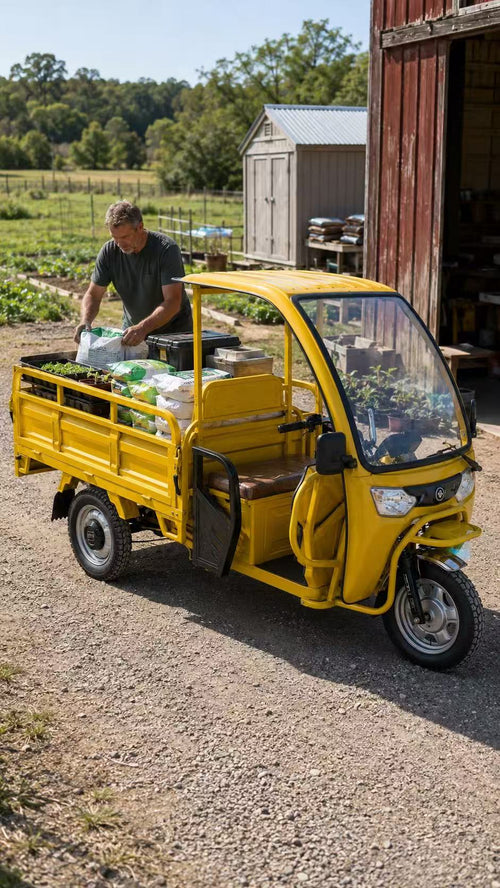
Many daily farm tasks are smaller, slower, and more repetitive than buyers realize. A worker may need to move feed bags from storage to a barn, tools from a shed to a repair area, harvest crates from a field edge to a packing table, or small supplies between work zones.
These jobs are important, but they may not require a high-cost gas machine every time.
For small farms, homesteads, greenhouses, orchards, nurseries, and private rural properties, the better question is not always:
What is the strongest machine I can buy?
The better question is:
What kind of movement happens every day?
If the real job is repeated short-distance material movement, a compact electric work trike may make more sense than many buyers first expect.
Gas UTVs Are Useful, But They Are Not Always Necessary
A gas UTV can be a strong tool.
It may be the right choice when the buyer needs long-distance property travel, towing, rough terrain capability, multiple passengers, high ground clearance, or heavier off-road work.
For some farms, a UTV is worth the cost.
But small farms often have many jobs that are not really UTV-level jobs.
A worker may only need to move a few feed bags, crates, buckets, tools, fencing supplies, garden supplies, small repair parts, or harvest boxes across a short internal route.
The distance may be 200 feet, 500 feet, or a few minutes across the property.
The work may happen many times during the day, but each load may not require a full gas UTV.
That is where buyers should slow down and think carefully.
A UTV may be powerful, but power is not the only buying factor.
Cost, maintenance, fuel, storage, route size, load type, and daily use pattern all matter.
The Real Farm Question: What Happens Every Day?
Many buying mistakes happen when people choose equipment based on the largest possible job instead of the most common daily job.
A small farm may occasionally need a large machine.
But what happens every day?
Do workers move feed bags?
Do they move tools?
Do they move produce crates?
Do they move soil bags, mulch, compost, buckets, irrigation parts, or fencing supplies?
Do they travel across short private routes between a barn, shed, greenhouse, field edge, storage area, and packing zone?
Do they repeat these trips many times?
If yes, the farm may need a daily material movement tool more than a full gas UTV for every trip.
A compact electric work trike is not designed to replace every UTV. It is designed to support repeated short-distance hauling inside private farms and controlled work areas.
That difference is important.
Short-Distance Material Movement Is Its Own Job
Short-distance material movement may look simple, but it creates real labor.
A worker may walk back and forth carrying small loads. A wheelbarrow may be used for one or two trips, but repeated pushing becomes tiring. A hand cart may work on smooth ground, but it can still slow the worker down when trips keep repeating.
A pickup truck or gas UTV may be more machine than the task needs.
A compact electric work trike can fill the middle position.
It is stronger than hand carrying.
It is easier than repeated wheelbarrow use.
It is smaller and simpler than many gas-powered machines.
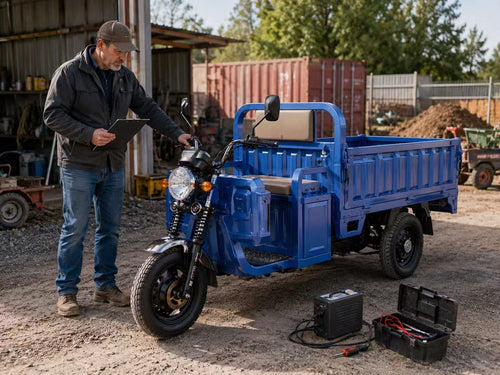
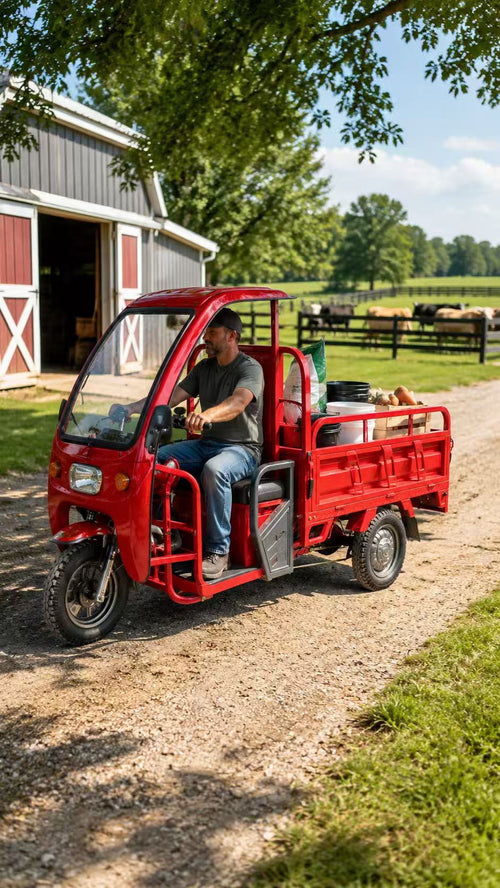
It can carry practical farm loads in the cargo bed and move slowly across private internal routes.
This is why the daily trip matters more than the biggest possible machine.
Where an Electric Work Trike Can Fit
A compact electric work trike can fit many small farm and property tasks, such as:
moving feed bags from storage to barns
carrying tools for fence repair
moving harvest crates to a packing area
transporting irrigation parts and small supplies
moving greenhouse trays or nursery materials
carrying buckets, hand tools, and maintenance items
moving small loads of soil, compost, or mulch
supporting orchard, garden, or homestead work
transporting market supplies before loading a truck
helping with repeated short trips across private property
The key is not extreme speed or large towing power.
The key is repeated movement.
If the same short route is used many times, low-speed electric transport work equipment can help reduce wasted walking, pushing, and unnecessary use of larger machines.
When a Gas UTV Is Still the Better Choice
This article is not saying that electric work trikes replace gas UTVs.
That would be wrong.
A gas UTV is still a better choice when the buyer needs:
higher off-road capability
longer property travel
passenger carrying
towing
steeper or rougher terrain
heavier-duty suspension
larger load capacity
higher speed
more power for difficult outdoor conditions
If those are daily needs, a gas UTV may be worth the higher cost.
A compact electric work trike should not be treated as a heavy-duty UTV replacement.
Its best role is different.
It is a low-speed electric transport work tool for moving materials inside private sites and controlled work areas.
That honest boundary helps buyers choose correctly.
When an Electric Work Trike May Make More Sense
An electric work trike may make more sense when the buyer’s work looks like this:
The route is short.
The work is repeated.
The load is moderate.
The work area is private or controlled.
The buyer mainly moves materials, not passengers.
The buyer does not need towing.
The buyer does not need high speed.
The buyer wants lower-cost support equipment for daily movement.
The buyer wants simpler electric operation.
The buyer wants a compact cargo bed for tools, crates, feed, and supplies.
This is common on small farms, ranches, homesteads, nurseries, greenhouses, orchards, and private rural properties.
The buyer does not always need the most powerful machine.
The buyer needs the right tool for the daily task.
Cost Is Not Only the Purchase Price
A gas UTV can cost much more than a compact electric work trike.
But the buying decision should not stop at purchase price.
Buyers should also think about fuel, maintenance, storage, insurance questions, repair complexity, and whether the machine is being used efficiently.
If a gas UTV is needed every day for serious farm work, it may be a smart investment.
But if most tasks are short internal material trips, the buyer may be paying for capability that is not used often.
That is where a lower-cost electric work trike can be practical.
It does not try to do every UTV job.
It focuses on the jobs that happen again and again: moving materials across short distances inside the work area.
Why Electric Operation Can Be Practical
Electric operation can be useful for small farm movement.
There is no gasoline engine to start for every short trip.
There is less noise than many gas machines.
There is no exhaust in barns, market prep areas, greenhouse zones, or tight workspaces.
Charging can usually be done near a barn, shed, shop, storage area, or utility space.
For private-site work, this simplicity can be valuable.
The equipment can be loaded, used for a short trip, unloaded, and parked again. It does not need to turn every small job into a larger machine operation.
This is especially useful when the farm has many short jobs spread throughout the day.
Do Not Choose by Maximum Power Alone
Many buyers compare machines by looking at maximum power, maximum load, maximum speed, or the biggest machine they can afford.
That is not always the best way to choose.
A farm tool should be matched to the real task.
If the daily task is towing across rough ground, buy equipment built for that.
If the daily task is moving feed bags, crates, tools, and supplies across short private routes, a compact electric work trike may be enough.
The goal is not to buy the most powerful machine.
The goal is to reduce wasted work.
For many small farms, that means choosing equipment that matches repeated daily movement, not occasional extreme use.
Reasonable Use Still Matters
An electric work trike should be used within its rated working load.
This is especially important when moving dense materials such as feed, soil, compost, gravel, sand bags, bricks, or wet materials.
A cargo bed may look like it can hold more because there is still space, but actual weight matters more than volume.
If equipment is designed for a certain working load, buyers should not repeatedly overload it beyond that range.
Overloading can increase stress on the battery, motor controller, motor, brakes, tires, bearings, frame, and cargo bed.
Reasonable use is part of long-term reliability.
A compact electric work trike can be useful for daily material movement, but it should not be abused like heavy construction equipment or a high-power UTV.
How Small Farm Buyers Should Decide
Before buying a gas UTV or compact electric work trike, buyers should ask practical questions:
What materials do we move every day?
How far do we move them?
How many trips happen in a normal day?
Do we need towing?
Do we carry passengers?
Do we need high speed?
Is the route private and controlled?
Is the ground firm enough?
Are the loads moderate and suitable for a cargo bed?
Would a smaller electric tool reduce repeated walking and carrying?
Would a gas UTV be used fully, or would it be oversized for most daily tasks?
These questions help buyers avoid choosing equipment only by habit.
A UTV may be the right answer for some farms.
An electric work trike may be the better answer for others.
The daily task should decide.
The Middle Ground Between Hand Labor and a Gas UTV
Many small farms do not need to choose only between hand labor and a gas UTV.
There is a middle ground.
That middle ground is compact electric transport work equipment.
It can help move materials more efficiently than hand carrying or repeated wheelbarrow use, while avoiding the cost and size of a larger gas-powered machine for every small task.
It is not the strongest tool on the farm.
It is not supposed to be.
It is the practical tool for the many small trips that happen every day.
That is where its value appears.
Final Thought
Small farms do not always need a gas UTV for daily material movement.
A gas UTV is useful when the work requires speed, towing, passengers, rough terrain, long distances, or heavier-duty capability.
But many daily farm tasks are simpler: move feed, tools, crates, supplies, repair materials, and small loads across short private routes.
For those jobs, a compact electric work trike can be a practical lower-cost support tool.
The question is not whether a gas UTV is stronger.
The question is whether your daily work actually needs one.
If most of the job is repeated short-distance material movement, smaller electric transport work equipment may be the smarter choice.