Small Batch Orders: Moving Partial Loads Inside Wholesale Markets
Share
Wholesale markets are not built only around full pallets, large truckloads, or high-volume buyers. Every day, many vendors also serve customers who buy in smaller quantities. These may include neighborhood grocery stores, restaurants, seafood shops, food trucks, convenience stores, market resellers, and small delivery operators. Their orders are often too large to carry by hand, but too small to justify a full forklift move.
This creates a common but often overlooked problem inside wholesale markets: how to move small batch orders and partial loads quickly, safely, and repeatedly throughout the day.
A small batch order may include several produce crates, a few seafood boxes, some frozen cartons, a group of meat cases, or a mixed combination of packaging supplies and daily stock items. From the customer’s point of view, this is a simple purchase. But from the vendor’s side, the order may require multiple short-distance trips between the stall, cold room, side storage area, aisle staging point, and loading area.
That is why partial load transport in wholesale markets deserves more attention.
For many vendors, the real issue is not whether the goods are available. The real issue is whether those goods can be brought together and moved efficiently without wasting labor, blocking aisles, or slowing down customer pickup. This is especially important in produce markets, seafood wholesale markets, meat supply areas, and restaurant supply centers, where order sizes change constantly and short-distance transport happens all day long.
Why Small Batch Orders Are Different from Large Wholesale Loads
Large orders usually follow a clearer handling path. They may be palletized, pre-staged, or moved with a forklift from a warehouse section to a truck loading point. The route is more predictable, the equipment is more obvious, and the load size justifies structured handling.
Small batch wholesale orders are different.
They often involve partial loads that are not palletized. The order may come from more than one location. The quantity may not be enough for forklift handling, but it still requires more effort than a single hand-cart trip. A worker may have to gather several produce crates from the stall, pick up additional cartons from a cold room, and then move the full order to the customer loading area.
This repeated short-distance movement creates labor pressure. It also creates time pressure when multiple buyers are waiting, especially during busy market hours. Even if each individual order looks small, the total number of trips can become a daily bottleneck.
That is why small load handling in wholesale markets should not be treated as a minor task. It is a real operating need, and vendors who handle it better can serve customers faster and keep internal movement more organized.
Where the Delay Usually Happens
The delay is often not in the sale itself. The customer may already know what they want. The vendor may have the goods ready. The issue begins once the order has to move from one point to another.
Common routes include:
* from a produce stall to the pickup lane
* from a seafood cold room to the loading area
* from a side storage corner to the customer vehicle
* from a packaging section to a mixed order staging area
* from one vendor aisle to another within the same market
The distance may only be short, but these routes happen over and over again. If workers rely only on manual pushing for every small order, the job becomes slower as traffic increases. If they wait for a forklift for every small move, the process becomes inefficient and unnecessary.
This is why many vendors need a practical middle solution for short-distance market transport.
Why Manual Carts Often Become the Bottleneck
Manual carts are useful and will always have a place in wholesale market work. They are simple, easy to access, and suitable for lightweight movement. But when a vendor is handling frequent small customer orders throughout the day, manual carts begin to show their limits.
A worker may need to move six produce crates on one trip, then return for seafood boxes, then go again for packaging materials. If the floor is wet, the aisle is crowded, or the goods are unevenly packed, the cart becomes harder to push and control. Each return trip costs time. Each extra trip adds labor fatigue.
The problem gets worse when the order is not heavy enough for large equipment, but too heavy or too repetitive for efficient manual movement. This is exactly where many market vendors lose time.
In busy produce and seafood markets, a vendor may serve many small buyers within a single morning. Restaurant owners, local resellers, food truck operators, and convenience-store buyers often place orders that are not large in volume but still require organized movement. If every order means repeated hand-cart runs, the market team spends more time transporting than selling.
That is not just a labor issue. It is also a customer service issue. When buyers wait too long for small batch orders, they may choose a faster supplier next time.
Why Forklifts Are Not Always the Right Answer
Forklifts play an important role in wholesale markets. They are useful for inbound receiving, pallet movement, warehouse handling, and larger truck-loading work. But they are not the best answer for every order.
Small batch orders usually do not justify full forklift use. Many partial loads are loose, mixed, or packed in smaller cartons and crates. The route may pass through active market aisles where turning space is limited. In customer-facing areas, a forklift may also create unnecessary congestion or safety pressure.
In some cases, the forklift may simply be busy with other work. It may be reserved for bulk loads, receiving jobs, or heavy-duty warehouse transport. Waiting for it to become available adds more delay to small order movement.
For that reason, vendors handling small batch orders in wholesale markets often need a more flexible tool—something faster and less tiring than manual carts, but smaller and more practical than a forklift.
This is where a compact electric cargo trike can fit naturally into the workflow.
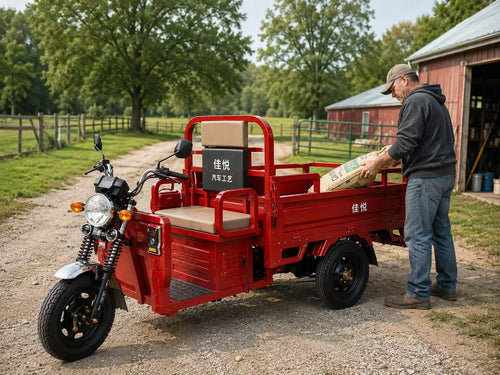
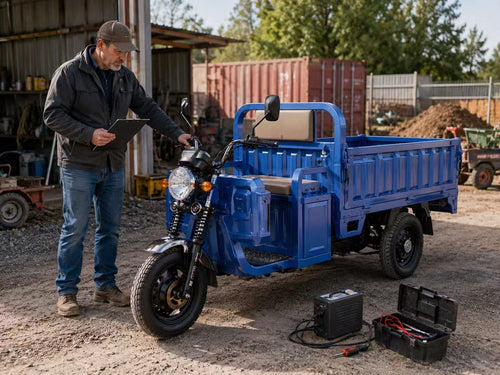
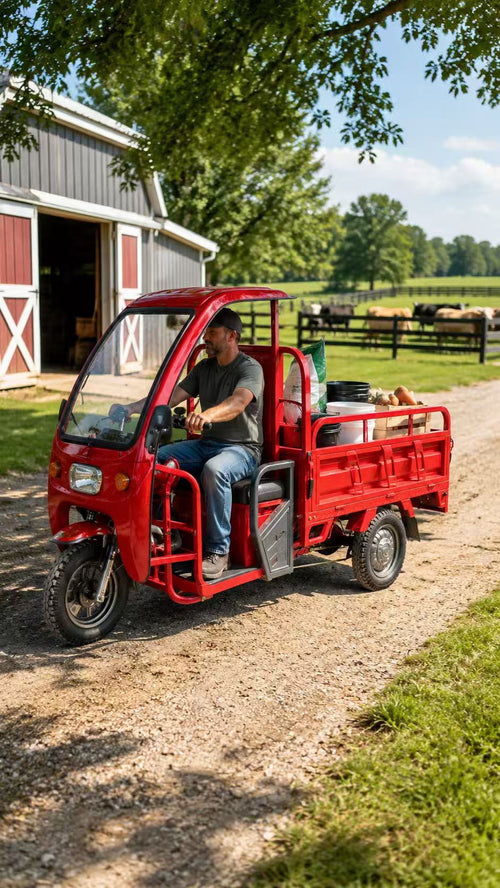
A compact electric cargo trike is not designed to replace every forklift, truck, or warehouse machine. Its value is different. It works as a wholesale market utility vehicle for repeated short-distance movement inside the market itself. It helps vendors transport partial loads between stalls, cold rooms, storage points, loading areas, and customer pickup zones with less repeated manual effort.
For vendors dealing with small customer orders, this can make daily operations smoother.
How a Compact Electric Cargo Trike Helps with Partial Load Transport
A compact electric utility vehicle is useful when the market team needs to move goods that are too frequent for hand carts and too small for forklift handling. It is especially practical for:
* produce crates
* seafood boxes
* frozen cartons
* meat cases
* packaging materials
* plastic bins
* foam boxes
* mixed daily orders
* restaurant supply cartons
* small restocking loads
The biggest benefit is not just carrying one bigger load. The biggest benefit is reducing the number of repeated manual trips. Instead of pushing several smaller cart runs, the vendor can move more goods in a steadier and more organized way.
This matters because small batch orders are often time-sensitive. A restaurant buyer may want to leave quickly. A reseller may need to continue to the next stop. A market vendor may already have the next customer waiting. Faster internal transport helps keep the entire workflow moving.
Why This Matters for Produce, Seafood, and Restaurant Supply Markets
In produce markets, customers often buy mixed quantities of fruits, vegetables, and packaged items. In seafood wholesale markets, orders may need to move quickly from chilled storage to pickup. In restaurant supply environments, the buyer may purchase a partial load of cartons, dry goods, containers, or cleaning supplies from different sections.
These are not giant warehouse shipments. They are working orders that happen repeatedly in real business conditions.
That is why long-tail search terms such as moving small customer orders inside a wholesale market, partial load transport in wholesale markets, produce market transport vehicle, and seafood market small order transport are meaningful. They reflect actual problems buyers and vendors face.
When a vendor has the right short-distance transport tool, the internal flow improves. The aisle stays clearer. Workers spend less time making back-and-forth trips. Orders come together faster. Customers wait less. The operation feels more controlled.
Choosing the Right Vehicle for Small Batch Orders
Not every market transport vehicle is suitable for wholesale market work. A vendor should think about the real route before choosing equipment.
Useful questions include:
* How wide are the aisles?
* How often do workers move partial loads each day?
* Are the goods packed in crates, cartons, or mixed boxes?
* Does the route pass through cold room access points or customer pickup lanes?
* Is the floor often wet or busy?
* Does the vendor need to serve many smaller buyers in one shift?
A practical wholesale market utility vehicle should match the actual layout and workflow. It should be compact enough for market movement, stable enough for loaded crates and cartons, and useful for repeated short-distance trips. In that middle zone between hand carts and forklifts, a compact electric cargo trike can be a strong fit.
A Better Solution for the Customers Vendors Actually Serve
The important point is this: not every wholesale customer buys in bulk. Many real buyers purchase partial loads. They still expect speed, accuracy, and efficient pickup.
If a vendor only plans around palletized handling, they may overlook the daily reality of smaller orders. But these smaller buyers are often loyal repeat customers. They may order every day, every week, or several times a week. Serving them well creates long-term business value.
That is why solving the small batch order problem is not just about internal efficiency. It is also about improving the buying experience.
When a vendor can move partial loads more smoothly inside a market, the customer notices. The pickup process becomes faster. The staff look more organized. The order feels more professional. This can support repeat business and strengthen trust.
Final Thought
Small batch orders are one of the most common and most underestimated workflows inside wholesale markets. They may not look dramatic like a large forklift job or a full truckload delivery, but they create constant short-distance transport demands throughout the day.
For many vendors, the challenge is clear: hand carts can be too slow under repeated loads, and forklifts can be too large or unnecessary for small orders. A compact electric cargo trike offers a practical middle solution.
As a wholesale market utility vehicle, it helps vendors move partial loads more efficiently, handle short-distance transport with less labor strain, and support the real needs of produce, seafood, meat, and restaurant supply customers.
In other words, if the question is how to move small customer orders faster inside a busy wholesale market, the answer is often not bigger equipment. The answer is more suitable equipment.