How Wholesale Markets Handle Truck-Bed Height Without a Loading Dock
Share
Wholesale markets do not always operate inside perfect warehouse conditions. Many seafood vendors, produce wholesalers, meat distributors, restaurant supply warehouses, and general merchandise sellers work from mixed spaces where trucks, cold rooms, storage areas, customer pickup zones, and vendor stalls are connected by short but difficult handling routes.
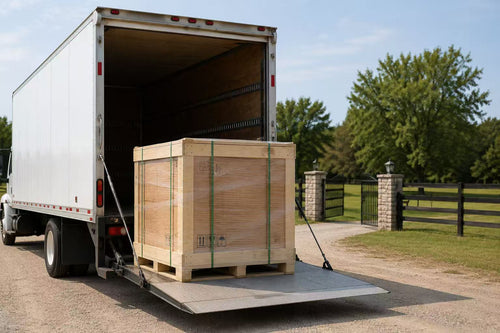
One of the most common problems is truck-bed height.
When a box truck, refrigerated van, pickup truck, or delivery trailer arrives, the cargo floor is often higher than the ground. In a large distribution center, a standard loading dock may solve this problem. But many smaller wholesale warehouses, cash-and-carry suppliers, food market buildings, seafood markets, and independent produce facilities do not always have the right dock height for every truck.
That creates a daily material handling challenge.
Workers may need to move mixed boxes, foam seafood containers, vegetable crates, sealed meat cartons, restaurant supply boxes, packaging materials, or general merchandise cartons between ground level and truck-bed height. Some loads are not palletized. Some orders are mixed. Some goods need to be checked, sorted, counted, or handed over one box at a time.
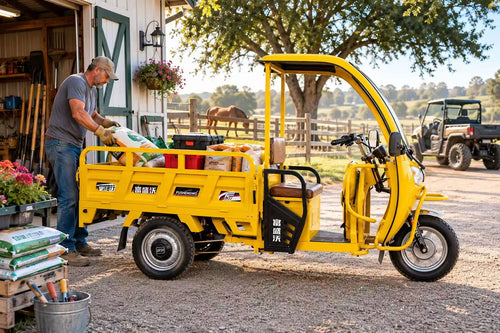
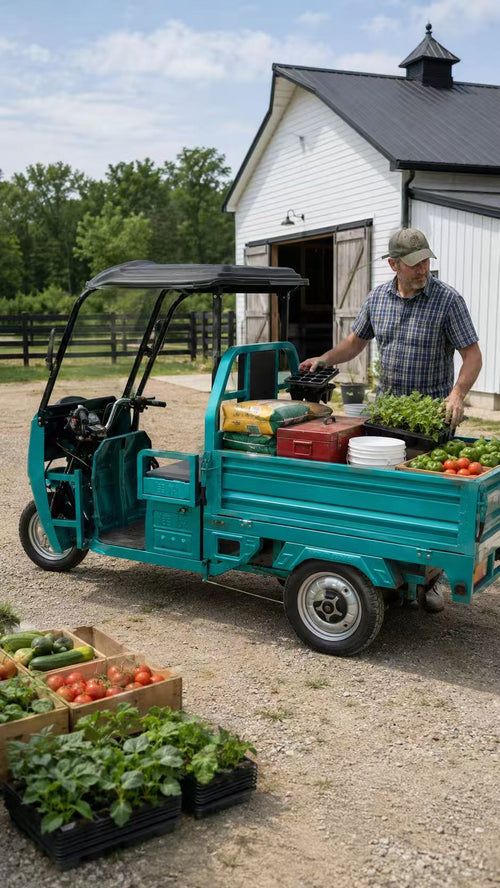
This is where a mobile electric lift tricycle with a dual hydraulic platform can become a practical tool for wholesale market loading work.
It is not a forklift replacement. It is not only a flatbed electric tricycle. It is a mobile worker-access platform designed to help handle height differences when goods are not always sitting on a pallet.
Why Truck-Bed Height Becomes a Problem in Wholesale Markets
Wholesale markets move many different goods in a very short time window.
A seafood vendor may receive foam boxes filled with packed seafood and ice. A produce wholesaler may prepare mixed fruit and vegetable orders before sunrise. A meat distributor may move sealed cartons from cold storage to pickup vehicles. A restaurant supply warehouse may load rice bags, flour, cooking oil, sauces, paper goods, and takeout packaging into customer vans.
In these situations, the loading job is often more complicated than simply moving one full pallet.
A forklift can lift pallets. A pallet jack can move floor-level palletized goods. But many wholesale market jobs involve non-palletized goods, mixed cartons, loose boxes, and customer pickup orders. Workers still need space to stand, reach, lift, sort, and transfer products safely.
When the truck bed is higher than the ground, workers may climb in and out of the vehicle, lift boxes above waist height, or pass goods down manually. Over time, this repeated movement can slow down loading, increase fatigue, and make short-distance handling less efficient.
A mobile lift platform helps close this gap by bringing the working surface closer to truck-bed height.
The Gap Between Forklifts, Pallet Jacks, and Hand Carts
Forklifts and pallet jacks are important tools in wholesale operations. They remain the right choice for heavy palletized goods, standard dock work, and warehouse storage movement.
But they do not solve every job.
Forklifts are best when goods are already arranged on pallets and the working space allows safe operation. Pallet jacks are useful for moving pallets across flat floors. Hand carts are flexible, but repeated manual hauling can become tiring when workers move dozens or hundreds of boxes per day.
A mobile electric lift tricycle fits between these tools.
It can move through short-distance work areas, carry goods on a flat platform, and raise the platform to a usable height. For loading assistance, truck-bed height handling, and non-palletized goods movement, this creates a more flexible option for small wholesale businesses.
The key idea is simple:
A forklift lifts pallets.
A mobile lift platform helps workers handle mixed boxes at working height.
That difference matters in wholesale market environments where every order does not arrive as a perfect pallet.
What a Dual Hydraulic Lift Platform Adds
A dual hydraulic platform is especially useful when the work requires balanced lifting support.
In a wholesale market, the load may include cartons, crates, sealed boxes, foam containers, tools, or supplies placed across the platform. A dual hydraulic lift system provides more balanced support than a single lift point design, especially when workers need to raise the platform for loading assistance or height-difference handling.
For a vehicle such as an electric lift tricycle with a dual hydraulic platform, the value is not only movement. The value is the combination of:
- electric mobility
- flatbed carrying space
- hydraulic lifting function
- worker-access platform design
- compact size for wholesale spaces
- support for non-palletized goods
- loading assistance near trucks and pickup vehicles
This makes the vehicle useful in places where large equipment may be too much, but hand loading is too slow or tiring.
Where This Vehicle Fits in Wholesale Market Loading Work
A mobile electric lift tricycle can support several common wholesale market loading tasks.
In seafood wholesale markets, it can help workers move foam boxes and packed seafood containers between a truck, a cold room entrance, and a pickup area. In produce wholesale markets, it can help raise fruit boxes or vegetable crates closer to truck-bed height when there is no proper loading dock. In meat wholesale and cold storage areas, it can support sealed carton movement between cold rooms and loading zones. In restaurant supply warehouses, it can help load mixed business orders that include cartons, bags, packaging materials, and cleaning supplies.
The vehicle is especially useful when the job involves:
- ground-to-truck loading
- truck-to-ground unloading
- small box truck loading
- customer pickup vehicle loading
- mixed box handling
- non-palletized goods movement
- warehouse aisle to loading area transfer
- loading assistance where dock equipment is limited
It can also support inspection and maintenance work inside wholesale facilities. Cold storage doors, overhead lighting, security cameras, warehouse signs, ventilation equipment, and dock area fixtures often require a worker to reach above ground level. A mobile lift vehicle can help workers reach these areas without moving a large lift machine through a crowded market space.
Why This Matters for Small and Mid-Size Wholesale Businesses
Large distribution centers often have standard dock equipment, dock levelers, electric pallet jacks, forklifts, and dedicated loading zones. Smaller wholesale businesses may not have the same setup.
A seafood stall, produce supplier, meat distributor, restaurant supply warehouse, cash-and-carry wholesale store, or local food distributor may work in a more flexible space. Trucks may arrive at different heights. Customers may bring different vehicles. Orders may be packed in cartons instead of pallets. Workers may need to load products quickly while serving other customers.
In these businesses, a small mobile lift platform can reduce dependence on repeated manual lifting.
It can help workers bring goods closer to a comfortable working height, move goods over short distances, and handle loading tasks without using a forklift for every small order. This can be useful when the order is too small for a forklift, too heavy for repeated hand loading, or too irregular for pallet-only equipment.
One of the biggest mistakes in wholesale market planning is assuming that every load is palletized.
Many wholesale market orders are mixed.
A restaurant may buy rice, cooking oil, sauce cartons, takeout packaging, and cleaning products in the same trip. A seafood store may pick up several foam boxes and ice containers. A small grocery customer may collect fruit boxes, vegetable crates, and frozen cartons. A butcher shop may pick up sealed meat cartons from a cold storage area.
These orders often need human handling.
A mobile lift platform is useful because it supports human work instead of removing it. Workers can stand near the platform, arrange boxes, count goods, check labels, and pass products into the vehicle at a better height.
For this reason, an electric lift tricycle is not only a vehicle. It is a loading assistance tool for real wholesale workflows.
A Practical Tool for Truck-Bed Height Handling
The most practical use case is simple: a truck arrives, but the business does not have a suitable loading dock.
Instead of lifting every box from ground level into the truck, workers can use the lift platform to raise goods closer to the truck floor. This can make the loading process smoother, especially for mixed cartons and non-palletized goods.
For unloading, the same concept works in reverse. Goods can be moved from the truck bed onto the platform, lowered, and then transported to a storage area, cold room entrance, stall, or customer pickup point.
Because the vehicle is mobile, it can move to different parts of the market instead of staying fixed in one dock position. This mobility is valuable in wholesale markets where loading, pickup, storage, and customer service often happen in different areas.
Choosing the Right Tool for the Right Job
A strong wholesale market does not rely on one piece of equipment for every task.
Forklifts are still important for pallet movement. Pallet jacks are still useful for flat-floor pallet transport. Hand carts still work for very small loads. Refrigerated vehicles still matter for longer cold-chain delivery.
But between these tools, there is a gap.
A mobile electric lift tricycle with a dual hydraulic platform can help fill that gap by combining movement, lifting, and working-height support in one compact vehicle.
For wholesale businesses that handle mixed boxes, non-palletized goods, customer pickup orders, truck-bed height differences, and facility inspection work, this type of vehicle can become a practical part of daily material handling.
It is best understood as a compact loading assistance vehicle for wholesale markets, food distribution spaces, restaurant supply warehouses, seafood markets, produce markets, meat storage areas, and general wholesale pickup operations.
When the job is too small for a forklift, too repetitive for hand loading, and too height-sensitive for a flat cart, a mobile electric lift platform can provide a more flexible way to keep goods moving.