Is an Electric Farm Utility Trike Easier to Use Than a Bigger UTV?
Share
Many buyers assume a bigger UTV is always the easier choice for farm work.
That idea makes sense at first.
A UTV looks strong. It has passenger seats. It can travel across a property. It may tow, carry tools, handle rough ground, and feel familiar to many American farm and ranch buyers.
But bigger does not always mean easier to use every day.
For many small farms, homesteads, nurseries, greenhouses, barns, horse properties, private lots, and warehouse yards, the daily work may be much simpler than full-size UTV work.
A worker may need to move feed bags.
Carry tools.
Move crates.
Transport nursery trays.
Bring small supplies from a shed to a work area.
Move boxes between buildings.
Handle daily chores around a private property.
For those jobs, the real question may not be:
Which machine is bigger?
The better question may be:
Which machine is easier to use often?
That is where an electric farm utility trike deserves attention.
Bigger Machines Have Real Advantages
A bigger UTV can be the right tool for many jobs.
If a farm needs passenger seats, towing, long property travel, higher ground clearance, rough-terrain capability, or more all-around performance, a UTV may be the better choice.
Large ranches, hunting properties, wide farms, and heavy-duty work areas often need a machine that can do more than carry light or moderate cargo.
A UTV can be useful for:
moving people
checking large properties
towing small trailers
crossing rougher terrain
carrying tools and passengers together
working farther away from the barn or shed
handling more demanding outdoor routes
These are real benefits.
This article is not saying a UTV is wrong.
The point is different.
A bigger UTV may be more capable, but that does not automatically make it easier for every daily chore.
Daily Use Is Different from Maximum Capability
Many buyers compare machines by maximum capability.
They ask:
How fast is it?
How much can it tow?
How many people can it carry?
How rough of a route can it handle?
How big is the engine?
How much power does it have?
Those questions matter when the work needs those capabilities.
But daily chores often require a different kind of thinking.
For repeated small jobs, convenience can matter more than maximum capability.
A machine that is easy to get into, easy to load, easy to position, easy to use slowly, and easy to repeat several times per day may be more useful than a larger machine that is technically stronger.
That is why a smaller electric farm utility trike can sometimes feel more practical for daily work.
It is not trying to beat a UTV in every category.
It is trying to make repeated private-site material movement easier.
Easy Entry and Exit Matter More Than Buyers Think
A daily work tool is not used once.
It may be used many times.
The operator may get in, move a short distance, stop, unload, step out, load again, and repeat.
This is common around barns, greenhouses, nurseries, packing areas, storage sheds, maintenance yards, and small farm properties.
If a machine is large, high, awkward to climb into, or inconvenient for frequent stop-and-go work, the operator may avoid using it for small chores.
They may carry things by hand instead.
They may use a wheelbarrow.
They may make several walking trips.
They may save tasks for later.
A lower, simpler electric utility trike can be useful because it supports frequent short trips.
The operator does not need a passenger cabin.
The operator may only need a practical seat, a cargo bed, low-speed control, and easy access.
For some buyers, that is easier than using a bigger UTV for every small job.
Small Work Areas Need Small Movement
Not every farm work area is wide open.
Many daily chores happen around tight or controlled spaces:
barn entrances
feed rooms
greenhouse paths
nursery tables
packing zones
tool sheds
warehouse doors
fenced areas
private yards
pallet storage areas
market preparation spaces
property maintenance routes
A larger UTV may be useful in open areas, but it may feel less convenient around smaller work zones.
An electric farm utility trike with a cargo bed can be easier to position for simple material movement.
It can move slowly.
It can stop near the work area.
It can carry moderate materials without taking up as much space as a larger passenger utility vehicle.
This does not mean it fits every narrow area.
The buyer still needs to check the route, turning space, surface, and load.
But for many small private work areas, a smaller cargo-focused machine can be easier to use often.
The Cargo Bed May Be More Useful Than Extra Size
A bigger UTV may offer more overall capability, but a daily farm chore often comes down to one practical question:
Can I move the materials I handle every day?
For many buyers, those materials include:
feed bags
toolboxes
small crates
buckets
boxes
nursery trays
greenhouse supplies
fencing parts
repair items
small farm materials
property maintenance supplies
If the main job is material movement, the cargo bed becomes the most important feature.
An electric farm utility trike is built around that idea.
It focuses on cargo movement rather than passenger transport or high-speed riding.
The cargo bed gives the operator a place to organize daily materials and reduce repeated hand carrying.
For small farms and work areas, that can be more useful than extra passenger seats or larger machine size.
Quiet and Simple Can Make Daily Use Easier
Gas UTVs and larger machines can be powerful, but they can also be louder and more involved to operate.
That may not matter for heavy work.
But it can matter for chores near barns, horses, livestock, greenhouses, nurseries, residential areas, hotels, schools, campuses, or private properties.
A quiet electric farm utility trike can be easier to use for low-speed daily movement.
There is no need to start a loud gas engine for every small trip.
There is less noise around animals and workers.
There is no fuel smell around enclosed or semi-enclosed work areas.
The operator can use it as a calm daily support tool.
Again, this does not make electric better for every job.
But for short private-site chores, quiet and simple operation can make the equipment more useful in daily routines.
The Question Is Not “Can a UTV Do More?”
A UTV can usually do more.
That is not the debate.
The real debate is whether the buyer needs “more” for the work that happens most often.
A UTV may be the better machine for long travel, towing, passengers, rough terrain, or heavy outdoor work.
But if the daily task is moving small and moderate materials around a farm yard, greenhouse, nursery, barn, or private lot, the buyer may not need all of that extra capability every day.
The buyer may need a tool that is easier to use repeatedly.
That is a different standard.
Maximum capability is not the same as daily convenience.
A machine can be stronger and still be less convenient for small work.
Where an Electric Farm Utility Trike Makes Sense
An electric farm utility trike makes sense when the buyer needs:
low-speed movement
short-distance cargo hauling
private-site use
easy access
simple daily operation
moderate material transport
repeated small trips
less hand carrying
less noise around work areas
a practical cargo bed for feed, tools, crates, and supplies
This may fit:
small farms
homesteads
greenhouses
nurseries
orchards
barns
horse properties
warehouse yards
logistics parks
private lots
property maintenance areas
market preparation spaces
In these settings, the value is not extreme strength.
The value is being easy to use often.
When a Bigger UTV Is the Better Choice
A bigger UTV may be the better choice if the buyer needs:
regular passenger carrying
heavy towing
rough terrain
large ranch travel
higher speed
deep mud capability
snow pushing
high ground clearance
long-distance property patrol
strong off-road suspension
dealer-backed UTV service expectations
all-around heavy utility performance
In those cases, an electric farm utility trike may not be the correct first tool.
It should not be treated as a UTV replacement for demanding work.
It should not be used as a public-road vehicle.
It should not be forced into extreme slopes, deep mud, heavy towing, or long-distance travel.
The buyer should choose the machine that matches the job.
That is the honest answer.
Why “Easy to Use” Can Save Time
Many daily chores are small, but they repeat.
The time loss comes from repetition.
Walking back and forth with tools.
Carrying feed bags by hand.
Moving boxes one at a time.
Using a large vehicle for every small task.
Leaving a task unfinished because the right tool is not convenient.
A machine that is easy to use can reduce this waste.
If the operator can quickly load a few items, move them safely, unload near the work area, and repeat the task without much trouble, the machine becomes part of the daily workflow.
That is where an electric farm utility trike can create value.
It is not the biggest machine.
It is a daily helper.
That role can matter more than buyers expect.
How to Decide Between a Bigger UTV and a Smaller Electric Trike
A buyer should not decide by appearance alone.
The buyer should ask:
Do I move people or materials more often?
Do I need towing?
Do I need high speed?
Do I need rough-terrain performance?
Do I mostly work in a private controlled area?
Do I make many short trips every day?
Do I need easy loading and unloading?
Do I work near barns, animals, greenhouses, or people?
Would a smaller cargo tool be used more often than a larger machine?
Would a cargo bed solve most of my daily chores?
These questions make the decision clearer.
If people, towing, and rough terrain are the main needs, a UTV may be better.
If daily cargo movement is the main need, an electric farm utility trike may be easier to use.
How This Applies to OneClickChina Buyers
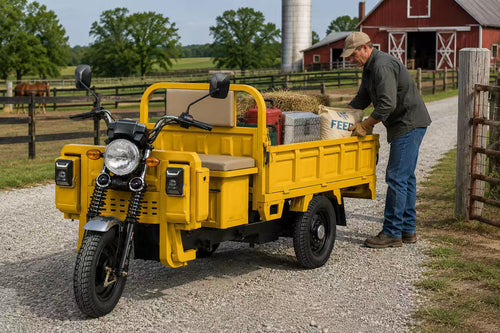
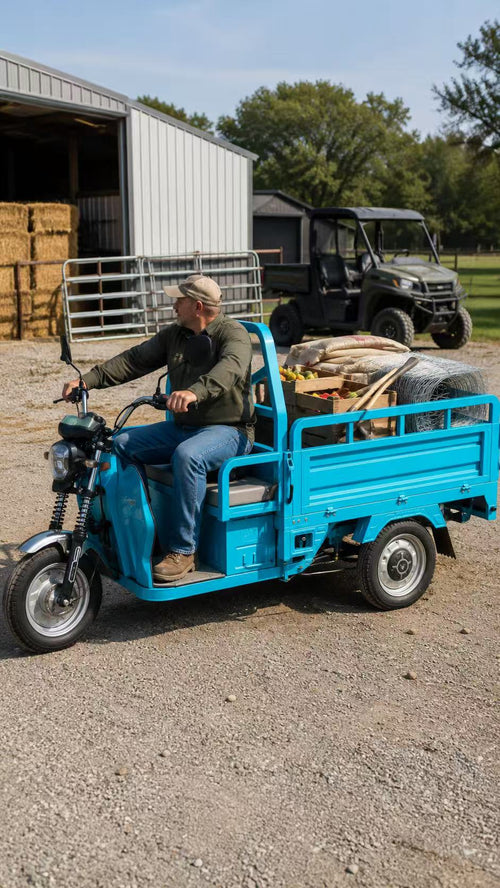
OneClickChina electric utility and cargo trike models are designed for private-site, low-speed material movement.
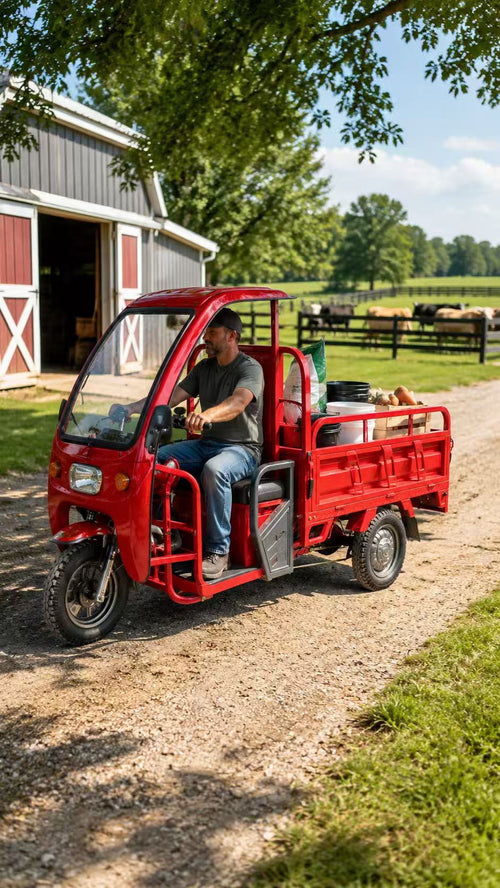
The ordinary open cargo model, canopy cargo model, cab utility cargo model, and hydraulic dump model serve different work needs.
An open cargo model may be suitable for fast access to feed bags, crates, tools, and boxes.
A canopy model may help when some operator coverage is useful.
A cab model may provide more protection for certain work conditions.
A hydraulic dump model may be better for loose materials such as soil, compost, mulch, manure, gravel, or sand.
The buyer should choose based on daily work, not just equipment size.
If the work is repeated cargo movement, the smaller electric utility trike may be easy to use often.
If the work requires UTV-level capability, a larger machine may be the correct choice.
Final Thought
A bigger UTV can be more capable.
But more capable does not always mean easier to use every day.
If the daily work is short-distance movement of feed, tools, crates, boxes, nursery trays, and supplies inside a private or controlled work area, an electric farm utility trike may be easier to use than buyers expect.
The smartest purchase is not always the biggest machine.
It is the machine that gets used for the work that happens every day.