Electric Cargo Trike for Ranch Work: Why Torque, Tires, and Cargo Bed Design Matter
Share
On a ranch, speed is rarely the first question. A vehicle does not become useful just because it can run fast on a clean road. Ranch work is different. The real question is whether the vehicle can move steadily at low speed, carry practical loads, stay stable on rough ground, and help with daily chores such as hauling feed, fencing tools, buckets, wire rolls, and repair supplies.
That is why an electric cargo trike for ranch work should be judged differently from a regular electric tricycle or a city cargo bike. Ranch buyers should look first at torque, tires, suspension, and cargo bed design. These details matter more than top speed because most ranch routes are not city streets. They are gravel lanes, packed dirt paths, pasture edges, barn-to-fence routes, and rough working areas where the vehicle needs control more than speed.
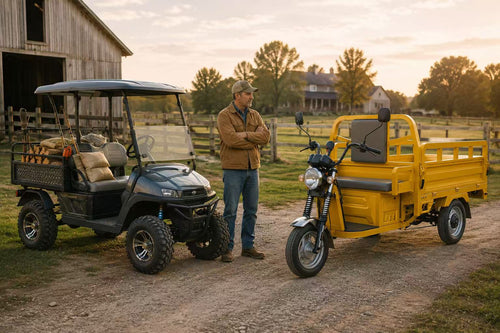
A ranch cargo trike is not designed to replace every UTV, ATV, tractor, or pickup. Heavy towing, deep mud, extreme slopes, and oversized loads may still require larger equipment. But for repeated low-speed hauling around a ranch property, the right electric cargo trike can reduce unnecessary use of gas-powered ATVs and UTVs for smaller daily jobs.
Why Torque Matters More Than Top Speed
Many buyers look at speed first, but ranch work usually rewards torque more than speed. Torque is what helps a vehicle start smoothly with cargo, move across uneven ground, and handle low-speed work without feeling weak. A ranch route may involve loose gravel, slight slopes, grass edges, hard-packed dirt, and repeated stop-and-go movement. These conditions do not require racing speed. They require steady pulling power.
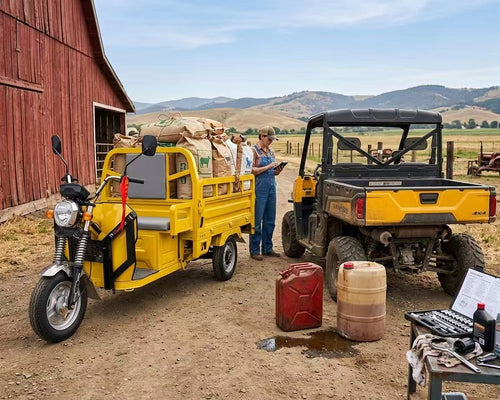
For example, moving two feed bags, a bucket of tools, and fence repair parts from the barn to a pasture gate is not a high-speed job. The vehicle may only travel a short distance, but it needs to carry the load without struggling. That is where torque becomes important.
This is also why ranch buyers should be careful with vehicles designed mainly for recreational riding or city commuting. A trike that feels comfortable on a flat street may not be suitable for ranch work if it lacks low-speed strength, stable tires, and a real cargo bed.
A practical electric cargo trike for ranch use should feel useful at working speed. It should be able to move slowly, stop often, turn safely, and continue hauling moderate cargo across real property routes. The value is not in how fast it can go. The value is in how reliably it can help with daily work.
Fat Tires and Ranch Ground Conditions
Tires are another major difference between a ranch-ready cargo trike and a basic electric tricycle. Ranch ground is rarely perfect. Even when the main path is dry, the vehicle may still pass over loose gravel, small ruts, grass, dirt, uneven edges, or soft areas after rain.
Fat tires and stronger tread can help improve stability and contact with the ground. They can also make the ride feel more controlled when the vehicle is carrying feed bags, fencing equipment, tools, or other ranch supplies. A narrow tire may be fine on pavement, but ranch work often needs more surface contact and more confidence on mixed ground.
This does not mean every electric cargo trike can handle deep mud or extreme off-road trails. That would be unrealistic. Deep mud, steep rough hills, and heavy off-road conditions may still require a UTV, ATV, tractor, or specialized ranch vehicle. But for moderate ranch paths, gravel lanes, pasture-side routes, and daily internal transport, better tires can make a big difference.
When looking at an electric cargo trike for ranch work, the buyer should ask where the vehicle will run most often. Is it mostly hard-packed dirt? Loose gravel? Barnyard ground? Pasture edge? A mix of paved and unpaved ranch paths? The more clearly the buyer understands the route, the easier it is to choose the right vehicle.
Cargo Bed Design Is Not a Small Detail
For ranch work, the cargo bed is not just a storage box. It is the working part of the vehicle.
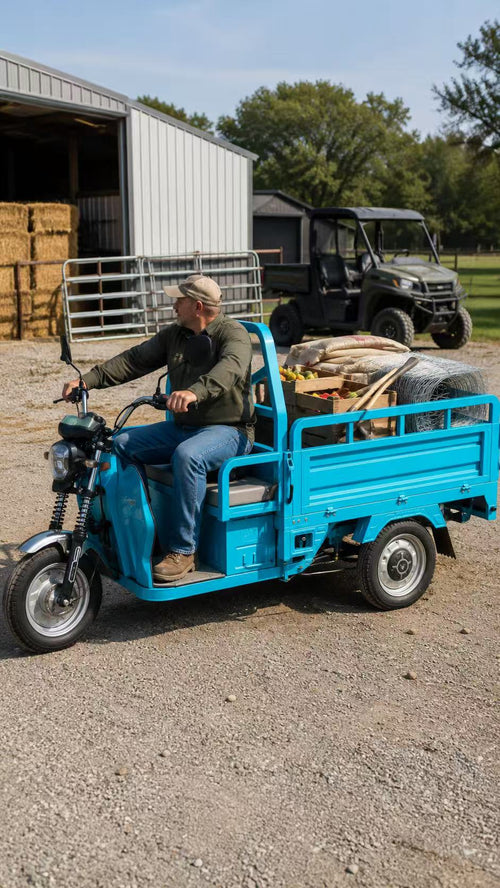
A ranch operator may need to carry feed bags, mineral blocks, fence tools, wire rolls, gate hardware, water buckets, small equipment, gloves, ropes, hand tools, and repair parts. These items are not always clean, light, or neatly shaped. A small basket or decorative storage area is not enough.
A real rear cargo bed gives the vehicle practical value. It should be easy to load, easy to reach, and strong enough for daily use. Side access can be helpful when loading bags or tools. A rear bed can also make it easier to carry mixed supplies in one trip instead of walking back and forth between the barn, tool shed, and fence line.
For ranch buyers, the question should not be only “How much weight can it carry?” The better question is: “Can this cargo bed carry the things I move every day?”
That may include feed, fencing tools, electric fence supplies, buckets, small repair parts, hoses, or pasture maintenance tools. If the cargo bed matches the daily work, the vehicle becomes much more useful.
When a Dumping Cargo Bed Makes Sense
A dumping cargo bed can be useful on ranches when the work involves loose or bulky materials. This may include manure, bedding, compost, soil, gravel, mulch, or small cleanup loads. A hydraulic dump bed can reduce manual unloading and make short-distance material movement easier.
However, not every ranch task requires a dump bed. If the main cargo is feed bags, tools, fencing supplies, buckets, and repair parts, an open cargo bed may be enough. If the ranch frequently moves loose materials, bedding, manure, or soil, then a dumping cargo bed becomes more valuable.
This is why ranch buyers should match the vehicle to the real workload. A dumping cargo bed is not just a feature to look impressive. It is useful when the daily job actually involves unloading loose materials. For tool and supply transport, bed size, access, and stability may matter more.
The best decision comes from listing the most common loads. If most loads are bags and tools, a simple rear cargo bed may fit well. If many loads are loose materials, a dump bed deserves serious attention.
Ranch Loads Are Different from City Cargo
A city cargo bike may carry groceries, packages, children, or household items. Ranch cargo is different. It is often dirty, heavy, uneven, and related to daily work.
Common ranch loads may include:
Feed bags, fencing pliers, wire rolls, t-post tools, mineral blocks, water buckets, gloves, ropes, small chains, repair kits, and pasture tools.
These items require a vehicle that is easy to load and stable at low speed. They also require a cargo area that can handle practical work, not just clean consumer cargo.
This is one reason the phrase electric cargo trike for ranch is valuable. It describes a different search intent from a regular electric cargo trike. The buyer is not mainly looking for a family bicycle or a shopping trike. The buyer is thinking about ranch chores, rougher ground, feed movement, fence repair, and equipment hauling.
Where an Electric Cargo Trike Fits on a Ranch
An electric cargo trike can fit well into many ranch routines.
It can move feed from storage to a livestock area. It can carry tools along a fence line. It can transport wire rolls, gate parts, and repair supplies to a broken section of fence. It can help move small maintenance supplies between a barn, shed, pasture gate, and equipment area. It can also support cleanup work around stalls, pens, and work zones when the cargo is moderate and the route is suitable.
The most valuable use case is repeated short-distance movement. Ranch work often involves many small trips. A worker may need to carry tools to one side of the property, return for supplies, then move feed or parts to another area. These trips take time. A cargo trike can reduce walking and help keep supplies together.
The vehicle is especially useful when the route is too long for easy hand carrying but too small of a job for a larger machine. That middle space is where a ranch cargo trike can make sense.
How It Compares with Gas ATVs and UTVs
Gas-powered ATVs and UTVs are common on ranches because they are strong, familiar, and useful for many jobs. But they are not always necessary for every task. Starting a gas vehicle for every small job can create noise, fuel use, maintenance, and operating cost.
An electric cargo trike gives ranch owners another option for lighter work. It can be used for quieter movement around barns, livestock areas, storage areas, and internal ranch paths. It can help with tools, feed, and supplies without needing the same size or operating style as a larger machine.
The right comparison is not “electric cargo trike or UTV.” A better comparison is “which tasks need the UTV, and which tasks only need a smaller cargo vehicle?”
For heavy towing, rough hill work, deep mud, or demanding off-road conditions, the UTV may still be the right tool. For feed bags, hand tools, fence repair supplies, and repeated short trips, an electric cargo trike can be a practical support vehicle.
This is a more realistic way to evaluate the vehicle.
The Three Questions Ranch Buyers Should Ask
Before choosing an electric cargo trike for ranch work, buyers should ask three simple questions.
First, what is the terrain like?
If the route is mostly packed dirt, gravel, barnyard ground, pasture-side lanes, or moderate ranch paths, the vehicle may be a good fit. If the route is deep mud, steep rough hills, or heavy off-road terrain, the buyer should be more careful.
Second, what loads do you carry most often?
If the main loads are feed bags, fencing tools, buckets, wire rolls, small equipment, and repair supplies, a cargo trike can be very useful. If the ranch regularly moves oversized loads, heavy logs, large trailers, or very heavy materials, a larger utility vehicle may still be needed.
Third, do you need a dump bed or a standard open cargo bed?
If the work includes loose materials such as manure, compost, soil, bedding, or gravel, a dumping cargo bed may save labor. If the work is mostly bags, tools, and supplies, an open cargo bed may be enough.
These questions help the buyer avoid choosing only by appearance or price. They also make the decision more practical.
Why Country Routes Are Different from City Routes
A ranch vehicle should be evaluated by country miles, not city miles. City use may involve smooth pavement, traffic rules, and clean cargo. Ranch use involves uneven ground, dust, short repeated trips, and practical work materials.
This changes the buying logic.
A ranch buyer should not only ask about range and speed. Range matters, but most ranch work happens on internal routes. Speed matters, but most chores require control, not racing. The important factors are torque, stability, tires, bed size, and whether the vehicle can handle the normal working environment.
The best ranch vehicle is not always the fastest one. It is the one that makes daily work easier.
What This Means for a Practical Ranch Setup
A ranch does not need one vehicle to do every job. A good setup may include larger machines for heavy work and smaller electric cargo vehicles for routine movement. This can make the operation more efficient because each vehicle is used for the kind of task it handles best.
The electric cargo trike can take over many small hauling jobs that do not need a full UTV. That may include moving feed, tools, wire, buckets, small repair parts, and general supplies. Over time, this can reduce unnecessary trips with larger gas equipment and make daily chores smoother.
For many ranches, the value comes from frequency. If the vehicle is used several times a day for small tasks, it can quickly become part of the work routine.
Conclusion
An electric cargo trike for ranch work should not be judged like a city electric tricycle. Ranch use requires a different standard. The buyer should look at torque over top speed, tire stability, cargo bed practicality, and the type of terrain the vehicle will face.
For ranches that need to move feed bags, fencing tools, buckets, wire rolls, and repair supplies across moderate property routes, a cargo trike can be a practical daily support vehicle. It is not the right tool for every heavy job, and it should not be presented as a full replacement for every ATV, UTV, tractor, or pickup.
Its real value is in the daily work between those larger jobs: the repeated short trips, the moderate loads, the fence-line repairs, the barn-to-pasture movement, and the quiet low-speed hauling that happens again and again on a ranch.
When torque, tires, and cargo bed design match the job, an electric cargo trike can become one of the most useful small vehicles on the property.