Cheapest UTV for Farm Work: What Should You Compare Before Buying?
Share
Cheapest UTV for Farm Work: What Should You Compare Before Buying?
Many small farm owners search for the cheapest UTV for farm work because they need a practical machine without spending too much money.
That search makes sense.
A full-size UTV can be expensive. New models can quickly move far beyond a small farm budget, especially after delivery, accessories, taxes, maintenance, and future repairs. Even many budget UTVs still cost much more than some buyers expect.
But before choosing the cheapest UTV, it is worth asking a more useful question:
Do you really need a UTV for the work you do every day?
The cheapest UTV is not always the most cost-effective farm work vehicle. If you need 4WD, towing, passengers, rough-terrain ability, and long-distance property movement, a budget UTV may be a reasonable choice.
But if your daily work is mostly short-distance hauling, moving loose materials, carrying feed, transporting tools, or unloading compost, manure, soil, mulch, or wood chips around a small farm, a simpler electric work vehicle may be a better fit.
The goal is not to buy the cheapest machine.
The goal is to buy the right machine for the daily job.
Why Buyers Search for the Cheapest UTV
Most buyers who search for a cheap UTV are not looking for a toy.
They usually have real farm work to do.
They may need to move feed, tools, fencing supplies, buckets, firewood, livestock supplies, soil, compost, manure, mulch, or repair materials. They may have a small farm, ranch home, homestead, nursery, greenhouse, orchard, private property, or worksite where walking back and forth takes too much time.
They may like the idea of a UTV because it feels strong, familiar, and proven.
But the price creates hesitation.
That is why many buyers start comparing budget UTVs, used UTVs, utility side-by-sides, Kawasaki Mule models, Polaris Ranger models, CFMoto models, Landmaster units, Tractor Supply UTVs, and similar lower-cost options.
This is a normal buying path.
But the buyer should not stop at price alone.
What “Cheap UTV” Usually Means
A cheap UTV is still not always cheap.
A new budget UTV may still cost several thousand dollars before accessories and service costs. A used UTV may look more affordable, but it can bring other questions: hours, mileage, maintenance history, tire wear, suspension condition, battery condition, engine condition, drivetrain issues, previous farm use, and unknown repairs.
A low purchase price can become less attractive if the vehicle needs immediate work.
That does not mean budget UTVs are bad. Some are useful machines. Some are strong enough for real farm chores. Some older models have good reputations for durability.
But the buyer should compare the full ownership picture:
purchase price
delivery or pickup cost
tires
battery
brakes
fluids
belts
filters
engine service
suspension
accessories
future repair risk
local service access
A cheap UTV can still be expensive if it is more complex than the job requires.
What Budget UTV Articles Usually Compare
When farm buyers compare budget UTVs, most buyer guides focus on several important features.
Cargo bed capacity matters because farm work usually involves carrying materials.
Towing capacity matters when the vehicle needs to pull a trailer, move fencing supplies, or support heavier property work.
4WD matters when the ground is muddy, steep, uneven, or rough.
Ground clearance matters when the vehicle crosses pasture ruts, rocks, dirt roads, or uneven farm lanes.
Passenger seating matters when two or three workers need to ride together.
Dumping cargo beds matter when the buyer moves loose materials and wants easier unloading.
Reliability matters because farm work vehicles must be ready when needed.
These are real factors.
If your farm needs all of these functions, a UTV may be the right machine.
But many small farm chores do not require all of them.
When a Cheap UTV Makes Sense
A budget UTV can make sense when the work demands UTV-level capability.
Choose a UTV if you need to carry passengers, tow trailers, cross rough ground, climb slopes, drive through mud, move across larger acreage, or use the vehicle for both transportation and work.
A UTV may also make sense if the property requires a stronger suspension, higher ground clearance, 4WD, and a more protected operator area.
For livestock farms, large ranch properties, rough pasture routes, wooded land, hunting properties, and mixed recreation-work use, a UTV can be worth the cost.
In that situation, buying the cheapest possible option may still not be the best choice. The buyer should look for the lowest-cost UTV that still has enough strength, reliability, cargo space, towing ability, and local service support.
Cheap should not mean weak.
Cheap should mean cost-effective for the work.
When Even the Cheapest UTV May Be Too Much
A UTV may be more machine than necessary when the daily work is simple and local.
Many small farms do not need high speed or long-distance riding for every task. A lot of work happens between a barn, shed, greenhouse, nursery area, feed storage, compost pile, livestock pen, driveway, work yard, or garden area.
The job may be repeated many times, but the route is short.
The load may be important, but it may not require a full-size UTV.
If the daily work is mostly short-distance hauling, the buyer should ask:
Do I need 4WD every day?
Do I need passenger seating every day?
Do I need high speed every day?
Do I need towing every day?
Do I need a gas-powered side-by-side, or do I mainly need a cargo bed?
If the answer is mainly cargo movement, then a simpler electric work vehicle may be worth comparing before buying a cheap UTV.
Compare by Job Type, Not Just Price
The best way to compare a cheap UTV with another work vehicle is by job type.
If you move feed bags, buckets, small boxes, tools, trays, cleaning supplies, repair parts, or fencing hardware, an open cargo bed may be the most important feature.
If you move soil, manure, compost, mulch, wood chips, gravel, or cleanup debris, a hydraulic dump bed may be more important than speed or passenger seating.
If you tow heavy trailers, cross rough terrain, and carry multiple people, a UTV may be the better fit.
If you mainly work on short routes at low speed, a compact electric cargo trike or hydraulic dump utility vehicle may do the job at a lower cost and with less mechanical complexity.
This is the core buying question:
Are you buying UTV capability, or are you buying daily hauling function?
Those are not always the same thing.
Electric Cargo Trike as a Lower-Cost Work Tool
A compact electric cargo trike is not a UTV.
It is not designed for high-speed riding, rough trail recreation, passenger transport, or heavy towing.
Its value is different.
It is a cargo-first work tool for short-distance movement.
For a small farm, greenhouse, nursery, warehouse, market, private property, or maintenance site, this can be exactly what the buyer needs.
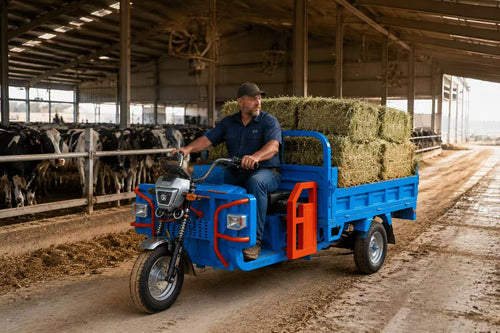
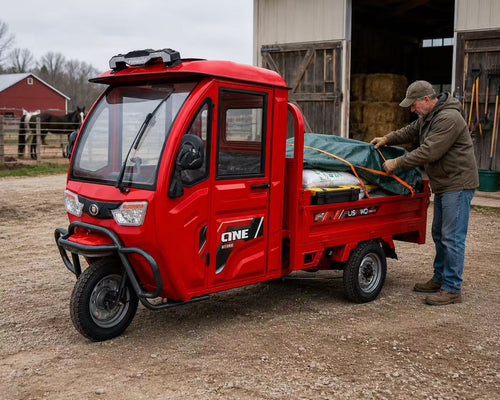
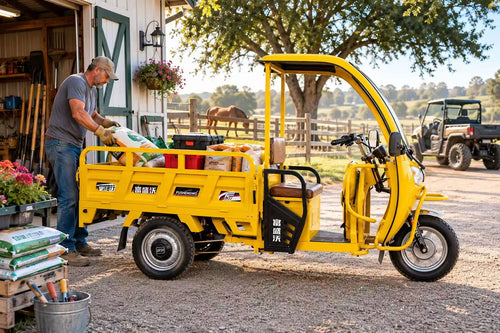
A flat-bed electric cargo trike is useful when the work involves bagged, boxed, or organized materials. It can carry feed bags, buckets, toolboxes, nursery trays, repair parts, cleaning supplies, and small farm materials.
The vehicle is simple, compact, and focused on moving materials instead of carrying passengers.
If the buyer does not need 4WD, towing, long routes, or multiple seats, a cargo trike may make more financial sense than even a cheap UTV.
Hydraulic Dump Utility Vehicle for Loose Materials
For many farm jobs, the problem is not just moving the load.
The problem is unloading it.
Loose materials such as soil, compost, manure, mulch, wood chips, gravel, wet debris, and cleanup material can be tiring to unload by hand. If the buyer is moving these materials repeatedly, a hydraulic dump bed can be more valuable than extra UTV features.
This is where a hydraulic dump utility vehicle becomes relevant.
Instead of paying for speed, passengers, and recreational features, the buyer is paying for the work function that matters most: hauling and dumping.
For small farms, horse stables, ranch homes, nurseries, gardens, and property maintenance areas, this can be a practical alternative to a budget UTV.
The question becomes simple:
Do you need a side-by-side, or do you need a dump bed that helps finish the chore faster?
Maintenance: Cheap UTV vs Simple Electric Work Vehicle
Maintenance is one of the biggest differences between a UTV and a simple electric work vehicle.
A gas-powered UTV may involve engine oil, filters, belts, fluids, fuel system service, drivetrain components, suspension parts, and more complex mechanical maintenance.
A used UTV may also bring unknown history.
How was it driven?
Was it used heavily on a farm?
Were fluids changed?
Are the tires worn?
Does the dump bed work properly?
Is the transmission smooth?
Are there electrical issues?
Does it need parts soon?
A simple electric cargo trike or electric dump utility vehicle has a different maintenance logic.
The main systems are the battery, motor, controller, wiring, frame, wheels, brakes, cargo bed, hydraulic dump system if equipped, and normal wear parts.
There is no engine oil to change.
There is no gasoline engine to maintain.
There is no fuel system to service.
That does not mean there is no maintenance. Tires, brakes, batteries, wiring, switches, hydraulic parts, and wear parts still need attention over time.
But the structure is easier to understand.
For buyers who want a practical work tool instead of a complex vehicle, this simplicity matters.
Local Repair Coordination Support
After-sales service is part of the buying decision.
OneClickChina understands that small farm buyers want a practical way to solve service needs after delivery.
For electric cargo trikes and hydraulic dump utility vehicles, the support model is based on local repair coordination.
When service is needed, we first ask the buyer to recommend a reputable local farm machinery repair technician, motor and electrical repair technician, small equipment repair shop, or independent electric vehicle repair shop near them.
If the buyer does not already have a preferred local technician, OneClickChina can help search nearby repair options through Google Maps and coordinate support using photos, videos, parts guidance, and remote communication.
The goal is simple:
help the buyer solve service needs locally and reduce worry after purchase.
For a simple electric work vehicle, local coordination can be more realistic than treating every issue like a major vehicle repair.
What to Compare Before Buying the Cheapest UTV
Before buying the cheapest UTV for farm work, compare the real job.
Ask these questions:
How far do I drive each day?
Do I need 4WD?
Do I need towing?
Do I need to carry passengers?
Is the ground rough, muddy, steep, or mostly controlled?
Am I moving organized cargo or loose material?
Do I need a dump bed?
How much maintenance am I willing to handle?
Is local UTV service easy to find?
Would a simpler electric cargo vehicle do the same daily work?
These questions can prevent a buyer from choosing a vehicle only because it has the lowest UTV price.
The cheapest UTV may be a good choice if the work truly requires UTV capability.
But if the work does not require those features, it may not be the most cost-effective choice.
When a Budget UTV Is the Right Choice
Choose a budget UTV if your small farm work requires rough terrain, towing, passengers, longer travel distances, higher ground clearance, and 4WD.
A UTV is also a better fit if the vehicle will be used for both farm work and outdoor recreation.
If you need one machine to move people, pull trailers, carry tools, cross pasture, and handle rough ground, a UTV may justify the cost.
In that case, do not only choose the cheapest model.
Choose the most reliable budget model that matches your terrain, load, service options, and real work.
When an Electric Dump or Cargo Vehicle May Fit Better
Choose an electric cargo trike if your daily work is short-distance, low-speed, cargo-focused, and mostly on controlled surfaces.
Choose a hydraulic dump utility vehicle if your work involves repeated hauling and unloading of loose materials.
These options may fit small farms, ranch homes, horse stables, nurseries, greenhouses, warehouses, markets, campuses, and private worksites.
They are not replacements for every UTV.
They are alternatives for buyers who do not need all UTV features every day.
If the real job is moving materials around a property, a simpler electric work vehicle may be a more cost-effective answer than searching for the cheapest UTV.
Final Decision
The cheapest UTV for farm work may still cost more than your daily job requires.
That does not mean budget UTVs are bad. For rough terrain, towing, passengers, 4WD, and larger properties, they can be useful machines.
But many small farm owners are not trying to ride trails or move across large acreage.
They are trying to move materials.
Feed. Tools. Buckets. Compost. Soil. Manure. Mulch. Wood chips. Small boxes. Repair parts. Farm supplies.
If that is your real work, compare the cheapest UTV with a simpler cargo-first electric work vehicle before buying.
The right choice is not always the lowest-price UTV.
The right choice is the vehicle that matches your load, route, terrain, budget, and daily chores.