Electric Utility Cart for Real Work: What Matters More Than Speed?
Share
An electric utility cart is built around a simple idea: move tools, supplies, materials, and everyday loads efficiently without using more vehicle than the job requires. On farms, in warehouses, around commercial properties, and across industrial facilities, many daily trips are short, repetitive, and focused on hauling rather than speed.
That distinction matters. A work vehicle should not be judged by top speed alone. For real material handling, buyers should also consider payload, cargo-bed size, low-speed control, operating range, terrain, grade, braking, turning space, and how often the operator needs to stop, load, unload, and move again.
For many operations, a battery-powered utility cart can fill the space between manual carts and larger utility vehicles. The right choice depends on the work being done—not simply on which machine has the biggest motor or highest advertised speed.
WHAT IS AN ELECTRIC UTILITY CART?
Electric utility carts are powered work vehicles designed primarily for transporting people, tools, supplies, equipment, or materials over working distances. The category is broad. It can include compact motorized utility carts, industrial electric utility carts, ride-on cargo vehicles, flatbed models, maintenance carts, and vehicles equipped with utility or dump beds.
What connects these machines is their purpose: practical transportation and material handling.
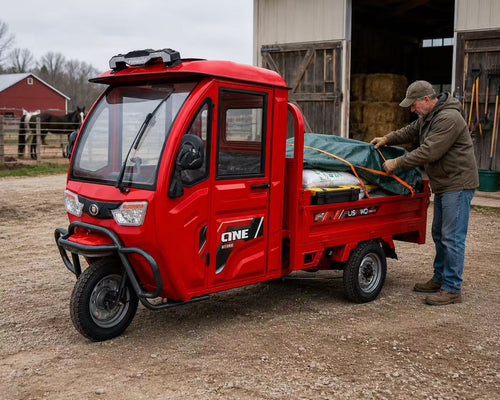
On a small farm, that might mean carrying feed bags, fencing supplies, hand tools, harvested produce, or soil between a barn, greenhouse, field, and storage area. In a warehouse or industrial facility, the same basic concept can be used for moving parts, boxes, maintenance equipment, or supplies between work areas.
This is why the useful question is not simply, “How fast does it go?” A better question is, “How well does it perform the work I repeat every day?”
WHY WORK CAPABILITY MATTERS MORE THAN TOP SPEED
Speed can matter when a vehicle regularly travels long distances. But many utility jobs are dominated by loading, unloading, maneuvering, and frequent stops.
Consider fence maintenance on a farm. An operator may travel a short distance, stop to repair a section, move again, collect another tool, and repeat the process. Property-maintenance crews may follow a similar pattern while moving tools and supplies between buildings. Warehouse personnel may spend more time maneuvering through work areas than traveling at maximum speed.
In these situations, useful performance comes from a combination of:
• Payload and load capacity
• Stable low-speed handling
• Braking under load
• Turning radius and maneuverability
• Cargo-bed accessibility
• Battery range for the actual work cycle
• Ability to handle the normal surface and grade
• Easy loading and unloading
A faster machine is not automatically a more productive machine.
MATERIAL HANDLING: START WITH THE LOAD
The first specification to evaluate is what the vehicle actually needs to carry.
A buyer should look at normal daily loads rather than the heaviest load that might occur once or twice a year. Feed, tools, fencing materials, boxes, produce, landscaping supplies, maintenance equipment, and construction materials all create different payload and cargo-bed requirements.
Load capacity should also be considered together with operating conditions. A rated payload on a level, firm surface does not automatically mean the vehicle should carry the same load on a slope, loose soil, wet grass, or uneven ground.
Cargo-bed design matters as well. A flatbed can work well for boxes and equipment. Side panels help contain loose or irregular cargo. A conventional utility bed is useful for general hauling, while a dump bed can make unloading bulk materials substantially easier.
This is one reason electric utility carts should be selected around the task rather than a single headline specification.
FARM, NURSERY AND GREENHOUSE WORK
Small farms are a natural example of short-distance utility work.
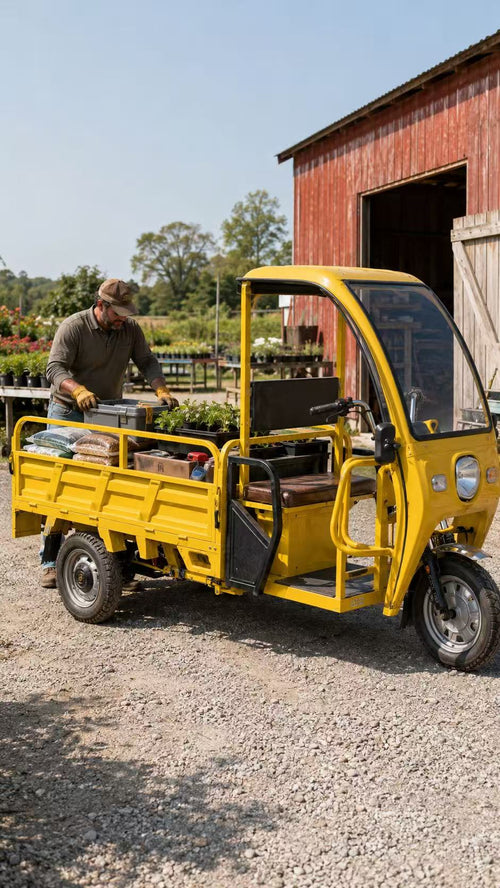
Many daily farm chores involve moving moderate loads repeatedly: feed from storage to livestock areas, tools to a fence line, harvested vegetables to a packing area, or supplies between a greenhouse, barn, orchard, and work shed.
For these jobs, compact size can be an advantage. A smaller electric work vehicle can operate on established farm lanes, around buildings, and through tighter working areas where a larger vehicle may be cumbersome.
Electric drive also has practical advantages around enclosed or noise-sensitive environments. There is no gasoline-engine exhaust at the point of use, and electric operation is quieter around barns, greenhouses, livestock areas, and other workspaces.
However, an electric utility cart is not automatically the right machine for every farm. Deep mud, severe side slopes, very rough undeveloped terrain, heavy towing, or long-distance travel can require a different type of vehicle. Matching the machine to the actual route is more important than forcing one vehicle to handle every possible farm task.
WAREHOUSE, INDUSTRIAL AND COMMERCIAL USE
The same work-first logic applies to industrial electric utility carts.
Warehouses, factories, campuses, commercial properties, maintenance departments, and other facilities often need a vehicle to move tools, parts, supplies, and equipment repeatedly throughout the day. These jobs are closer to material handling than recreational driving.
Here, maneuverability becomes especially important. Tight turns, narrow routes, frequent stops, and predictable operating distances can make a compact electric vehicle more useful than a larger machine.
For indoor or mixed indoor-outdoor operations, buyers should consider vehicle width, turning radius, braking, tire selection, battery operating time, charging access, and the dimensions of the cargo area.
The goal is not maximum vehicle performance. It is reducing unnecessary walking, manual carrying, and repeated trips while keeping the vehicle appropriate for the workspace.
TERRAIN, INCLINE AND MANEUVERABILITY
Terrain should be evaluated before choosing any utility vehicle.
Firm dirt lanes, pavement, concrete, compacted gravel, maintained grass, and moderate grades create very different requirements from deep mud, loose rock, severe slopes, or undeveloped ground.
Buyers should consider traction, tire type, ground clearance, braking, stability, and loaded performance on the actual routes where the vehicle will work. Incline capability should never be evaluated only from an advertised number; payload, surface condition, weather, and direction of travel all affect real-world performance.
Maneuverability is equally important. On farms, nurseries, warehouses, and properties with narrow passages, a compact footprint and practical turning radius can save time on every trip.
BATTERY, MOTOR AND REAL-WORLD RANGE
Battery specifications should be judged by the work cycle rather than by range alone.
Ask how far the vehicle normally travels between charging opportunities, how much of that travel occurs under load, whether the route includes grades, and how frequently the vehicle starts and stops.
Battery-powered utility carts are particularly practical when work is concentrated around a farmstead, warehouse, campus, facility, or property where charging is readily available. Overnight charging can fit naturally into operations where the vehicle returns to the same base each day.
Motor output also needs context. More power may be useful for heavier loads and grades, but the correct combination of motor, gearing, battery, braking, and vehicle weight is more important than one large power figure.
Cold temperatures, heavy payloads, steep grades, and difficult surfaces can all reduce usable range. Buyers should therefore plan around realistic working conditions rather than an ideal maximum-range claim.
WHEN A DUMP BED MAKES SENSE
Not every electric utility cart needs a dump bed.
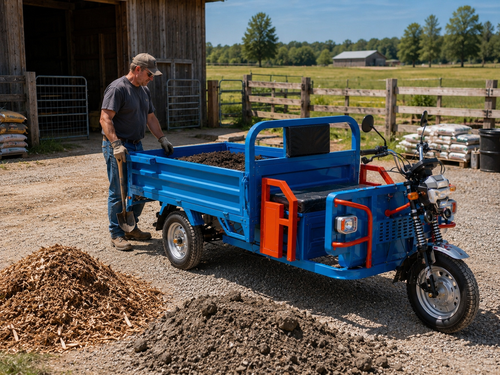
For boxed goods, tools, feed bags, fencing materials, and equipment, a standard cargo bed may be sufficient. But when the daily work involves soil, mulch, gravel, debris, manure, harvested material, or other loose bulk loads, a dumping mechanism can significantly reduce manual unloading.
An electric or hydraulic dump bed changes the vehicle from simple transportation into a more specialized work tool.
The important question is frequency. If bulk materials are unloaded repeatedly, powered dumping can improve productivity. If the vehicle mostly carries organized tools and packaged supplies, paying for a dumping system may provide little benefit.
HOW TO CHOOSE THE RIGHT ELECTRIC UTILITY CART
Before buying, define the work first and the vehicle second.
Start with these questions:
1. What will the vehicle carry most days?
2. What is the normal payload—not the rare maximum?
3. Is the work mostly short-distance hauling or long-distance travel?
4. Will it operate on pavement, gravel, grass, dirt, slopes, or rough ground?
5. How narrow are gates, aisles, greenhouse entrances, or work routes?
6. Is heavy towing actually required?
7. Would a dump bed save meaningful unloading time?
8. Where and how often can the battery be charged?
9. Does the vehicle need to work indoors?
10. What parts, warranty, and repair support are available after purchase?
These questions are more useful than choosing a machine because it has the highest speed or the largest motor.
A farm carrying feed and tools over established lanes has different requirements from a warehouse moving parts between departments. A construction crew hauling debris needs a different bed configuration from a property-maintenance team carrying hand tools. An industrial facility operating all day may prioritize battery capacity and serviceability more heavily than an occasional-use property owner.
WHEN A LARGER UTV STILL MAKES MORE SENSE
An electric utility cart should not be presented as a replacement for every UTV.
A full-size working UTV remains the better tool when the job regularly requires severe off-road capability, four-wheel traction, high-speed travel across large properties, heavy towing, multiple passengers, deep mud operation, or demanding attachments.
The distinction is important.
If most daily work consists of carrying tools, supplies, feed, materials, or moderate loads over established routes, a compact electric work vehicle may provide the capability actually being used without unnecessary size and complexity.
If the work genuinely requires the additional capabilities of a UTV, those capabilities are not excessive—they are necessary.
The best work vehicle is therefore not the fastest or largest one. It is the machine whose payload, mobility, range, cargo configuration, terrain capability, and support match the work performed most often.
THE BOTTOM LINE
An electric utility cart should be evaluated as a working transportation and material-handling tool.
For farms, warehouses, industrial facilities, construction sites, and property-maintenance operations, the most useful specifications are often payload, cargo configuration, maneuverability, terrain suitability, battery range, braking, and ease of loading and unloading.
Speed still has a place in the decision, but it should not dominate the decision when the real job is repeated short-distance hauling.
Define the load. Define the route. Define the frequency of use. Then choose the vehicle.
That approach makes it much easier to distinguish between a machine that looks impressive on a specification sheet and one that will actually make everyday work easier.