Is an Electric Cargo Trike a Good Idea for Farm Use on Rural Roads?
Share
A farm buyer may not start by asking for an electric cargo trike.
The first question may be much simpler:
Is this actually a good idea for farm use?
That is a fair question.
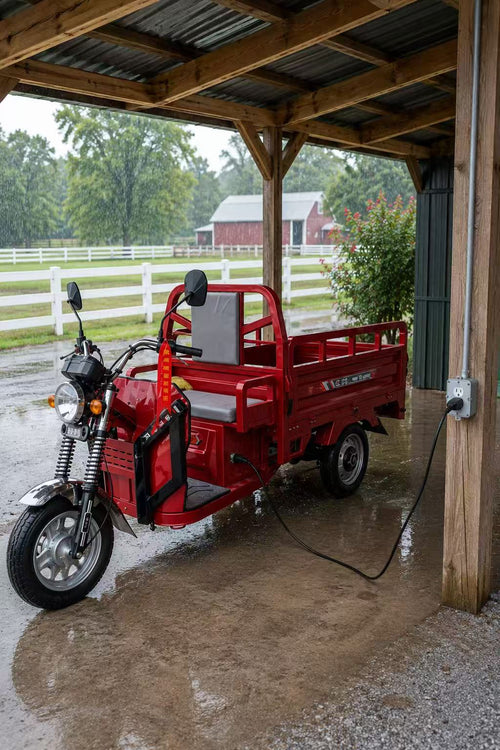
A farm is not a smooth city street. Rural roads can be gravel, dirt, grass, mud, uneven lanes, barn entrances, narrow gates, and field edges. A vehicle that looks practical in a product photo may not be practical if the route is too rough, the cargo is too heavy, or the ground changes after rain.
So the answer is not yes for every farm.
An electric cargo trike can be a good idea for some farm routes, some cargo types, and some daily jobs. It is not a replacement for every ATV, UTV, tractor, or pickup.
The real question is where it fits.
Why Farmers Consider an Electric Cargo Trike
Many farm jobs are not large enough for a tractor but still too repetitive for hand carrying.
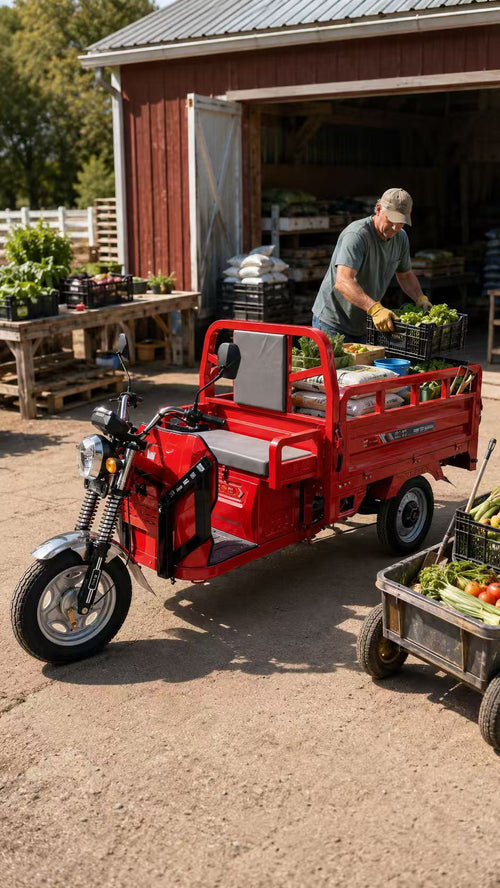
A worker may need to move feed bags from storage to the barn. Another trip may carry tools to a fence line. Later, the same vehicle may move buckets, seed trays, produce crates, or repair supplies.
These jobs are small, but they happen again and again.
That is where an electric cargo trike can make sense.
It gives the farm a compact vehicle for short-distance hauling. It can reduce walking, reduce wheelbarrow use, and reduce unnecessary starts of a gas ATV, UTV, or pickup.
The value is not one big load.
The value is repeated daily movement.
Where It Works Best
An electric cargo trike works best on farm routes that are reasonably firm, short, and repeated.
Good routes include:
barn to feed room
storage shed to greenhouse
garden rows to packing area
nursery aisle to loading area
orchard edge to tool shed
livestock area to supply room
farm stand to storage area
rural home to outbuilding
These routes do not require extreme off-road power. They require a small work vehicle that can carry useful loads at low speed.
If the route is mostly flat dirt, firm gravel, compacted farm lane, or maintained rural path, an electric cargo trike can be practical.
If the route is deep mud, steep hill, large rocks, soft pasture after rain, or rough off-road trail, the buyer should be more cautious.
Rural Roads Are Different from City Roads
A rural road may look simple, but it changes how the vehicle performs.
Gravel can shift under tires. Dirt roads can become soft after rain. Grass can hide uneven ground. A small slope can feel different when the cargo bed is loaded.
That is why a farm buyer should not only ask about speed or range.
For rural roads, more important questions include:
Will the road stay firm after rain?
Is the route flat or sloped?
Are there deep ruts?
Is the gravel loose or compact?
Will the vehicle carry a load while turning?
Is there enough braking control when loaded?
Can the trike pass through gates and barn lanes?
Will the route be used near animals or workers?
An electric cargo trike can be useful on rural roads, but only when the route matches the vehicle.
Why Low-Speed Control Matters More Than Speed
Some buyers compare vehicles by top speed. For farm use, that is usually not the best standard.
A farm vehicle often works near barns, animals, people, tools, crates, fences, gates, and uneven surfaces. Speed is not the main value.
Low-speed control matters more.
A useful farm cargo trike should start smoothly, turn predictably, stop safely, and carry a balanced load without feeling unstable.
This is especially important when the cargo bed contains feed bags, tools, buckets, seed trays, or produce crates.
A fast vehicle that is hard to control while loaded is not helpful.
A slower vehicle that moves predictably may be more useful for daily farm work.
What It Can Carry Well
An electric cargo trike is a good idea when the main cargo is solid, manageable, and loaded by hand.
Common suitable cargo includes:
feed bags
fertilizer bags
toolboxes
buckets
harvest crates
produce boxes
seed trays
nursery supplies
fencing supplies
small farm equipment
daily maintenance items
These loads fit well with an open cargo bed because the worker can load and unload from the side or rear.
A roof canopy can also make repeated trips more comfortable by giving the operator some protection from sun and light rain.
But the cargo should still be arranged carefully.
Low and balanced loading is better than stacking cargo too high. Even if the vehicle has enough power, a high or uneven load can affect stability on rural roads.
When It Is Not the Best Idea
An electric cargo trike is not the right answer for every farm job.
It may not be suitable if the farm mainly needs:
heavy towing
deep mud travel
steep hill climbing
large field crossing
rocky off-road routes
very heavy loose material
long-distance rural travel
work in extremely rough terrain
In those cases, a tractor, UTV, ATV, or larger farm vehicle may be a better fit.
This point matters because a good buying decision should not force one vehicle into every job.
An electric cargo trike is best used as a short-route utility vehicle, not as a complete replacement for all farm equipment.
Can It Replace a Gas ATV or UTV?
For some daily farm jobs, yes.
For all farm jobs, no.
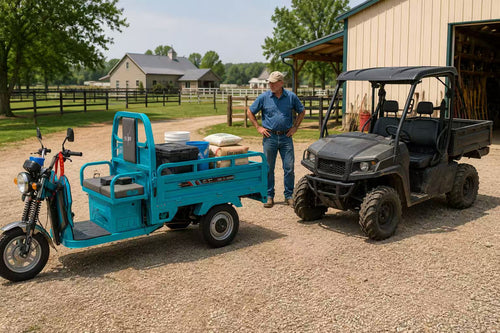
A gas ATV or UTV may still be better for towing, rough off-road travel, steep terrain, and heavy-duty work.
But many farms use a gas vehicle for small repeated trips that do not really need that much machine.
For example:
moving two feed bags
carrying tools to a barn
transporting seed trays
moving produce crates to packing
taking buckets and supplies across the property
checking small work areas
For these jobs, an electric cargo trike may be quieter, easier to operate, and less expensive to run.
The best way to think about it is not:
Will this replace my UTV?
The better question is:
Which small daily trips can this take away from my UTV, pickup, wheelbarrow, or hand carrying?
That is where the vehicle can make sense.
Why Quiet Operation Can Help on Farms
Electric cargo trikes are usually quieter than gas vehicles.
That can matter around animals, workers, barns, greenhouses, and residential rural properties.
A quieter vehicle may be useful near:
horse stables
dairy barns
poultry areas
livestock pens
greenhouses
farm stands
nurseries
rural homes
Noise is not only about comfort. In some farm environments, less noise can make daily movement less disruptive.
But quiet operation does not make the vehicle suitable for every terrain.
The road still needs to be usable. The load still needs to be balanced. The vehicle still needs enough control for the route.
Frame, Tires, and Ground Conditions Matter
Some buyers ask whether fat tires, stronger frames, or heavier construction are needed for farm use.
That question makes sense.
Farm routes can be harder on a small vehicle than smooth pavement. The buyer should pay attention to frame strength, tire type, wheel size, braking, suspension, and rear axle design.
But these parts should be judged together with the route.
A farm with firm gravel lanes may not need the same setup as a farm with soft muddy paths. A greenhouse route may need compact size and careful control more than aggressive tires. A rural property with slopes may need braking confidence more than top speed.
The vehicle should match the ground, not just the product specification sheet.
Open Bed or Dump Bed?
For rural farm use, the cargo bed also matters.
An open cargo bed is practical for solid cargo such as feed bags, tools, buckets, crates, and farm supplies.
A dump bed becomes more useful when the farm moves loose material such as manure, compost, wet soil, mulch, gravel, or cleanup loads.
The difference is unloading.
If the worker can unload by hand, an open bed may be enough.
If the worker has to shovel out loose material after every trip, a dump bed may save more labor.
So the buyer should ask two questions together:
What do I carry?
How do I unload it?
That will usually make the body style decision clearer.
A Good Fit for Small Farms and Daily Chores
An electric cargo trike is often most useful for small farms, hobby farms, greenhouses, nurseries, orchards, rural homes, and livestock properties that have repeated daily chores.
It can be especially useful when the farm has:
short internal routes
manageable cargo
firm gravel or dirt paths
many small trips per day
limited space for larger vehicles
need for quiet operation
regular feed, tools, or crate movement
work near barns, fences, and storage areas
The vehicle does not need to be the biggest machine on the property.
It needs to be the one that is easy to use often.
The Real Test: Your Daily Route
Before buying, walk the daily route and look at the ground.
Do not only look at the vehicle photo.
Check the actual route:
Where will the vehicle start?
Where will it load?
Where will it unload?
What is the worst ground section?
What happens after rain?
How much cargo will be carried?
Will the route include slopes?
Are the gates wide enough?
Can the vehicle turn safely?
Will the operator use it many times per day?
This is the real test.
A vehicle can be a good idea in general, but the buyer needs to know whether it is a good idea for this farm, this route, and this load.
Final Answer: Is It a Good Idea?
An electric cargo trike can be a good idea for farm use when the job is short-distance, repeated, low-speed, and focused on carrying manageable loads.
It works best on firm farm roads, gravel lanes, flat dirt paths, greenhouse routes, nursery aisles, barn areas, and rural property roads.
It is useful for feed bags, tools, produce crates, seed trays, buckets, supplies, and many daily chores.
It is not the best choice for deep mud, steep hills, rocky trails, heavy towing, or extreme off-road work.
So the answer is not simply yes or no.
The better answer is:
Yes, if the vehicle matches the cargo, the rural road, and the daily route.
That is the right way to judge whether an electric cargo trike makes sense for farm use.