When an Electric Cargo Trike Is Not the Right Choice for Farm Work
Share
An electric cargo trike can be useful for many farm jobs, but it is not the right vehicle for every farm.
That point matters.
Many buyers first notice the low cost, quiet electric operation, compact size, and open cargo bed. Those are real advantages for short farm routes. But if the job is too heavy, the ground is too rough, or the buyer expects it to replace every ATV, UTV, tractor, or pickup, the decision can become wrong very quickly.
For agricultural use, the best buying decision is not only knowing when an electric cargo trike works.
It is also knowing when it does not.
Do Not Use It as a Heavy Towing Machine
An electric cargo trike is mainly a carrying vehicle, not a heavy towing vehicle.
It can move feed bags, tools, harvest crates, buckets, seed trays, fertilizer bags, and daily farm supplies in the rear cargo bed. That is different from pulling heavy trailers, dragging equipment, or towing large farm attachments.
If the main job is heavy towing, a tractor, UTV, ATV, or larger utility vehicle may be more suitable.
A buyer should ask:
Am I carrying cargo in the bed, or am I trying to pull heavy equipment?
If the answer is towing, a small electric cargo trike may not be the right choice.
Deep Mud Is a Warning Sign
Light dirt roads, gravel lanes, barn paths, and firm rural routes can fit an electric cargo trike well.
Deep mud is different.
Mud reduces traction, increases rolling resistance, and makes a loaded vehicle harder to control. Even if the motor has enough power, the tires may not have enough grip. A loaded cargo bed can also make the vehicle sink more easily into soft ground.
If the farm route often becomes deep, soft, and rutted after rain, the buyer should be careful.
In that case, the better solution may be to improve the route first with gravel, drainage, or a firmer path. If the route cannot be improved, a larger off-road vehicle may be the better choice.
An electric cargo trike should not be treated as an extreme mud vehicle.
Steep Hills Change the Risk
Small slopes may be manageable when the vehicle is lightly loaded and the route is firm.
Steep hills are different.
A hill is not only about climbing power. The buyer also has to think about stopping, turning, and coming back down while loaded.
A cargo trike carrying feed bags, tools, or crates behaves differently from an empty vehicle. If the load is stacked too high or placed unevenly, the vehicle can feel less stable on slopes.
For steep farm roads, buyers should be cautious.
The key question is not only:
Can it climb?
The better question is:
Can it climb, stop, turn, and come down safely with my normal load?
If the answer is uncertain, a heavier-duty UTV, ATV, tractor, or different farm vehicle may be safer.
Rocky or Rough Off-Road Routes Are Not the Best Fit
An electric cargo trike is not designed to replace a rock-crawling off-road vehicle.
If the daily route includes large rocks, deep ruts, broken ground, uneven pasture, or rough trails, this type of vehicle may not be the best match.
A farm cargo trike works better when the route is practical and repeatable:
flat dirt road
barn-to-storage route
greenhouse path
nursery aisle
packing area road
farmyard path
rural property lane
It does not need a perfect paved road, but it should not be forced into extreme terrain.
If the road is too rough for stable low-speed cargo movement, the problem is the route, not only the vehicle.
Do Not Choose an Open Bed for Loose Wet Material
An open cargo bed is useful for solid cargo.
It works well for:
feed bags
fertilizer bags
toolboxes
buckets
harvest crates
produce boxes
seed trays
farm supplies
small equipment
But loose wet material is different.
Manure, wet soil, compost, mulch, gravel, and cleanup loads can be hard to unload by hand. If the worker has to shovel everything out after every trip, the vehicle only solves the transport problem, not the unloading problem.
For this type of work, a hydraulic dump model may make more sense.
The buyer should ask:
Can I unload this cargo by hand easily?
If the answer is no, an open-bed cargo trike may not be the right setup.
Do Not Expect a Roofless Open Vehicle to Protect the Operator
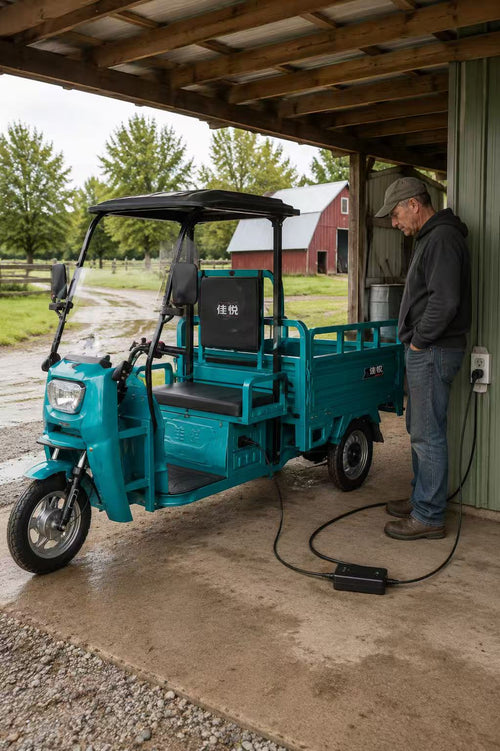
Some electric cargo trikes have roof canopies. Some do not.
A roofless open vehicle may be simple and practical, but it gives little protection from sun, rain, wind, dust, or cold weather.
That may be fine for short trips, mild weather, and occasional farm use. But if the operator will use the vehicle many times per day under hot sun or light rain, a canopy model may be more comfortable.
This does not mean every buyer needs a canopy.
It means the buyer should match the vehicle to the working conditions.
If operator comfort and weather exposure matter, a roofless open model may not be the best choice.
Do Not Use It for Long-Distance Farm Travel
An electric cargo trike is strongest on short repeated routes.
It is not mainly built for long-distance rural travel.
A farm may have short internal routes where this vehicle makes sense:
storage shed to barn
greenhouse to packing area
feed room to animal area
field edge to tool shed
garden to wash station
nursery row to loading area
These routes are repeated often and usually happen at low speed.
But if the buyer needs long-distance travel across large rural properties, long field roads, or remote off-road areas, range and terrain may become bigger concerns.
For long distances, a larger farm vehicle may be more suitable.
Do Not Overload It Just Because It Has a Cargo Bed
A cargo bed can make a vehicle look stronger than it should be used.
That is a common mistake.
Even when the vehicle has a useful rear bed, buyers should avoid overloading it or stacking cargo too high. A heavy or tall load can affect braking, turning, balance, and tire performance.
This is especially important on gravel, dirt, slopes, and uneven ground.
For farm work, a low and balanced load is safer than a high load that reaches the top of the side rails.
The right question is not only:
How much can it carry?
The better question is:
Can it carry this load safely on my route?
Do Not Buy It Only Because It Is Cheaper Than a UTV
Lower cost is one reason buyers consider electric cargo trikes.
But low price should not be the only reason.
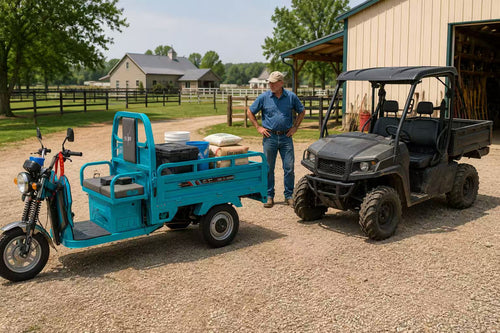
A UTV, ATV, tractor, pickup, wheelbarrow, and electric cargo trike do not solve the same problem.
A cargo trike can be useful for repeated short-distance carrying. It can reduce walking, small pickup trips, and unnecessary gas vehicle use. It can be quiet, simple, and practical around barns, greenhouses, nurseries, gardens, and rural properties.
But it is not automatically a full replacement for a UTV.
If the buyer needs heavy towing, extreme off-road ability, high speed, steep hill performance, or long-distance travel, the lower price may not solve the real job.
A good purchase starts with the work, not the price gap.
When a Different Vehicle May Be Better
A different vehicle may be better if the farm mainly needs:
heavy towing
deep mud travel
steep hill use
rocky off-road routes
long-distance field travel
large trailer pulling
heavy loose material hauling
all-weather operator protection
high-speed rural movement
very large cargo volume
In these cases, a tractor, UTV, ATV, pickup, dump vehicle, or larger electric utility vehicle may be the better tool.
This does not make an electric cargo trike useless.
It simply means it should be used for the right job.
Where an Electric Cargo Trike Still Makes Sense
After listing the limits, the strong use case becomes clearer.
An electric cargo trike can make sense when the job is:
short-distance
low-speed
repeated daily
focused on carrying, not towing
used on firm routes
loaded with manageable cargo
operated near barns, storage, greenhouses, nurseries, or livestock areas
used for feed, tools, crates, buckets, trays, and farm supplies
This is where the vehicle can be very practical.
It fills the gap between a wheelbarrow and a larger gas vehicle.
It is more capable than hand carrying, but smaller and simpler than a UTV or pickup for small daily jobs.
The Right Question Before Buying
Before choosing an electric cargo trike for farm work, ask these questions:
Is my route firm enough?
Is the route mostly flat or only slightly sloped?
Will the vehicle carry cargo instead of towing equipment?
Can I unload the cargo by hand?
Is the cargo solid, bagged, boxed, or crated?
Do I need a dump bed instead?
Do I need a roof canopy?
Will the vehicle be used many times per day?
Am I expecting it to replace a UTV, or only reduce small daily trips?
What is the worst ground condition after rain?
These questions help prevent the wrong purchase.
Final Answer
An electric cargo trike is not the right choice for every farm job.
It is not the best tool for deep mud, steep hills, heavy towing, rocky trails, long-distance travel, or loose wet material that needs dumping.
It is also not the best choice if the buyer needs full weather protection or expects it to replace every larger farm vehicle.
But for short, repeated, low-speed farm routes, it can be a practical daily work vehicle.
The best use is not extreme off-road work.
The best use is simple, repeated agricultural carrying: feed bags, tools, crates, buckets, trays, and farm supplies moved around a property many times per week or many times per day.
The right buyer is not asking whether this vehicle can do everything.
The right buyer is asking whether it can take over the small farm trips that happen again and again.