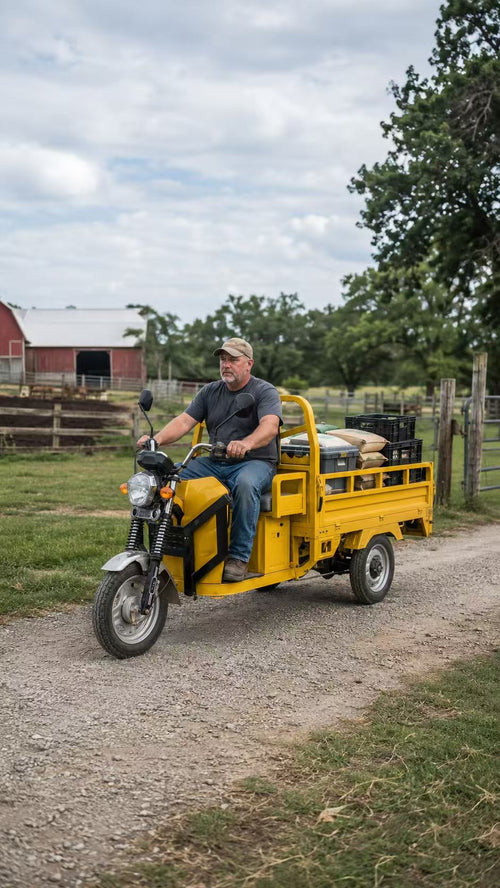
Will Cold Weather Cut the Range of an Electric Farm Utility Trike Too Much?
Share
Cold weather is one of the first concerns buyers raise when they consider an electric farm utility trike.
They may ask:
Will the battery lose too much range?
Will the vehicle still finish the normal farm route?
Will cold weather make the machine unreliable?
Will the battery need to be charged more often?
Will an electric utility trike still make sense in winter?
These are reasonable questions.
Cold temperatures can reduce available battery performance.
But that does not automatically mean an electric farm utility trike becomes impractical.
The real answer depends on:
the battery type
the battery condition
the outside temperature
the route length
the cargo load
the ground condition
the number of trips
the amount of climbing
the charging routine
the distance from the charging area
For a short private-site route, winter range loss may have very little practical effect.
For a buyer already using almost all available range every day, the same winter conditions may become a serious limitation.
The important question is not only:
How much range is lost?
The better question is:
How much of the vehicle’s available range does my real winter route require?
Cold Weather Does Not Affect Every Buyer the Same Way
Two buyers can use the same electric farm utility trike and have completely different winter experiences.
One buyer may travel only between:
a barn
a feed area
a greenhouse
a workshop
a storage shed
a nearby animal enclosure
The total daily distance may be short.
The vehicle may return to the same charging point several times during the day.
Even if cold weather reduces available range, the buyer may still use only a small part of the battery capacity.
Another buyer may travel long distances across a large property.
The route may include:
slopes
snow
soft ground
mud
heavy cargo
frequent stops
long periods away from charging
For that buyer, winter range matters much more.
This is why one fixed percentage cannot answer the question for every farm.
What Cold Weather Can Change
Battery systems generally work less efficiently in cold conditions.
The vehicle may have less usable energy than it has in mild weather.
The operator may notice:
shorter driving distance
slower charging
reduced performance under heavy load
more noticeable voltage drop
less reserve capacity at the end of the route
The effect may become stronger when cold weather is combined with other demands.
For example:
a heavy load requires more energy
a steep route requires more energy
soft ground creates more rolling resistance
snow increases resistance
low tire pressure increases resistance
frequent acceleration increases energy use
Cold weather is therefore only one part of the winter range problem.
The buyer must evaluate the complete route.
Do Not Use One Fixed Winter Range Number
It is tempting to write that winter always reduces range by a specific percentage.
That would be misleading.
Actual winter performance varies according to:
battery chemistry
battery age
state of charge
battery temperature
vehicle weight
cargo weight
route surface
slope
wind
stop-and-start frequency
charging conditions
A healthy battery used on a short, firm route may still perform well.
An older battery used under heavy load on snow, mud, or steep ground may lose useful range much faster.
The buyer should not rely on one generic number from another vehicle.
The correct approach is to create a winter operating margin.
What Is a Winter Operating Margin?
A winter operating margin means the buyer does not plan the route around the maximum advertised range.
The vehicle should have energy left after the normal work is complete.
For example, the buyer should not plan a route that already uses nearly all available capacity in mild weather.
There should be reserve for:
lower temperature
unexpected extra trips
heavier cargo
detours
soft ground
battery aging
delayed charging
A buyer who normally uses only a modest part of the battery has more flexibility.
A buyer whose route already pushes the vehicle close to empty has less flexibility.
The advertised range is not the same as the safe daily working range.
The daily working range should include reserve capacity.
Short Private-Site Routes Are Different
Many electric cargo trike for farm applications involve short, repeated routes.
The vehicle may travel:
from feed storage to animal pens
from the barn to the workshop
from the greenhouse to the packing area
from a warehouse to an outdoor loading point
from a nursery storage area to plant rows
from a maintenance shed to a work zone
These trips may only take a few minutes.
The vehicle may stop frequently.
It may return to the same building many times.
This type of route can fit an electric farm utility trike well, even in winter.
The buyer does not need the longest possible range.
The buyer needs enough useful range for:
the morning workload
a possible midday charging period
the afternoon workload
a full recharge before the next day
This is a different operating model from a gasoline UTV traveling long distances without returning to base.
Morning Work Can Carry the Highest Demand
Many farms complete their most concentrated work in the morning.
The vehicle may be used to move:
feed bags
tools
animal-care supplies
boxes
crates
repair parts
garden materials
nursery trays
winter maintenance supplies
The operator may complete several short trips before lunch.
If cold weather reduces available range, the buyer can plan the highest-priority work first.
The most important loads can be moved while the battery is at its strongest charge level.
The operator can also avoid unnecessary trips by combining loads when practical.
A large cargo bed can help reduce repeated travel.
Instead of moving one small item at a time, the buyer can carry several compatible items in one trip.
That can reduce total energy use.
Use the Lunch Break as a Charging Window
A useful electric farm work pattern is:
people work in the morning
people stop for lunch
the vehicle charges during the break
people return to work
the vehicle returns to service
This does not require extra labor time.
The operator is already resting and eating.
The vehicle can use the same period to add energy.
For short private-site work, a midday charging period may reduce the practical effect of winter range loss.
The vehicle may not need to reach a complete charge during lunch.
It only needs to add enough energy for the afternoon route.
The buyer should consider:
how much battery remains at lunch
how long the break lasts
how much work remains
whether the afternoon load is heavy
whether the route includes slopes or snow
This makes range management part of the work schedule.
It does not need to become a major interruption.
A Midday Charge Is Not a Sign of Failure
Some buyers think that charging during the day means the vehicle does not have enough range.
That is not always true.
Many machines are used around natural work pauses.
Workers refuel equipment.
They change batteries in tools.
They charge radios and handheld equipment.
They maintain machines between work periods.
Using a lunch break for charging can be a practical operating decision.
The key question is whether the charging schedule fits the work.
If the vehicle completes the required jobs without delaying the operation, the system is working as intended.
For a short-route farm utility trike, midday charging can be completely reasonable.
Overnight Charging Prepares the Vehicle for the Next Day
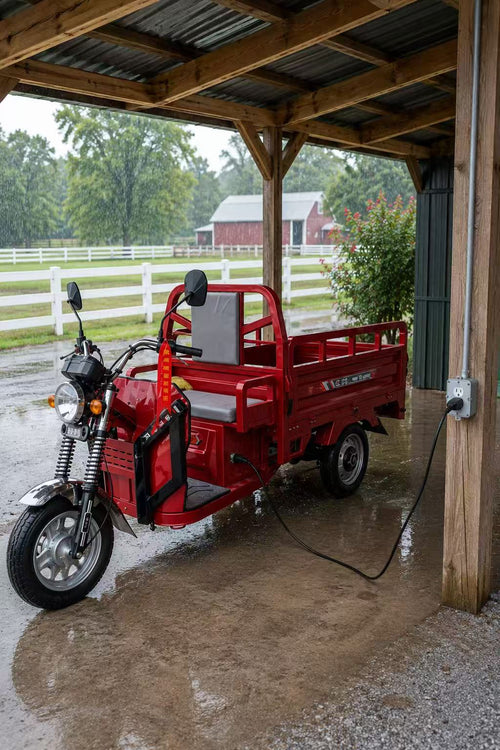
After the day’s work is complete, the vehicle can return to its covered outdoor charging area.
The charging location should be:
protected from rain
dry
ventilated
away from hay, fuel, and chemicals
equipped with a suitable outlet
clear of animal traffic
free from standing water
The buyer should use the charger matched to the vehicle and battery system.
Many matched chargers are designed to reduce, stop, or maintain charging automatically after the battery reaches the intended charge level.
However, the owner should still follow the instructions for the specific charger and battery system.
The buyer should not assume that every charger operates in exactly the same way.
A full overnight charging cycle can prepare the electric farm utility trike for the next morning.
For daily short-distance work, this pattern can be very practical:
morning use
midday top-up if needed
afternoon use
overnight recharge
Cold Weather May Not Cause a Real Work Problem
A reduction in available range only becomes a practical problem when it prevents the vehicle from completing the required work.
If the vehicle normally travels only a small part of its available range, winter loss may not change the workday.
For example, a buyer may only need the trike for:
several short feeding trips
moving tools between buildings
carrying boxes to a packing area
transporting nursery supplies
property-maintenance work near the barn
Even when winter conditions reduce available energy, the vehicle may still have more than enough capacity for those jobs.
The buyer should compare the winter route with the vehicle’s realistic working reserve.
Do not compare winter performance only with the maximum advertised number.
The practical question is:
Does the vehicle still complete my normal winter route with energy remaining?
When Winter Range Becomes More Important
Cold weather range deserves more attention when the buyer needs:
long daily routes
continuous work away from charging
heavy cargo on most trips
regular uphill travel
operation in deep snow
operation in mud or soft ground
high daily mileage
fast turnaround with no charging pause
work far from the barn or charging point
If several of these conditions happen together, the buyer may need a different solution.
That solution may include:
a larger battery system
a lithium option designed for the climate
a second battery or backup vehicle
a four-wheel electric UTV
a gasoline UTV
an ATV
a tractor
another purpose-built machine
The electric farm utility trike should not be forced into work beyond its design.
It is a low-speed private-site cargo tool.
It is not a long-distance winter off-road vehicle.
The Ground Can Matter as Much as the Temperature
A cold, firm gravel route may use less energy than a warmer muddy route.
A snow-covered route can increase rolling resistance.
Deep mud can require much more energy.
Soft soil can slow the vehicle.
Ruts can cause repeated acceleration and steering corrections.
This means buyers should not blame every winter range change on temperature.
They should also inspect:
snow depth
mud depth
route firmness
tire pressure
wheel drag
load balance
slope
A route that becomes difficult in winter may need maintenance, drainage, gravel, snow clearing, or an alternate path.
A stronger battery cannot repair a bad route.
The route and vehicle should work together.
Heavy Cargo Reduces the Winter Margin
A loaded vehicle requires more energy than an empty one.
The buyer should not test winter range only while the cargo bed is empty.
The real working test should reflect normal cargo.
That may include:
feed bags
tools
crates
boxes
small equipment
animal-care supplies
winter maintenance materials
The load should remain:
within the vehicle rating
low in the cargo bed
balanced from side to side
secured when necessary
A high, uneven, or excessive load can reduce stability and increase energy use.
The buyer should also avoid carrying unnecessary weight.
Winter route planning should use the regular working load, not the lightest possible condition.
Battery Condition Matters
An older or poorly maintained battery may show more noticeable winter performance loss.
Before assuming the weather is the only problem, the owner should check:
battery age
charging behavior
terminal condition
cable condition
charger operation
whether the battery reaches its intended charge
whether the battery is repeatedly deeply discharged
For lead-acid systems, routine battery care may also include checking the requirements of the specific battery type.
For lithium systems, the buyer should confirm that the battery management system is working correctly.
A weak battery cannot be corrected only through better route planning.
It may need testing, service, or replacement.
Low-Temperature Charging Needs Special Attention
Some lithium battery systems should not be charged below certain temperatures unless they include suitable low-temperature protection or heating.
The battery management system may limit or stop charging when the battery is too cold.
This protection can prevent unsafe charging conditions.
The buyer should ask:
Can this battery charge below freezing?
Does it include low-temperature charging protection?
Does it include internal heating?
What temperature range is allowed?
How long should the battery warm before charging?
Lead-acid batteries also require winter care.
A discharged lead-acid battery is more vulnerable to freezing than a properly charged battery.
The owner should avoid leaving the vehicle deeply discharged during cold weather.
The correct charging routine depends on the actual battery system.
Canopy Protection Helps the Operator, Not the Battery Range
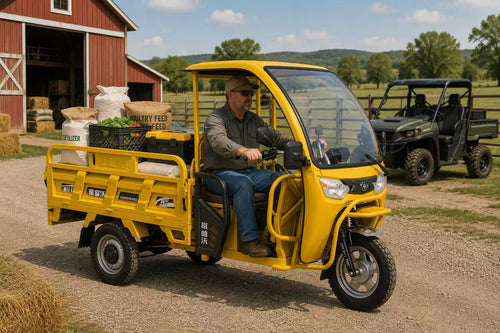
A canopy electric utility trike can improve operator comfort during short winter work.
It may reduce direct exposure to:
light rain
snowfall
wind
sun
However, a canopy does not create a heated cab.
It does not warm the battery.
It does not prevent winter range loss.
It does not turn the vehicle into an all-weather UTV.
The canopy helps the operator.
The battery and route still need separate planning.
Buyers should not confuse operator weather protection with battery performance.
How to Calculate a Real Winter Route
A buyer can make a simple route plan before purchasing.
First, identify the charging point.
Second, identify the farthest regular work area.
Third, record the distance for one round trip.
Fourth, estimate how many trips happen in one day.
Fifth, include the normal cargo load.
Sixth, note slopes, mud, snow, and soft ground.
Seventh, decide whether midday charging is available.
Eighth, keep a reserve for unexpected work.
The buyer should plan around a conservative winter route, not a perfect summer test.
A useful question is:
If the weather is cold, the vehicle is loaded, and one extra trip is required, can it still return to the charging area with reserve remaining?
If the answer is yes, the route may be suitable.
If the answer is no, the buyer should reduce the route, add charging time, choose a larger battery system, or select another machine.
Do Not Judge Winter Use by One Bad Day
One extremely cold day does not always represent the entire winter.
A buyer should look at:
normal winter temperatures
the coldest expected days
how often extreme cold occurs
whether work can be rescheduled
whether the vehicle can be stored under cover
whether charging can happen during lunch
Some farms can avoid using the trike during the most extreme conditions.
Other operations must work every day.
The correct equipment decision depends on how essential the vehicle is during severe weather.
A backup plan may be more important than trying to make one machine handle every condition.
When a Gas Utility Vehicle Still Makes More Sense
A gasoline utility vehicle may remain the better choice when the buyer needs:
fast refueling
long continuous operation
remote work far from electricity
heavy towing
deep snow performance
rough off-road routes
daily use close to the maximum range
This does not mean electric vehicles cannot work in winter.
It means the machine must match the job.
A buyer should not choose electric only because it is quiet or simple.
A buyer should not choose gasoline only because it is familiar.
The real route should decide.
Questions to Ask Before Buying
Before purchasing an electric farm utility trike for winter use, the buyer should ask:
What battery type is included?
What is the rated capacity?
What winter operating temperature is recommended?
What charging temperature is allowed?
Does the lithium version include low-temperature protection?
What charger is supplied?
How long is a normal full charging cycle?
Can the vehicle be charged during lunch?
Can it be charged overnight in a covered outdoor area?
What daily route is realistic under load?
How much reserve should remain?
What replacement battery options are available?
Can local technicians service the battery and charger?
These answers should match the actual model.
Generic electric vehicle claims are not enough.
A Practical Winter Work Schedule
For many short-distance operations, a practical schedule may look like this:
Morning:
Begin with a properly charged battery.
Complete the heaviest and highest-priority transport work first.
Combine compatible loads to reduce unnecessary trips.
Keep the cargo low and balanced.
Lunch:
Park in the covered charging area.
Check that the charger, plug, and ground are dry.
Connect the matched charger.
Allow the vehicle to add energy while workers eat and rest.
Afternoon:
Confirm the remaining charge.
Complete the second work period.
Reduce unnecessary trips.
Avoid soft or snow-covered routes when a firm alternative is available.
Evening:
Return the vehicle to the covered charging area.
Inspect the charger and cable.
Complete the recommended charging cycle for the next day.
This schedule can reduce the practical effect of winter range loss without adding a separate work interruption.
Final Thought
Will cold weather cut the range of an electric farm utility trike too much?
For some buyers, it may.
For many short private-site routes, it may not create a serious working problem.
Cold weather can reduce available battery performance.
Heavy cargo, slopes, snow, mud, low tire pressure, and battery age can reduce it further.
But the buyer should not judge the vehicle only by the maximum advertised range or by one fixed winter-loss percentage.
The correct decision depends on the real route.
If the daily work is short, low-speed, cargo-focused, close to a charging area, and divided into morning and afternoon periods, a midday charging break and an overnight charging cycle may keep the vehicle ready for regular work.
If the route is long, remote, steep, heavily loaded, or dependent on continuous winter operation, a larger battery system, a four-wheel UTV, a gasoline machine, or another purpose-built vehicle may be the better choice.
The goal is not to eliminate every effect of cold weather.
The goal is to build a work schedule and equipment choice that still completes the job.