Open Bed or Covered Box: Which Electric Cargo Trike Setup Fits Agricultural Work?
Share
Before buying an electric cargo trike for agricultural use, many buyers compare motor power, range, and payload.
Those numbers matter, but the cargo body style may matter just as much.
For farm work, one important question is:
Do you need an open cargo bed, a covered box, or a dump bed?
This question is not only about appearance. It affects how the vehicle loads, unloads, protects cargo, handles mixed farm supplies, and fits daily agricultural routes.
A farm that moves feed bags and tools may need a different setup from a farm that delivers produce to a farmers market. A property that moves wet soil or manure may need something different again.
That is why the cargo body should be matched to the job before choosing the vehicle.
What an Open Cargo Bed Does Best
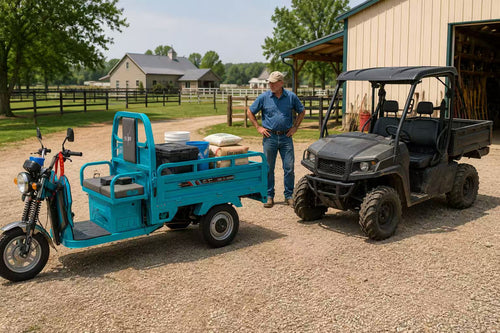
An open cargo bed is the most flexible setup for many daily farm jobs.
It works well when the cargo is solid, hand-loaded, and moved across short routes. The operator can load from the side, arrange different items quickly, and unload at several stops around the farm.
An open bed is useful for:
feed bags
fertilizer bags
toolboxes
buckets
harvest crates
produce boxes
seed trays
fencing supplies
nursery materials
small equipment
daily farm supplies
For this type of work, the main advantage is access.
A farm worker may not be doing one large delivery. The worker may be making many small trips between the barn, storage shed, greenhouse, field edge, feed room, and packing area.
An open cargo bed makes those small repeated trips easier because cargo can be loaded and removed quickly.
When an Open Bed Makes the Most Sense
An open bed makes the most sense when the cargo does not need full weather protection and does not need to be dumped.
For example, feed bags, toolboxes, buckets, and harvest crates can usually be loaded by hand. They can be placed low in the cargo bed and removed at the destination.
This setup fits farms that need flexibility more than enclosure.
It is especially practical when the vehicle is used for mixed daily work. One trip may carry tools. Another trip may carry feed. Later, the same vehicle may move produce crates, seed trays, or repair supplies.
For mixed agricultural work, an open bed is often easier than a covered box because the cargo type changes throughout the day.
Roof Canopy Is Not the Same as a Covered Cargo Box
This is an important point.
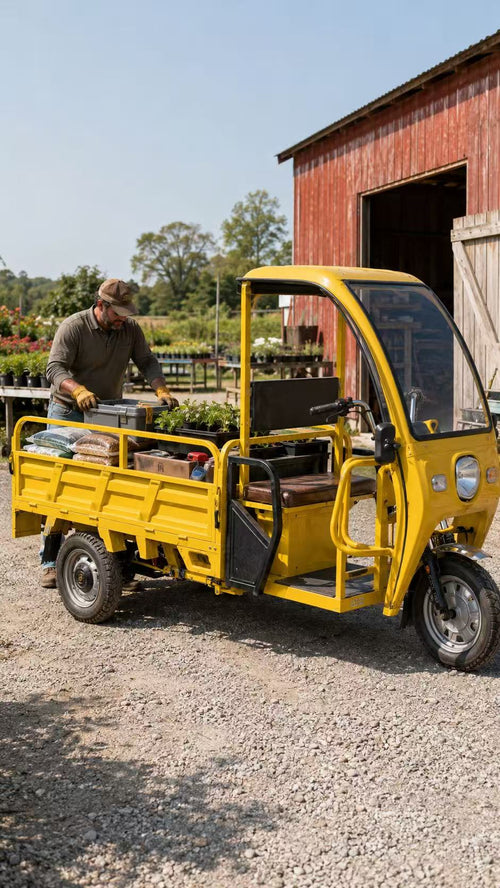
Some electric cargo trikes have a roof canopy over the operator. That canopy can help with sun and light rain while driving. It can make daily farm use more comfortable, especially when the vehicle is used many times per day.
But a roof canopy does not fully protect the cargo.
A canopy protects the driver area more than the cargo bed. The rear cargo area remains open. Rain, dust, wind, and sunlight may still reach the load.
So a roof canopy and a covered cargo box solve different problems.
A roof canopy helps the operator.
A covered box protects the cargo.
For many farm jobs, a canopy-equipped open-bed trike is a practical middle choice. It keeps the loading area simple and flexible while giving the operator some overhead protection.
When a Covered Box Makes More Sense
A covered box or enclosed cargo body makes more sense when the cargo needs protection.
This may include:
packaged produce
farmers market goods
delivery items
tools that must stay dry
boxed products
clean supplies
weather-sensitive cargo
small commercial goods
If the vehicle is used for farm-to-market transport, local delivery, or packaged goods movement, a covered box may be more suitable than an open bed.
A covered box can protect cargo from rain, dust, and road debris. It can also make the vehicle look more organized for route-based delivery.
But there is a tradeoff.
A covered box may reduce loading flexibility. It may be slower to load irregular items. It may not work as well for tall, mixed, or bulky farm supplies.
That is why a covered box should be chosen when cargo protection is more important than quick open access.
Open Bed vs Covered Box for Produce
Produce transport can go either way.
If the vehicle is moving harvest crates from field rows to a packing area, an open bed may be enough. The route is short, the cargo is handled quickly, and the worker needs fast loading and unloading.
If the vehicle is moving packaged produce to a roadside stand, farmers market, restaurant, or customer location, a covered box may make more sense. In that case, the cargo may need protection from weather, dust, and direct sun.
So the buyer should ask:
Is this farm-internal transport, or farm-to-market transport?
That one question can change the best cargo body choice.
Open Bed vs Covered Box for Tools
Tools also create different needs.
For quick repair work around a farm, an open bed is convenient. A worker can throw in toolboxes, fencing supplies, hoses, buckets, and small parts. The vehicle can stop at different locations, and the worker can access everything quickly.
But if expensive tools must stay protected from rain, dust, or theft, a covered box may be better.
A farm that uses the vehicle like a mobile maintenance cart may prefer open access.
A farm that uses the vehicle like a small service vehicle may prefer enclosure.
The correct choice depends on how the tools are used, not just what the tools are.
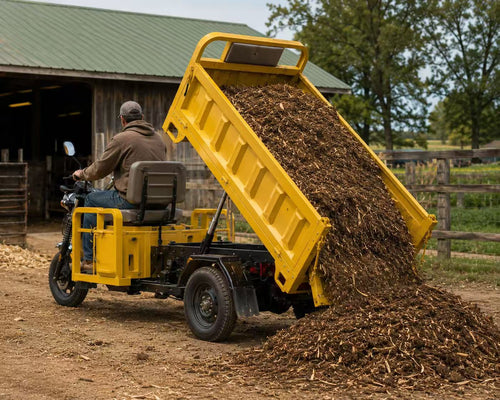
Where a Dump Bed Fits
Open bed and covered box are not the only choices.
For some agricultural work, a dump bed is the better option.
A dump bed makes sense when the cargo is loose, heavy, wet, or difficult to unload by hand.
This includes:
manure
wet soil
compost
mulch
gravel
loose fertilizer
farm cleanup loads
landscaping material
The key difference is unloading.
If a worker needs to shovel the cargo out after every trip, an open bed may save transport time but still leave too much labor at the unloading point.
A hydraulic dump bed can reduce unloading work when the material is loose and repeated.
So the decision should not be only:
How much can the vehicle carry?
The better question is:
How will the cargo be unloaded?
That question often decides whether an open bed, covered box, or dump bed is the better setup.
Farm Routes Also Affect the Choice
The cargo body should also match the route.
For short barn-to-feed-room trips, an open bed is usually practical.
For greenhouse-to-packing-area movement, an open bed may work well for trays and crates.
For farm-to-market transport, a covered box may be more suitable.
For manure, soil, or compost movement, a dump bed may be the better choice.
For mixed daily chores, an open bed with a roof canopy can be a flexible option.
The buyer should think about the route, the cargo, and the unloading method together.
A vehicle body that works well for one route may not be the best choice for another.
Do Not Choose by Looks Alone
Some buyers may choose a covered box because it looks more complete. Others may choose an open bed because it looks simple and strong.
But the best choice is not about appearance.
A covered box is not automatically better.
An open bed is not automatically more useful.
A dump bed is not automatically necessary.
Each body style solves a different problem.
Open bed solves access and flexibility.
Covered box solves cargo protection.
Dump bed solves unloading labor.
The right setup depends on which problem matters most on the farm.
A Simple Buying Checklist
Before choosing the cargo body style, ask these questions:
What do I carry most often?
Is the cargo bagged, boxed, crated, loose, wet, or fragile?
Do I need to load and unload many times per day?
Does the cargo need rain or dust protection?
Is the vehicle used only inside the farm, or also for local delivery?
Will I carry tools that need to stay dry?
Will I move produce to a market or only to a packing area?
Will I move manure, compost, gravel, or wet soil?
Do I need fast access or enclosed protection?
Do I need a dump bed to reduce unloading labor?
These questions are more useful than choosing only by cargo bed size or motor power.
Which Setup Fits Agricultural Work Best?
For many farms, an open-bed electric cargo trike is the most flexible choice for daily agricultural use.
It fits feed bags, tools, harvest crates, seed trays, buckets, and mixed farm supplies. A roof canopy can make the operator more comfortable during repeated short trips, while the open bed stays easy to load and unload.
A covered box is better when cargo protection matters more than flexible access. It can fit packaged produce, market goods, delivery items, and clean supplies.
A dump bed is better when the main work involves loose material that is hard to unload by hand.
The best setup depends on the real work.
If the farm needs quick daily hauling, choose open access.
If the cargo needs weather protection, consider a covered box.
If unloading loose material is the hard part, consider a dump bed.
For agricultural use, the cargo body should match the job, not just the product photo.