Trash Can Hauler, UTV, or Electric Cleaning Trike: What Works Best for a Long Driveway and Large Property?
The day before trash collection, a long driveway can turn a simple household task into a repeated hauling job.
One trash bin may not be a problem. But many large properties also need to move recycling bins, garbage bags, fallen branches, leaves, grass clippings, cleaning tools, fence repair materials, and other yard waste. On a farm, estate, park, apartment community, school, resort, or large rural home, the real question is no longer just how to move a trash can.
The real question is:
What is the most practical way to haul trash and yard waste across a long driveway or large property without wasting time, overworking the operator, or buying more vehicle than the job requires?
The answer depends on the distance, surface conditions, slope, number of waste collection points, load type, and how often the work must be repeated.
A simple trash can hauler may be enough for one property. Another property may need a golf cart, riding mower, UTV, open-cargo electric utility trike, or enclosed electric garbage collection trike.
The most useful way to choose is to start with the actual daily workload.
A Long Driveway Creates More Than One Waste Problem
Many homeowners begin by searching for the best way to move trash cans down a long driveway.
That search usually starts with one familiar problem: a heavy wheelie bin must travel several hundred feet from the house to the roadside. The difficulty increases when the driveway is gravel, curved, steep, muddy, icy, or covered with snow.
For older property owners or anyone with back, shoulder, or mobility limitations, manually pushing a full trash bin can become a serious physical burden.
However, large-property waste collection often grows beyond one or two roll-out garbage cans.
A typical grounds maintenance day may also include:
- moving loose leaves and branches
- carrying heavy yard waste bags
- collecting litter from several locations
- transporting recycling
- hauling grass clippings and brush
- moving tools and cleaning equipment
- carrying compost, mulch, feed bags, or fence materials
- collecting bagged waste from barns, workshops, guest areas, or rental units
This is the point where the job changes from “moving a trash can” to “managing material flow across a property.”
Option 1: Manually Push the Trash Bins
Manual movement has no equipment cost and works well when the driveway is short, level, smooth, and used by only one or two light bins.
It also requires no storage space and no vehicle maintenance.
The problem is repetition.
A heavy garbage can becomes difficult to control on a slope. Small trash-bin wheels create high rolling resistance on gravel and dirt. Rain, mud, snow, and ice make the task slower and less stable. A curved driveway may require repeated stopping and repositioning.
Manual pushing works best when:
- the distance is short
- the surface is paved and level
- the bins are not overloaded
- the task is infrequent
- the operator can handle the physical effort safely
It becomes a poor long-term solution when the route is long, steep, rough, or repeated every week.
Option 2: Use a Trash Can Hitch Attachment or Tow-Behind Hauler
For moving one or two standard trash cans, a trash can hitch attachment is often the most economical answer.
Products in this category connect a wheelie bin to an existing pickup, SUV, ATV, UTV, golf cart, lawn tractor, or riding mower. Some attach to a trailer ball. Others use a 2-inch receiver hitch. Certain designs allow the trash-bin wheels to remain on the ground, while lifting-style systems raise the bin partially or completely off the surface.
A tow-behind trash can hauler works best when:
- only one or two bins must be moved
- the property already has a suitable vehicle
- the route stays on private property
- the operator wants a low-cost solution
- the bins travel directly from one point to another
For a paved or short gravel driveway, a simple hitch attachment may solve the entire problem.
A lifting-style carrier can be more suitable for a long gravel driveway because it reduces wear on the trash can’s small wheels. It may also improve stability when transporting heavy bins.
However, a trash can hauler still has clear limits.
It does not provide a cargo box. It cannot carry loose branches, leaves, tools, multiple garbage bags, compost, or cleaning supplies unless those materials are first placed inside a bin.
A rear-mounted hauler can also be difficult to reverse on narrow or curved routes. The operator must confirm that the attachment fits the specific trash-bin handle or lower lifting bar. The hitch height, vehicle width, turning path, and bin size also matter.
The correct buying question is not simply, “Does it pull a trash can?”
It is:
“Does it fit my bin, my vehicle, my driveway, and the number of cans I move each week?”
Option 3: Use a Riding Mower or Garden Tractor
A riding mower can perform double duty on a large lawn. When fitted with a small utility trailer, dump cart, or trash can bracket, it can move bins, leaves, mulch, branches, and light yard waste.
This is often practical for homeowners who already own the machine.
A riding mower is most useful when:
- the property has a large maintained lawn
- the machine is already available
- waste hauling is a secondary task
- the ground is relatively firm
- the loads are light to moderate
Its main advantage is avoiding the purchase of another powered vehicle.
Its main disadvantage is that the machine was designed primarily for mowing, not constant hauling. Repeated heavy towing may increase wear on the transmission, belts, tires, and engine. Its long wheelbase and attached cart may also make it less convenient in narrow paths or tight turns.
A riding mower is a reasonable multipurpose solution, but not always the best dedicated property maintenance vehicle.
Option 4: Use an Electric Golf Cart
An electric golf cart is quiet, easy to operate, and inexpensive to charge. It works well on paved lanes, private communities, resorts, campuses, apartment properties, and other controlled environments.
A golf cart with a rear utility bed can carry:
- garbage bags
- recycling
- cleaning tools
- small branches
- light yard waste
- maintenance supplies
Its advantages include quiet operation, simple controls, comfortable seating, and low routine maintenance.
A golf cart works best when:
- the route is paved or firm
- the property is mostly level
- passenger movement is also important
- the hauling load is light
- the operator values comfort and easy access
Its limitations become more obvious on loose gravel, wet grass, steep slopes, mud, snow, and rough farm tracks. Standard golf carts often have limited ground clearance, traction, cargo capacity, and braking performance compared with a UTV.
For community transport and light property maintenance, a golf cart may be ideal.
For repeated heavy waste collection, it may be too limited.
Option 5: Use a UTV or Side-by-Side
A UTV is the strongest all-around option for difficult terrain and heavy property work.
Models such as a utility side-by-side are commonly selected for farms, wooded acreage, ranches, construction areas, and large rural properties because they combine a dump bed, strong suspension, towing capacity, ground clearance, and four-wheel-drive capability.
A UTV is the better choice when the property includes:
- steep hills
- deep mud
- loose dirt
- snow
- forest trails
- rocky surfaces
- heavy towing
- large loads of firewood, soil, gravel, or equipment
A hydraulic or assisted dump bed can reduce the physical effort required to unload wet leaves, compost, mulch, soil, and other dense material.
The tradeoff is cost.
A full-size utility vehicle may provide far more capability than a property actually needs. Purchase price, fuel, tires, suspension components, drivetrain service, storage space, and insurance can all be higher.
A UTV is not the wrong answer. It is simply the answer for a more demanding job.
For a relatively flat property where the main tasks are waste collection, grounds maintenance, cleaning support, and light-to-medium hauling, a large four-wheel-drive UTV may be more machine than necessary.
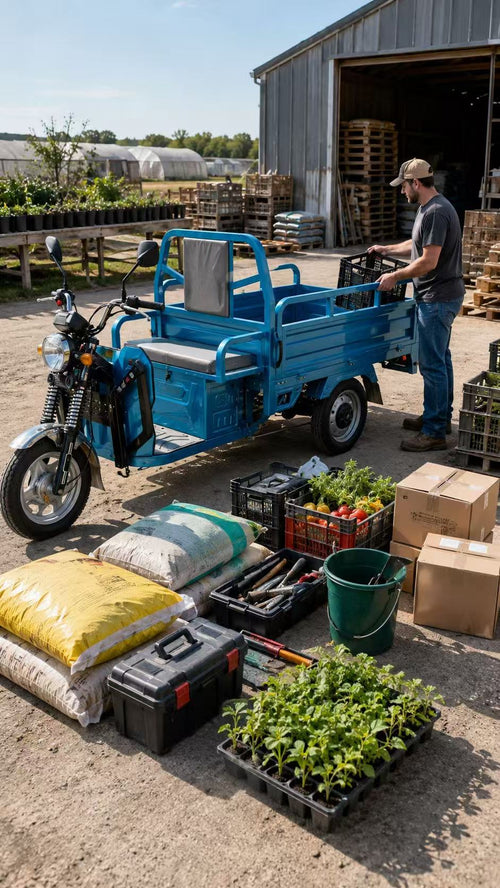
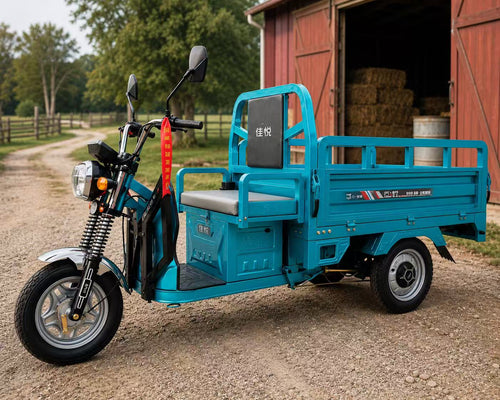
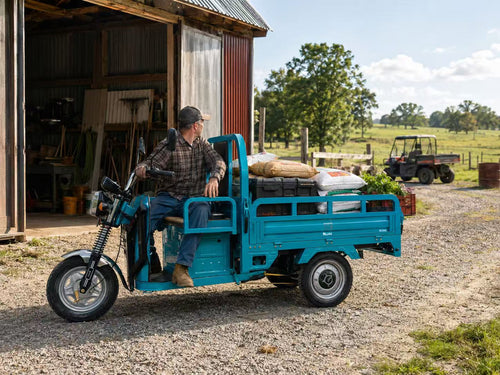
Option 6: Use an Open-Cargo Electric Utility Trike
An open-cargo electric utility trike fills the gap between a small trash can attachment and a high-cost UTV.
It is designed for frequent stop-and-go work on private property and can carry mixed loads that a trash can hauler cannot handle.
An open cargo box can hold:
- standard trash bins
- bagged garbage
- recycling
- loose branches
- leaves
- grass clippings
- hand tools
- cleaning equipment
- mulch
- feed bags
- maintenance supplies
This type of electric work vehicle is particularly useful for a large property with several collection points.
Instead of pulling one bin from the house to the road, the operator can travel through the property, collect waste from multiple locations, and carry everything in the cargo box.
The low loading height can make it easier to lift heavy garbage bags, tools, and yard waste into the vehicle. A compact three-wheel layout can also provide a small turning radius for narrow paths, service lanes, courtyards, greenhouse areas, barn aisles, and tightly arranged maintenance zones.
An electric utility trike works best when:
- the property is mainly paved, concrete, hard-packed gravel, or firm dirt
- daily work involves repeated collection and transport
- cargo volume is more important than passenger seating
- low noise is valuable
- the operator does not need four-wheel drive
- heavy trailer towing is not required
- the property needs lower operating and maintenance costs
Its main strengths are quiet operation, low charging cost, easy loading, simple controls, compact size, and large cargo capacity relative to its footprint.
Its main limitations must also be understood.
A three-wheel electric work vehicle is not a replacement for a four-wheel-drive UTV in deep mud, heavy snow, severe off-road terrain, or very steep conditions. It is designed primarily for carrying loads, not for pulling heavy trailers. It should also be used on private property and appropriate work areas rather than treated as a public-road commuting vehicle.
Option 7: Use an Enclosed Electric Garbage Collection Trike
An enclosed or box-style electric cleaning trike is more specialized.
Instead of carrying open yard waste and mixed tools, it provides a contained cargo compartment for scheduled waste collection.
This type of vehicle is well suited to:
- bagged household waste
- litter collection
- wet or dirty refuse
- recycling bags
- park waste
- apartment-community garbage collection
- hotel and resort sanitation work
- farm and barn cleanup
- industrial-site cleaning routes
- campus and facility maintenance
The enclosed cargo box helps reduce scattering, dripping, odor exposure, and contact between collected waste and the operator.
A washable metal box can also be more practical for repeated sanitation work than a standard open utility bed.
This vehicle is especially useful when a maintenance team follows a fixed route through a property, stopping at several trash collection points before returning to a central disposal area.
It is not necessarily the best choice for large branches, long tools, oversized yard waste, or mixed maintenance materials. Those loads are usually easier to handle in an open cargo box.
The difference is simple:
An open-cargo utility trike is a flexible material hauler.
An enclosed garbage collection trike is a dedicated waste collection vehicle.
Which Option Is Best for Your Property?
Choose manual movement when the distance is short, the ground is level, and the bins are light.
Choose a hitch-mounted or tow-behind trash can hauler when you move one or two standard bins and already own a suitable vehicle.
Choose a riding mower when it is already part of your lawn equipment and hauling is only an occasional secondary task.
Choose a golf cart when the property is smooth, level, quiet, and focused on light transport or passenger movement.
Choose a UTV when you need four-wheel drive, high ground clearance, heavy towing, snow performance, or serious off-road ability.
Choose an open-cargo electric utility trike when the job includes frequent transport of trash bins, bags, branches, leaves, tools, and maintenance materials across a relatively firm property.
Choose an enclosed electric cleaning trike when the job is organized around repeated garbage collection, sanitation routes, litter control, and contained waste transport.
The Cheapest Purchase Is Not Always the Lowest-Cost Solution
A trash can attachment may cost far less than a dedicated work vehicle, and for one weekly trip it may be the correct choice.
But equipment value changes when the task is repeated every day.
A property maintenance team may lose hours making separate trips for:
- garbage bags
- recycling
- landscaping debris
- cleaning tools
- water containers
- repair materials
- fallen branches
In that situation, a dedicated electric utility vehicle may reduce labor time, physical strain, fuel use, and unnecessary movement across the property.
The decision should be based on total weekly workload, not only the price of the equipment.
Questions to Ask Before Buying
Before selecting a trash can hauler, golf cart, UTV, or electric cleaning trike, answer these questions:
How long is the route?
A 200-foot paved driveway and a 1,500-foot gravel driveway require different solutions.
What is the steepest section?
Slope affects traction, braking, stability, and safe load limits.
What surface will the vehicle use?
Pavement, gravel, dirt, wet grass, mud, and snow place very different demands on tires and drivetrain design.
How many collection points are there?
One house-to-road trip may only require a trash can hitch. Multiple collection points favor a cargo vehicle.
What will be carried besides garbage cans?
Branches, loose leaves, recycling, tools, compost, mulch, cleaning equipment, and fence materials require cargo space.
Is four-wheel drive necessary?
If the route includes deep mud, heavy snow, severe slopes, or rough woodland, a UTV is usually the safer choice.
Is passenger seating important?
A golf cart or UTV may be better when people must travel with the load.
Is contained waste transport required?
An enclosed electric garbage collection trike is better for bagged, wet, dirty, or easily scattered waste.
How often will the equipment be used?
A once-a-week task and a daily property maintenance route justify very different investments.
A Practical Example
Consider a large rural property with a long paved driveway, several rental units, a workshop, a barn, and landscaped grounds.
A simple trash can hitch can move the household bins to the road once a week.
But it cannot efficiently collect garbage bags from several buildings, carry fallen branches from the garden, transport cleaning supplies to the workshop, and return with recycling in the same trip.
A full-size UTV can complete all of those tasks, but the property may not need four-wheel drive, high-speed suspension, or heavy towing.
An open-cargo electric utility trike may handle the mixed daily workload more efficiently, while an enclosed electric garbage collection trike may be added when the property requires a regular sanitation route.
The correct solution is not always one vehicle.
It is matching the equipment to the task.
How OneClick China Approaches Property Waste Collection
OneClick China supplies several electric work vehicle configurations for private-property maintenance and waste collection.
Open-cargo electric utility trikes are suited to mixed loads such as trash bins, yard waste, tools, branches, recycling, and maintenance supplies.
Enclosed electric garbage collection trikes are designed for bagged waste, litter, sanitation routes, and contained refuse transport.
Other configurations can support cleaning crews, water tanks, pressure-washing equipment, and specialized property-maintenance tasks.
These vehicles are intended for appropriate private-property and work-site use. They are not presented as replacements for four-wheel-drive UTVs in severe terrain.
For buyers, the most important step is to match the vehicle to the property surface, slope, route length, cargo type, load frequency, and required working conditions.
For a short weekly trash-bin trip, a hitch attachment may be enough.
For deep mud, snow, steep slopes, and heavy towing, choose a UTV.
For frequent waste collection and grounds maintenance on relatively firm surfaces, an electric cleaning trike can provide a practical middle ground between a small accessory and an expensive full-size utility vehicle.