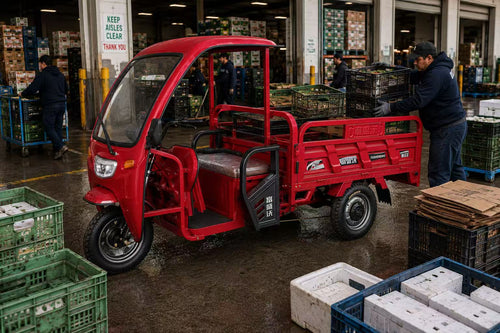
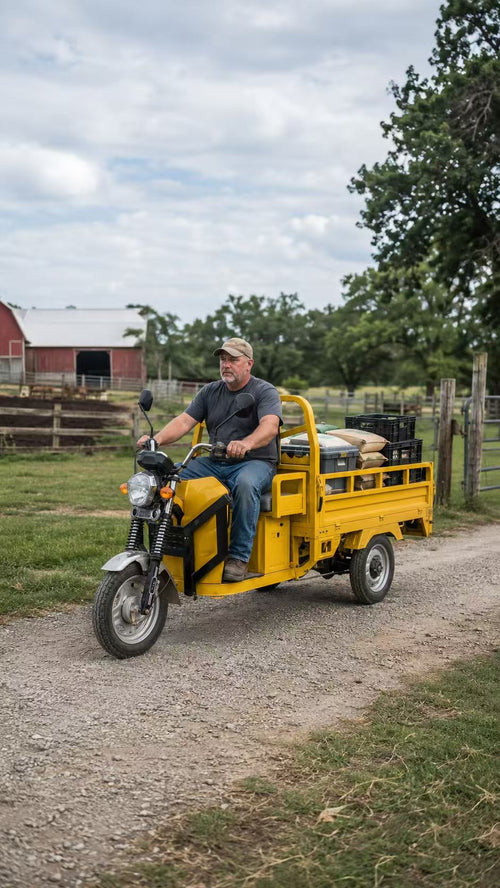
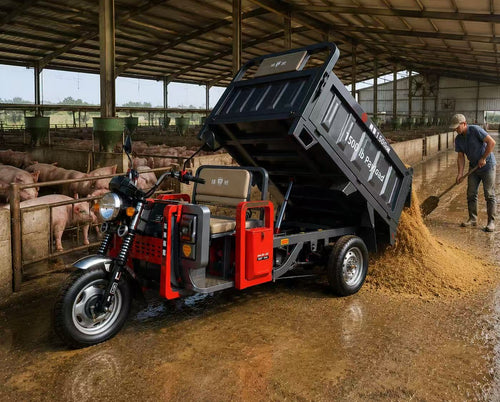
Electric Cargo Trike for Farm Use: Does Your Daily Workload Justify Buying One?
Share
An electric cargo trike for farm use should not be purchased simply because it looks useful or because its specifications appear impressive. The real question is whether the daily workload on your farm, ranch, orchard, nursery, greenhouse, or rural property has reached the point where manual hauling is wasting too much time and physical effort.
Many small agricultural operations face the same problem. A pickup truck is too large for short trips between barns, fields, storage areas, animal pens, and work zones. A gas-powered UTV may be expensive to purchase, fuel, and maintain. A wheelbarrow or handcart is affordable, but it becomes inefficient when the same route must be repeated many times every day.
This is where an electric farm tricycle can become practical. It provides powered short-distance transportation without the size and operating cost of a larger farm utility vehicle. However, it is only a good investment when it solves a real and repeated material-handling problem.
The most useful buying decision begins with the work itself.
Why Daily Workload Matters More Than Vehicle Specifications
Buyers often focus first on motor power, battery voltage, speed, range, and maximum payload. These details matter, but they should not be the starting point.
A high payload rating does not automatically mean that a farm needs the vehicle. A powerful motor does not create value if the trike is used only once or twice a month. The vehicle becomes valuable when it replaces repeated walking, lifting, pushing, loading, and returning for another trip.
Before comparing models, examine a normal working day.
How many times do workers move feed bags, produce crates, tools, fencing materials, compost, animal bedding, soil, mulch, irrigation parts, potted plants, manure, or maintenance supplies?
How far are these materials moved?
How many people are involved?
How much time is spent walking back empty?
Does the hauling work leave workers tired before they begin the main task?
These questions reveal more than a specification sheet.
For many farms, the biggest problem is not one extremely heavy load. It is the same moderate load being moved again and again. Ten short trips with a wheelbarrow can consume more time and energy than one larger trip with an electric utility trike.
The buying decision should therefore be based on hauling frequency, transportation distance, worker fatigue, and lost productivity.
What Types of Farm Work Benefit Most
An electric cargo trike is most useful in operations where materials move repeatedly along predictable routes.
Typical examples include carrying feed from a storage building to livestock pens, moving harvest bins from growing areas to a packing location, transporting tools between barns and repair zones, delivering plants through nursery aisles, and collecting waste during property maintenance.
The following farm environments often benefit the most.
Livestock and Horse Properties
Livestock operations require constant movement of feed, bedding, fencing supplies, water containers, cleaning tools, and manure.
A horse property may involve daily trips between the feed room, stalls, turnout areas, storage sheds, and manure collection points. Even when each trip is short, the total walking distance becomes substantial over the course of a week.
An electric farm tricycle allows workers to carry several bags, tools, or containers in one trip. It can also reduce the need to start a larger vehicle for small routine tasks.
For stall cleaning, feeding, fence repair, and general barn maintenance, the main benefit is not speed. It is reducing repeated manual movement.
Orchards, Vineyards, and Produce Farms
Orchards and vineyards often have narrow internal routes where a pickup truck or large UTV may be inconvenient. Workers may need to move harvest containers, pruning tools, irrigation parts, fertilizer, and maintenance equipment between rows.
A compact agricultural tricycle can handle these short routes while using less space than a conventional farm vehicle.
During harvest, the value becomes more obvious. Produce boxes and harvest bins must move repeatedly from the field to a collection or packing point. A powered utility transport vehicle can reduce the number of manual trips and help keep harvested produce moving more consistently.
Greenhouses and Nurseries
Greenhouses and nurseries depend on frequent movement of potted plants, soil, fertilizer, trays, tools, and watering equipment.
The loads are often not extremely heavy, but they are repetitive and awkward. Workers may carry the same materials through long aisles many times each day.
An electric cargo trike can act as a mobile material-handling platform. It allows one worker to transport multiple items at once and reduces time spent walking back and forth between storage and growing areas.
For nursery operations, the cargo bed can also be useful for moving customer orders, empty pots, plant containers, and landscaping supplies.
Small Farms and Rural Properties
A small farm may not need a full-size UTV, but it may still have more hauling work than a wheelbarrow can efficiently handle.
Common tasks include moving compost, mulch, soil, firewood, animal feed, fencing materials, tools, garden supplies, and property-maintenance waste.
In this situation, an electric work vehicle can fill the gap between manual equipment and larger farm machinery.
This is especially useful when one person handles several different jobs during the day. Instead of returning to the shed for every tool or material, the worker can carry a complete load to the work area.
How Much Daily Hauling Justifies Buying One
There is no single number that applies to every buyer. The value depends on how frequently the vehicle is used and how much labor it replaces.
A useful starting point is to calculate the total time spent on material movement.
For example, imagine that a worker makes twelve hauling trips each day. Each round trip takes six minutes, including walking, loading, unloading, and returning.
That equals seventy-two minutes of daily labor.
Over five working days, the total becomes six hours.
Over fifty working weeks, it becomes approximately three hundred hours.
Even if a powered vehicle reduces only part of that time, the annual labor savings can be significant.
This is why a farm with moderate loads may benefit more than a farm that occasionally moves one very heavy load.
The strongest buying cases usually include several of the following conditions:
• Materials are moved every day or several days per week.
• Workers make repeated trips along the same route.
• The distance is too long for comfortable manual hauling but too short to justify a pickup truck.
• One load often requires several wheelbarrow trips.
• Workers lose time walking back empty.
• Physical fatigue affects later tasks.
• A larger farm utility vehicle is unavailable, expensive, or shared with other workers.
• Work continues throughout most of the year instead of only during a short season.
When several of these conditions are present, an electric cargo trike for farm use may be easier to justify.
Signs Manual Hauling Is No Longer Efficient
Manual hauling is not always a problem. A wheelbarrow remains one of the most useful and affordable tools on a farm. It works well for light, occasional, short-distance jobs.
The problem begins when manual hauling becomes part of the daily production bottleneck.
One sign is that workers divide loads into smaller amounts simply because the wheelbarrow or handcart is difficult to push safely. This increases the number of trips.
Another sign is that tasks are delayed because workers are waiting for a pickup truck, tractor, or UTV that is being used elsewhere.
A third sign is physical fatigue. Repeated lifting and pushing may reduce productivity even when no single load appears unusually heavy.
Manual hauling may also become inefficient when the route includes mild slopes, uneven ground, gravel, grass, or long aisles. A short distance on a smooth surface can feel very different from the same distance across a working farm.
The clearest sign is simple: the movement of materials is taking too much time away from the work that actually produces value.
A worker hired to care for animals, maintain crops, repair fencing, or prepare customer orders should not spend a large part of the day walking back and forth for tools and supplies.
When a Wheelbarrow Stops Being Enough
A wheelbarrow is ideal for small loads, tight spaces, and occasional work. It requires no charging, little maintenance, and very little storage space.
However, it has clear limits.
It usually carries less material per trip. It places most of the physical effort on the operator. It becomes harder to control on slopes or uneven ground. It also requires the worker to push the loaded wheelbarrow and then walk back with it empty.
An electric utility trike becomes more practical when the load volume, trip frequency, or travel distance has moved beyond those limits.
The decision is not about replacing every wheelbarrow on the property. In many cases, both tools should remain in use.
The wheelbarrow handles the final few feet, tight corners, or small cleanup tasks. The electric farm tricycle handles the repeated transportation between work zones.
Used together, they can create a more efficient workflow than relying entirely on either one.
Electric Cargo Trike vs a Small Farm UTV
Many buyers compare an electric cargo trike with a compact UTV because both are designed for moving materials around a property. However, they are built for different workloads.
A small farm UTV is generally better for higher travel speeds, rough terrain, towing equipment, and carrying several passengers. It is often the preferred choice for large farms where workers must travel long distances between fields.
An electric cargo trike serves a different purpose. It is designed for frequent, short-distance transportation where stopping, loading, unloading, and restarting happen many times throughout the day.
For example, feeding animals, moving compost, transporting harvested produce, carrying irrigation supplies, or delivering tools between work areas usually involve repeated trips over relatively short distances. In these situations, a compact electric cargo trike may complete the work more efficiently because it is simple to operate, easy to park, and requires very little preparation before each trip.
The decision should not be based on which vehicle is more powerful. It should be based on which vehicle spends more time working and less time waiting.
If your property covers hundreds of acres and workers travel long distances throughout the day, a UTV may remain the better choice.
If most work happens within barns, orchards, greenhouses, nurseries, livestock areas, or maintenance zones where materials are constantly being moved, an electric cargo trike often becomes the more practical daily work vehicle.
Daily Operating Costs
Operating costs are another factor that many buyers overlook.
A gasoline-powered utility vehicle requires fuel, engine oil, filters, spark plugs, belts, and other regular maintenance items. Seasonal servicing also adds both cost and downtime.
An electric cargo trike eliminates many of these routine maintenance requirements. There is no engine oil to replace, no fuel system to maintain, and fewer moving parts requiring regular service.
Electricity is also generally less expensive than gasoline for the short daily routes common on small farms.
This does not mean an electric vehicle is maintenance-free.
Like any working equipment, it still requires routine inspection of brakes, tires, suspension components, lights, electrical connections, and the battery charging system.
Keeping tires properly inflated, cleaning the cargo bed after hauling corrosive materials, and charging the battery correctly will help extend service life.
For farms that use the vehicle almost every day, simple preventive maintenance usually costs less than waiting for major repairs.
Who Probably Does Not Need an Electric Cargo Trike Yet
Not every property will benefit from purchasing another vehicle.
If you move materials only a few times each month, a wheelbarrow, garden cart, or existing pickup truck may already meet your needs.
Likewise, if nearly all transportation takes place over long distances on public roads or across very large agricultural operations, a road-legal vehicle or larger farm utility vehicle will probably be more suitable.
Some buyers are attracted by the specifications but have very little routine hauling work.
Buying equipment that sits unused most of the year rarely improves productivity.
Instead, ask yourself a few simple questions.
Do I move materials almost every day?
Do I repeat the same hauling route many times?
Does manual hauling regularly delay other work?
Would reducing physical labor allow me to finish more productive tasks?
If the answer to most of these questions is "no," then waiting before purchasing may be the smarter decision.
A good machine should solve an existing problem rather than create another expense.
A Simple Buying Checklist
Before purchasing an electric cargo trike for farm use, evaluate your daily work instead of focusing only on specifications.
Consider how many hauling trips are made each day.
Estimate how much walking is required.
Identify which materials are moved most frequently.
Measure the typical travel distance between loading and unloading points.
Think about whether the work is performed by one person or several workers.
Finally, decide whether reducing repetitive transportation would noticeably improve productivity on your property.
If manual hauling has become one of the largest consumers of time and physical effort, an electric cargo trike is likely to become one of the most frequently used machines on the farm.
Conclusion
The best equipment purchase is not always the machine with the highest specifications. It is the one that removes the greatest amount of repetitive work from your daily routine.
For many small farms, ranches, orchards, vineyards, nurseries, greenhouses, and rural properties, the challenge is not moving one extremely heavy load. It is moving ordinary materials dozens of times every week.
An electric cargo trike for farm use fills the gap between a simple wheelbarrow and a larger utility vehicle. It reduces repeated walking, improves material flow, and helps workers spend more time on productive tasks instead of transporting supplies from one place to another.
If your daily workload already includes constant hauling, repeated short-distance transportation, and growing physical fatigue, the question may no longer be whether an electric cargo trike is useful.
The better question is how much time and labor it could save over the coming years.