Electric Cargo Trike Operating Cost: Charging, Maintenance, Battery Replacement, and Gas UTV Comparison
Share
For farms, ranches, nurseries, warehouses, wholesale markets, and large private properties, the purchase price of a work vehicle is only the beginning. Fuel, electricity, maintenance, repairs, downtime, and major component replacement often determine whether a vehicle remains economical after several years of use.
The electric cargo trike operating cost is usually lower than the running cost of a gasoline UTV when the vehicle is used for repeated short-distance hauling on private property. However, the real savings depend on battery size, local electricity rates, annual working days, payload, terrain, maintenance habits, and whether the electric trike actually replaces work previously completed by a gas-powered vehicle.
This guide explains how to calculate charging cost, routine maintenance cost, battery replacement cost, annual operating expenses, and total cost of ownership. It also shows where a heavy-duty electric cargo trike can reduce expenses and where a gas UTV may still be the more suitable machine.
What Is Included in Electric Cargo Trike Operating Cost?
Operating cost refers to the expenses required to keep the vehicle working after purchase. For a commercial electric cargo trike, these expenses normally include:
Electricity used for charging
Brake, tire, bearing, and suspension wear
Inspection of wiring, connectors, and charging components
Battery replacement over the vehicle’s service life
Possible motor, controller, charger, or hydraulic-system repairs
Labor and downtime when maintenance is required
Operating cost is not exactly the same as total cost of ownership. Total cost of ownership also includes the original purchase price, financing, delivery, insurance where applicable, major repairs, resale value, and the remaining value of the vehicle after several years.
Separating these two concepts is important. A buyer may have very low monthly charging expenses but still needs to account for eventual battery replacement. In the same way, a gas UTV may be easy to refuel, but fuel, oil changes, filters, drive belts, cooling-system maintenance, and engine repairs can increase its long-term ownership cost.
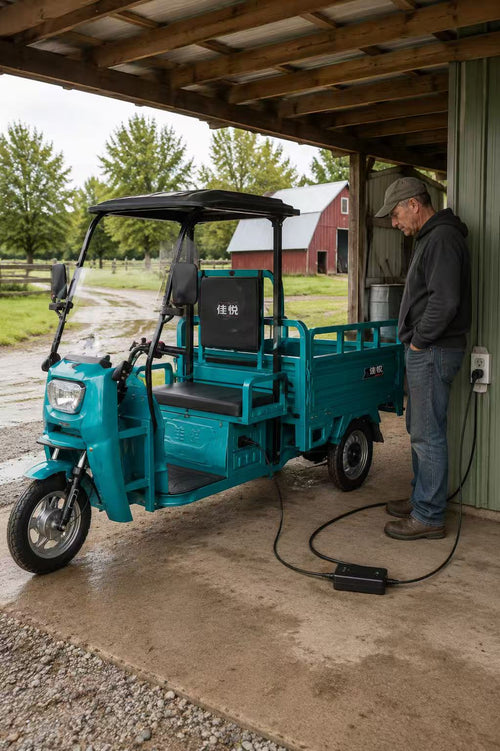
How Much Does It Cost to Charge an Electric Cargo Trike?
The charging cost of an electric cargo trike depends on four main factors:
Battery voltage
Battery amp-hour capacity
Charging efficiency
Local electricity price
The basic calculation begins with battery capacity:
Battery capacity in kilowatt-hours = Voltage × Amp-hours ÷ 1,000
A 60V 60Ah battery stores approximately 3.6 kWh.
A 72V 60Ah battery stores approximately 4.32 kWh.
The charger must draw slightly more electricity from the outlet than the battery stores because some energy is lost during charging. Depending on the charger, battery condition, temperature, and charging stage, a practical calculation can include approximately 10% to 20% charging loss.
For example, a 72V 60Ah battery stores about 4.32 kWh. If charging losses increase wall consumption to approximately 4.8 to 5.2 kWh, the cost of a full charge can be estimated by multiplying that amount by the local electricity rate.
At $0.15 per kWh:
4.8 kWh × $0.15 = $0.72
5.2 kWh × $0.15 = $0.78
In this example, a full charge costs roughly $0.72 to $0.78. The exact amount will be different in areas with higher or lower electricity rates.
This is why a fixed statement such as “every electric cargo trike costs 50 cents to charge” is unreliable. Battery size and local electricity price must be included.
How to Calculate Monthly and Annual Charging Cost
A better way to estimate electric cargo trike running cost is to calculate the number of full-charge equivalents used during actual work.
A vehicle does not always use an entire battery every day. A farm may use 40% of the battery for feed delivery and tool transport. A wholesale market may use 70% during a long shift. A nursery with repeated loaded trips may require almost a full charge per working day.
The formula is:
Annual charging cost = Cost per full charge × Full-charge equivalents per day × Working days per year
Using the previous example of approximately $0.75 per full charge:
Light use:
0.4 full-charge equivalent × 250 days × $0.75 = $75 per year
Moderate use:
0.7 full-charge equivalent × 250 days × $0.75 = $131.25 per year
Heavy daily use:
1 full charge × 300 days × $0.75 = $225 per year
These figures are examples, not universal promises. Heavy payloads, steep grades, soft ground, frequent acceleration, cold weather, low tire pressure, and battery aging can increase energy consumption.
Even when charging cost rises above these examples, electricity is usually only one part of the ownership calculation. For many buyers, avoided fuel and engine maintenance create more savings than electricity alone.
Why Payload and Terrain Change Electricity Cost
Battery capacity does not tell the whole story. Two owners with the same 72V electric utility trike may experience different annual energy costs.
A vehicle carrying tools across level warehouse floors consumes less energy than the same vehicle carrying wet soil uphill. Stop-and-go work, repeated starts under load, rough ground, low tire pressure, and long periods at maximum payload increase electricity use.
Buyers should estimate charging cost based on their actual work cycle:
Distance traveled per day
Average cargo weight
Number of loaded trips
Surface type
Slope and terrain
Frequency of stops
Outdoor temperature
Available charging time
This work-cycle approach is more accurate than estimating cost from advertised range alone. Advertised range is normally affected by speed, load, terrain, battery condition, and test conditions. Real commercial use should always be calculated with a reasonable operating reserve.
Electric Cargo Trike Maintenance Cost
An electric cargo trike has fewer engine-related maintenance requirements than a gasoline UTV, but it is not maintenance-free.
Routine maintenance for a heavy-duty electric cargo trike may include:
Checking brake performance and brake wear
Inspecting tire pressure, tread, and sidewalls
Tightening wheel, frame, cargo-bed, and suspension hardware
Inspecting wheel bearings and steering components
Checking rear axle and differential components where applicable
Inspecting wiring, plugs, terminals, fuses, and connectors
Keeping the charging port and battery area dry and clean
Checking suspension components under repeated heavy loads
Inspecting hydraulic hoses, fittings, cylinders, and fluid on dump models
Lubricating mechanical pivot points where required
The maintenance needs of a commercial electric work vehicle should not be confused with those of a lightweight electric bicycle. A heavy-duty cargo trike carries larger loads, uses stronger brakes and tires, and may include a rear axle, differential, suspension system, hydraulic dump bed, and commercial-grade electrical components.
That means the correct comparison is not simply “chain and brake-pad cost.” The buyer must consider the complete work-vehicle system.
Routine Wear Items Versus Major Replacement Costs
For a useful cost analysis, maintenance should be divided into two categories.
Routine wear items include:
Tires
Brake components
Bearings
Bushings
Fasteners
Cables and connectors
Hydraulic seals or hoses where applicable
Major replacement items may include:
Traction battery
Electric motor
Motor controller
Battery charger
Main wiring components
Rear axle or differential components
Hydraulic pump, cylinder, or control components
Routine wear is expected in any working vehicle. Major component replacement is less frequent but can create a larger one-time expense.
The battery is normally the most important long-term cost in an electric cargo trike. Its service life depends on battery chemistry, cycle count, depth of discharge, charging habits, storage temperature, workload, and maintenance.
A battery repeatedly discharged to a very low level, stored empty, exposed to extreme heat, or operated under excessive load may age faster. A battery kept properly charged, stored correctly, and used within its intended workload may provide a longer service life.
Battery Replacement Cost and Ownership Planning
Battery replacement should be treated as a future ownership expense rather than ignored.
A practical annualized battery cost can be calculated with this formula:
Annualized battery cost = Replacement battery price ÷ Expected years of service
For example, if a replacement battery eventually costs $1,800 and provides six years of service:
$1,800 ÷ 6 = $300 per year
This does not mean the owner pays $300 every year. It means the buyer reserves approximately that amount when estimating long-term ownership cost.
This annualized method makes electric and gas vehicle comparisons more realistic. A buyer should not compare the electricity bill of an electric cargo trike with the fuel bill of a UTV while completely excluding battery replacement. The same rule applies to the gasoline vehicle: engine, transmission, CVT, drive-belt, cooling-system, and fuel-system costs should not be excluded.
Battery chemistry also matters. Lead-acid batteries may have a lower initial replacement price but are heavier and may require replacement sooner, depending on use and care. Lithium batteries normally cost more initially but can offer lower weight, greater usable capacity, faster charging, and longer cycle life.
The best choice depends on daily workload, expected ownership period, charging access, climate, and replacement budget.
Electric Motor, Controller, and Charger Costs
Electric motors typically require less routine service than internal-combustion engines because they have fewer moving parts and do not need oil changes, spark plugs, fuel injectors, air-fuel adjustments, or exhaust-system maintenance.
However, the motor is only one part of the electrical system. The controller regulates power delivery, the charger manages battery charging, and wiring connects the complete system. Water intrusion, loose terminals, damaged insulation, overloaded circuits, poor-quality replacement parts, and incorrect charging equipment can cause failures.
Preventive inspection should therefore include:
Loose battery terminals
Heat-damaged plugs
Corroded connectors
Damaged charging cables
Unusual motor noise
Controller overheating
Reduced power under normal load
Repeated fuse or breaker problems
Catching these problems early can reduce downtime and prevent damage to more expensive components.
Electric Cargo Trike vs Gas UTV Operating Cost
The most meaningful comparison is not simply electricity versus gasoline. It is the complete annual operating expense required to perform the same work.
A gas UTV may require:
Gasoline
Engine oil and oil filters
Air filters
Fuel filters
Spark plugs
Coolant and cooling-system service
CVT belt or drive-system service
Battery maintenance
Fuel-system cleaning or repairs
Exhaust-system repairs
Engine and transmission repairs
An electric cargo trike may require:
Electricity
Brake and tire replacement
Bearing and suspension maintenance
Electrical inspections
Battery replacement reserve
Possible motor, controller, charger, axle, or hydraulic repairs
The electric cargo trike often has an advantage when the job involves repeated low-speed travel, short routes, frequent stops, and daily cargo movement within a controlled property.
Examples include:
Delivering feed between barns
Moving tools around a ranch
Transporting plants through a nursery
Carrying produce inside a wholesale market
Moving cartons between warehouse buildings
Collecting waste on a private property
Transporting landscaping tools across a campus
Moving maintenance supplies through a resort
These tasks can be inefficient for a gas UTV because the engine may idle frequently and operate for many short trips. An electric work vehicle uses energy mainly when moving and does not consume fuel while stationary in the same way as an idling gasoline engine.
A Practical Annual Cost Comparison
Because fuel prices, UTV engine sizes, terrain, and working hours vary, a single universal comparison would be misleading. A better method is to calculate three usage scenarios.
Light-use operation:
The vehicle performs a few short hauling trips each day.
Moderate-use operation:
The vehicle operates regularly throughout the working day with repeated loading and unloading.
Heavy-use operation:
The vehicle covers long property routes, carries frequent loads, and works most days of the year.
For each scenario, the owner should record:
Annual electricity or gasoline expense
Routine maintenance expense
Expected major repairs
Battery or engine-related replacement reserve
Downtime and lost labor
The electric vehicle may create the largest savings under moderate, repeated use. Very light use may not produce enough fuel savings to justify replacing an existing vehicle immediately. Extremely heavy multi-shift work may require additional batteries, opportunity charging, or more than one vehicle.
When an Electric Cargo Trike Produces Real Savings
The strongest financial case usually exists when the electric cargo trike replaces an expensive machine on tasks that do not require that machine’s full capability.
For example, using a four-wheel-drive gas UTV to move tools 600 feet between buildings may be unnecessary. Using the same UTV for repeated produce movement inside a paved market may also create fuel, noise, heat, and maintenance costs without using its off-road advantages.
An electric cargo trike can produce real savings when:
Most routes are inside private property
Travel distances are short or moderate
The vehicle returns to a regular charging location
Loads fit within the rated payload and cargo-bed size
Four-wheel drive is not required
High-speed travel is unnecessary
The work involves frequent stops
Noise and indoor emissions matter
The trike replaces existing gas-powered trips
The last condition is critical. Buying an electric trike as an additional vehicle does not automatically create savings. The savings occur when it takes over work that previously consumed fuel, maintenance, operator time, or unnecessary engine hours.
When a Gas UTV May Still Be the Better Choice
A gas UTV may remain more suitable when the work requires:
Deep mud or severe off-road terrain
Four-wheel-drive traction
Very steep or irregular routes
High-speed property travel
Long remote routes without charging access
Continuous multi-shift operation
Heavy towing beyond the trike’s design
Immediate refueling with no charging time
A high-quality cost comparison should not claim that an electric cargo trike replaces every UTV. The two vehicles serve overlapping but different roles.
For many farms and businesses, the best strategy may be to reserve the UTV for severe terrain, towing, and remote work while assigning repetitive daily hauling to an electric cargo trike. This reduces engine hours on the more expensive vehicle and may extend the UTV’s maintenance intervals and service life.
Downtime Is Part of Operating Cost
Vehicle downtime has a financial value.
A broken vehicle can delay feeding, order movement, landscaping work, maintenance service, or material transport. The visible repair bill may be smaller than the cost of lost labor and interrupted operations.
Electric cargo trikes have simpler propulsion systems, but owners should still plan for parts availability and local service. A practical support system may involve local farm-equipment technicians, electric-motor repair shops, motorcycle or small-vehicle technicians, golf-cart repair shops, and mobile equipment mechanics.
Common mechanical parts such as tires, brakes, bearings, wiring, and hydraulic components can often be inspected locally. Product-specific electrical parts should be correctly identified before replacement.
A buyer should consider the following before purchase:
Are replacement parts available?
Can common repairs be completed locally?
Is wiring information available?
Can the battery, charger, controller, and motor be identified correctly?
Who pays for covered parts and labor during the warranty period?
How quickly can technical support respond?
These questions influence real ownership cost as much as the initial selling price.
How to Calculate Total Cost of Ownership
A practical five-year ownership calculation can use:
Purchase price
Delivery and setup cost
Five years of electricity or fuel
Five years of routine maintenance
Expected battery replacement or engine-related reserve
Estimated repair expense
Downtime cost
Estimated resale value
The formula is:
Total Cost of Ownership = Purchase Cost + Energy + Maintenance + Major Replacements + Repairs + Downtime − Resale Value
This calculation should be completed for both vehicles using the same workload.
Do not compare a lightly used electric trike with a heavily used UTV. Do not compare electricity for 100 working days with gasoline for 300 working days. The route, payload, working days, and completed tasks should be as similar as possible.
How to Reduce Electric Cargo Trike Running Cost
Owners can reduce operating expenses by following a few practical rules.
Use the correct charger for the battery system.
Avoid repeatedly discharging the battery below the recommended level.
Maintain correct tire pressure.
Do not exceed the rated payload.
Reduce unnecessary hard acceleration under heavy load.
Inspect electrical terminals before corrosion or heat damage becomes serious.
Keep the battery and charger protected from water.
Repair brake drag and bearing resistance promptly.
Use the vehicle for routes that match its design.
Schedule periodic inspections instead of waiting for failure.
Correct vehicle selection is also important. An underpowered vehicle may consume more energy, overheat components, and wear faster under excessive load. A correctly specified 60V or 72V electric cargo trike should be matched to payload, slope, route length, cargo type, and daily operating hours.
Frequently Asked Questions
How much does it cost to charge an electric cargo trike?
The cost depends on battery capacity, charger efficiency, and the local electricity rate. Multiply the electricity drawn from the outlet in kWh by the utility price per kWh.
Is an electric cargo trike cheaper to run than a gas UTV?
It is often cheaper for repeated short-distance hauling on private property because electricity normally costs less than gasoline and the electric drivetrain avoids many engine maintenance items. The actual savings depend on workload and battery replacement cost.
What is the largest long-term electric cargo trike expense?
The traction battery is usually the largest planned long-term replacement expense. Buyers should include an annualized battery replacement reserve in total cost of ownership.
What maintenance does a heavy-duty electric cargo trike need?
Typical maintenance includes brakes, tires, bearings, steering, suspension, rear axle components, wiring, electrical connectors, charging equipment, and hydraulic components on dump models.
Does an electric cargo trike require zero maintenance?
No. It eliminates many gasoline-engine maintenance items, but tires, brakes, bearings, suspension, electrical components, batteries, and hydraulic systems still require inspection and service.
How many years does an electric cargo trike battery last?
Battery life depends on chemistry, cycle count, depth of discharge, temperature, charging habits, payload, and storage. Buyers should use the manufacturer’s battery specifications and warranty rather than relying on one universal lifespan.
Should a farm replace every UTV with electric cargo trikes?
Not necessarily. Electric cargo trikes are best for repetitive property hauling where four-wheel drive, high speed, and severe off-road capability are not required. Gas UTVs may still be needed for mud, steep terrain, towing, and remote routes.
Final Buying Decision
The real value of an electric cargo trike is not that it uses electricity. Its value comes from matching a simpler, lower-maintenance vehicle to work that does not require a gasoline UTV.
For farms, ranches, nurseries, warehouses, wholesale markets, and property-maintenance operations, the strongest use case is repeated hauling across predictable private-property routes. In these conditions, charging cost can remain low, engine-related maintenance is eliminated, noise is reduced, and the gas UTV can be reserved for work that truly requires its off-road capability.
Before buying, calculate the route, payload, battery size, working days, electricity rate, maintenance requirements, battery replacement reserve, and local repair options. A realistic calculation will provide a much better decision than comparing purchase price or advertised range alone.