Stop Moving One Box at a Time
Share
Many small farms, markets, nurseries, and work areas lose time in a simple way.
One box at a time.
One crate at a time.
One tool at a time.
One feed bag at a time.
Each trip looks small. Each task feels easy enough. A worker walks across the yard, carries a box, returns empty, grabs another item, walks again, and repeats the same movement many times during the day.
This does not look like a major problem at first.
But in real daily work, one-box-at-a-time movement can quietly slow down the whole operation.
The issue is not that one box is too heavy.
The issue is that the work is repeated too many times.
For farms, produce markets, farmers market vendors, small warehouses, nurseries, greenhouses, and private work areas, the smarter question is not only:
Can this item be moved by hand?
The better question is:
How many trips does this work create every day?
Why One Small Trip Becomes a Big Problem
A single short trip may not matter.
Moving one crate from a storage area to a table may take only a few minutes. Carrying one tool from a shed to a repair area may feel simple. Moving one feed bag from storage to a barn may not seem like a reason to buy equipment.
But many workdays are not made of one trip.
They are made of repeated trips.
A worker may move one box, then another box, then empty cartons, then tools, then cleaning supplies, then more crates, then repair parts, then bags of feed or soil.
The distance may be short, but the repetition becomes the problem.
When every small item creates a separate trip, the work becomes slower than it needs to be.
This is especially true for small teams. If one worker spends too much time walking back and forth, the whole operation loses time.
The Hidden Problem Is Poor Material Flow
Many buyers think about equipment in terms of load size.
They ask:
How much can it carry?
How powerful is it?
How large is the cargo bed?
Those questions matter, but they are not the whole story.
Another important question is material flow.
Material flow means how goods, tools, crates, supplies, and work materials move through the property or work area.
A good material flow reduces wasted movement.
A poor material flow creates too many short trips.
In small farms and market operations, poor material flow often looks like this:
workers carrying one box at a time
tools scattered between work zones
crates moved in separate trips
feed or supplies carried by hand across the same route
hand carts making too many repeated runs
workers returning empty again and again
This is not only a physical problem. It is an organization problem.
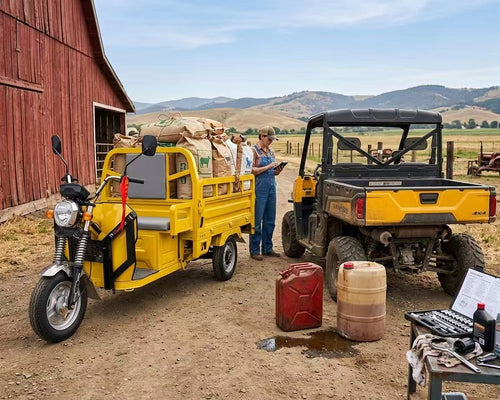
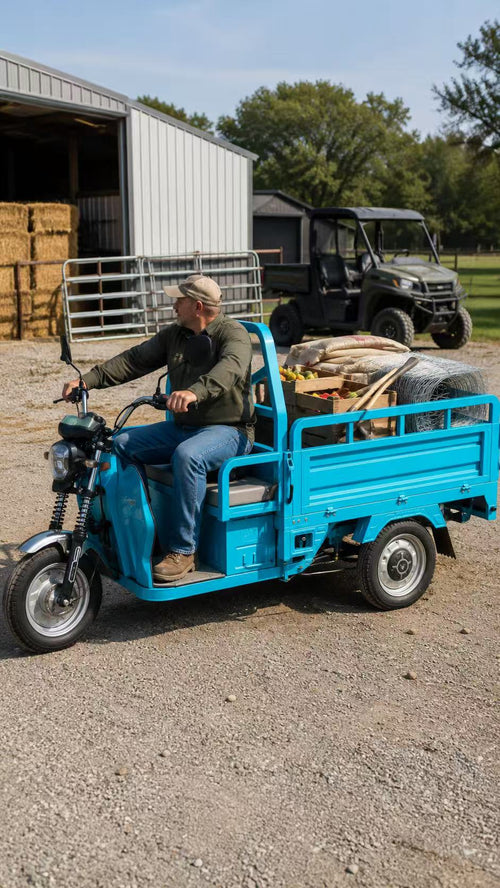
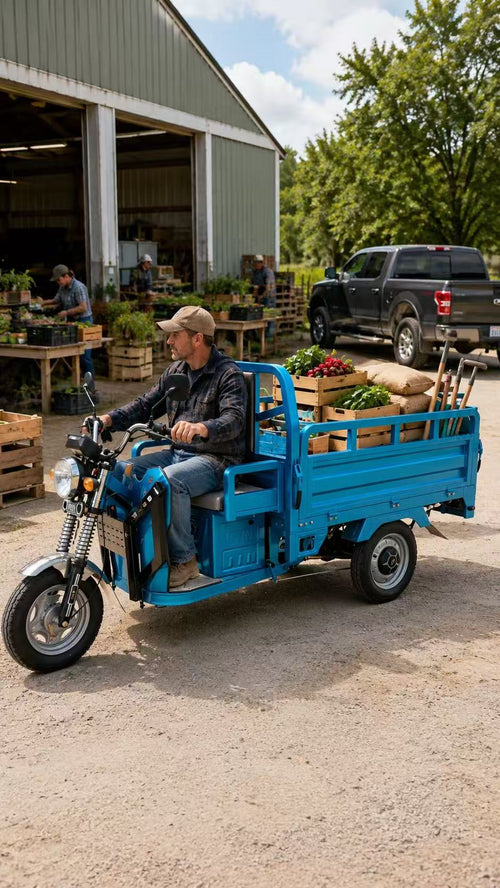
A compact electric work trike can help by allowing workers to combine several small items into one more organized trip.
Why Hand Carrying Feels Normal
Hand carrying feels normal because it is familiar.
Most workers do not stop and calculate how much time is lost moving materials in small separate trips. They simply do the work.
That is why this problem can hide inside daily routines.
A worker may think:
I only need to move a few boxes.
But those few boxes may become many trips.
A farm owner may think:
The barn is not far.
But the same short route may be walked many times.
A market vendor may think:
The storage area is close.
But every crate, carton, and supply item still takes time to move.
Small trips are easy to ignore because they do not look like major work.
But when they repeat every day, they become part of the labor cost.
Where This Happens Most Often
One-box-at-a-time movement happens in many practical work areas.
On farms, it may happen when workers move feed bags, buckets, tools, fencing supplies, harvest crates, repair parts, and small farm materials between storage areas, barns, sheds, and work zones.
At farmers markets, it may happen when vendors move produce crates, empty cartons, tableside supplies, display items, and packaging materials between vehicles, stalls, and storage areas.
In produce markets, workers may move boxes, plastic bins, fresh produce, cleaning supplies, and packing materials across short internal routes.
In nurseries and greenhouses, workers may move trays, soil bags, irrigation parts, plant containers, tools, and supplies between growing areas and work tables.
In warehouse yards or small shop logistics areas, workers may move inventory boxes, parts, repair tools, and supplies from one point to another.
The materials are different, but the problem is the same:
too many separate short trips.
The Goal Is Not Maximum Load
This is an important point.
The goal is not to overload the equipment.
The goal is not to turn a compact electric work trike into a heavy machine.
The goal is to reduce unnecessary repeated trips.
A good trip may combine several moderate items that would otherwise be carried separately. The load should still be balanced, stable, and within the rated working capacity of the equipment.
This is where buyers need practical judgment.
A cargo bed should not be filled beyond safe limits just because there is space. Weight matters. Balance matters. The route matters. The operator’s control matters.
The smart use is not “carry everything at once.”
The smart use is “carry a reasonable group of items together so the worker does not repeat the same short route again and again.”
Why a Compact Electric Work Trike Helps
A compact electric work trike can help because it gives workers a simple powered cargo platform for short internal movement.
It can carry multiple boxes, crates, tools, bags, or supplies in one organized load.
It can move at low speed inside private or controlled work areas.
It can reduce repeated walking, carrying, pushing, and returning empty.
It does not need to be the biggest machine on the property.
It needs to fit the daily movement pattern.
For many small operations, the work is not about one extremely heavy load. It is about many small and medium loads that need to move throughout the day.
That is exactly where compact electric transport work equipment can make sense.
It helps turn scattered small trips into more organized material movement.
A Better Way to Think About Short Trips
Instead of asking only, “Can a worker carry this?” buyers should ask:
Can this movement be organized better?
Can several small items be moved together?
Can one trip replace three trips?
Can the worker avoid returning empty again and again?
Can tools, crates, and supplies be grouped by task?
Can daily work zones be connected more efficiently?
These questions change how the buyer thinks about equipment.
The electric work trike is not just a cargo bed.
It is a way to improve short-distance material flow inside the work area.
When a Hand Cart Is Still Enough
A hand cart, dolly, or wheelbarrow can still be useful.
If the load is light, the route is very short, and the movement happens only occasionally, manual tools may be enough.
There is no need to use powered equipment for every tiny job.
But when the same movement happens many times per day, a manual tool can become slow.
The problem is not that hand carts are useless.
The problem is that repeated hand-cart movement still depends on human pushing, pulling, walking, balancing, loading, unloading, and returning.
A compact electric work trike becomes more useful when the movement is frequent enough to justify powered support.
Where Buyers Should Be Careful
Buyers should not treat compact electric work equipment as a public-road vehicle, high-speed machine, or heavy construction unit.
This equipment fits private sites, controlled work areas, farm yards, market preparation spaces, nursery paths, warehouse yards, and similar internal routes.
It should be used carefully and within its rated working load.
Buyers should avoid:
overloading the cargo bed
stacking items too high
loading unevenly
driving too fast in work areas
using it on unsafe public roads
using it on extreme slopes or unstable ground
treating it like a heavy-duty UTV or construction machine
The value comes from practical repeated movement, not abuse.
Good operation protects the worker, the equipment, and the materials being moved.
How to Know If One-Box Trips Are Costing Too Much
A buyer can look at the workday and ask a few simple questions.
How many times does a worker walk the same route?
How many separate trips are made for boxes, crates, tools, and supplies?
How often does someone return empty?
How much time is spent moving small items instead of doing higher-value work?
Could several items be grouped into one trip?
Is the movement inside a private or controlled work area?
Would a compact powered cargo bed reduce repeated walking?
If the answers show repeated movement every day, then one-box-at-a-time work may already be costing more than expected.
This is where a compact electric work trike can become a practical support tool.
Examples of Better Material Flow
On a small farm, instead of carrying feed bags, tools, and repair parts separately, a worker can load them together and move to the barn area in one trip.
At a farmers market, instead of carrying produce crates, cartons, and display supplies separately, a vendor can group them in the cargo bed and move them from storage to the stall more efficiently.
In a greenhouse, instead of moving trays, soil bags, irrigation parts, and tools one at a time, workers can organize a single trip to the work zone.
In a small warehouse yard, instead of walking back and forth for boxes, parts, and tools, a worker can move multiple items together between workstations.
These are not dramatic changes.
But they improve the daily flow of work.
Small improvements repeated every day can matter.
The Real Buyer Takeaway
The problem is not always heavy load.
Sometimes the problem is too many small trips.
A compact electric work trike helps when a work area needs better short-distance material flow. It can reduce repeated hand carrying, reduce unnecessary walking, and help workers group small items into fewer organized trips.
It is not meant to replace every machine.
It is not meant for public-road travel.
It is not meant for extreme heavy-duty work.
It is a practical low-speed electric transport work tool for private-site material movement.
That is the role buyers should understand.
Final Thought
Moving one box by hand is not the problem.
Moving one box by hand all day is the problem.
Many farms, markets, nurseries, warehouses, and private work areas lose time because workers move small items in separate trips instead of organizing materials into fewer short-distance loads.
A compact electric work trike can help solve that problem.
The question is not whether a worker can carry one crate, one tool, or one bag.
The question is whether the workday is being slowed down by too many small trips.
If the answer is yes, it may be time to stop moving one box at a time.