The Hidden Labor Cost of Moving Crates, Feed, and Supplies by Hand
Share
A box does not look expensive to move by hand.
A feed bag does not look expensive to carry.
A few tools do not look expensive to transport across a farm, market, nursery, warehouse yard, or private work area.
That is why many small operators underestimate this part of the job.
The real cost is not one trip.
The real cost is repetition.
A worker may move produce crates from a packing table to a loading area. Then go back. Then move empty crates. Then carry tools. Then return for another small load. A farm worker may carry feed bags from storage to a barn, then return for buckets, fencing parts, or repair tools. A nursery worker may move trays, bags of soil, and irrigation supplies all day in short repeated trips.
Each individual load may seem manageable.
But repeated short-distance carrying creates a hidden labor cost that many buyers do not calculate clearly.
This article is not about making hand work sound impossible. Hand carrying, hand carts, and wheelbarrows still have a place. The real question is different:
At what point does repeated short-distance movement stop being a small task and start becoming an efficiency problem?
For many farms, markets, and private work areas, that point comes earlier than expected.
Why Hand Moving Feels Cheap at First
One reason buyers ignore this cost is simple.
Hand moving does not look like a major expense.
There is no fuel bill for one carried crate. There is no machine purchase behind one feed bag. There is no equipment line item for one worker walking tools from a shed to a fence line.
The movement blends into the day.
It feels normal.
But normal is not the same as efficient.
A task can be common, accepted, and familiar while still costing time, effort, and productivity.
That is what happens with repeated short-distance movement.
If a worker walks a short route twenty times a day, the cost is not in one trip. The cost is in the total labor required to repeat the same movement over and over.
This is especially true when the loads are not extremely heavy, but are still heavy enough to slow the worker down, require multiple trips, or increase fatigue.
The Daily Work Most Buyers Forget to Count
When buyers think about equipment, they often focus on major jobs.
They think about the biggest field task, the largest delivery, the heaviest possible load, or the most difficult route.
But many real operations are shaped more by daily repeated small tasks than by occasional large tasks.
That is where hidden labor cost appears.
Examples include:
moving produce crates from one part of a market preparation area to another
carrying feed bags between storage and animal areas
transporting hand tools, fencing supplies, or repair materials around a property
moving greenhouse trays, nursery supplies, and soil bags
carrying seafood boxes, fresh produce containers, and packing materials in market areas
moving small boxes and supplies in warehouse yards or small shop logistics areas
transporting irrigation parts, buckets, and maintenance items around a private site
These are not dramatic tasks.
But they happen again and again.
A business may not notice the cost because each trip feels small. The worker does not stop the day to record it. No one creates a separate invoice for it. It simply becomes part of the rhythm of work.
That is exactly why it is so easy to underestimate.
Time Loss Adds Up Faster Than Buyers Think
Suppose a worker spends only a few minutes on each small movement task.
One trip may not matter.
Five trips may still feel reasonable.
But once the task becomes daily and repeated, the total time loss becomes visible.
A worker may spend a meaningful part of the day walking back and forth with materials that could have been moved more efficiently in fewer trips.
This is not only about the distance.
It is also about loading, carrying, balancing, setting down, returning empty, and repeating the route.
The hidden cost grows in several ways at the same time.
First, there is time.
Second, there is physical effort.
Third, there is reduced pace for the next task.
Fourth, there is fatigue that affects the rest of the day.
Even when the load is not extremely heavy, repetition creates drag on labor efficiency.
This is particularly important for small teams where every worker matters. If one worker spends too much time repeating low-value movement tasks, the whole operation loses efficiency.
The Problem Is Not Hard Labor Alone
Some buyers assume the issue is only heavy lifting.
That is not the full picture.
Even moderate loads can become inefficient when the task repeats often enough.
A crate of produce may not be heavy by itself. A feed bag may be manageable. A set of tools may be easy to carry once. A bucket, small box, tray, or supply container may not look serious at all.
But when those items move all day in repeated short routes, the problem is not one difficult lift. The problem is the number of times the worker must repeat the task.
That is why even relatively simple movement work can justify better transport support.
You do not need extreme loads to create inefficiency.
Where Hand Carts and Wheelbarrows Still Work
This article is not saying every operation must stop using hand carts or wheelbarrows.
They are still useful.
For very small loads, very short distances, occasional movement, or tasks where powered equipment would add no real benefit, hand tools remain practical.
A wheelbarrow can still be useful for small loose materials.
A hand cart can still help with light boxes.
Manual tools are not the problem by themselves.
The question is whether the work pattern has outgrown them.
If a worker uses a hand cart for one or two light trips, that may be perfectly fine.
If the same worker uses it twenty times a day with repeated crates, feed, supplies, or tools, the labor equation changes.
A manual tool can still be useful while also being too slow for the volume of work.
That is the boundary buyers need to recognize.
When Repetition Becomes the Real Cost
Repeated short trips create a special kind of labor cost because they do not feel like “big work” in the moment.
They feel like background work.
A worker says, “I just need to grab one more load.”
Then another.
Then another.
This is common in:
small farms
ranches
orchards
nurseries
greenhouses
market vendor operations
fresh food preparation areas
warehouse yards
small logistics areas
property maintenance work
private work compounds
The route is usually internal.
The speed requirement is low.
The job is not highway transport.
The task is simple: move materials from one work point to another.
Because the task seems simple, it often remains manual longer than it should.
But simple does not mean cheap.
The hidden labor cost exists because repeated simple work absorbs time all day.
A More Practical Middle Ground
Many buyers think in extremes.
They imagine only two choices.
Option one: carry things by hand, use a hand cart, or keep using a wheelbarrow.
Option two: jump to a much larger machine.
But there is often a practical middle ground.
That middle ground is low-speed electric transport work equipment used inside private or controlled work areas for repeated material movement.
This kind of equipment is not meant to replace every machine.
It is not public-road transport.
It is not a high-speed solution.
It is not heavy construction equipment.
It is not a substitute for large trucks, forklifts, or powerful utility machines when those are truly required.
Its value is different.
It helps reduce the hidden labor cost of repeated short-distance movement.
That means fewer walking trips, fewer repeated manual carries, and better support for daily internal hauling.
Why a Compact Electric Work Trike Fits This Problem
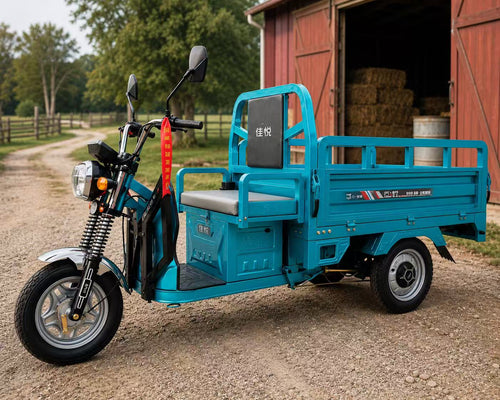
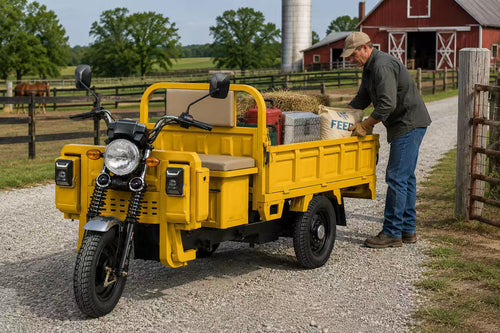
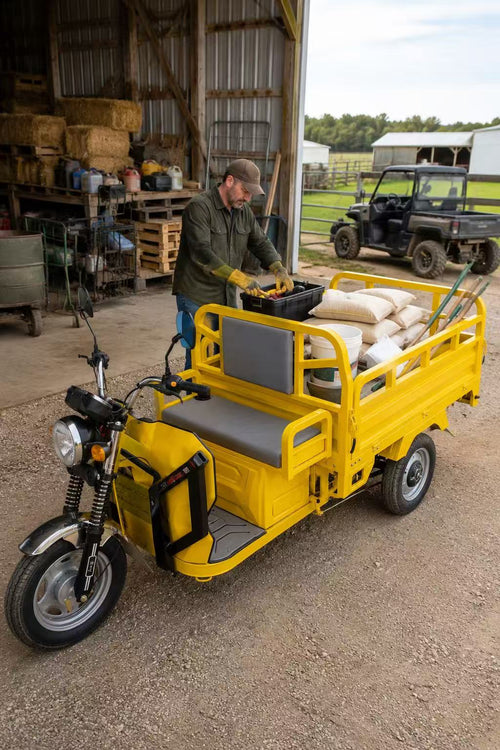
A compact electric work trike fits this type of work because it matches the daily movement pattern many small operations actually have.
It can carry practical loads of crates, feed bags, boxes, tools, supplies, and similar materials inside a cargo bed.
It can move slowly across a private route.
It can support repeated internal trips without making every small movement task dependent on hand carrying.
This matters most when the work happens many times a day.
The value is not only in carrying more per trip.
The value is also in reducing repetition and physical strain.
A worker can combine multiple small items into one load, move them together, unload, and continue the task with less wasted movement.
This does not turn labor into zero.
But it makes labor more productive.
Examples of Hidden Labor Cost in Real Work
On a small farm, a worker may move feed bags from one shed to a barn several times a day. The route is not long, but each trip takes time. Buckets, tools, fencing supplies, and animal care materials may add more trips. By afternoon, the total movement time is far more than expected.
At a farmers market or produce market preparation area, workers may move crates, packing materials, tableside supplies, empty bins, and hand tools repeatedly. A truck may have delivered the goods to the site, but much of the work afterwards becomes short internal movement.
In a greenhouse or nursery, workers may move trays, bags of media, irrigation components, and maintenance supplies around the property. None of these trips alone looks major, but the repeated pattern creates drag on the workday.
In a small warehouse yard or shop logistics setting, employees may shift boxes, small inventory loads, materials, and supplies between storage points and working areas. This kind of movement is usually low speed, internal, and repetitive.
These are exactly the situations where hidden labor cost appears.
Reasonable Equipment Use Still Matters
Powered transport work equipment can improve daily efficiency, but it still must be used reasonably.
Buyers should not assume that because a cargo bed looks spacious, any load is acceptable.
Weight matters.
Density matters.
Repeated overloading creates unnecessary stress on the battery, controller, motor, frame, wheels, tires, and brakes.
The goal is not to turn compact electric work equipment into a heavy-duty machine it was never meant to be.
The goal is to match the tool to the repeated daily task.
Used within its normal working role, this kind of equipment can be a practical support tool for farms, markets, nurseries, warehouses, and private work areas.
Misused beyond its intended role, any equipment will become less reliable.
That is why good buying judgment matters as much as the product itself.
How Buyers Should Judge the Real Need
A buyer should not ask only, “Can my worker carry this by hand?”
That is the wrong question.
The better questions are:
How many times per day does this movement happen?
How far is the repeated route?
How many materials need to move in a normal day?
How much time is spent walking back and forth?
How much fatigue does this create?
Could multiple small trips be reduced into fewer practical loads?
Is the movement inside a private or controlled work area?
Would a compact powered transport tool improve daily flow?
These questions help reveal whether the operation still fits manual movement, or whether the hidden labor cost has become too large to ignore.
The Real Cost Is Not in One Crate
One crate is not the issue.
One feed bag is not the issue.
One set of tools is not the issue.
The real issue is how often they move, how much labor that movement absorbs, and how much of the workday gets spent on repeated internal hauling.
That is why many buyers eventually realize that the problem was never one item.
The problem was repetition.
And once repetition becomes the daily pattern, hidden labor cost becomes real cost.
Final Thought
Hand carrying, hand carts, and wheelbarrows still have their place.
But repeated short-distance material movement creates a hidden labor cost that many small operations underestimate.
When workers repeatedly move crates, feed, tools, supplies, trays, boxes, and similar materials by hand, the cost appears in time, effort, fatigue, and reduced daily efficiency.
For farms, markets, nurseries, warehouse yards, and private work areas, the right question is not whether one trip can be done manually.
The right question is whether repeated manual movement is still the smartest way to do the job.
When the answer becomes no, compact electric transport work equipment can become a practical support tool for reducing repeated labor and improving internal movement efficiency.