When a Pickup Truck Is Too Much for Short Farm and Market Trips
Share
Many farms, markets, and private work areas already have access to a pickup truck.
A pickup is useful. It can travel long distances, carry larger loads, tow equipment, and handle public-road transportation when needed.
But not every job needs a pickup truck.
Many daily tasks are much smaller than that. A worker may need to move produce crates from a packing area to a market table, feed bags from storage to a barn, tools from a shed to a repair area, or supplies across a private farm yard.
The distance may be short. The load may not be large enough for a full truck. But the trip may happen again and again during the day.
That is where a pickup truck can become too much for the job.
For short farm and market trips, low-speed electric transport work equipment may make more sense. It is not meant to replace a pickup truck. It is meant to reduce the number of small internal trips where a pickup is bigger, slower, costlier, or less convenient than the task requires.
The Problem Is Not the Pickup Truck
A pickup truck is still one of the most useful tools on many American farms, ranches, markets, and private properties.
It is good for road travel. It is good for towing. It is good for long-distance hauling. It is good for larger loads and jobs that require more power.
The problem is not the pickup.
The problem is using a full-size truck for every small movement.
In many work areas, the real task is not “transport a large load across town.” The real task is “move this moderate load across the property again.”
That is a very different job.
A full-size truck may need more space to turn, more care around people, more parking space, and more time to load and unload for a very short trip. In a market area, barn yard, nursery path, greenhouse lane, warehouse yard, or farm service area, that can become inefficient.
The truck is not wrong.
It may simply be too much for that specific task.
Short Trips Add Up
A single short trip may not seem important.
But repeated short trips can take a surprising amount of time.
One trip from the barn to the storage area is simple. Ten trips are different. Moving crates one time may be easy. Moving crates all morning is different. Carrying tools once may not matter. Carrying tools back and forth across a property every day becomes part of labor cost.
This is where buyers often underestimate the problem.
They think the job is small, so they do not count the time.
But small jobs repeated many times become real work.
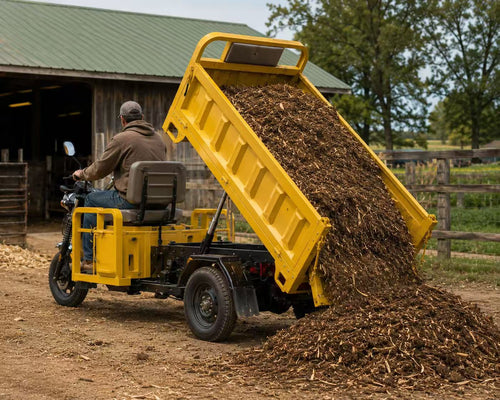
A compact electric work trike can help reduce repeated walking, hand carrying, and unnecessary pickup use inside controlled work areas.
It can carry moderate loads, move slowly through private routes, and support the worker without turning every small task into a truck job.
Where Pickup Trucks Can Feel Too Big
A pickup truck may feel too big in many daily work situations.
Examples include:
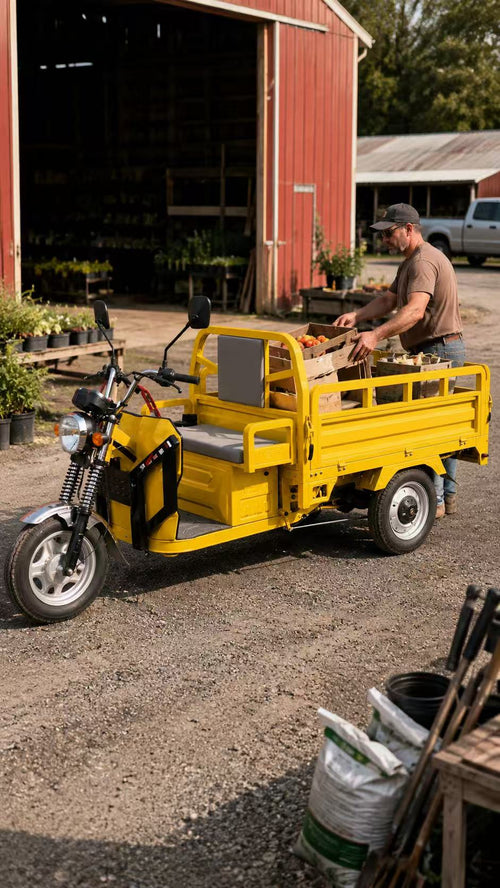
moving produce crates inside a farmers market area
moving boxes between a storage area and a stall
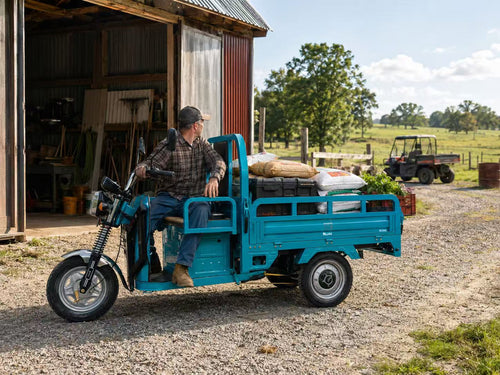
carrying feed bags between a shed and a barn
moving small tools around a ranch yard
transporting nursery trays across a growing area
moving maintenance supplies inside a property
carrying packaging materials across a market
moving small farm orders from packing tables to loading zones
supporting short-distance work inside a warehouse yard
moving garden, orchard, or greenhouse supplies across private routes
In these situations, the work is often low-speed and repeated.
The buyer may not need highway capability. The buyer may not need towing. The buyer may not need a large truck bed for every trip.
The buyer may simply need a practical way to move materials inside the work area.
That is a different kind of transport problem.
A Better Fit for Internal Movement
Low-speed electric transport work equipment fits a specific role.
It is not public-road transportation. It is not a long-distance machine. It is not a replacement for heavy trucks, tractors, forklifts, or UTVs in every job.
Its better role is short-distance material movement inside private sites and controlled work areas.
That may include:
farm yards
barn areas
ranch service zones
produce packing areas
farmers market support spaces
warehouse yards
nursery paths
greenhouse lanes
maintenance areas
small private worksites
commercial market areas
In these places, the value is not speed.
The value is convenience.
The operator can load crates, tools, feed bags, supplies, or small work materials into the cargo bed and move them across a short route without using a full-size truck for every small job.
This can save time and reduce physical effort when the task is repeated throughout the day.
Why Smaller Can Be Smarter
Many buyers naturally think bigger equipment is better.
But bigger is not always smarter.
A larger machine may cost more to buy, more to operate, more to store, and more to maintain. It may also be less convenient in tight work areas.
A smaller electric work trike is not trying to win a power contest against a pickup truck.
That is the wrong comparison.
The better question is:
What does the daily task actually require?
If the job requires road travel, towing, heavy loads, or long-distance transport, the pickup truck is still the better tool.
If the job requires repeated short trips inside a controlled work area, smaller electric transport equipment may be more practical.
The right tool is not always the largest tool.
The right tool is the one that matches the trip.
Farm Work: Many Loads Are Not Truck Loads
Farm work includes many different types of material movement.
Some jobs need a truck or tractor. Others do not.
Many daily farm jobs involve moderate loads, short routes, and repeated trips. A worker may move feed, buckets, tools, fencing supplies, harvest crates, soil bags, repair parts, or packaging materials.
These items may be too heavy or inconvenient to carry by hand, but not always large enough to justify using a pickup truck.
A compact electric work trike can fill this gap.
It gives the worker a powered cargo bed for short-distance movement without turning every small errand into a truck trip.
This can be especially useful on small farms, ranches, orchards, greenhouses, nurseries, horse stables, and private rural properties.
Market Work: Tight Spaces Change the Decision
Farmers markets, produce markets, seafood markets, and fresh food areas have a different problem.
Space is limited.
There may be vendors, crates, stalls, customers, pallets, parked vehicles, wet areas, and narrow internal lanes. A pickup truck may be useful for bringing products to the market, but it may not be the best tool for moving small loads inside the market area.
Once products arrive, the work often becomes internal movement.
Crates need to move from a truck to a stall. Empty boxes need to return to a storage area. Tools and packaging supplies need to be moved across the market. Small orders may need to be moved between vendor areas and pickup points.
For this kind of work, compact electric transport equipment may fit better than a full-size truck.
It can support the worker in tight spaces where large equipment feels inconvenient.
Not a Replacement, But a Support Tool
It is important to be realistic.
A compact electric work trike should not be sold as a full pickup replacement.
That would be misleading.
A pickup truck is still needed for many jobs. It is better for road travel, longer distances, towing, large loads, bad weather road use, and jobs that require full-size vehicle capacity.
The electric work trike is different.
It is a support tool for short-distance, low-speed, internal material movement.
It helps reduce unnecessary small trips with larger equipment. It can make daily movement easier without pretending to do every job a pickup can do.
That honest positioning helps buyers make a better decision.
When an Electric Work Trike Makes Sense
An electric work trike may make sense when:
the work area is private or controlled
the route is short and repeated
workers move crates, tools, feed, supplies, or market goods often
a pickup truck feels too large for the task
hand carrying is tiring
hand carts are becoming slow
the load fits safely in a compact cargo bed
the buyer wants lower-cost support equipment for daily movement
the goal is material movement, not public-road transportation
The best fit is repeated small and medium loads.
That is where a compact electric work trike can provide real value.
When a Pickup Truck Is Still the Better Choice
A pickup truck is still the better choice when the buyer needs:
public-road travel
long-distance transport
towing
large loads
heavy equipment movement
high-speed travel
weather-protected driving
full-size truck bed capacity
jobs that leave the private work area
This article is not saying the pickup is unnecessary.
It is saying the pickup is not always the best tool for every short internal trip.
That difference matters.
How Buyers Should Decide
Before buying any equipment, buyers should look at the actual daily trip.
Ask:
How far do workers move materials?
How many times per day does this trip happen?
What materials are moved most often?
Are the routes private and controlled?
Is the surface firm enough?
Is the load suitable for a compact cargo bed?
Is the work too frequent for hand carrying?
Is the task too small for a pickup truck?
Would a smaller electric transport tool reduce unnecessary movement?
These questions are more useful than asking only about maximum power or maximum size.
A good buying decision starts with the daily task.
The Hidden Cost of Using the Wrong Tool
Using a pickup for every small task may not seem expensive at first.
But over time, the hidden cost appears.
Workers spend time starting, moving, positioning, loading, unloading, and parking a larger machine. In tight work areas, they may need to walk materials from the truck anyway. In markets or farm service areas, a truck may create space problems for simple movement.
Using the wrong tool can turn a small job into a slow job.
That is why many farms and markets benefit from having more than one type of transport tool.
The pickup can handle big jobs.
The compact electric work trike can handle daily short trips.
Each tool has its place.
Why Electric Operation Helps
Electric operation can be useful for short farm and market trips.
There is no gasoline engine to start for every small move. There is less noise than many gas-powered machines. There is no exhaust in tight work areas. Charging can be done near the shed, barn, shop, or storage area.
For private-site work, this simplicity is useful.
The equipment can be loaded, driven slowly across the work area, unloaded, and parked again without turning a small task into a larger operation.
That is the value.
It is not about speed.
It is about practical movement.
Final Thought
A pickup truck is useful, but it is not always the right tool for every short farm or market trip.
When the job involves road travel, towing, large loads, or long-distance transport, the pickup still matters.
But when the job is repeated short-distance material movement inside a farm, market, warehouse yard, nursery, greenhouse, or private work area, a compact electric work trike may be the smarter support tool.
The goal is not to replace the pickup.
The goal is to stop using a full-size machine for every small task.
For many buyers, that is the real question:
Is the pickup doing work that a smaller electric transport tool could handle more efficiently inside the work area?