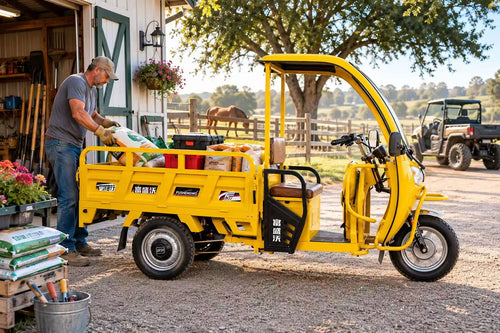
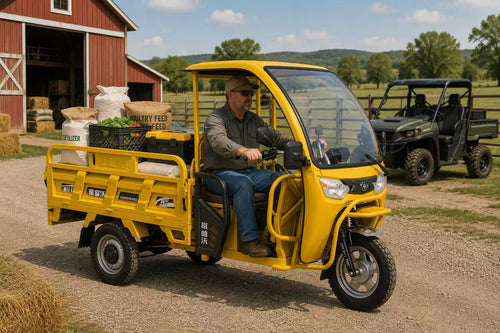
Should You Fix the Farm Route Before Buying an Electric Farm Utility Trike?
Share
Many farm and homestead buyers begin by asking which vehicle they should buy.
Should they buy a larger UTV?
Should they choose an ATV?
Should they buy a tractor?
Would an electric farm utility trike be enough?
Those are reasonable questions.
But when the daily route is muddy, deeply rutted, poorly drained, or soft for much of the year, the more important question may be:
Should I improve the route before buying the vehicle?
A stronger machine can sometimes cross difficult ground.
It cannot always solve a bad road.
If the route collects water, loses its base, forms deep ruts, or stays soft after every rain, buying a more powerful vehicle may only hide the real problem for a short time.
The vehicle may still get stuck.
The route may become more damaged.
The load may become harder to control.
The buyer may spend more money on a machine without improving the daily transport system.
For some properties, the correct first step is not buying a bigger machine.
It is understanding the route.
Why Buyers Often Blame the Vehicle First
When a vehicle struggles on a farm path, the machine is usually blamed first.
The buyer may think:
The motor is not strong enough.
The tires are too small.
The vehicle needs four-wheel drive.
The machine needs more ground clearance.
The vehicle needs to be heavier.
Sometimes those conclusions are correct.
A rough, steep, muddy, or deeply uneven property may require a four-wheel UTV, ATV, tractor, or another machine designed for difficult terrain.
But sometimes the real issue is not the vehicle.
It is the road foundation.
A route with poor drainage can stay soft long after the rain stops.
A path without a stable base can form deeper ruts every time a loaded vehicle passes.
A low area may collect water repeatedly.
A sloped route may allow water to wash away loose material.
A heavy machine may cross the route once, but its weight can make the next trip more difficult.
This is why buyers should separate two questions:
What vehicle fits the work?
What route can support the vehicle?
Both questions matter.
A Vehicle Cannot Replace Drainage
Water is often the real cause of a bad farm route.
When water has nowhere to go, it remains on or under the path.
The surface softens.
The wheels push downward.
Mud moves sideways.
Ruts become deeper.
The next rain fills the same low areas again.
In this situation, changing vehicles does not remove the water.
A larger UTV may cross more easily.
A tractor may pull through.
A four-wheel-drive machine may reduce the chance of getting stuck.
But the underlying route still has a drainage problem.
If the route must be used frequently, the buyer may need to consider:
shaping the route so water can move away
improving roadside drainage
filling low areas
adding suitable gravel
building a stronger base
using a culvert where water crosses the route
creating a fixed travel path
avoiding the route during the wettest period
The exact solution depends on the property.
Some drainage or wetland work may also require local approval, so buyers should not make major changes without checking local requirements.
The important point is simple:
A vehicle can move over a route.
It cannot repair the route by itself.
When You Should Improve the Route First
Some conditions strongly suggest that route work should come before a new electric farm utility trike.
The route stays wet for long periods.
Water regularly stands in the same location.
The ground sinks under normal foot traffic.
Existing vehicles repeatedly create deep ruts.
The path has no stable base.
Loaded vehicles become difficult to steer.
The route has a strong sideways slope.
The surface breaks down after every rain.
The buyer must cross the same weak area many times each day.
The work requires regular heavy loads.
In these conditions, a light electric cargo vehicle should not be treated as a solution to a road problem.
The buyer should first determine whether drainage, grading, gravel, or a different route is needed.
This is not only about avoiding damage to the vehicle.
It is also about protecting the cargo and operator.
A loaded vehicle behaves differently from an empty vehicle.
The weight in the cargo bed can increase wheel sink.
Uneven ruts can shift the load.
Mud can reduce steering control.
A soft shoulder can collapse under one wheel.
A route that looks passable when empty may become unsafe when loaded.
The route should be evaluated under the real working condition, not only by looking at it on a dry day.
When an Electric Farm Utility Trike Can Still Fit
Not every imperfect path needs major construction.
Many farms have routes that are usable but not perfect.
A path may have:
small surface stones
minor bumps
short sections of packed soil
light seasonal dampness
a shallow rut
a firm grass surface
a short gravel lane
a controlled barnyard route
An electric farm utility trike can fit when the route is fundamentally firm and predictable.
The best conditions usually include:
short distance
low-speed travel
private property
firm gravel
concrete
asphalt
compacted soil
relatively level ground
moderate cargo
space for safe turning
In these conditions, a smaller electric 3 wheel farm utility vehicle may be practical for carrying tools, feed bags, crates, boxes, buckets, nursery trays, and maintenance supplies.
The buyer does not need a perfect road.
The buyer needs a route that can support the vehicle and load consistently.
The Difference Between Temporary Mud and a Bad Road
A route may be muddy after one heavy storm.
That does not always mean it needs to be rebuilt.
The buyer should ask whether the problem is temporary or permanent.
Temporary conditions may include:
one unusually heavy rainfall
short-term surface mud
a single shallow puddle
seasonal thaw
temporary construction disturbance
A chronic route problem is different.
The same area may stay soft every season.
The same rut may return after every repair.
Water may repeatedly cross the path.
The route may lack a stable base.
Loaded vehicles may struggle even during normal weather.
If the problem is temporary, the buyer may simply need to wait, use another route, reduce the load, or avoid the path until it dries.
If the problem is chronic, buying a different vehicle may not be the best first investment.
The buyer may receive more value by improving the route.
Why a Bigger UTV Is Not Always the Complete Answer
A larger UTV can offer important advantages.
It may have:
four-wheel drive
wider tires
greater ground clearance
better suspension
more traction
greater towing ability
more stability on suitable rough terrain
Those features matter when the property genuinely requires them.
But a bigger UTV also adds:
more weight
greater purchase cost
larger turning space
more pressure on soft ground
higher maintenance needs
more room required for storage
A heavier machine may cross a soft section once, but repeated passes can deepen the damage.
The buyer may then need an even stronger machine or more expensive road work later.
This does not mean buyers should avoid UTVs.
It means a UTV should be purchased for real work needs, not as a substitute for drainage and route planning.
If the property requires rough-terrain capability, towing, long hours, or steep-ground work, a UTV may be the correct choice.
If the work is short-distance cargo movement on a firm private route, an electric farm utility trike may be enough.
The road and the workload should decide.
A Fixed Route Can Be More Valuable Than More Power
Small farms and homesteads often have several work points:
a barn
a feed storage area
a garden
a greenhouse
a workshop
a nursery area
an animal enclosure
a packing area
a warehouse building
a property-maintenance zone
The buyer may try to drive directly between every location.
That creates many different paths.
Some may cross soft ground.
Some may become muddy.
Some may be too narrow.
Some may not support repeated loaded travel.
A fixed route can improve the entire transport system.
A buyer may choose one dependable path between the main work areas.
That route can be:
kept clear
properly drained
covered with suitable material
checked for turning space
used consistently
maintained before major damage develops
This can make a smaller farm utility trike more useful.
Instead of asking the vehicle to travel everywhere, the buyer creates one reliable path for regular cargo work.
That is often more efficient than buying a machine for the worst part of the property.
How Load Changes Route Performance
The same electric cargo trike for farm use may behave very differently when loaded.
An empty vehicle places less pressure on the surface.
A loaded vehicle places more weight on the rear wheels.
Soft areas become more important.
Ruts affect the vehicle more strongly.
Braking distance may increase.
Turning requires more care.
The buyer should evaluate the route using the normal working load.
Questions should include:
What do I carry most often?
How much does the normal load weigh?
Is the cargo placed low in the bed?
Is the load balanced from side to side?
Does the route remain firm after rain?
Can the loaded vehicle stop safely?
Can it turn without entering a soft shoulder?
Is there enough room to avoid damaged areas?
A route that supports an empty electric farm cargo trike may not support the same vehicle with a full cargo bed.
This is why route planning and load planning must be considered together.
When Gravel Can Help
Gravel can improve many farm routes, but simply spreading a thin layer over mud may not solve the problem.
If the base underneath is soft, the gravel may sink.
The wheels may push the material into the soil.
Water may continue to collect.
The route may look improved for a short time and then fail again.
A stronger route may require:
removing unstable surface material
creating a firm base
using suitable aggregate
building enough depth
shaping the surface for drainage
maintaining the edges
adding more material where traffic is concentrated
The exact construction depends on soil, water, traffic, load, and local conditions.
The purpose of this article is not to provide road-engineering instructions.
It is to help the buyer understand that route quality is a separate investment from vehicle quality.
A good vehicle cannot correct a poorly built path.
A good path can make a modest vehicle far more useful.
When a Lighter Vehicle Can Be an Advantage
Larger equipment is not always better for every route.
A lighter electric farm utility trike may place less total weight on a firm route than a large UTV or pickup.
It may also be easier to use in:
barnyards
nursery lanes
greenhouse work areas
small private yards
warehouse paths
market loading zones
narrow property routes
This advantage only applies when the surface is suitable.
A lighter vehicle is not automatically a mud vehicle.
It is not designed to float over deep soft ground.
It is not a replacement for four-wheel drive in difficult terrain.
It can, however, reduce unnecessary machine size when the main job is moderate cargo movement on a controlled route.
This is an important difference.
The buyer should not ask:
Is the trike strong enough to cross every part of my property?
The better question may be:
Can I create one reliable route for the work I do most often?
That can lead to a smarter purchase.
When You Should Choose Another Machine
An electric utility trike with cargo bed is not the correct choice when the route regularly includes:
deep mud
steep slopes
strong side slopes
large rocks
deep washouts
soft pasture
forest trails
large roots
heavy snow
severe ruts
long off-road distances
The buyer should also choose another machine if the work requires:
heavy trailer towing
farm implements
high-speed travel
continuous all-day operation
public-road use
deep off-road capability
In those situations, a UTV, ATV, tractor, compact tractor, tracked carrier, or other purpose-built equipment may be more appropriate.
The buyer should not modify the route decision only to justify a preferred vehicle.
The work and terrain should determine the machine.
Can You Use a Different Route?
Sometimes the cheapest solution is not rebuilding the existing route.
It may be choosing another one.
A buyer should walk the property before purchasing.
Look for:
higher ground
firmer soil
shorter crossings
existing gravel paths
barn access lanes
areas with better drainage
wider turning points
routes that avoid side slopes
A slightly longer route may be safer and more reliable.
This matters because buyers often focus only on the shortest path.
The shortest route is not always the best working route.
A stable route that is slightly longer may reduce:
stuck vehicles
surface damage
cargo movement
tire wear
operator stress
repeated repairs
For a low-speed farm utility trike, route quality usually matters more than saving a few seconds.
How Often Will the Route Be Used?
Frequency changes the decision.
A weak path used once a month creates a different problem from a weak path used twenty times each day.
The buyer should estimate:
daily trips
weekly trips
seasonal use
normal cargo weight
maximum regular cargo weight
rainy-season traffic
winter traffic
A lightly used route may only require careful timing and load limits.
A heavily used route may justify permanent improvement.
If an electric cargo trike for small farm work will travel between the barn and storage area every day, that path should be dependable.
Repeated daily transport requires more than occasional passability.
It requires consistency.
Should You Buy the Vehicle First?
Sometimes yes.
The buyer may already have a firm route.
Only minor improvements may be needed.
The vehicle may help carry gravel bags, tools, drainage pipe, or repair materials while route work is completed.
A buyer may also need the vehicle immediately for work areas that are already suitable.
In that situation, buying the electric farm utility trike first can make sense.
But the buyer should not send it through the worst part of the property simply because it has arrived.
The machine should begin work on the routes that match its design.
Other areas can be improved later.
Should You Fix the Route First?
Sometimes yes.
The route should come first when:
the ground cannot support the normal load
the path has deep standing water
the route repeatedly causes stuck vehicles
the surface is strongly tilted
the same area fails every season
the work requires many loaded trips each day
the buyer has no safe alternate route
In those cases, route improvement may create more value than changing the vehicle.
A firm route can support:
an electric farm utility trike
a UTV
an ATV
a tractor
a cart
workers on foot
The road benefits the entire operation.
That makes route work a long-term property investment.
Questions to Ask Before Buying
Before purchasing, the buyer should inspect the normal route and answer these questions.
Is the route firm when dry?
How long does it stay wet after rain?
Does water collect in the same places?
Are the ruts shallow or deep?
Does the route have a stable base?
Is there a strong side slope?
Can the vehicle turn safely?
Is there a firm shoulder?
Can a loaded vehicle stop safely?
How many trips happen each day?
What is the normal load?
Is there another route?
Would drainage or gravel solve the problem?
Does the work truly require four-wheel drive?
These questions help separate a vehicle problem from a route problem.
A Better Buying Order
A practical buying process can follow this order:
First, define the daily cargo.
Second, measure the route.
Third, inspect the surface after normal weather.
Fourth, identify mud, drainage, slope, and turning problems.
Fifth, decide whether those problems are temporary or permanent.
Sixth, improve the critical parts of the route if necessary.
Seventh, choose the vehicle that matches the finished working route.
This prevents the buyer from purchasing a machine based only on the worst patch of ground.
It also prevents the buyer from expecting a light cargo vehicle to perform heavy off-road work.
Final Thought
Should you fix the farm route before buying an electric farm utility trike?
The answer depends on the route.
If the path is fundamentally firm, short, private, and suitable for low-speed cargo transport, an electric farm utility trike may work well with only minor route maintenance.
If the path has chronic mud, standing water, deep ruts, soft foundations, strong side slopes, or repeated heavy traffic, the road problem should be addressed first.
A larger UTV may cross difficult ground more easily.
It cannot replace drainage, a firm base, or a safe working route.
The best equipment decision is not only about the machine.
It is about the complete transport system:
the vehicle
the load
the route
the surface
the weather
the frequency of use
A reliable route can make a smaller cargo vehicle more useful.
A bad route can make even a powerful vehicle frustrating.
Before buying more machine, make sure the road is ready for the work.