Do Not Buy the Biggest Machine First
Share
Many buyers make the same mistake at the beginning.
They start by looking for the biggest machine.
They assume bigger means better. Bigger means stronger. Bigger means more useful. Bigger means they will not regret buying too small.
That sounds logical at first.
But for many farms, markets, nurseries, private properties, and small work areas, the biggest machine is not always the smartest first choice.
The real question is not:
What is the biggest machine I can buy?
The better question is:
What kind of trip happens every day?
This matters because many daily jobs are not long-distance, high-speed, heavy-duty transport jobs. Many of them are short internal trips. Workers move crates, feed bags, tools, supplies, boxes, and work materials from one point to another inside a private or controlled work area.
If that is the real daily job, buying the biggest machine first may not solve the problem as efficiently as buyers expect.
Bigger Is Not the Same as Better Matched
A large machine may be powerful.
It may handle rougher ground. It may travel faster. It may carry more. It may tow more. It may look more professional and more impressive on paper.
But none of those things automatically means it is the best first tool for daily work.
A machine can be too large for the route.
Too large for the turning area.
Too large for the daily load.
Too expensive for the actual task.
Too much machine for work that only requires repeated short-distance material movement.
This is where many buying decisions go wrong.
Buyers compare maximum capability, but they do not compare daily suitability.
A bigger machine may still be useful later. But it may not be the best first answer to a simpler transport problem.
The Daily Trip Should Decide the Tool
Before buying transport work equipment, a buyer should look closely at the daily trip.
What is being moved every day?
How far does it move?
How often does the trip repeat?
Is the route private and controlled?
Does the work mainly involve crates, feed, boxes, tools, supplies, or small work materials?
Does the operator really need higher speed, towing power, or passenger capacity?
Or does the operator mainly need a practical way to move moderate loads across short internal routes?
These questions matter more than buyers often realize.
Many operations do not lose time because they lack the biggest machine.
They lose time because they lack the right-sized tool for repeated daily movement.
What Many Buyers Actually Need
In many farms, markets, nurseries, greenhouses, barns, warehouse yards, and private work areas, the daily task is surprisingly basic.
Move produce crates from storage to packing.
Move feed bags from a shed to the barn.
Move tools and repair parts to a work area.
Move boxes and supplies between workstations.
Move packaging materials and cleaning items across a market zone.
Move trays, soil bags, irrigation parts, and small materials in a nursery.
These are practical daily movement jobs.
They are important, but they are not always large-machine jobs.
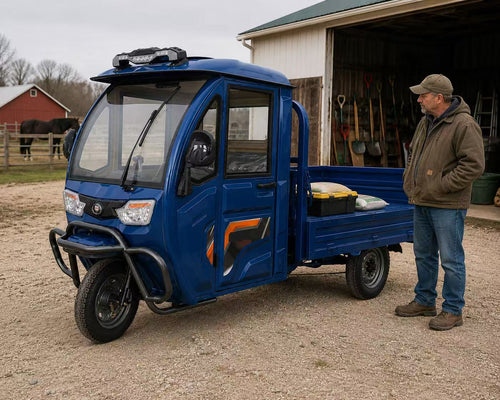
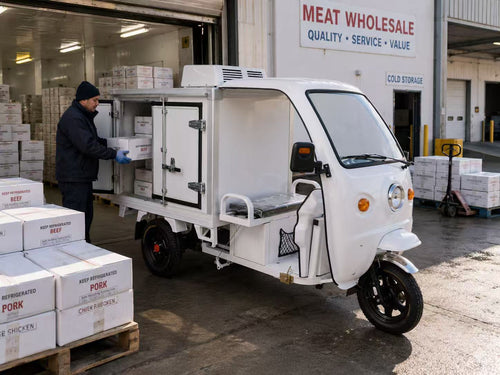
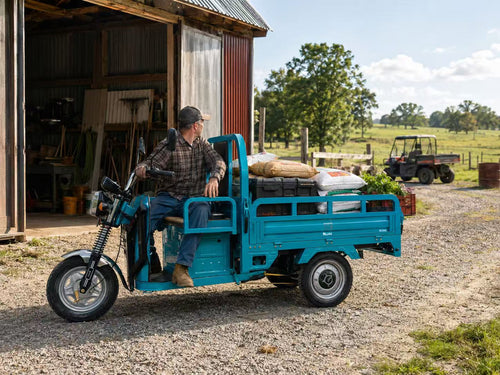
A buyer may be tempted to start with the biggest equipment available because it feels safer. But in reality, a compact electric transport work trike may match these daily trips more directly.
It is not about buying small for the sake of buying small.
It is about matching the tool to the actual work.
The Biggest Machine Can Create Its Own Problems
A machine that is larger than the daily task can create new inefficiencies.
It may cost more to buy.
It may take more room to store.
It may feel less convenient for frequent short trips.
It may be harder to position near worktables, barns, market prep spaces, greenhouse lanes, or narrow work routes.
It may be underused.
This is one of the least discussed problems in buying decisions.
People worry about buying too small.
But they do not worry enough about buying too large for the real job.
A machine that is oversized for daily internal movement may still work, but it may not work in the most practical way.
That is why the first machine should usually be chosen by daily use, not by maximum imagination.
The First Tool Should Solve the Most Frequent Problem
A smart buying approach is simple.
Solve the most frequent problem first.
If the most frequent problem is repeated short-distance movement of crates, feed bags, tools, boxes, and supplies, then the first tool should improve that daily flow.
That does not mean a buyer will never need larger equipment.
It means the buyer should not start with a larger solution if the real problem is smaller and more repetitive.
Many operations spend more time on everyday movement than on occasional heavy transport.
That is why short internal trips deserve more attention.
A compact electric work trike can often fit this role well. It gives the operator a low-speed powered cargo platform for moving practical daily loads across private work areas.
This is a very different purpose from buying the biggest machine simply because it looks more capable.
Buying by daily trip is often more efficient than buying by maximum size.
Reasonable Capacity Matters More Than Theoretical Capacity
Another common mistake is chasing theoretical capacity.
Buyers look at what a machine could handle in extreme cases, not what they will use most of the time.
But work equipment should be judged by normal use, not only by extreme use.
If most trips involve moderate loads, short routes, and low-speed movement, then a right-sized tool may be more useful in daily practice than a much larger machine with capabilities that are rarely used.
This is especially true when the work is repetitive.
Even if the machine carries less than a larger unit, it may still be the better first choice because it matches the real route, the real operator, and the real work pattern.
The smartest equipment is not always the one with the biggest number.
It is the one that fits the daily job without creating unnecessary cost or inconvenience.
Where a Compact Electric Work Trike Makes Sense
A compact electric work trike makes sense when the daily work includes:
moving feed bags across a private farm yard
transporting produce crates in a market prep area
moving tools and maintenance supplies around a property
carrying nursery materials between work zones
moving small warehouse loads across a yard
supporting repeated low-speed internal hauling
handling moderate loads that are too much for repeated hand carrying
reducing one-box-at-a-time trips
improving short-distance material flow
In these situations, the goal is not public-road travel.
The goal is not high-speed transport.
The goal is not towing.
The goal is practical daily movement inside a private or controlled work area.
That is the role this type of equipment can fill.
When a Bigger Machine Really Is Necessary
This article is not saying bigger machines are unnecessary.
That would be inaccurate.
A larger machine may absolutely be the right choice if the daily job includes:
heavier loads
rougher terrain
longer route distances
towing needs
higher ground clearance needs
more demanding jobsite conditions
passenger carrying
larger-scale outdoor work
regular use that truly requires higher capability
In those cases, buying bigger first may make sense.
The key point is not that bigger is bad.
The key point is that bigger should be justified by the daily trip.
If the daily trip does not require that level of machine, then buying the biggest machine first may not be the most efficient decision.
Why Buyers Overestimate Their First Need
Many buyers overestimate the first machine they need because they imagine future tasks more than present tasks.
They think:
What if I need more later?
What if I occasionally move something bigger?
What if I regret not buying larger?
Those are understandable thoughts.
But in practice, daily work patterns usually reveal the truth more clearly than imagination does.
If the workday is mostly made of short internal trips with moderate materials, then the first piece of transport work equipment should probably serve that exact pattern.
A tool that gets used every day well may deliver more value than a larger machine that is only fully useful occasionally.
This is why matching the first purchase to the daily task is so important.
A Buyer Should Think in Layers
A practical buyer does not need to think in extremes.
The decision is not always “small forever” or “big immediately.”
A better approach is to think in layers.
What tool solves the daily repeated transport problem?
What tool might be needed later for heavier or more specialized tasks?
Can the first purchase cover the most common work efficiently?
Can larger equipment come later only if the work truly grows into it?
This kind of layered thinking prevents overspending and helps the buyer build a more practical equipment setup over time.
In many cases, a compact electric work trike can be that first practical layer.
It handles the repeated short trips that consume time every day.
Good Buying Decisions Start with Honesty
The best buying decisions start with an honest look at the work.
Not the most dramatic job.
Not the most impressive machine.
Not the biggest specification.
Just the real daily movement problem.
If workers spend most of the day moving moderate loads inside a private site, then the buyer should choose a tool that makes that movement easier.
That is why this article matters.
Many people do not need the biggest machine first.
They need the best-matched tool first.
That simple difference can save money, improve daily efficiency, and reduce wasted movement from the beginning.
Final Thought
Do not buy the biggest machine first just because it seems safer.
Buy the tool that matches the daily trip.
If the real work is repeated short-distance movement of crates, feed, tools, boxes, supplies, and small materials inside a private or controlled work area, then a compact electric transport work trike may be the smarter first choice.
A bigger machine may still be useful later.
But the first purchase should solve the work that happens every day.
That is what makes equipment practical.
And that is what makes a buying decision smarter.