Do You Really Need a Hydraulic Dump Bed on an Electric Farm Utility Trike?
Share
Many farm buyers compare a standard cargo bed with a hydraulic dump bed and ask the same question:
Is the hydraulic system really worth paying more for?
That is a reasonable question.
A hydraulic dump bed can make unloading faster and easier.
But not every buyer needs it.
The answer depends on:
what material is carried
how often it is unloaded
how heavy the normal load is
whether the material is loose or packaged
how much manual labor is available
whether the buyer wants a simpler machine
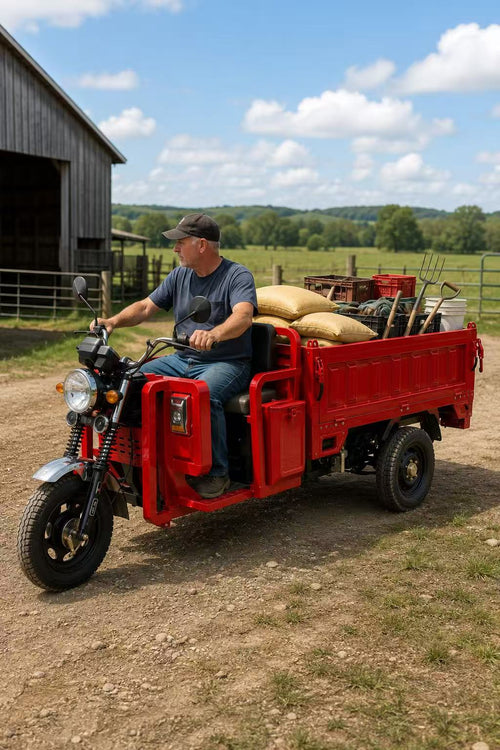
A farm utility vehicle used mainly for tools, feed bags, boxes, crates, and nursery trays may not need a hydraulic dump bed.
A vehicle used repeatedly for soil, compost, manure, wood chips, sand, gravel, or loose farm waste may benefit from it every day.
The correct question is not only:
Can the cargo bed lift?
The better question is:
How much time and physical effort will the lifting function save during my real work?
Why Hydraulic Dump Beds Attract Buyers
A hydraulic dump bed looks like a major upgrade.
It gives the vehicle a stronger work-machine appearance.
It can raise the cargo bed without requiring the operator to lift it by hand.
For buyers who regularly move loose materials, this feature can reduce:
shoveling
raking
lifting
bending
unloading time
operator fatigue
But the hydraulic system also adds:
purchase cost
components
inspection points
possible repair needs
weight
complexity
That is why buyers should evaluate the function honestly.
A useful hydraulic system is not a luxury.
An unused hydraulic system is an expensive feature.
The Material Type Matters Most
The first question should be:
What will you carry?
A standard open cargo bed works well for:
feed bags
boxes
crates
toolboxes
buckets
nursery trays
small equipment
repair supplies
These items usually need to be removed one by one.
Tilting the cargo bed may not help.
In some cases, dumping packaged cargo could damage it.
A hydraulic dump bed is more useful for loose materials such as:
soil
compost
manure
wood chips
mulch
sand
gravel
small stones
loose agricultural waste
These materials can often slide or roll out when the bed is raised.
The buyer should match the bed to the cargo.
Do Not Pay for Dumping If the Cargo Cannot Be Dumped
Some buyers see a hydraulic dump bed and assume it will improve every transport job.
That is not true.
If the normal cargo includes:
stacked boxes
fragile produce
glass containers
tools
bags that must remain intact
nursery trays
the operator will still unload the items by hand.
The hydraulic function adds little value to those jobs.
The bed may still be useful as a normal cargo platform.
But the buyer should not pay extra only because the feature looks impressive.
The function should match the material.
Frequency Changes the Value
A buyer who unloads loose material once per month may not recover the added cost.
A buyer who unloads several loads every day may receive value quickly.
For example, a farm may move:
manure from animal areas
compost to gardens
wood chips to pathways
soil to greenhouse beds
gravel to maintenance routes
If the operator unloads ten times each day, hydraulic lifting can reduce a large amount of manual work.
The buyer should estimate:
loads per day
loads per week
minutes saved per load
physical effort reduced
This gives a more realistic answer than asking only whether hydraulic dumping is convenient.
Heavy Loose Loads Are Different From Light Loose Loads
A light load of dry leaves is easy to unload.
A heavy load of wet soil is not.
Material weight changes the decision.
A hydraulic dump bed becomes more valuable when the buyer regularly carries:
wet compost
dense manure
soil
sand
gravel
stone
These materials can be difficult to remove with a shovel or rake.
The operator may need to bend repeatedly inside the cargo bed.
That can slow the work and increase fatigue.
The buyer should still remain within the rated vehicle and bed capacity.
Hydraulic lifting does not make overloading safe.
A raised bed also changes the center of gravity, so unloading must happen on firm, level ground.
Hydraulic Lifting Does Not Guarantee Complete Unloading
A hydraulic system raises the cargo bed.
It does not guarantee that every material will slide out completely.
Some materials may stick.
Examples include:
wet clay
packed manure
sticky compost
long branches
vines
tangled brush
frozen material
Material may also remain in the bed if:
the bed angle is not sufficient
the tailgate is not opened correctly
the load is packed too tightly
the bed surface is rough
The operator may still need to use a rake or shovel.
The buyer should not expect the hydraulic system to eliminate all manual work.
It reduces lifting and unloading effort.
It does not replace good loading and unloading practices.
A Manual Dump Bed Can Be Enough
A manual dump bed may be enough when:
loads are light
materials slide easily
unloading is occasional
the operator is physically able
the purchase budget is limited
A manual bed can offer:
lower cost
simpler construction
fewer electrical or hydraulic components
easier local inspection
But the operator must be able to control the bed safely.
A load that feels easy when empty may become difficult when full.
The buyer should not assume that a manual bed can be lifted comfortably under every load.
Counterbalance and latch design matter.
The operator should never stand in an unsafe position or force a loaded bed beyond their strength.
A Fixed Cargo Bed Can Be the Better Choice
A fixed cargo bed may be the best choice when the work focuses on:
packaged goods
tools
feed bags
produce crates
nursery supplies
maintenance equipment
The buyer may prefer:
lower purchase price
simpler structure
less maintenance
more predictable loading
A fixed bed can still provide strong work value.
A large, long, and deep cargo bed can replace many walking trips.
The vehicle does not need hydraulic dumping to be useful.
The best vehicle is not the one with the most features.
It is the one that completes the normal work.
How Much Time Can Hydraulic Unloading Save?
The buyer should measure the unloading process.
Suppose one manual unloading cycle takes fifteen minutes.
A hydraulic dump cycle may reduce that to several minutes, depending on the material.
If the buyer unloads six times per day, the time savings can become significant.
The calculation should include:
positioning the vehicle
opening the tailgate
raising the bed
allowing material to move
lowering the bed
cleaning remaining material
The buyer should not compare only the lift time.
The complete unloading cycle matters.
If the material still requires heavy cleanup, the actual time savings may be smaller.
If the material slides cleanly, the savings may be much greater.
Physical Effort Has Real Value
Farm work often involves repeated lifting and bending.
Hydraulic dumping can reduce:
back strain
shoulder strain
shoveling
raking
manual bed lifting
This can be important for:
older operators
one-person farms
workers with back or joint concerns
operations with limited labor
The buyer should not treat physical effort as having no financial value.
Fatigue can slow other work.
An operator who spends less effort unloading may complete more work during the day.
But hydraulic dumping should not be presented as a medical solution.
The buyer still needs safe loading, safe unloading, and realistic work limits.
When a Hydraulic Dump Bed Creates Strong Value
A hydraulic dump bed is often worth more when:
loose material is moved frequently
loads are heavy
unloading happens several times per day
manual labor is limited
the operator wants faster turnaround
the property has a safe unloading area
This can fit:
livestock farms
compost operations
landscaping work
property maintenance
small construction areas
nurseries
greenhouses
A hydraulic dump trike can serve as a short-distance material-flow tool.
It does not replace a large dump truck or heavy construction machine.
It handles repeated private-site transport more efficiently.
When It May Be an Unnecessary Upgrade
The hydraulic system may not be worth the extra cost when:
most cargo is packaged
loads are light
unloading is rare
the buyer already has another dumping machine
the buyer prefers the simplest vehicle
the property has no safe unloading area
The buyer should not purchase hydraulic dumping for one imagined future job.
The decision should be based on work that happens regularly.
Use a short work diary.
Record the loads moved during one week.
If almost none of them can be dumped, the hydraulic feature may remain unused.
The Unloading Area Matters
A hydraulic dump bed should be raised on:
firm ground
level ground
stable ground
The operator should avoid:
strong side slopes
soft shoulders
deep mud
uneven ruts
unstable piles
Raising the bed moves the load upward.
That changes vehicle balance.
The operator should also check:
overhead clearance
people nearby
animals nearby
tailgate position
material flow direction
The vehicle should not be driven with the bed raised.
The operator should lower and secure the bed before moving.
The Tailgate Must Match the Material
The tailgate is an important part of the unloading system.
The operator should understand:
how it opens
how it latches
whether it swings
whether it can be removed
whether material may jam
A hydraulic bed with a poorly managed tailgate may not unload well.
The tailgate should be checked before raising the bed.
The operator should not stand directly behind the load.
Loose material may move suddenly.
The unloading area must remain clear.
Hydraulic Systems Add Components
A hydraulic dump bed may include:
electric motor
pump
hydraulic cylinder
oil reservoir
hoses
fittings
switches
wiring
mounting points
These parts require inspection.
The owner should watch for:
oil leaks
loose fittings
damaged hoses
corroded electrical connections
slow lifting
unusual noise
bed movement that is not smooth
A hydraulic system can be reliable when used and maintained correctly.
But it is more complex than a fixed bed.
The buyer should accept that added complexity before choosing the feature.
The buyer should ask:
Can a local farm-equipment technician inspect the hydraulic system?
Can a hydraulic shop service the hose or cylinder?
Can an electrical technician check the pump and wiring?
Are replacement parts available?
A simple local repair plan increases long-term confidence.
OneClickChina’s support approach is to coordinate service near the buyer’s location.
The buyer may recommend a trusted local technician with experience in:
farm equipment
motors
electric vehicles
hydraulics
small equipment
If the buyer does not know someone nearby, service options can be searched around the customer’s location.
The purpose is to keep repair practical and local.
Hydraulic Dumping Does Not Replace a Loader
A dump bed helps unload material.
It does not load the vehicle.
The buyer may still need:
shovel
fork
small loader
tractor bucket
manual labor
The complete work cycle includes both loading and unloading.
If loading takes most of the labor time, hydraulic dumping may solve only part of the problem.
That does not make it useless.
It means the buyer should evaluate the entire workflow.
Do You Need a Larger Hydraulic System?
Buyers sometimes assume that more lifting power is always better.
The hydraulic system only needs to safely handle the rated bed and load.
Oversizing can add:
cost
weight
energy use
complexity
The buyer should focus on:
rated payload
bed dimensions
dump angle
cycle time
system reliability
A stronger system does not permit the buyer to exceed the vehicle’s safe load rating.
The chassis, brakes, tires, bed, and route all have limits.
Can the Hydraulic Bed Help With Snow?
A hydraulic dump bed may help unload:
light snow
salt
sand
winter maintenance materials
But the vehicle is not a snow-plowing machine simply because it has a dump bed.
Deep snow, icy slopes, and heavy winter towing may require a different vehicle.
The buyer should not use one feature to justify work beyond the machine’s design.
The hydraulic function should remain connected to realistic cargo work.
Can the Hydraulic Bed Help With Manure?
Manure is one of the strongest use cases for a hydraulic dump bed.
But manure condition matters.
Dry loose manure may unload easily.
Wet compacted manure may stick.
Bedding may tangle.
Long straw may bridge across the bed.
The buyer may need to:
load evenly
avoid excessive packing
use a liner
clean the bed after unloading
The hydraulic system can still reduce major lifting and shoveling.
But it should not be described as fully automatic.
Can It Handle Gravel?
A hydraulic dump trike may be useful for short-distance gravel movement.
The buyer should pay close attention to:
weight
route firmness
braking
loading method
bed capacity
Gravel becomes heavy quickly.
The cargo bed should not be filled by volume without considering weight.
A visually half-full bed may already be near the vehicle’s rated capacity, depending on the material.
The operator should know the approximate density of the material and avoid overloading.
Does Hydraulic Dumping Improve Resale Value?
Some buyers believe hydraulic dumping will automatically increase resale value.
It may make the vehicle more attractive to certain buyers.
But future value still depends on:
condition
brand recognition
battery health
hydraulic condition
local demand
service records
The buyer should not assume that the full upgrade cost will return during resale.
The main value should come from work completed during ownership.
Buy the feature because it saves time and effort now.
Treat future resale as a secondary benefit.
A Better Cost Comparison
The buyer can compare two options.
Standard cargo bed:
lower purchase cost
simpler structure
manual unloading
best for packaged cargo
Hydraulic dump bed:
higher purchase cost
faster loose-material unloading
less manual bed lifting
more components to inspect
Then estimate:
loads per week
minutes saved per load
labor cost
years of use
maintenance cost
If the hydraulic bed saves hundreds of hours over several years, the upgrade may be easy to justify.
If it saves only a few hours, the standard bed may be better.
Do Not Buy Only for Appearance
A raised hydraulic bed makes the vehicle look powerful.
That can influence buyers.
But appearance is not the same as value.
A feature should be purchased because it improves the work.
The buyer should not ask:
Which vehicle looks more professional?
The buyer should ask:
Which vehicle reduces the cost and effort of my real material flow?
That produces a better decision.
Questions to Ask Before Buying
Before choosing a hydraulic dump bed, ask:
What materials will I carry?
How heavy are they?
How many loads will I unload per day?
Will the material slide?
Will it stick?
Is the unloading area level and firm?
Can I unload safely without the hydraulic system?
How much extra does the feature cost?
Can local technicians service it?
Are replacement parts available?
Will the feature be used every week?
These questions help separate a real operational need from an attractive option.
A One-Week Material Test
Before buying, record one week of cargo work.
For every load, write down:
material type
estimated weight
number of trips
manual unloading time
physical effort
At the end of the week, divide the loads into two groups:
cargo that must be removed by hand
cargo that can be dumped
If most loads must be removed by hand, a standard cargo bed may be enough.
If most loads are heavy loose material, hydraulic dumping may create strong value.
When the Standard Cargo Bed Wins
The standard cargo bed is often the better choice when:
the buyer carries boxes
the buyer carries bags
the buyer carries tools
the buyer wants lower cost
the buyer wants fewer components
The standard bed should not be considered inferior.
It is a different tool.
It can be the correct tool for many farms.
When the Hydraulic Dump Bed Wins
The hydraulic dump bed is often the better choice when:
the buyer handles soil
the buyer handles manure
the buyer handles compost
the buyer handles wood chips
the buyer handles gravel
the buyer unloads repeatedly
The feature creates value when it reduces a recurring bottleneck.
Final Thought
Do you really need a hydraulic dump bed on an electric farm utility trike?
Sometimes yes.
Sometimes no.
If the vehicle mainly carries tools, feed bags, boxes, crates, and nursery trays, a standard open cargo bed may be the simpler and more economical choice.
If the vehicle repeatedly carries and unloads soil, manure, compost, wood chips, sand, gravel, or other loose materials, hydraulic dumping can save time and physical effort.
The buyer should evaluate:
material
weight
frequency
unloading time
operator effort
maintenance acceptance
The hydraulic system should be purchased for real daily value.
Not appearance.
Not fear.
Not one rare future job.
The best cargo bed is the one that matches the material handled every week.