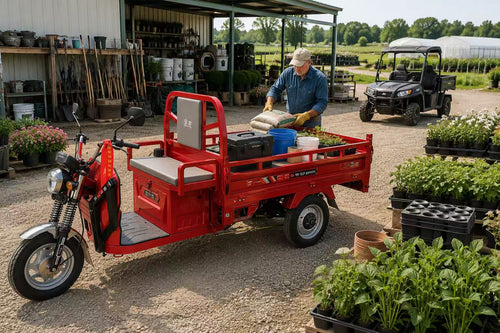
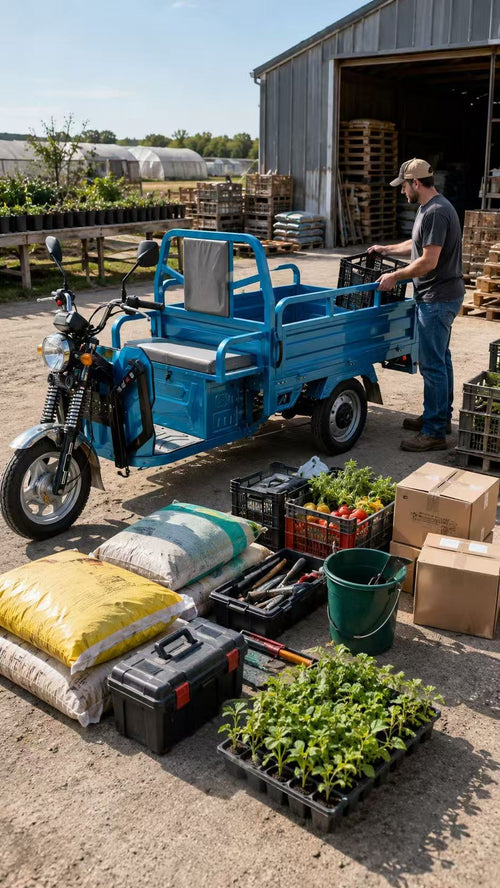
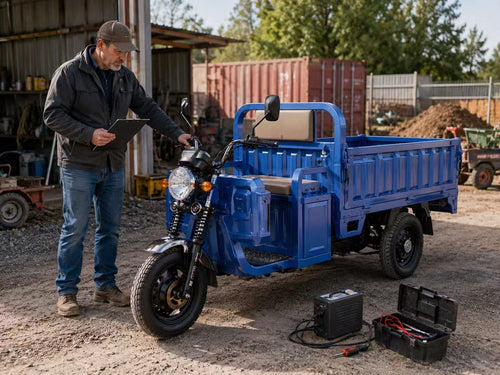
Electric Utility Vehicle for Ranch Livestock Handling – 50KM Low-Cost Industrial Mobility System for Cattle Movement and Feed Transport
1. FACT REALITY – RANCH TRANSPORT PROBLEM
Ranch operations in the United States rely heavily on short-distance internal transport systems for cattle movement, feed delivery, fencing materials, and yard management.
Most daily work happens within a limited operational radius of approximately 50 kilometers inside the ranch environment.
However, current transport systems are not designed for this pattern of work.
Key realities include:
* Frequent short-distance repetitive movement
* Narrow cattle lanes and uneven ground conditions
* High workload distributed across multiple zones
* Continuous feed and livestock handling cycles
The result is a structural inefficiency in internal ranch logistics.
⸻
2. SYSTEM FAILURE – WHY TRUCKS AND TRACTORS FAIL
Traditional ranch transport systems rely on pickup trucks, tractors, or ATVs.
However, these systems are structurally mismatched for internal ranch logistics.
Failure reasons:
* Fuel-based systems are optimized for long-distance transport, not repetitive short cycles
* Trucks are oversized for internal cattle yard movement
* Tractors are expensive to operate for light repetitive tasks
* Fuel consumption becomes inefficient at low-speed high-frequency usage
* Maintenance complexity increases with mechanical drivetrain systems
This creates a system-level inefficiency, not just an equipment limitation.
⸻
3. COMPARATIVE PROOF – ELECTRIC VS FUEL SYSTEM
Fuel-Based Ranch Transport System:
* High fuel consumption per cycle
* High maintenance cost (engine, gearbox, oil systems)
* Limited maneuverability in narrow cattle lanes
* Inefficient for stop-and-go operations
⸻
Electric Utility Vehicle System:
* Electric motor direct-drive efficiency
* Extremely low cost per operational cycle
* High torque at low speed for cattle handling
* Suitable for narrow, uneven, and off-road ranch terrain
* Minimal mechanical maintenance requirements
⸻
This comparison shows that both systems are not incremental alternatives, but fundamentally different mobility architectures.
⸻
4. LOGICAL NECESSITY – WHY CHANGE IS INEVITABLE
Within a 50KM ranch operational radius, transport work is defined by:
* high-frequency repetition
* short-distance loops
* distributed workload zones
* terrain variability
Under these conditions, fuel-based systems become economically and structurally inefficient.
Therefore, a low-cost electric mobility system is not an option—it is a necessary structural replacement for internal ranch logistics.
⸻
5. SYSTEM SOLUTION – ELECTRIC 50KM MOBILITY ARCHITECTURE
The Electric Utility Vehicle system provides a dedicated mobility layer for ranch operations.
It is designed specifically for:
* cattle movement between pens and loading zones
* feed transport across ranch areas
* fencing and maintenance logistics
* short-distance heavy-duty repetitive transport
This creates a unified internal transport system optimized for ranch environments.
⸻
6. ECONOMIC + MAINTENANCE SUPERIORITY
Compared to fuel-based ranch transport systems, the electric mobility system provides:
* No fuel dependency for daily operations
* Significantly reduced operating cost per kilometer
* Lower mechanical failure rate due to simplified structure
* Reduced maintenance cycles and downtime
* Optional solar-assisted charging capability for off-grid ranches
This results in a structurally lower total cost of ownership over time.
⸻
7. SYSTEM VALIDATION – MULTI-RANCH OPERATION PROOF
The system is applicable across multiple ranch operational tasks:
* cattle handling and movement
* feed distribution systems
* livestock yard logistics
* ranch maintenance operations
* loading and transport coordination
All scenarios share the same requirement: low-cost, high-frequency, short-distance mobility
All system analysis, operational logic, and ranch application validation converge into a single industrial mobility solution gateway:
👉 https://oneclickchina.shop/
This platform represents the unified deployment entry point for the 50KM Industrial Mobility System, providing electric utility vehicle solutions for ranch, agricultural, and rural transport operations.