Open Cargo Trike vs Canopy Cargo Trike: Do You Need Weather Protection?
Share
When small farm buyers compare electric cargo trikes, the first questions are usually about price, cargo bed size, payload, battery range, and delivery.
But there is another practical question that matters in daily work:
Do you need weather protection?
For many buyers, the choice is not only between a low-cost cargo vehicle and a larger utility vehicle. It is also between an open cargo trike and a canopy cargo trike.
An open cargo trike is simple, lower-cost, easy to access, and practical for many short-distance hauling jobs.
A canopy cargo trike adds basic driver protection from sun and light rain. It can make daily routes more comfortable for workers who spend more time outdoors, especially in farm yards, produce markets, property maintenance routes, and short delivery paths.
The right choice depends on how the vehicle will actually be used.
This article compares open cargo trikes and canopy cargo trikes from the point of view of small farm and light commercial buyers.
What Is an Open Cargo Trike?
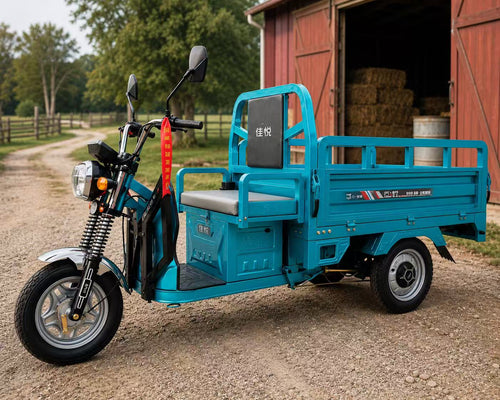
An open cargo trike is the simplest version of an electric cargo work vehicle.
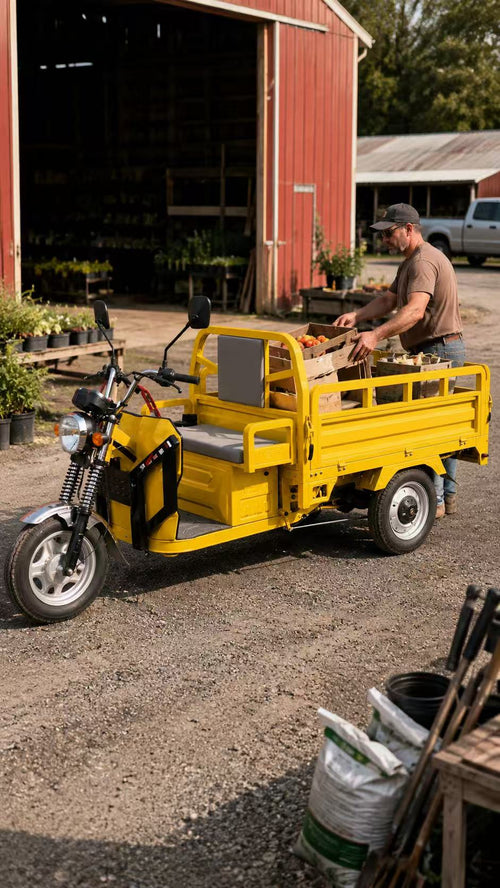
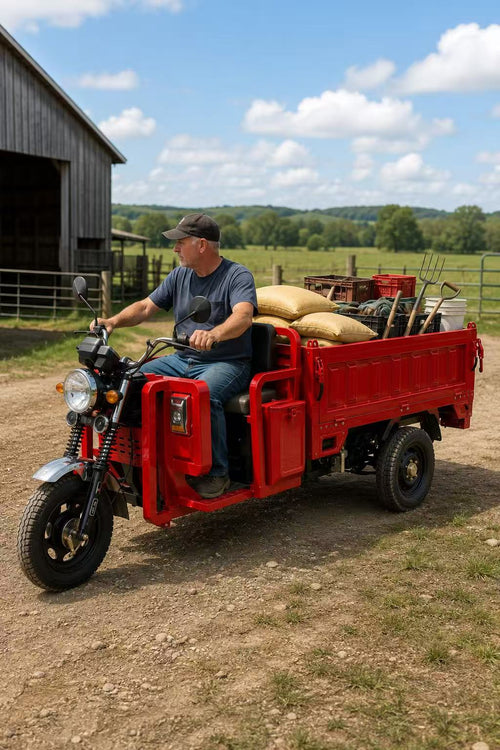
It has a driver area, electric drive system, three-wheel layout, and a rear cargo bed for hauling supplies, tools, crates, bags, and small equipment.
It is often the best starting point for buyers who want a practical lower-cost hauling vehicle without adding unnecessary structure.
The OneClickChina Multi-Purpose Electric Utility Vehicle starts from $2,499. It is designed for short-distance cargo movement around farms, ranch work areas, orchards, greenhouses, markets, warehouses, and property maintenance sites.
This type of vehicle can work well for:
feed bags
fertilizer bags
toolboxes
vegetable crates
fruit crates
farm supplies
greenhouse trays
small equipment
packaging materials
maintenance parts
An open cargo trike is easy to understand. It is built around cargo movement, not passenger comfort or high-speed travel.
That simplicity is part of its value.
When an Open Cargo Trike Makes Sense
An open cargo trike may be the better choice when the buyer wants the lowest entry cost and does not need much driver weather protection.
It fits buyers who mostly work:
inside farm yards
near barns and sheds
inside or near greenhouses
around packing areas
inside markets
around warehouses
on short property routes
in mild weather conditions
If most work happens under cover, inside a work area, or during good weather, an open cargo trike may be enough.
It also gives the driver easy access. There is no roof structure to think about, no front canopy frame to work around, and the vehicle keeps a very simple layout.
For many small farm jobs, this is the most practical option.
The buyer is paying for the cargo bed, electric movement, and basic work function.
What Is a Canopy Cargo Trike?
A canopy cargo trike adds a roof structure and front driver protection above the basic cargo trike layout.
It is not a fully enclosed cab.
That distinction is important.
A canopy model is designed to provide basic protection from direct sun and light rain. It can make the driver area more comfortable during daily outdoor routes, but it is not meant to replace a full cab in severe weather.
The OneClickChina Canopy Utility Cargo Vehicle starts from $2,599. It gives buyers a slightly more protected option while still staying in a lower-cost work vehicle category.
A canopy cargo trike can be useful for:
produce market routes
orchard and nursery work
outdoor warehouse paths
property maintenance
campus maintenance
hotel or resort maintenance
farm-to-packing-area movement
short local delivery work
If a worker spends more time outside, the canopy can make a real difference.
Why Weather Protection Matters
Many small farm tasks are short, but they happen repeatedly.
One short trip in the sun may not be a problem.
But twenty or thirty short trips across a workday can be different.
A worker may move feed in the morning, tools before lunch, crates in the afternoon, and supplies between storage and work zones throughout the day.
In hot weather, direct sun exposure can become tiring.
In light rain, a basic canopy can help keep the driver more comfortable for short routes.
This is where a canopy model becomes practical.
The value is not luxury.
The value is daily comfort during repeated work.
Canopy Does Not Mean Full Cab
A canopy cargo trike should not be oversold.
It is not a sealed cab.
It does not fully protect the driver from strong wind, heavy rain, cold weather, storms, or blowing dust from all directions.
It mainly helps with overhead sun and light rain exposure.
If a buyer needs stronger driver protection, a cab model may be the better choice.
The OneClickChina Cab Utility Cargo Vehicle is priced at $3,399 and is designed for buyers who want more weather protection than a canopy can provide.
This matters because choosing the right vehicle means being honest about the work.
If the buyer only needs shade and basic light-rain protection, a canopy model may be enough.
If the buyer works in more difficult weather, an enclosed cab may be more suitable.
Cargo Protection Is Different From Driver Protection
Some buyers assume a canopy protects both the driver and the cargo.
That is not always true.
A canopy mainly protects the driver area.
The cargo bed may still be open unless the buyer uses covers, bins, tarps, boxes, or other cargo protection methods.
This is important for produce, tools, supplies, seed, feed, packaging materials, and other items that may need to stay dry or clean.
If the buyer needs cargo protection, the question should be:
Do I need a covered cargo bed?
Do I need waterproof containers?
Do I need a tarp or cargo cover?
Do I need enclosed storage boxes?
Do I need a cab model or custom cargo solution?
The canopy helps the driver. It does not automatically solve every cargo protection need.
Open Cargo Trike vs Canopy Cargo Trike: Cost Difference
For many buyers, the price difference is small compared with the daily comfort difference.
The open Multi-Purpose Electric Utility Vehicle starts from $2,499.
The Canopy Utility Cargo Vehicle starts from $2,599.
That means the canopy option can be considered by buyers who want basic driver protection without moving into a much higher price category.
However, the lower open model still makes sense when the buyer wants maximum simplicity and lowest entry cost.
The best choice depends on how much time the worker spends outdoors.
If the vehicle is mostly used inside a barn area, greenhouse, warehouse, or covered yard, the open model may be enough.
If the vehicle is used in open sun, market routes, property routes, or outdoor farm paths, the canopy model may be worth considering.
Use Case: Small Farms
On small farms, both open and canopy models can work.
The open model is practical for moving feed, tools, fertilizer, and crates around short routes.
The canopy model becomes more useful when the worker spends more time outside between storage, barns, fields, and work areas.
If the farm operates in a hot region or has many open outdoor routes, driver shade can become valuable.
If the work is mostly close to buildings or under cover, the open model may be more cost-efficient.
Use Case: Produce Markets and Farm Stands
Produce markets, farmers markets, and farm stands often involve short routes, repeated cargo movement, and outdoor exposure.
Workers may move crates, boxes, packaging materials, coolers, small tools, and supplies between storage areas, stalls, vehicles, and customer-facing areas.
A canopy cargo trike can make sense here because it gives the driver some shade during repeated trips.
But if the market route is mostly under cover or inside a warehouse-style environment, an open cargo trike may still be enough.
The key question is how much of the route is exposed to sun or light rain.
Use Case: Property Maintenance
Property maintenance teams often move tools, cleaning supplies, landscaping materials, small parts, and equipment between buildings.
In apartment communities, campuses, resorts, hotels, parks, and commercial properties, workers may spend a lot of time outdoors.
A canopy cargo trike can make these routes more comfortable without turning the vehicle into a large, expensive utility vehicle.
For maintenance teams that work in mild weather and need simple cargo movement, the open model may still be a good fit.
For outdoor service routes, the canopy model can be more practical.
Who Should Choose the Open Cargo Trike?
Choose the open cargo trike if:
lowest price is the main priority
your routes are short
you work mostly in good weather
you use the vehicle near barns, sheds, warehouses, or greenhouses
you want the simplest structure
you do not need sun or light-rain protection
you mainly want cargo movement, not driver comfort features
This is the best entry-level choice for many small farm buyers.
Who Should Choose the Canopy Cargo Trike?
Choose the canopy cargo trike if:
you work outdoors often
your area has strong sun
you make repeated short trips during the day
you want basic light-rain protection
you use the vehicle in markets, campuses, farms, or property routes
you want more driver comfort without paying for a full cab
you do not need a sealed enclosed driver cabin
This model is for buyers who want practical weather protection while keeping the vehicle simple and affordable.
Who Should Consider a Cab Model Instead?
Choose a cab model if:
you need more complete driver protection
you work in colder or wetter conditions
you want more separation from wind and rain
the driver spends long periods outside
you want more all-weather comfort
A canopy is not the same as a cab.
A cab model costs more, but it may be the right choice when weather exposure becomes a serious daily issue.
Final Buying Thought
The open cargo trike and canopy cargo trike are both useful, but they solve slightly different problems.
The open model gives buyers the lowest-cost, simplest cargo-hauling option.
The canopy model adds basic driver protection from sun and light rain while staying in a low-cost electric work vehicle category.
If your work is mainly short-distance cargo movement in mild conditions, the open model may be enough.
If your worker spends more time outdoors, makes repeated trips, or operates in open sun or light rain, the canopy model may be the better fit.
The right vehicle is not always the one with the most features.
It is the one that matches the daily route, weather exposure, cargo needs, and budget.