1500W Electric Farm Cargo Trike for Hills and Rough Ground: What to Check Before You Buy
Share
A 1500W electric farm cargo trike often looks like the sweet spot for buyers who need more than a light-duty yard trike but do not want the cost, size, or fuel use of a larger utility vehicle. On paper, 1500W sounds strong. In real farm use, however, the number alone does not tell you whether the trike is truly ready for loaded climbs, rough lanes, feed hauling, or repeated stop-and-go work.
That is why the smarter buying question is not simply “Is it 1500W?” but “How does this 1500W setup behave under real farm conditions?”
Why 1500W Gets Attention from Farm Buyers
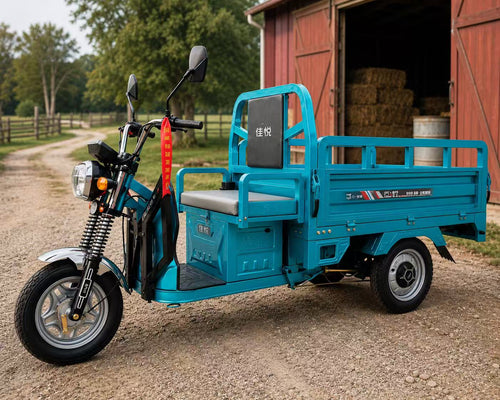
A 1500W electric farm cargo trike is usually positioned as a heavy-duty three-wheel hauler for agricultural transport, daily property work, and short-distance rural logistics. Buyers are often looking at this power level because they want enough torque for heavier loads, better hill performance, and more confidence on uneven ground.
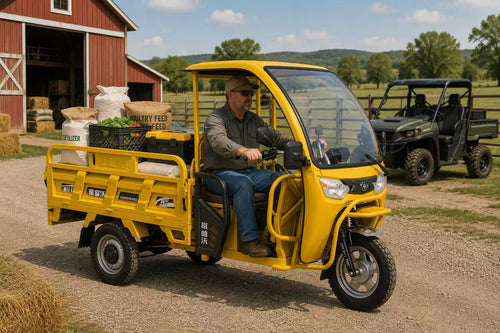
For many farms, this category fits the gap between lightweight electric trikes and much larger utility machines. It can be practical for moving feed, fertilizer, tools, harvested produce, fencing materials, and other routine loads around the property. In many cases, it also becomes an alternative to frequent wheelbarrow trips or repeated manual hauling.
What 1500W Should Really Mean in Farm Use
The useful part of a 1500W setup is not just top speed. On a farm, the bigger value is pulling power at low speed, especially when the cargo bed is loaded and the route includes turns, ruts, soft ground, or a mild incline.
A real farm-ready 1500W cargo trike should feel capable in these situations:
- pulling away smoothly with a loaded bed
- climbing practical farm grades without struggling
- maintaining stable low-speed control on rough lanes
- handling repeated start-stop work during daily hauling
This is why buyers should look beyond the motor label. Voltage, controller quality, axle strength, and overall chassis design matter just as much. A weak frame or poor suspension can make a “1500W” machine feel much less capable once it is actually working.
Match the Trike to the Load, Not Just the Spec Sheet
One of the biggest mistakes in this category is choosing by power number alone. A better method is to match the trike to the real load you move most often.
If your daily work includes:
- bagged feed
- tool transport
- produce crates
- fencing supplies
- hay bales in smaller quantities
- manure, compost, or soil
- harvest loads from field to shed
then the cargo system matters as much as the motor. Some farms need a standard cargo bed for general transport. Others benefit much more from a hydraulic or tipping dump bed, especially when unloading loose material like compost, soil, or manure.
A 1500W electric farm cargo trike makes the most sense when the work is frequent, local, repetitive, and too heavy for hand hauling, but not so extreme that a full-size diesel or gasoline machine is required.
The Cargo Bed Setup Can Change the Whole Buying Decision
When buyers search this category, they are often comparing more than motor power. They are also comparing bed style, side panels, and unloading convenience.
A few common setups include:
Open cargo bed
Best for feed bags, bins, tools, and general daily transport.
Drop-side bed
Useful when loading and unloading from the side is important, especially for crates or bulky supplies.
Hydraulic dump bed
Best for farms moving loose materials such as manure, soil, gravel, compost, or waste. This setup saves time and reduces labor during unloading.
If the machine will mainly carry bulk material, the dump system may be more valuable than a slightly higher speed number. In real work, easier unloading often improves productivity more than a small change in headline specs.
Range and Battery Expectations Should Be Practical
A 1500W farm cargo trike is often paired with 60V or sometimes 72V systems, depending on the build. In practical use, range depends heavily on payload, route surface, stop frequency, and terrain.
A flat, light-load estimate does not reflect real farm work. A loaded trike moving across dirt lanes, grass, or mild hills will naturally use more energy than a lightly loaded trike on smooth ground.
So buyers should think in terms of work pattern:
- how many trips per day
- how far each trip usually is
- whether the route includes hills or mud
- whether the load is light, medium, or consistently heavy
A realistic buyer is not shopping for the biggest advertised mileage. A realistic buyer is shopping for a machine that can finish a normal day’s hauling without becoming a charging problem.
Rough Ground Changes Everything
For farms with uneven land, rough tracks, or muddy sections, terrain matters as much as motor size. This is where many buyers find the real difference between a light-duty electric trike and a proper cargo-oriented farm model.
For rough-ground use, the important checks include:
- tire size and traction
- rear axle stability
- suspension strength
- brake confidence under load
- bed and frame durability
- low-speed control when turning on uneven surfaces
A 1500W trike may look strong online, but if it is really built more for paved or light commercial use, it may not perform well on real agricultural ground. That is why farm buyers should judge the full machine, not just the watt rating.
When 1500W Is the Right Choice
A 1500W electric farm cargo trike is often a good fit if you need:
- regular hauling around a farm, ranch, orchard, or homestead
- more climbing power than basic low-power trikes
- enough bed capacity for meaningful daily work
- a compact machine that can move through tighter routes than larger utility vehicles
- lower noise and simpler daily operation for short-distance work
This power level is especially attractive for properties that need a practical workhorse for repeated hauling but do not want to jump immediately to larger and more expensive equipment.
When You May Need More Than 1500W
Even though 1500W is a strong category, it is not the answer for every operation.
You may need to look above this level if:
- your loads are consistently very heavy
- your route includes long, steep climbs
- your ground is often muddy and soft
- your work is closer to construction-grade hauling than daily farm utility work
- you expect the vehicle to replace a much larger utility machine in every situation
In those cases, the buyer should focus not only on more motor power, but also on stronger structure, more serious suspension, and a more robust load-handling system.
Final Thought
A 1500W electric farm cargo trike can be an excellent choice for farms that need a compact, low-speed hauler for real daily work. But the smart purchase decision comes from understanding how that power setup matches your route, load type, unloading needs, and terrain.
In other words, 1500W is not the finish line. It is the starting point.
The best machine is the one that works smoothly with your actual farm routine — loaded starts, uneven ground, repeated short trips, practical unloading, and dependable daily use.