What Can You Use Instead of a UTV on a Small Farm?
Share
What Can You Use Instead of a UTV on a Small Farm?
Many small farm owners start with the same assumption: if you want a practical work vehicle, you probably need a UTV.
But that is not always true.
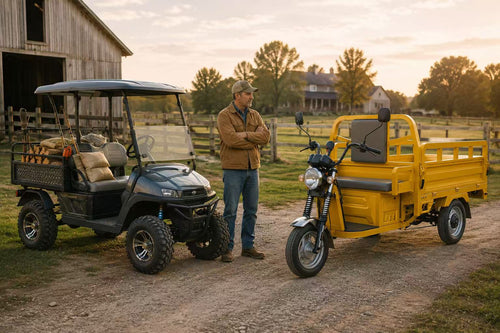
A UTV can be useful, but it is not the only answer for a small farm. In many cases, it may not even be the most cost-effective answer. A small farm usually has a different work pattern than a large commercial farm. The daily job is often short-distance hauling, moving tools, carrying feed, transporting buckets, shifting nursery trays, bringing fencing supplies, or moving materials between a barn, shed, greenhouse, garden, or work yard.
That kind of work does not always require a full-size side-by-side.
So the better question is not simply, “Should I buy a UTV?”
The better question is, “What can I use instead of a UTV on a small farm?”
The answer depends on the real work you do every day.
Start With the Job, Not the Vehicle Name
Many buyers begin by comparing vehicle categories. They look at UTVs, ATVs, tractors, mini trucks, golf carts, or old pickups and try to decide which sounds best. But that often leads to buying too much machine or the wrong machine.
A better approach is to start with the work itself.
What are you moving every day?
How far are you moving it?
Is the route flat, muddy, steep, narrow, or rough?
Do you need to carry passengers, or just cargo?
Are you moving bagged supplies, boxed items, tools, buckets, and feed, or are you moving loose material like soil, compost, and manure?
Once those questions are clear, the best UTV alternative becomes much easier to identify.
Sub-Compact Tractor
One of the strongest alternatives to a UTV is a sub-compact tractor.
If your small farm work includes grading, lifting, digging, scraping, pulling implements, moving pallets, maintaining driveways, or handling heavier land-management jobs, a tractor can do much more than a UTV. This is why tractors often appear in discussions about UTV alternatives. They are slower, but they are also far more capable when the work goes beyond transportation.
A tractor makes sense when your farm chores include real ground-engaging tasks. If you need a front-end loader, brush hog, box blade, post-hole digger, or other implements, then a tractor is not just an alternative to a UTV. It may be the better long-term investment.
But a tractor is not the best answer for every small farm. It takes more storage space, usually costs more than a simple cargo vehicle, and can be excessive if your daily work is mainly short-distance hauling of ordinary farm supplies.
If your job is mostly carrying things rather than digging or grading, there may be a more affordable and simpler option.
ATV With a Small Trailer
An ATV can also work as a UTV alternative on a small farm.
It is more agile than a tractor and often cheaper than a full UTV. It can move quickly around fence lines, orchards, woods, or narrow outdoor routes. If you already own an ATV, adding a small trailer may seem like an easy solution.
For light hauling, spraying, checking livestock, and pulling a small load now and then, an ATV can be useful.
But it has limits.
An ATV is not designed around cargo. The load usually sits in a trailer or on small racks, which means less convenience for organized daily hauling. Loading and unloading can be awkward, and the system is not ideal for repeatedly moving feed bags, toolboxes, crates, cleaning supplies, or stacked materials. It also offers less stability and less protection than a dedicated cargo vehicle.
An ATV works best when you need mobility first and cargo second.
If your work pattern is cargo-first, then another type of vehicle may fit the job better.
Used Kei Truck or Mini Truck
Used Japanese kei trucks and small mini trucks often come up when people ask for an alternative to a UTV.
That makes sense. A kei truck gives you a small truck-like platform, a cargo bed, weather protection in many cases, and a more enclosed feel than an ATV or open work cart. For road-to-property movement, hauling bulkier items, or transporting supplies across a mixed work route, it can be a practical option.
Some buyers like kei trucks because they feel more complete than a small off-road vehicle. They may also include useful features such as enclosed cabs or compact dump beds.
Still, a kei truck is not automatically the perfect solution for every small farm. Buyers need to think about parts availability, local service knowledge, registration or road-use rules, and whether the platform is more complicated than their daily work really requires.
If your main job is short-distance hauling within a farmyard, greenhouse area, barn zone, market space, nursery, or private property, a truck platform may be more than you need.
Golf Cart or Motorized Cart
A golf cart or motorized cart is another common alternative.
For flat terrain, very light hauling, low-noise movement, and simple property use, it can be attractive. Golf carts are usually easy to operate and may have relatively low maintenance demands.
On some properties, especially clean and flat ones, they work well for carrying a few tools, light bins, or small daily items.
But golf carts also have clear limitations. They are not ideal for muddy ground, rough work zones, heavier cargo, or repeated farm hauling. Their cargo ability is usually limited unless they are utility-style carts, and even then, many are built more for light property use than real farm chores.
A golf cart may help if your work is gentle and your route is smooth.
If your daily chores are more practical, more repetitive, and more cargo-focused, you may want a machine built around hauling rather than passenger comfort.
Old Pickup Truck
Many small farm owners already have an old pickup truck, so it naturally becomes part of the comparison.
A pickup can haul bigger loads, tow trailers, and travel on public roads. It is familiar, useful, and versatile.
But it is not always the best substitute for a UTV in everyday small farm work.
A pickup is larger, heavier, and often less convenient for short back-and-forth trips across a controlled worksite. It uses more fuel, usually involves more maintenance complexity, and may be inconvenient in tight spaces or around livestock, sheds, orchards, nurseries, or greenhouse work areas. It also tends to be more vehicle than necessary when the job is simply moving supplies from one part of the property to another.
A pickup still makes sense when you need road travel, towing, or larger-scale hauling.
But for many small farm chores, it can be too much tool for too small a job.
Electric Cargo Trike
This is where a compact electric cargo trike becomes a very practical UTV alternative.
A cargo trike is not trying to replace a tractor in heavy land work, and it is not trying to replace a full-size pickup for road hauling. Its real strength is much simpler: short-distance cargo movement for real daily work.
That makes it highly relevant to small farms.
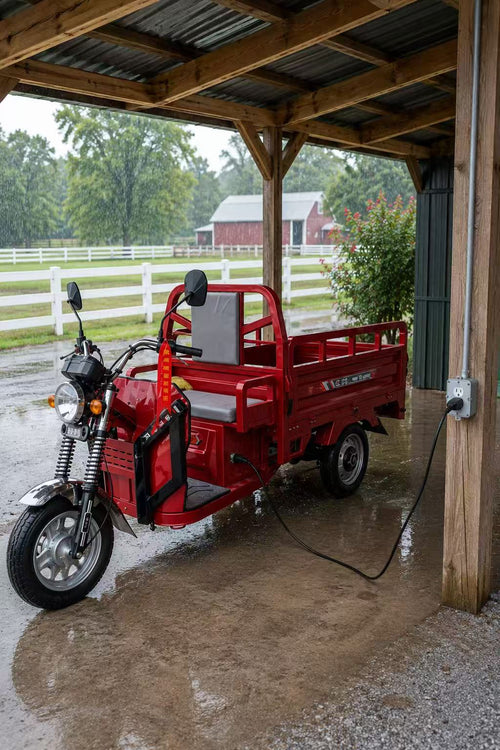
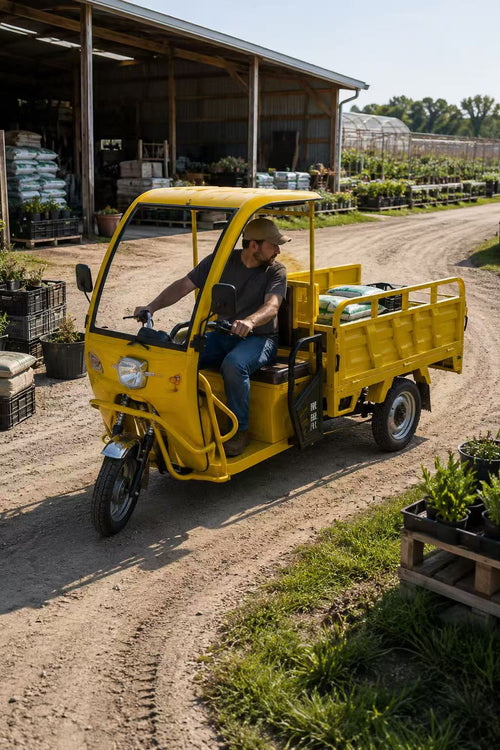
If your daily chores involve feed bags, toolboxes, buckets, nursery trays, cleaning supplies, small boxes, repair parts, fencing materials, maintenance items, or similar loads, an electric cargo trike can be a strong answer. It is built around the cargo bed. The job is straightforward. Load the bed, move the supplies, unload at the work point, and return for the next trip.
For many small farms, this is exactly the work pattern that repeats every day.
The biggest advantage is that a cargo trike focuses on what many small farm owners actually need: affordable, simple, useful hauling.
It avoids paying for features that may not matter in daily chores, such as higher speed, recreational riding design, extra passenger seating, or more off-road performance than the property actually requires.
Why a Flat-Bed Cargo Trike Fits Small Farm Chores
A flat-bed electric cargo trike makes the most sense when the daily load is organized and manageable.
That includes feed bags, seed bags, buckets, plastic crates, nursery trays, toolboxes, fencing supplies, cartons, small repair equipment, and cleaning materials. These are the kinds of cargo many small farm owners move again and again.
A flat-bed design is useful because it keeps the work simple. Items can be placed directly into the cargo bed, carried across the property, and unloaded by hand where needed. For small farms with barns, sheds, pasture gates, garden areas, orchards, greenhouse sections, or work yards, that simplicity saves time and labor.
It is also easier to justify financially.
If your main task is carrying materials over short distances, a dedicated cargo trike may solve the problem without the cost level of a UTV.
When a Hydraulic Dump Vehicle Is Better
Not every farm load belongs on a flat bed.
If your daily chores involve loose materials such as soil, compost, manure, mulch, wood chips, wet debris, or gravel, unloading by hand becomes slower and more tiring. In those situations, a hydraulic dump utility vehicle often makes more sense than a flat cargo bed.
This is an important buying point.
The best UTV alternative is not just about vehicle category. It is also about load type.
If you mostly move bagged, boxed, or organized materials, a flat-bed cargo trike can be a smart fit.
If you mainly move loose materials that need repeated unloading, a hydraulic dump work vehicle may be the better choice.
That is why choosing by work pattern matters more than choosing by label.
What About Maintenance?
Maintenance is one of the biggest practical factors in small farm buying decisions.
A tractor, pickup, or gasoline UTV may offer more performance, but they usually bring more service complexity. Oil changes, fuel systems, engines, belts, filters, and other mechanical systems all add to the maintenance routine.
A simple electric cargo trike is easier to understand.
Its main systems include the battery, motor, controller, wiring, frame, brakes, tires, cargo bed, and standard wear parts. There is no gasoline engine and no engine oil to change. That does not mean there is no maintenance at all, but the maintenance logic is simpler.
For buyers who want a practical work tool rather than a machine with more upkeep, this matters.
Simple maintenance is part of the value.
Local Repair Coordination Support
Another common concern is after-sales service.
When small farm buyers compare UTV alternatives, they are not only comparing the machine. They are also comparing how easy it will be to keep the machine working.
OneClickChina takes a practical support approach.
If service is ever needed, we first ask the customer to recommend a trusted local technician, such as a farm machinery repair person, a motor or electrical repair technician, a small equipment repair shop, or an independent electric vehicle repair shop near them.
If the customer does not already know a suitable local technician, OneClickChina can help search nearby options through Google Maps and help coordinate support remotely using photos, videos, parts guidance, and communication.
This approach is especially practical for simple electric work vehicles. The goal is to reduce buyer worry and make local problem-solving easier.
How to Choose the Right Alternative
So what can you use instead of a UTV on a small farm?
The answer depends on the work.
Choose a sub-compact tractor if your tasks involve grading, lifting, digging, driveway work, brush cutting, or using implements.
Choose an ATV with a small trailer if you need quick movement, light towing, and flexible access through narrow outdoor routes.
Choose a kei truck if you want a compact truck-like platform and are comfortable with the parts, service, and practical considerations that come with it.
Choose a golf cart or motorized cart if your property is mostly flat and your work is very light.
Choose an old pickup if you need road travel, towing, and larger load capacity.
Choose an electric cargo trike if your work is short-distance daily hauling, especially when the load is feed bags, buckets, tools, trays, boxes, or maintenance materials.
Choose a hydraulic dump utility vehicle if your repeated work involves loose bulk materials such as compost, mulch, manure, soil, or wood chips.
Final Thoughts
Not every small farm needs a UTV.
That is the most important takeaway.
A UTV may still be the right tool for some buyers, especially when the property is rough, the distances are long, the work involves towing, or multiple passengers need to ride together.
But many small farm owners are really trying to solve a simpler problem.
They need a reliable way to move things around the property every day without overspending.
For that kind of work, practical alternatives can make more sense.
If your chores are light to medium duty, low speed, cargo-focused, and short distance, a compact electric cargo trike can be one of the most cost-effective alternatives to a UTV on a small farm.
The best decision is not based on which machine sounds strongest.
It is based on what you actually do every da