Do You Need More Features, or an Electric Farm Utility Trike That Is Simple to Maintain?
Share
Many buyers are attracted to machines with more features.
That is understandable.
A larger UTV or high-option utility machine may offer four-wheel drive, passenger seats, complex suspension, a cab, power steering, winch, lights, accessories, digital controls, larger tires, and many other features.
Those features can be useful.
For some farms, ranches, hunting properties, large private land, and demanding work areas, a more complex machine may be the right choice.
But more features are not always the same as better daily use.
Every extra feature can also become one more thing to understand, maintain, repair, replace, or pay for.
For many small farms, homesteads, nurseries, greenhouses, barns, private lots, warehouse yards, and property maintenance areas, the daily work may be much simpler.
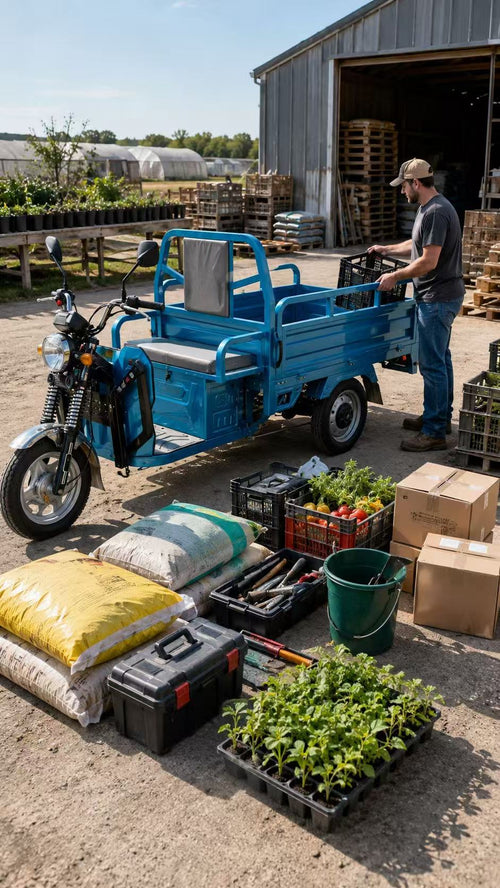
Feed bags need to move.
Tools need to move.
Crates need to move.
Small boxes need to move.
Nursery trays need to move.
Farm supplies need to move from one work area to another.
That leads to a more practical buying question:
Do you need more features, or do you need an electric farm utility trike that is simple to maintain?
More Features Can Look Like More Value
A fully equipped machine looks impressive.
It may seem safer to buy something with more capability than needed. A buyer may think that if the machine has more features, it will be useful in more situations.
Sometimes that is true.
If the buyer needs passenger carrying, towing, rough-terrain performance, long-distance property travel, deep mud capability, or heavy-duty outdoor use, a larger feature-rich machine may make sense.
But many buyers do not use all those features every day.
Some features are used occasionally.
Some features are never used.
Some features add cost without solving the daily problem.
Some features make the machine more complex than the work requires.
This is why buyers should not start with the longest feature list.
They should start with the daily job.
What Does the Work Actually Require?
Before choosing equipment, the buyer should list the actual daily work.
Not the rare heavy job.
Not the imagined future task.
The normal daily routine.
Does the buyer move feed bags from storage to a barn?
Does the buyer move tools to a repair area?
Does the buyer move produce crates to a packing table?
Does the buyer move nursery trays between growing areas?
Does the buyer carry small boxes, buckets, supplies, or maintenance parts around a private property?
Does the buyer work mostly on low-speed private routes?
Does the buyer need to move materials more often than people?
If the daily job is mostly material movement, then a simple cargo-focused machine may make more sense than a complex feature-heavy machine.
An electric farm utility trike is not built to win a feature contest.
It is built to help with low-speed, short-distance cargo movement in private or controlled work areas.
That can be enough when the daily job is simple and repeated.
Simple Does Not Mean Useless
Some buyers hear the word simple and think it means weak or cheap.
That is not the right way to understand it.
Simple can mean focused.
Simple can mean easier to understand.
Simple can mean fewer systems to manage.
Simple can mean practical for one operator doing repeated daily work.
A simple electric farm utility trike can still be useful when it is matched to the right job.
It can carry feed bags, tools, crates, boxes, buckets, nursery trays, and small farm supplies across short private routes.
It can reduce walking.
It can reduce hand carrying.
It can support daily chores around barns, greenhouses, nurseries, warehouses, and private lots.
It does not need to be a full-size UTV to be useful.
It only needs to fit the daily work.
That is why simple equipment should not be dismissed too quickly.
Maintenance Matters More Than Buyers Think
Many buyers focus on price, power, speed, and appearance.
Maintenance is often considered later.
That is a mistake.
A machine used every day should be maintainable.
If it breaks, the buyer needs to understand what system is involved.
If a part wears out, the buyer needs to know whether it can be replaced.
If a local technician is needed, the buyer needs to know whether the machine is understandable enough for practical inspection and repair support.
A feature-heavy machine may offer more capability, but it may also bring more systems, more parts, more sensors, more controls, more accessories, and more complexity.
That does not make it bad.
But it does make maintenance planning more important.
A simple electric farm utility trike has a different structure.
The core system is usually built around battery, controller, and motor. Around that are basic working parts such as tires, brakes, lights, switches, wiring, connectors, bearings, frame, cargo bed, fasteners, and hardware.
This does not mean maintenance should be careless.
Battery, controller, motor, charger, and wiring work still require correct specifications and safe handling.
But the general logic is easier to understand than many buyers first imagine.
Why Simple Equipment Can Fit Local Repair Better
One concern buyers often have is local service.
That concern is reasonable.
If a buyer purchases a work machine, they want to know what happens when something needs attention.
A simple electric work trike may be easier for many local technicians to understand than a buyer expects.
Some basic inspection and repair logic may be familiar to technicians who work with electric bikes, electric scooters, electric trikes, golf carts, small electric equipment, farm equipment, or light mechanical systems.
The buyer should still use the correct parts and follow safe procedures.
But the machine is not a complex car.
It is not a high-speed public-road vehicle.
It is not a large UTV with many advanced systems.
For many common issues, the work may involve practical areas such as tires, brakes, wiring connections, lights, switches, charger, battery, motor, controller, cargo bed hardware, and frame inspection.
This is where simplicity can become valuable.
The easier the machine is to understand, the easier it may be to coordinate practical local support.
More Features Can Mean More Things to Go Wrong
Every feature has a purpose.
But every feature also adds something to maintain.
A cab adds structure, panels, doors, glass, seals, and hardware.
A winch adds wiring, motor, cable, and controls.
More electronics can add convenience, but also more diagnostic needs.
More suspension components can improve ride quality, but also add parts that wear.
More accessories can make a machine more comfortable, but also more complex.
For a buyer who needs those features, they may be worth it.
But for a buyer who mostly moves feed bags, crates, tools, boxes, nursery trays, and supplies across short private routes, many features may not solve the main problem.
The buyer may be paying for complexity instead of daily usefulness.
That is why this question matters:
Are the extra features helping the daily job, or are they just making the machine look more complete?
A good buying decision separates useful features from unnecessary complexity.
The Work Pattern Should Decide the Machine
A small farm buyer should not choose only by what looks strongest.
The buyer should choose by work pattern.
If the daily work is heavy towing, passenger movement, rough terrain, long travel, deep mud, or large-property use, a more complex UTV may be justified.
If the daily work is repeated short-distance cargo movement, a simple electric farm utility trike may fit better.
The buyer should ask:
How many trips happen per day?
What materials move most often?
How far is each trip?
Is the route private and controlled?
Does the work need speed?
Does the work need towing?
Does the work need passenger seats?
Does the buyer need advanced features every day?
Would simple cargo movement solve most of the problem?
These questions help prevent overbuying.
They also help prevent buying a machine that is too simple for the job.
The goal is not to choose the least complicated machine.
The goal is to choose the right level of complexity.
Where a Simple Electric Farm Utility Trike Makes Sense
A simple electric farm utility trike makes sense when the work is:
low-speed
short-distance
cargo-focused
private-site
repeated often
moderate in load
not dependent on passenger carrying
not dependent on heavy towing
not dependent on public-road travel
not extreme off-road work
This can fit many daily work settings:
small farms
homesteads
greenhouses
nurseries
barns
orchards
horse properties
warehouse yards
private lots
logistics parks
market preparation areas
property maintenance zones
In these places, the buyer may not need a machine with every feature.
The buyer may need a reliable daily cargo tool that is simple enough to use and maintain.
That is the role of an electric farm utility trike.
When More Features Are Worth Paying For
More features are worth paying for when they solve real work problems.
A larger or more complex machine may be better if the buyer needs:
four-wheel drive
deep mud capability
heavy towing
regular passenger carrying
long-distance property travel
rough terrain
strong suspension
higher ground clearance
weather protection for long hours
snow pushing
large ranch coverage
dealer-supported UTV-level service
In those cases, a simple electric farm utility trike may not be the right choice.
A buyer should not force a small cargo tool into heavy work.
The honest answer is that different jobs need different machines.
Simple is good only when the job is simple enough.
More features are good only when the work actually uses them.
The Cost of Unused Features
Unused features still cost money.
They can increase purchase price.
They can increase maintenance needs.
They can increase repair complexity.
They can increase storage concerns.
They can make the machine larger or harder to use in small work areas.
They can also distract the buyer from the main problem.
If the daily work is moving material, the buyer should not pay too much attention to features that do not help material movement.
A small farm does not need to impress anyone with a feature list.
It needs work done.
If a simple electric utility trike helps move daily materials efficiently, then it may be a better value than a more complex machine that is underused.
The smartest purchase is not the machine with the most features.
It is the machine with the right features.
How This Applies to OneClickChina Buyers
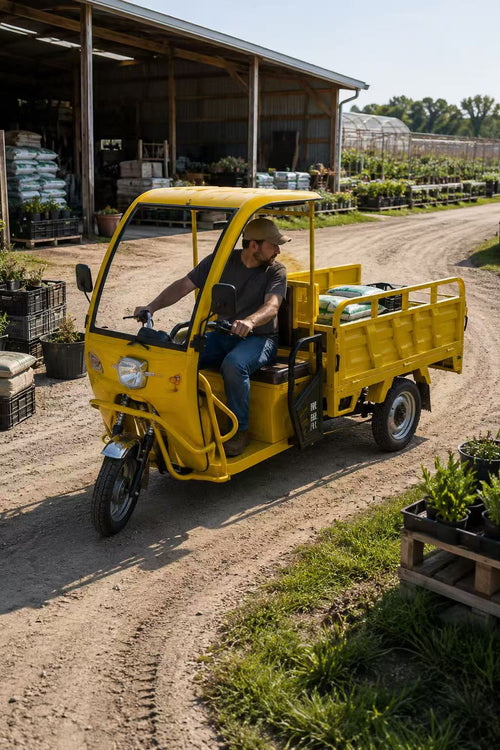
OneClickChina electric utility and cargo trike models are designed for low-speed private-site material movement.
They are not public-road vehicles.
They are not high-speed UTVs.
They are not tractors.
They are not heavy towing machines.
They are practical cargo-focused work tools for private or controlled areas.
The ordinary open cargo model may be useful for simple daily loading and unloading.
The canopy cargo model may help when the operator wants some sun or light weather coverage.
The cab utility cargo model may offer more operator protection.
The hydraulic dump utility model may be better when the buyer regularly moves loose materials such as soil, compost, mulch, manure, gravel, or sand.
The buyer should choose based on real work, not the number of features.
If the job is crates, feed bags, tools, boxes, and daily supplies, a simple cargo model may be enough.
If the job involves loose bulk material, a dump model may be more suitable.
If the job requires more operator coverage, canopy or cab options may be worth considering.
The right machine is the one that matches the work without adding unnecessary complexity.
A Simple Pre-Buying Check
Before buying, the buyer can make a simple checklist.
First, list the daily materials.
Feed bags, crates, tools, boxes, buckets, trays, or loose material?
Second, list the route.
Flat, gravel, concrete, packed dirt, grass, slopes, gates, barn lanes, greenhouse paths?
Third, list the required functions.
Cargo bed, dump bed, canopy, cab, towing, passenger seats, or high speed?
Fourth, list the maintenance expectations.
Can local support be coordinated?
Are common parts understandable?
Does the seller provide specifications and guidance?
Can the buyer avoid overloading and misuse?
Fifth, ask the most important question:
Do I need more features, or do I need a work tool that is simple enough to use often?
That question can prevent many wrong purchases.
Final Thought
More features can be useful.
But more features are not automatically better.
For many small farms, homesteads, greenhouses, nurseries, barns, warehouse yards, and private properties, the daily work is simple and repeated.
Move feed.
Move tools.
Move crates.
Move boxes.
Move supplies.
For that kind of work, an electric farm utility trike that is simple to maintain may be more practical than a larger feature-heavy machine.
Do not buy complexity unless the work truly needs it.
Buy the tool that matches the job you do every day.