Farm Cargo Trike for Agricultural Transport: Cargo Bed, Payload, and Power Options Explained
Share
A farm cargo trike should be chosen by the work it needs to handle, not only by how it looks in a product photo. For agricultural transport, the most important questions are practical: what will it carry, how heavy is the load, what type of cargo bed is needed, what terrain will it run on, and whether electric power or gas power makes more sense for the farm.
Farm cargo trikes are rugged three-wheeled vehicles used to move tools, crops, feed, supplies, and other farm materials across agricultural properties. Some are electric. Some are gas-powered. Some have open cargo beds. Others have drop-down sides or hydraulic dump beds. The right choice depends on the farm’s route, cargo type, payload requirement, and daily work pattern.
For many farms, the cargo bed and payload matter more than top speed. A vehicle used for daily agricultural transport must be able to carry real materials, load and unload efficiently, and move safely on farm roads, gravel lanes, dirt paths, barn areas, and working yards.
Why a Farm Cargo Trike Is Different from a Regular Tricycle
A regular tricycle may be built for personal transportation, light shopping, or short city rides. A farm cargo trike has a different purpose. It is designed around cargo movement.
On a farm, the vehicle may carry feed bags, produce crates, hand tools, seed bags, fencing supplies, buckets, irrigation parts, small equipment, soil, compost, bedding, or cleanup materials. These loads are not always clean or evenly shaped. They may be heavy, dusty, wet, or awkward to unload by hand.
That is why a farm cargo trike should be judged as a small agricultural transport vehicle. The focus should be cargo bed size, payload capacity, motor strength, frame durability, suspension, braking control, and route suitability.
If the vehicle cannot handle the real load and route, the name does not matter.
Start with the Cargo Type
The first step is to identify what the trike will carry most often.
Some farms mainly move produce crates from a field edge to a wash station or packing area. Some move feed from storage to livestock areas. Some carry tools, hoses, irrigation fittings, fencing supplies, and repair parts. Other farms need to move loose material such as compost, manure, soil, bedding, mulch, or gravel.
Each cargo type points to a different cargo bed choice.
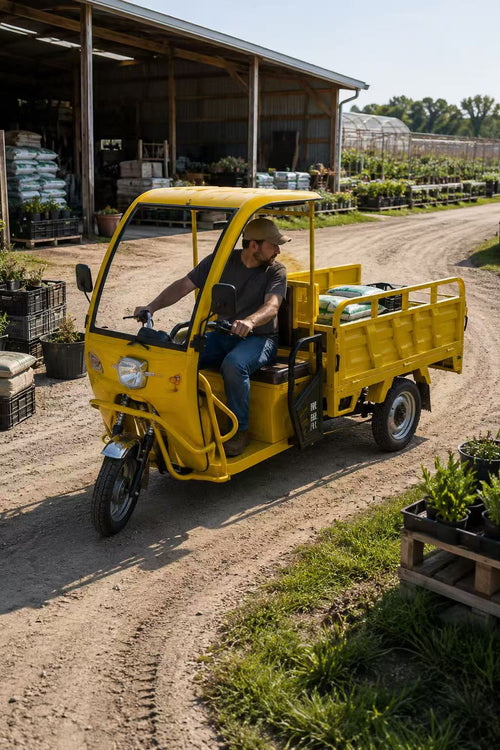
For bags, boxes, crates, tools, and supplies, an open cargo bed may be enough. It gives workers flexibility and simple access.
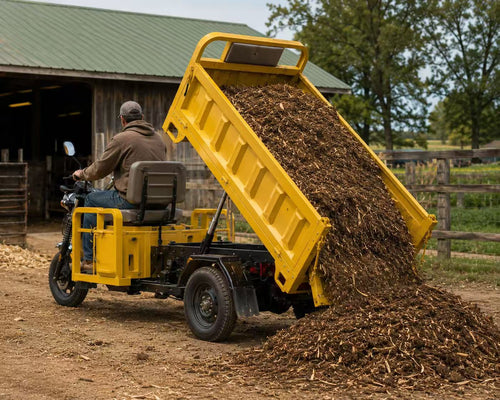
For loose material, a dump bed becomes more useful. A hydraulic dump cargo bed can reduce manual unloading and make repeated material handling easier.
For mixed daily loads, the buyer should look for a bed that is easy to load, easy to clean, and strong enough for repeated work.
Cargo Bed Size Matters
Cargo bed size is one of the most important details on a farm cargo trike. Many agricultural cargo trikes use beds around 1.5 to 1.8 meters in length, but the best size depends on the job.
A longer bed can carry larger tools, more crates, feed bags, and bulky supplies. A shorter bed may be easier to maneuver in tight areas, greenhouse entrances, packing spaces, or barn-side lanes.
The buyer should not only ask whether the cargo bed is large. They should ask whether the bed fits the actual materials moved every day.
For example:
Produce crates need stable floor space.
Feed bags need both weight capacity and side support.
Tools may need length and easy access.
Loose material may need a dump function.
Buckets and mixed supplies need a bed that prevents items from falling out.
A practical cargo bed is not only about volume. It is about how workers load, secure, move, and unload farm materials.
Drop-Down Sides and Loading Access
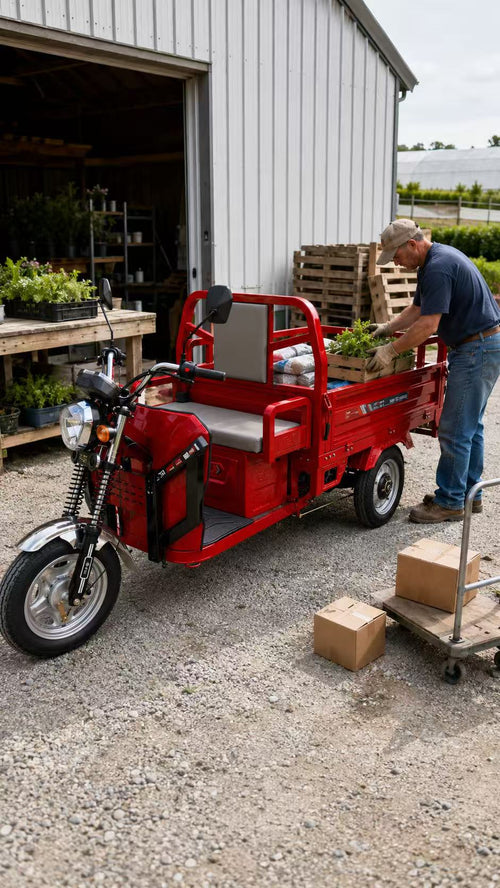
Drop-down sides can be very useful for agricultural transport. They allow workers to load crates, bags, tools, and supplies from the side instead of only from the rear.
This can matter in real farm spaces. A trike may stop beside a barn, greenhouse, packing table, storage pallet, or crop row. In these places, side loading can make the job faster and easier.
A fixed high-side bed can be stronger for some loads, but it may require workers to lift materials higher. A drop-side bed may improve access but should still be strong enough for farm use.
The buyer should think about how loading actually happens on the property. If workers frequently load from pallets, storage shelves, greenhouse aisles, or packing areas, cargo bed access becomes important.
Hydraulic Dump Capability
A hydraulic dump bed is most useful when the farm moves loose or bulk materials.
This may include:
Compost.
Manure.
Soil.
Bedding.
Mulch.
Gravel.
Small cleanup loads.
Loose material is different from bags and crates. It takes more labor to unload by hand. If the farm moves these materials repeatedly, a dump bed can save time and reduce physical effort.
However, a dump bed is not always necessary. If the farm mainly moves produce crates, boxed supplies, tools, and feed bags, a strong open cargo bed may be enough.
The key is to match the bed to the job. A buyer should not choose a hydraulic dump bed only because it looks stronger. It should match the farm’s actual unloading needs.
Payload Capacity: Look at the Real Load
Payload capacity is another major buying point. Search results for farm cargo trikes often mention a wide range of capacities, from lighter-duty models to heavy-duty agricultural versions.
But the buyer should not only look at the highest number. The real question is: how much weight will the farm carry in normal daily work?
The load should include:
The driver.
Cargo.
Tools.
Buckets or containers.
Any extra supplies.
A farm may not carry the maximum possible load every trip, but it may carry moderate loads many times a day. That repeated use is where the vehicle’s real value appears.
A practical buyer should list the top five common loads and estimate their weight. If the trike will carry feed bags, crates, tools, buckets, and repair parts every day, the payload should comfortably match that work.
Power Options: Electric or Gas-Powered
Farm cargo trikes may be electric or gas-powered. Each option has advantages.
Electric models are often quieter, simpler to operate, and lower maintenance for short daily routes. They can be useful for farms, greenhouses, orchards, nurseries, livestock areas, packing zones, and private agricultural properties where repeated short-distance transport is common.
Electric versions may use 60V or 72V battery systems, with motor sizes often ranging from around 1000W to stronger agricultural configurations. The right motor depends on load weight, route surface, slopes, and daily use.
Gas-powered models may be better when the farm needs longer continuous operation, higher power in rough conditions, or heavier-duty use. Some gas or diesel versions use small engines for more demanding agricultural transport.
The right choice depends on the property. If the route is short, repeated, and private, an electric farm cargo trike can be practical. If the work is heavier, longer, or more demanding, a gas-powered model or larger farm machine may be needed.
Speed Is Not the Main Standard
For agricultural transport, speed should not be the first buying standard.
A farm cargo trike does not need to behave like a highway vehicle. It usually works on private routes, moving between barns, sheds, crop areas, packing zones, greenhouses, livestock areas, and storage spaces.
The more important questions are:
Can it start smoothly with cargo?
Can it move steadily on farm lanes?
Can it stop safely when loaded?
Can it turn in the work area?
Can it handle the normal route without struggling?
For farm work, low-speed control is usually more important than high speed.
Battery Range and Daily Route Pattern
Electric farm cargo trikes are often discussed with ranges affected by battery capacity, terrain, load weight, and route pattern. A vehicle may show a maximum range, but actual performance depends on farm conditions.
A trike carrying light tools on flat concrete will not use power the same way as a trike carrying feed bags over gravel and dirt. A farm with repeated short trips may care more about all-day route support than a single long-distance number.
Before buying, the farm should estimate:
How far each trip is.
How many trips happen per day.
How heavy the average load is.
Whether the route includes slopes, gravel, or soft ground.
Where the vehicle can be charged.
Battery range should be matched to the real workday, not only to the best-case number.
Frame, Suspension, and Brakes
Durability is important because farm cargo is often heavy and uneven.
A reinforced frame helps the vehicle handle repeated load cycles. Strong suspension helps reduce bouncing and improves control on rough surfaces. Brakes are critical because a loaded vehicle must stop safely around people, animals, gates, barns, and equipment.
Some agricultural trikes use heavy-duty suspension or hydraulic spring-style support. Others may use simpler systems. The buyer should connect the suspension and brakes to the route and payload.
If the vehicle runs on rough terrain, gravel, dirt, or uneven work areas, suspension and braking control become more important.
A farm cargo trike should not only carry the load. It should carry it safely.
Terrain: Farm Roads, Dirt, Gravel, and Rough Ground
Terrain changes the buying decision.
A farm cargo trike may work well on gravel lanes, packed dirt, concrete barn areas, greenhouse access roads, orchard paths, and moderate farm roads. These routes are common for daily agricultural transport.
Deep mud, steep rough hills, soft fields, large rocks, or extreme off-road terrain may require a UTV, ATV, tractor, or heavier agricultural machine.
The buyer should be honest about the route. A trike can be a useful farm logistics vehicle, but it should not be expected to replace every heavy off-road machine.
The best fit is moderate terrain, repeated routes, and practical cargo movement.
Farm and Warehouse Use
Some search results connect farm cargo trikes with farms and warehouses. This makes sense because both environments have repeated internal transport.
On farms, the cargo may be feed, produce, tools, and agricultural supplies. In warehouses or packing areas, the cargo may be boxes, crates, parts, and packaged goods.
A farm that includes a packing shed, wash station, cold storage area, or supply warehouse may benefit from a cargo trike that moves between outdoor and indoor work zones.
This is especially useful when the vehicle is compact enough to move through farm lanes and storage areas but strong enough to carry useful cargo.
Private Property and Regulation Awareness
Farm cargo trikes should be positioned carefully. Many buyers may wonder whether the vehicle can be used on public roads or whether it is restricted by local rules.
For many agricultural buyers, the clearest use case is private property: farms, nurseries, orchards, greenhouses, ranches, barns, warehouses, and internal work routes.
If the buyer expects public road use, they should check local laws and vehicle requirements. A vehicle that works well for private farm transport may not be designed for highway driving or regulated road use.
This honest positioning helps avoid confusion and builds trust.
When a Farm Cargo Trike Makes Sense
A farm cargo trike makes sense when the farm needs a small cargo vehicle for repeated agricultural transport.
It is a good fit when:
The route is private property.
The terrain is moderate.
The cargo is tools, crops, feed, produce, supplies, or loose material.
The farm needs repeated short trips.
The cargo bed matches the load.
The payload capacity matches daily work.
The buyer wants a smaller vehicle than a tractor or UTV for routine transport.
It can be especially useful for small farms, produce farms, orchards, nurseries, greenhouses, livestock support areas, homesteads, and agricultural properties with daily hauling needs.
When a Larger Vehicle May Be Better
A farm cargo trike is not the best tool for every job.
If the work requires heavy towing, deep mud, steep hills, very large loads, field cultivation, loader work, or long-distance public road travel, a larger machine may be better.
A tractor, UTV, ATV, pickup, or commercial loader may still be necessary for heavy-duty agricultural work.
The trike’s strength is repeated small and medium transport, not every farm task.
Before choosing a farm cargo trike, buyers should check:
What materials will be moved most often?
What is the normal payload weight?
Is the cargo mainly bags, crates, tools, or loose material?
Does the bed need drop-down sides?
Is a hydraulic dump bed necessary?
Is electric power enough for the route and load?
Would a gas-powered model be better for heavier work?
What terrain will the vehicle travel on?
Are the frame, suspension, and brakes suitable for loaded farm use?
Will the vehicle be used on private property or public roads?
These questions give a much clearer answer than comparing price or appearance alone.
Conclusion
A farm cargo trike is a practical agricultural transport vehicle when the cargo bed, payload, power system, and route all match the work. It can move tools, crops, feed, produce, supplies, and loose materials across farms, greenhouses, nurseries, orchards, livestock areas, and packing spaces.
The best model is not always the largest or fastest one. The best model is the one that fits the farm’s daily transport pattern.
For many agricultural properties, an electric farm cargo trike or utility cargo trike can reduce unnecessary use of larger vehicles and make daily hauling more efficient. For heavier conditions, gas-powered models or larger equipment may still be needed.
The key is to choose by cargo type, payload, bed design, power options, and terrain. When those match, a farm cargo trike can become a useful part of the farm’s everyday transport system.