Is an Electric Farm Cargo Trike Too Awkward for Daily Farm Work?
Share
Some buyers look at an electric farm cargo trike and immediately wonder if it is too awkward for daily farm work.
That concern is reasonable.
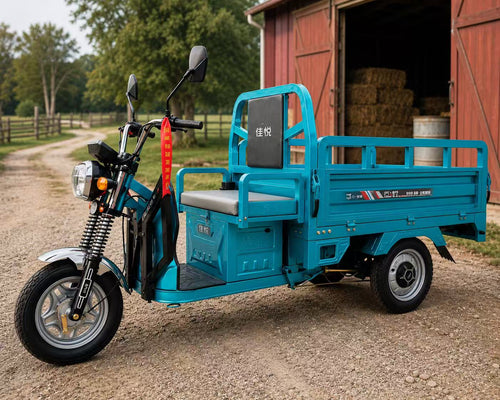
A three-wheel cargo machine looks different from a pickup truck, UTV, ATV, golf cart, wheelbarrow, or small tractor. It has a front wheel, a cargo bed, a low-speed work position, and a different turning feel from larger four-wheel equipment.
Some buyers may ask:
Is it too slow?
Is it too bulky?
Is it hard to handle?
Will it feel strange on a farm?
Can it turn around near barns, sheds, gates, and packing areas?
Is it useful enough for real daily work?
These are fair questions.
But the answer depends on how the equipment is used.
An electric farm cargo trike can feel awkward if the buyer expects it to behave like a UTV, pickup truck, tractor, or public-road vehicle.
But it can also feel very practical if the buyer uses it for the job it is actually designed to do: low-speed, short-distance material movement inside private or controlled work areas.
The real question is not whether a trike is awkward in every situation.
The real question is whether it fits your daily farm work pattern.
Why Some Buyers Think a Trike Looks Awkward
A cargo trike does not look like the equipment many American farm buyers are used to seeing.
A UTV looks familiar.
A pickup truck looks familiar.
A tractor looks familiar.
Even a wheelbarrow looks familiar.
An electric cargo trike sits in a different category. It is smaller than a UTV, more powered than a hand cart, simpler than many utility vehicles, and more cargo-focused than a regular electric bike or scooter.
That difference can make buyers hesitate.
They may think a three-wheel machine is unstable, slow, or difficult to use.
They may also wonder if it is “real farm equipment” or just a light-duty idea.
This is where the buyer needs to look past first impressions.
The shape may be unfamiliar, but the work problem is very familiar:
feed bags need to move
tools need to move
crates need to move
boxes need to move
small supplies need to move
nursery trays need to move
fencing parts need to move
daily farm materials need to move
If the work is repeated, short-distance, and cargo-focused, an electric farm cargo trike may be less awkward than it first appears.
The Wrong Comparison Makes the Trike Look Worse
A common mistake is comparing an electric farm cargo trike to the wrong machine.
If a buyer compares it to a full-size UTV for off-road riding, passenger carrying, towing, and rough terrain work, the trike will look limited.
If a buyer compares it to a pickup truck for public-road travel, highway speed, and long-distance hauling, the trike will look limited.
If a buyer compares it to a tractor for heavy pulling, field work, and large agricultural tasks, the trike will look limited.
But those are not the right comparisons.
A better comparison is:
How does it compare with repeated hand carrying?
How does it compare with using a wheelbarrow all day?
How does it compare with starting a pickup for every tiny internal trip?
How does it compare with using a UTV for light cargo work that happens many times per day?
How does it compare with walking back and forth with tools, feed, crates, and supplies?
In that comparison, the electric farm cargo trike becomes easier to understand.
It is not trying to be the strongest machine on the farm.
It is trying to make repeated small and moderate cargo movement easier.
That is a different job.
Daily Farm Work Is Often Not Dramatic
Many farm equipment discussions focus on the most difficult job.
The steepest hill.
The heaviest load.
The worst mud.
The longest route.
The most demanding day.
Those conditions matter, and buyers should be honest about them.
But many daily farm tasks are more ordinary.
A worker moves feed from storage to a barn.
A worker carries tools to a repair area.
A worker moves crates from a field edge to a packing table.
A worker moves nursery trays between growing areas.
A worker carries buckets, boxes, and supplies between buildings.
A worker brings small materials to a fence line, greenhouse, orchard row, or livestock area.
These jobs may not require a large machine every time.
They require something practical, simple, and available for repeated short trips.
That is where an electric farm cargo trike can make sense.
The trike may look unusual at first, but the work it supports is very normal.
Handling Depends on the Work Area
The word “awkward” often comes from poor matching.
A machine that works well in one area may feel wrong in another.
An electric farm cargo trike is best suited for private or controlled routes where the operator can drive slowly and safely.
Good work areas may include:
farm yards
barn lanes
greenhouse paths
nursery areas
orchard work routes
warehouse yards
packing areas
private lots
logistics parks
market preparation areas
property maintenance routes
These areas usually involve low-speed movement and repeated trips.
The trike is not meant for public-road traffic, high-speed travel, extreme off-road riding, or heavy towing.
If a buyer uses it where it belongs, handling can feel practical.
If a buyer uses it where it does not belong, it may feel awkward or unsafe.
That does not mean the trike is useless.
It means the job and route were not matched correctly.
Turning Space Matters More Than Buyers Expect
One reason buyers worry about cargo trikes is turning space.
This is a real issue.
A cargo trike has a cargo bed behind the operator. The buyer should think about the route before purchase.
Can it turn near the barn?
Can it enter the work area?
Can it pass through the gate?
Can it move beside a packing table?
Can it stop safely near a shed?
Can the operator turn around without backing into fences, pallets, crates, animals, or tools?
These questions are important.
A trike is useful only when the work area allows it to move naturally.
The buyer should not assume every path is suitable.
A farm utility trike works best when the route is planned: enough space, firm surface, reasonable turns, low speed, and clear movement areas.
When the route is suitable, the trike can become a helpful daily tool.
When the route is too tight or poorly planned, any equipment can become frustrating.
Operator Comfort Is Part of Practical Handling
A daily work tool should not only move cargo.
It should also feel usable for the operator.
That means the seating area, handlebar position, step-through area, foot space, visibility, and loading position all matter.
If the operator feels cramped, the machine feels awkward.
If the operator can sit naturally, step in and out easily, see the route, and load materials without fighting the design, the equipment becomes more practical.
For daily farm work, comfort is not luxury.
Comfort affects whether the equipment gets used.
A machine that feels difficult may stay parked.
A machine that feels simple may become part of the daily routine.
That is why electric farm cargo trike buyers should think about the human side of the machine, not just the specification sheet.
The Cargo Bed Can Make the Trike Feel More Useful
One reason an electric farm cargo trike can work well for daily use is the cargo bed.
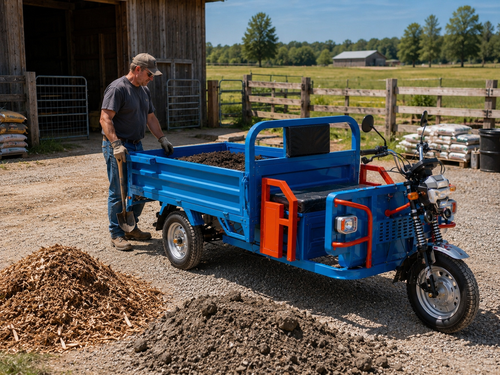
The cargo bed gives the worker a clear place for feed bags, crates, boxes, tools, buckets, nursery trays, and small farm materials.
Instead of carrying one item by hand, the worker can organize a practical load and move it in one short trip.
This is where the trike becomes more than a strange-looking three-wheel machine.
It becomes a small material movement system.
The cargo bed changes the question from:
Is this thing awkward?
to:
Can this help me move the materials I handle every day?
That is the right way to judge it.
If the cargo bed matches the daily materials, the trike becomes more useful.
If the cargo bed does not match the daily materials, the buyer should choose a different model.
Some buyers worry that an electric farm cargo trike is not fast enough.
But for many private-site farm tasks, speed is not the main value.
The value is low-speed control, cargo movement, repeated use, and reduced walking.
A worker does not need high speed when moving from a feed shed to a barn.
A nursery worker does not need high speed when moving trays between work areas.
A market farm worker does not need high speed when moving crates around a packing zone.
A property owner does not need high speed when moving tools around a private lot.
In these jobs, safety and control matter more than speed.
A faster machine is not always a better machine.
A slower machine that fits the route and task may be used more often and more safely.
That is why judging an electric farm cargo trike only by speed misses the point.
When the Trike Is the Wrong Choice
A serious buying guide should be honest.
An electric farm cargo trike is not right for every buyer.
It may be the wrong choice if the buyer needs:
public-road driving
high-speed travel
regular passenger carrying
heavy towing
deep mud performance
extreme hills
rough off-road riding
large ranch travel
heavy construction hauling
tractor-level work
full UTV replacement
In these situations, the buyer should consider a larger machine or different equipment category.
Trying to force a trike into the wrong job creates disappointment.
The trike is not awkward because it is bad.
It becomes awkward when it is asked to do the wrong work.
When the Trike Makes More Sense Than It Looks
An electric farm cargo trike may make more sense than it looks when the buyer’s daily work is simple and repeated.
For example:
moving feed bags across a private yard
carrying tools from shed to repair area
moving produce crates to a packing table
hauling nursery trays between growing zones
transporting small boxes around a warehouse yard
moving farm supplies around a homestead
supporting property maintenance work
reducing repeated hand carrying
replacing short internal trips that do not need a pickup or UTV
These are the kinds of jobs where the trike’s form starts to make sense.
The three-wheel layout, open cargo bed, low-speed operation, and simple electric drive are not trying to impress buyers with extreme capability.
They are trying to make ordinary daily movement easier.
That is a practical role.
Why the First Impression Can Be Misleading
Buyers often judge equipment by what they already know.
If they are used to pickup trucks, they may judge everything against a pickup.
If they are used to UTVs, they may judge everything against a UTV.
If they are used to tractors, they may expect every machine to feel like farm machinery.
But an electric farm cargo trike belongs to a different category.
It is closer to private-site electric transport work equipment.
It is not a road vehicle.
It is not an off-road recreation machine.
It is not a heavy agricultural machine.
It is a cargo-focused work tool for controlled areas.
Once the buyer understands that category, the trike becomes easier to judge fairly.
The question is no longer:
Why is this not like a UTV?
The better question is:
Can this reduce the daily cargo trips I already make?
That is where the buying decision becomes clearer.
A Practical Test Before Buying
Before deciding whether a trike is too awkward, buyers should map their daily work.
They should ask:
Where do I load materials?
Where do I unload them?
How far is the route?
How many turns are there?
Is the surface firm?
Is the path wide enough?
Can I drive slowly?
Do I need public-road use?
Do I need towing?
Do I need passengers?
What do I carry most often?
Would a cargo bed reduce repeated walking?
Would a smaller powered cargo tool be easier than using a pickup or UTV for every small trip?
These questions reveal whether the trike fits the buyer’s work.
If the route and work pattern match, the trike may not feel awkward at all.
It may feel like the right-sized tool.
How This Applies to OneClickChina Buyers
OneClickChina electric utility and cargo trike models are best understood as low-speed private-site material movement equipment.
The ordinary open cargo model, canopy cargo model, cab utility cargo model, and hydraulic dump model each serve different daily work needs.
An open cargo model may be useful for fast access to crates, feed bags, tools, and supplies.
A canopy model may help when the operator wants some coverage from sun or light weather exposure.
A cab model may provide more operator protection.
A hydraulic dump model may help when loose materials need controlled unloading.
The buyer should not choose by appearance alone.
The buyer should choose by daily route, cargo type, operator comfort, loading method, turning space, and work frequency.
That is how a strange-looking option can become a very practical tool.
Final Thought
An electric farm cargo trike can look awkward if buyers compare it to the wrong machine.
It is not a UTV.
It is not a pickup.
It is not a tractor.
It is not a public-road vehicle.
But for private-site, low-speed, short-distance movement of feed, tools, crates, boxes, nursery trays, and farm supplies, it may be a practical daily work tool.
The right question is not whether a cargo trike looks familiar.
The right question is whether it fits the work you repeat every day.
If the route is suitable, the load is reasonable, and the job is daily material movement, an electric farm cargo trike may be much less awkward than it first appears.