Electric Farm Cargo Trike for Feed, Seed, and Produce Routes: What to Check Before Buying
Share
An electric farm cargo trike is not just a small electric vehicle with a cargo bed. For farm use, it should be judged by the jobs it handles every day: moving feed, seed, tools, produce, crates, buckets, irrigation parts, and supplies across short internal routes. The real value comes from repeated farm hauling, not from top speed or appearance.
Many farms have daily routes that are too frequent for hand carrying but not always large enough for a tractor, pickup, UTV, or ATV. A worker may need to move feed from storage to an animal area, seed from a shed to a planting zone, produce from a field edge to a packing area, or tools from the workshop to a repair point. These short routes happen again and again. That is where an electric farm cargo trike can become useful.
The best way to choose one is to start with the route and the load. What do you move most often? How heavy is it? How wide are the farm lanes? Will the trike need to pass through narrow crop rows, greenhouse paths, barn-side lanes, or packing area corners? These questions matter more than a simple product photo.
Why Feed, Seed, and Produce Routes Matter
Farm hauling is different from city delivery. City cargo vehicles often move clean packages on pavement. Farm cargo trikes may carry feed bags, seed bags, produce crates, fertilizer bags, hand tools, buckets, hoses, small sprayers, and repair parts. The cargo is often uneven, dusty, heavy, or awkwardly shaped.
This is why a real farm cargo trike needs a working rear cargo bed. A small basket or light-duty cargo area may not be enough. The cargo bed should be large enough for common farm materials and easy enough to load during daily work.
For many buyers, the most important question is not “How fast can it go?” The better question is: “Can it carry the loads I move every day, on the routes I use most often?”
If the answer is yes, the vehicle may save time by reducing walking, reducing manual carrying, and reducing unnecessary use of larger gas-powered machines for smaller jobs.
Start with the Daily Farm Route
Before comparing motor size or payload numbers, the buyer should identify the route.
A farm cargo trike may be used between a feed room and a barn, a seed shed and a planting area, a greenhouse and a storage room, an orchard row and a packing station, or a field edge and a cold storage area. These are not public road routes. They are internal farm logistics routes.
The route may include packed dirt, gravel, concrete, grass edges, greenhouse floors, crop row paths, or uneven farm lanes. Some farms need the vehicle to turn tightly near barns or storage buildings. Others need it to move through narrow crop rows or around irrigation equipment.
This is where maneuverability matters. A large UTV may be strong, but it may not always be convenient in tight spaces. An electric farm cargo trike can be useful when the route is narrow, repeated, and moderate in distance.
However, the buyer should be realistic. Deep mud, steep hills, heavy towing, and extremely rough off-road terrain may still require a UTV, ATV, tractor, or larger farm machine. A cargo trike is best for repeated light to medium hauling on private property routes.
Motor Size Should Match Loaded Work
Search results for electric farm cargo trikes often mention motors in the 1000W to 1800W range. These numbers matter, but they should be understood in the context of real farm work.
A farm cargo trike does not need to be a high-speed vehicle. For many farm routes, 15 to 20 mph is already enough. What matters more is whether the vehicle can move steadily with cargo, start smoothly, and handle short-distance hauling without feeling weak.
A lighter workload may involve hand tools, small crates, buckets, or light produce. A heavier workload may involve feed bags, seed bags, fertilizer, stacked crates, or mixed supplies. The more weight the trike carries, the more important motor strength and low-speed pulling ability become.
The buyer should ask:
Will the trike usually carry light tools or heavier bags?
Will it move across flat ground or slight slopes?
Will it stop and start often?
Will it run several times a day?
Will it need to work in narrow areas where slow control matters?
The goal is not to choose the fastest machine. The goal is to choose a farm cargo trike that feels practical under load.
Payload Capacity Should Be Based on Real Farm Loads
Payload capacity is important, but it should not be judged only by the highest number in a product listing. A useful farm calculation includes the rider, the cargo, tools, containers, and any extra supplies.
For example, a produce route may include several crates, harvest containers, and hand tools. A feed route may include multiple feed bags and buckets. A seed route may include bags, trays, and small equipment. A repair route may include a toolbox, wire, hardware, hoses, and parts.
A buyer should list the top five things moved most often. Then estimate the normal weight and volume of those loads. This helps determine whether the cargo bed and payload capacity are suitable.
For many farm buyers, a vehicle that carries moderate loads many times per day is more valuable than a machine used only for occasional maximum-load trips. Repetition is what creates daily value.
Cargo Bed Design: More Than Just Size
The cargo bed is one of the most important parts of an electric farm cargo trike. It should match how the farm loads and unloads materials.
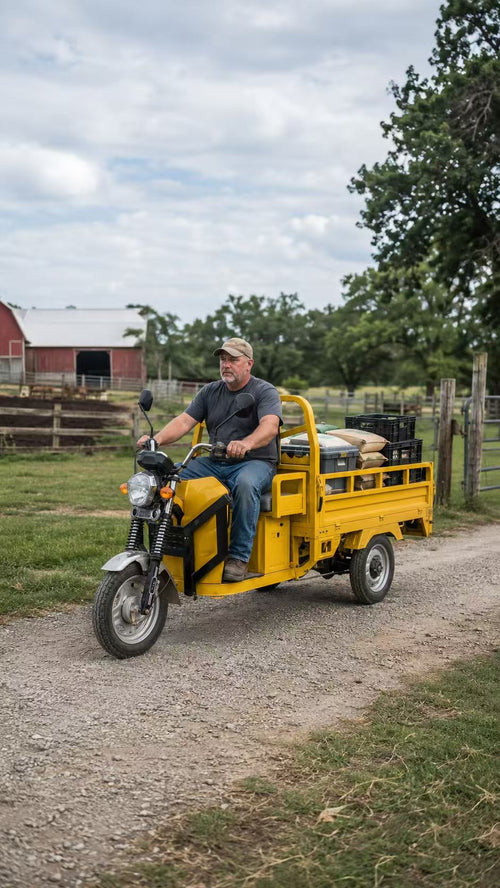
A standard open cargo bed is useful for feed bags, tools, produce crates, seed bags, buckets, and general supplies. It is simple, easy to access, and flexible for mixed cargo.
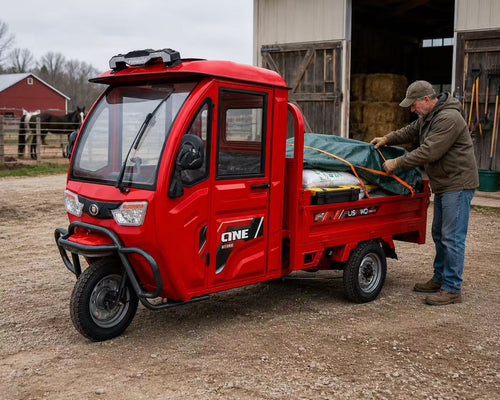
Drop-side gates can make loading and unloading easier. They are useful when workers need to place crates, bags, or tools from the side of the vehicle. This can be especially helpful in packing areas, greenhouses, barns, or narrow farm lanes where rear access is not always convenient.
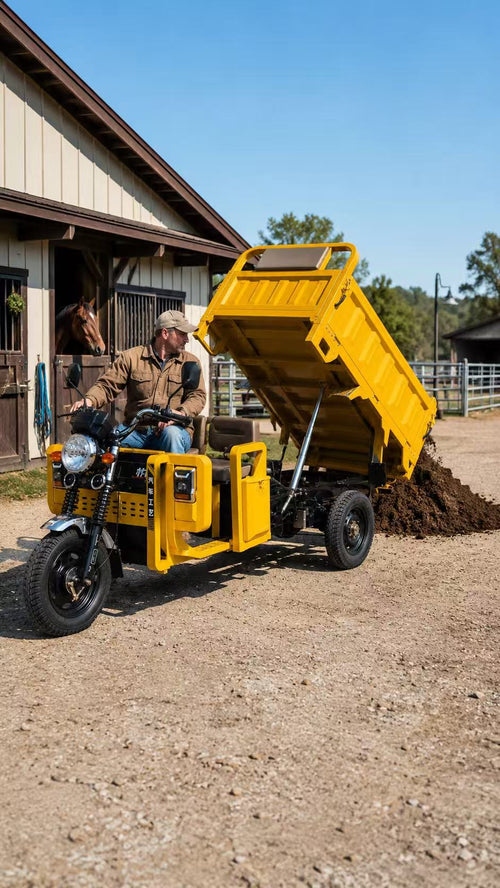
A dump bed is useful when the farm moves loose material. This may include compost, soil, mulch, manure, bedding, gravel, or cleanup loads. If the job involves frequent manual unloading of loose materials, a hydraulic dump bed can reduce labor.
The right cargo bed depends on the job. Feed, tools, and produce may only need a strong open bed with good access. Loose material handling may justify a dump bed. Small light-duty gear may not require a heavy cargo platform.
A serious buyer should choose the bed by daily workload, not by appearance.
Narrow Crop Rows and Tight Farm Spaces
One reason electric farm cargo trikes can be useful is their ability to work in tighter spaces than larger vehicles. Some farms need to move items through crop rows, greenhouse paths, nursery aisles, barn-side lanes, orchard service paths, or packing area corners.
In these areas, a large vehicle can be difficult to turn or park. A smaller three-wheel utility vehicle may be easier to maneuver, especially when the load is moderate and the route is short.
This does not mean every trike fits every row or path. The buyer should check the vehicle width, turning area, cargo bed width, and route clearance. A farm route with narrow turns may require a more compact setup than a wide utility vehicle.
Before buying, the farm should measure the most important work paths. This includes gates, barn doors, greenhouse aisles, row ends, packing area corners, and storage access points.
Maneuverability is not a small detail. It can decide whether the vehicle is used every day or left parked because it is inconvenient.
Suspension, Tires, and Stability
Farm routes can be uneven. Even when the route is not extreme off-road terrain, it may still include gravel, dirt, small ruts, grass edges, and rough transitions between work areas.
Durable frames, stronger suspension, and rugged tires help the vehicle handle farm tasks with cargo. They also help improve control when moving through uneven areas.
Suspension matters because a loaded cargo bed can bounce over rough ground. Tires matter because they affect traction and stability. Frame strength matters because farm cargo is often heavier and less uniform than city cargo.
A buyer should not only ask if the vehicle can move. They should ask if it can move safely and steadily with the normal daily load.
Battery Range and Daily Route Distance
Battery range should also be judged by real farm routes. Some listings mention 30 to 45 miles on a single charge, depending on battery capacity and system setup. But the buyer should not only look at the maximum range.
Farm use often involves repeated short trips. The important question is how many trips the vehicle makes in a day, how far each trip is, and whether the battery can support the daily routine.
A route from the feed shed to the barn may be short, but it may happen many times. A route from the field edge to the packing area may be longer, especially during harvest. A greenhouse or nursery may have many slow stop-and-go trips.
Battery planning should match the workday. If the vehicle will be used several times per day, charging access and battery capacity become part of the buying decision.
When It Can Reduce UTV or ATV Use
A gas-powered UTV or ATV may still be necessary for rough, heavy, or long-distance work. But not every farm task needs a larger gas vehicle.
An electric farm cargo trike can reduce unnecessary use of larger machines for smaller daily hauling jobs. It can be useful for feed, seed, produce, tools, and short internal transport. It can also be quieter around barns, greenhouses, livestock areas, and work zones.
The better comparison is not “cargo trike or UTV.” The better comparison is “which jobs need the UTV, and which jobs only need a smaller cargo vehicle?”
For many farms, both can exist together. The UTV handles heavy, rough, or demanding work. The electric farm cargo trike handles repeated light to medium hauling.
When It May Not Be the Right Fit
An electric farm cargo trike is not the right answer for every job.
If the farm needs heavy towing, deep mud performance, steep hill climbing, very oversized loads, or long public road travel, a different vehicle may be better. If the route is too rough or the load too heavy, a UTV, ATV, tractor, or pickup may still be necessary.
The strongest use case is moderate cargo, short internal routes, repeated farm hauling, and private-property work.
A realistic article should make this clear. This helps buyers choose the right tool instead of expecting one vehicle to solve every farm problem.
What to Check Before Buying
Before choosing an electric farm cargo trike, a buyer should check several points.
What are the most common loads: feed, seed, produce, tools, buckets, or loose material?
What is the normal payload including the rider and cargo?
Does the route include narrow crop rows, greenhouse lanes, barn doors, or tight corners?
Does the cargo bed allow easy side loading or rear loading?
Is a standard open bed enough, or is a dump bed needed?
Does the vehicle have enough motor strength for loaded low-speed work?
Are the tires and suspension suitable for uneven farm ground?
Is the battery range enough for the daily route?
Will the vehicle be used on private property rather than public roads?
These questions give a more practical answer than only comparing photos, top speed, or price.
Conclusion
An electric farm cargo trike can be a practical tool for feed, seed, and produce routes when the farm needs repeated short-distance hauling. Its value comes from matching the vehicle to the real job: the route, the load, the cargo bed, the motor, the tires, and the daily work pattern.
For farms, greenhouses, nurseries, orchards, packing areas, and private agricultural properties, a cargo trike can help move materials more efficiently than hand carrying and may reduce unnecessary use of larger gas-powered vehicles for smaller jobs.
The key is not to choose the biggest or fastest vehicle. The key is to choose the trike that fits the farm’s daily logistics.
If the main work involves moving feed, seed, produce, tools, and supplies through moderate routes and tight farm spaces, an electric farm cargo trike can become a useful part of the daily operation.