Custom Cargo Bed Electric Trike: Match the Box to the Farm Load
Share
Many buyers ask the same question first:
Can the cargo bed be longer?
Can it be deeper?
Can it be bigger?
The short answer is yes.
But the better question is not how big the cargo bed can be.
The better question is:
What kind of cargo do you actually move every day?
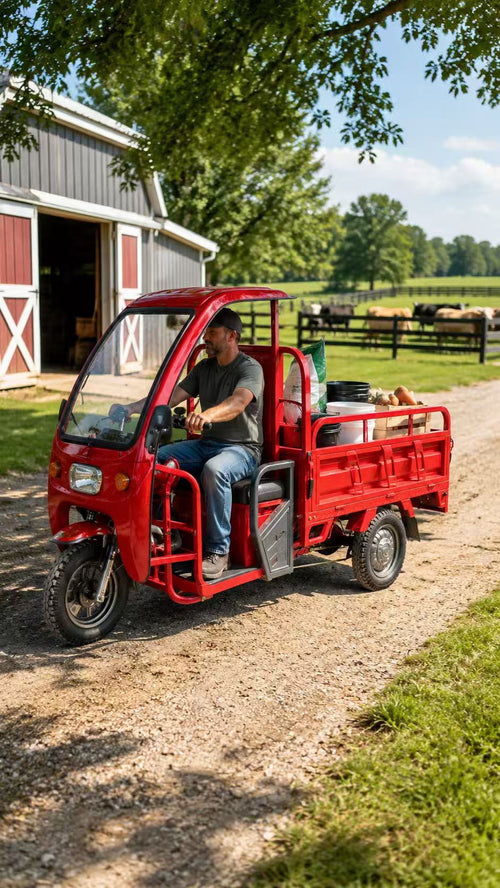
For small farms, orchards, nurseries, greenhouses, produce operations, and rural work properties, the cargo bed should match the real load. A bigger box is not always a better box. In many cases, a smarter cargo bed is more practical than a larger one.
That is one of the practical advantages of a lower-cost electric cargo trike. The vehicle is designed around short-distance hauling, and the cargo bed can be adjusted more closely to the buyer’s work.
Instead of forcing every job into one fixed box, the cargo bed can be planned around the cargo.
Why Cargo Bed Size Should Be Chosen by Load Type
A lot of buyers assume larger is always better because larger sounds more capable.
But cargo hauling is not that simple.
Farm cargo is not all the same. Some loads are dense and heavy. Some loads are light but bulky. Some loads are easy to stack. Some loads take up a lot of space even though they do not weigh much.
That means the right cargo bed depends on what the vehicle is really expected to carry.
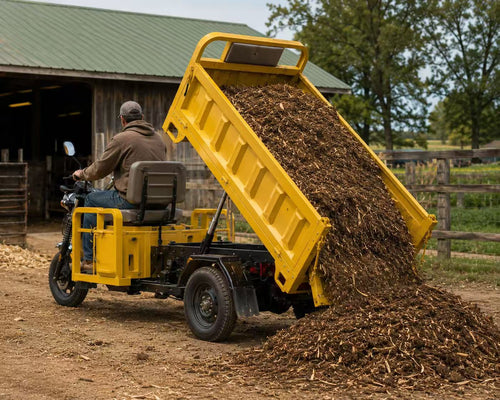
For example, a buyer moving gravel, wet soil, manure, sand, compost, or other dense material may not need a very long or very deep cargo bed. These materials become heavy quickly. A large box can actually invite overloading, which can affect safety, braking, handling, tire wear, and long-term vehicle life.
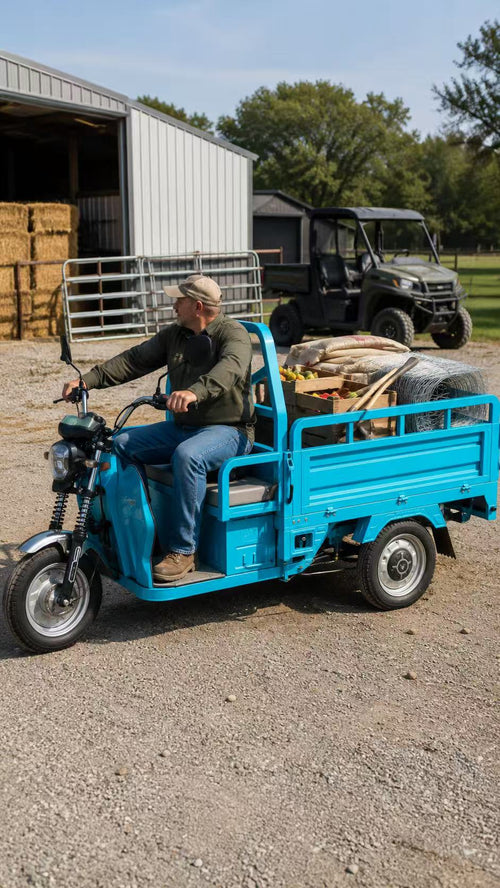
On the other hand, a buyer moving vegetable crates, fruit boxes, nursery trays, foam containers, packaging materials, plastic bins, or market goods may not be carrying extremely heavy loads. But these loads can take up a lot of space. In that case, a longer or deeper cargo bed may be more useful.
So the first rule is simple:
Cargo bed size should be chosen by cargo type, not by appearance.
Dense Heavy Loads Need Practical Control
Some of the most common farm and property loads are dense heavy materials.
These include:
gravel
wet soil
manure
sand
compost
mulch
feed bags
fertilizer bags
concrete bags
toolboxes
metal parts
For this kind of work, the cargo bed does not need to be excessively long, deep, or oversized. A compact and practical cargo bed is often the better option.
Why?
Because heavy materials reach the weight limit much faster than light materials.
A buyer who chooses an oversized cargo bed for dense loads may think they are gaining more capacity. In reality, they may simply be creating more temptation to overload the vehicle.
A more controlled bed size helps keep the vehicle practical. It can also make loading, unloading, balance, and route handling easier.
This matters on small farms where the vehicle may be moving between barns, feed areas, livestock zones, storage sheds, and gravel paths every day.
When the load is heavy, the smartest cargo bed is often not the biggest one.
Bulky Lighter Loads May Need More Space
Not every farm load is heavy.
Some loads are light enough in weight but large in volume.
These include:
vegetable crates
fruit boxes
foam containers
nursery trays
packaging supplies
plastic bins
market goods
empty containers
light tools
harvest baskets
small produce loads
For this kind of work, the buyer may benefit more from added space than from maximum dense-load strength.
A longer cargo bed can help hold more crates per trip.
A deeper cargo bed can help keep lighter cargo secure.
A wider or more practical arrangement can make it easier to load, organize, and transport goods without crushing or stacking them badly.
This is especially useful for:
produce growers
small orchard operations
nurseries
greenhouse businesses
rural markets
local delivery use
property maintenance teams moving lighter supplies
In this kind of work, a standard short box may be usable, but a customized box may be more efficient.
That is where a custom cargo bed setup becomes valuable.
One Box Does Not Fit Every Job
A common mistake is trying to buy one “largest possible” cargo bed in the hope that it will handle every possible task.
In practice, that can create problems.
If the cargo bed is too long, the vehicle may become less convenient in tight work areas.
If the cargo bed is too deep, loading and unloading by hand may become less comfortable.
If the cargo bed is too large for dense materials, overloading risk goes up.
If the cargo bed does not match the shape of the work, daily efficiency goes down.
A better approach is to think about the most common daily load first.
The right question is not:
How large can the cargo bed be?
The right question is:
What do I move most often, and how do I move it?
That answer leads to a more useful configuration.
The Advantage of a Lower-Cost Base Vehicle
This is where a lower-cost electric cargo trike has an important practical advantage.
Because the base vehicle cost is much lower, cargo bed customization can be more realistic for buyers who need a work-specific setup.
A buyer does not always need to purchase a much more expensive machine and then spend even more money trying to adapt it later.
With a lower-cost cargo trike, the buyer can often focus the budget more directly on the working setup.
That may include:
a practical standard cargo bed
a longer cargo bed for crates or bulky goods
a deeper cargo bed for light-volume cargo
a layout better suited to bagged materials
a more job-specific cargo space
This does not mean every buyer needs customization.
It means customization becomes a more practical option when the base vehicle price starts lower.
That makes a difference for small farms and growing businesses that need to control investment carefully.
Three Practical Cargo Bed Strategies
For most buyers, cargo bed choice can be simplified into three practical strategies.
1. Compact Practical Bed
This is a good option for buyers moving dense or heavier daily loads.
It fits work such as:
feed bags
fertilizer bags
toolboxes
gravel
wet soil
manure
small equipment
repair materials
barn supplies
This kind of cargo bed is controlled, practical, and easier to manage for dense loads.
2. Longer Cargo Bed
This is a good option for buyers moving more bulky cargo that takes up floor space.
It fits work such as:
vegetable crates
fruit boxes
nursery trays
harvest bins
foam boxes
market loads
packaging goods
A longer bed can improve trip efficiency when the cargo is not extremely heavy but needs more room.
3. Deeper Cargo Bed
This is useful when the cargo is light but occupies more volume or needs more containment.
It fits work such as:
plastic bins
packaging materials
light supplies
boxed goods
mixed market items
lighter farm merchandise
A deeper cargo bed can help protect lighter bulky cargo and make transport cleaner and more organized.
How Buyers Should Choose the Right Bed
If a buyer wants the best cargo bed setup, the starting point should be the actual job.
The buyer should ask:
What cargo do I move most often?
Is the cargo dense or bulky?
How many bags, crates, trays, or boxes go in one trip?
Do I load by hand?
Do I unload by hand?
Do I work in narrow routes or open work areas?
Do I need a flat cargo bed or a higher-sided bed?
Do I need more room, or do I need better control?
These are the practical questions that lead to the right cargo bed.
This is more useful than guessing based only on appearance.
Matching the cargo bed to the actual work can improve loading efficiency, route practicality, cargo stability, and day-to-day usefulness.
Who This Type of Vehicle Fits Best
A custom cargo bed electric trike is especially useful for buyers whose work is:
short-distance
cargo-focused
repetitive
done around barns and sheds
done around greenhouses and nurseries
done in orchards or produce areas
done between storage and work zones
done on practical farm or property routes
This buyer may not need a full-size off-road vehicle.
This buyer may simply need a smarter cargo-hauling machine for the real daily job.
That is where a cargo-focused electric trike becomes practical.
Who Should Think Carefully Before Oversizing
Some buyers may be tempted to request the biggest possible cargo bed immediately.
That can make sense in a few situations, but it should be considered carefully.
Oversizing is not automatically better if:
the work area is narrow
the cargo is dense and heavy
the load is handled by hand
the route includes turns, gates, or tighter spaces
the buyer wants easier loading and unloading
For many real working environments, balance matters more than maximum size.
The goal is not to create the biggest box.
The goal is to create the most useful box.
Final Buying Thought
The best cargo bed is not always the biggest cargo bed.
It is the cargo bed that matches the work.
If your work involves dense heavy materials, a compact and practical cargo bed may be the smarter setup.
If your work involves bulky lighter loads, a longer or deeper cargo bed may improve efficiency and reduce repeated trips.
Because the base vehicle cost is lower, a cargo-focused electric trike can give buyers more practical room to think about customization without moving into a much higher total budget.
That is the real value.
A smarter work vehicle is not only about motor power or overall size.
It is also about whether the cargo bed fits the cargo you actually move every day.