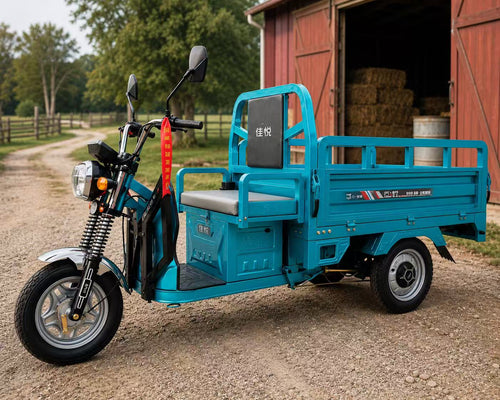
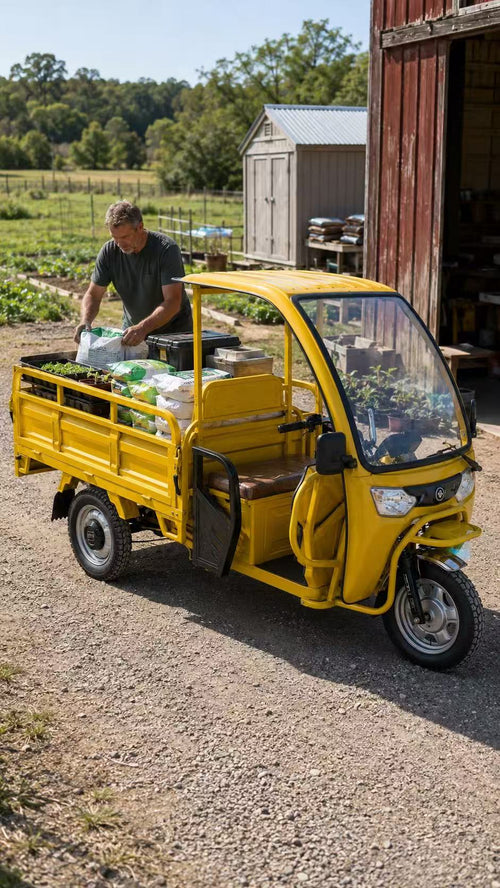
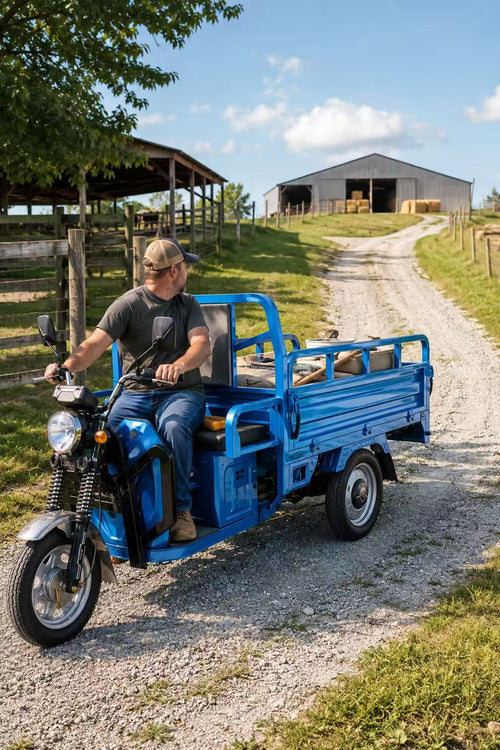
Electric Utility Tricycle for Farm Logistics: Moving Tools, Feed, and Produce Around the Property
Share
Farm logistics does not always require a full-size truck, tractor, or UTV. On many small farms, ranch support areas, greenhouses, nurseries, and produce operations, the daily work is more about moving smaller loads many times across short distances.
That is where an electric utility tricycle can make sense.
Instead of thinking only about large farm vehicles, it helps to look at the real movement pattern around the property. Tools need to move from a shed to a work area. Feed bags need to reach livestock pens. Produce crates need to move from picking areas to a washing or packing zone. Buckets, plant trays, fertilizers, hand tools, and maintenance supplies may need to move all day between different work points.
For this kind of internal farm logistics, a compact 3-wheel electric utility trike can be a practical work vehicle.
What Farm Logistics Really Means
Farm logistics sounds like a big term, but in daily use it is simple. It means moving the right materials to the right place at the right time.
On a small farm, that may include moving feed from storage to animal areas, taking tools to a fence repair point, carrying seed trays inside a greenhouse, transporting harvested vegetables to a sorting area, or bringing buckets and supplies from one building to another.
These jobs are usually not high-speed jobs. They are repeated, low-speed, short-distance tasks. A large vehicle may be more than necessary, especially when the route is narrow, the load is moderate, and the work area changes throughout the day.
An electric utility tricycle fits this type of work because it is designed around practical movement instead of passenger comfort or road speed.
Why a 3-Wheel Utility Vehicle Fits Small Farm Movement
A farm vehicle does not need to be large to be useful. In many work areas, smaller size can be an advantage.
A 3-wheel electric utility tricycle is easier to position around barns, feed areas, greenhouse rows, storage sheds, and produce handling zones. It can help reduce repeated walking, carrying, and handcart use while still staying compact enough for tight work areas.
For small to mid-sized agricultural properties, this matters because farm movement is often repetitive. One trip may not be heavy, but twenty trips in a day can waste time and labor.
A compact electric cargo tricycle can help connect work points across the property without requiring a larger UTV or pickup for every small job.
Moving Tools Around the Property
Hand tools, fencing tools, small equipment, buckets, and repair supplies are common daily loads. They may not be extremely heavy, but they are awkward to carry repeatedly.
An electric utility tricycle with a practical cargo bed can keep these items organized and close to the work area. Instead of walking back and forth to the shed, workers can move the supplies together in one trip.
This is especially useful for property maintenance, fence repair, greenhouse work, livestock area maintenance, orchard tasks, and general farm cleanup.
Moving Feed, Bags, and Daily Supplies
Feed bags, soil bags, fertilizers, bedding materials, and other supplies are often moved in small batches. These jobs can be tiring when done by hand, especially when the same route is repeated every day.
A farm utility tricycle can support this type of short-haul transport. It is not meant to replace every tractor or heavy-duty utility vehicle. Its value is in the frequent moderate-load movement that happens around barns, sheds, storage areas, and livestock pens.
For many farms, this is the work that happens most often.
Moving Produce and Greenhouse Materials
Farm logistics also includes produce handling. During harvest, crates, baskets, and small containers may need to move from picking areas to a washing station, packing table, cooler entrance, or roadside sales area.
In greenhouses and nurseries, plant trays, pots, soil bags, tools, and irrigation supplies may need to move through tighter spaces than a full-size vehicle can handle comfortably.
An electric utility tricycle can be useful here because it offers a cargo bed without the footprint of a larger vehicle. It can support produce crates and plant supplies while staying better suited for short internal routes.
Cargo Bed Layout Matters
For farm logistics, the cargo bed is more important than the vehicle label.
A useful bed should be easy to load, practical for mixed materials, and suitable for the items moved most often. For a farm utility tricycle, this may include tools, feed bags, buckets, crates, trays, and small equipment.
Buyers should not only ask how much the vehicle can carry. They should also ask whether the cargo space fits real farm loads. A load that looks small on paper may still be awkward if the cargo bed is not practical.
A simple open cargo bed can be useful for mixed daily farm supplies because workers can load and unload from different positions without complicated handling.
Quiet Operation Around Work Areas
Electric operation can be helpful in areas where noise matters. Farms with livestock, horses, poultry areas, barns, or greenhouses may benefit from quieter low-speed movement.
A quieter vehicle can also be useful when workers make repeated trips near work buildings, packing areas, or residential parts of a property.
Low noise does not mean the vehicle is suitable for every terrain or every heavy job. But for internal movement, quiet operation is one reason buyers consider electric utility tricycles instead of gas-powered alternatives.
Where This Type of Vehicle Fits Best
An electric utility tricycle is best suited for controlled farm work areas where the route is short and the load is moderate.
Good-fit areas may include:
barn service areas
feed storage zones
greenhouses
nurseries
orchard work lanes
small ranch work areas
produce handling zones
equipment sheds
farm shops
private gravel yards
It can also fit property maintenance tasks where workers move tools, buckets, and supplies between buildings or outdoor work points.
Where It May Not Fit
A compact 3-wheel utility trike is not the answer for every farm job.
It may not be ideal for deep mud, very rough pasture, steep slopes, heavy towing, large commercial field hauling, or highway driving. Buyers should be careful if the main route involves uneven ground, soft pasture, or long-distance transport.
This is why the buying decision should start with the farm surface, route distance, and type of load.
A 3-wheel electric utility tricycle works best when it is used as a practical internal transport tool, not as a full replacement for a tractor, pickup, or heavy-duty UTV.
What to Check Before Choosing One
Before buying an electric utility tricycle for farm logistics, check these points:
1. Work route
Will it move between barns, sheds, feed areas, greenhouses, or packing zones?
2. Surface condition
Will it run on gravel, concrete, packed dirt, or mixed farm surfaces?
3. Cargo type
Will it carry tools, feed bags, crates, trays, buckets, or general supplies?
4. Load frequency
Will it be used once a week or many times per day?
5. Cargo bed access
Can workers load and unload easily?
6. Turning space
Can it move through the actual lanes and work areas on your property?
7. Charging routine
Can charging fit into daily farm operations?
8. Service support
If maintenance is needed, can a local small equipment, farm machinery, or motor repair technician help with basic service coordination?
These questions help buyers choose based on real farm logistics instead of only vehicle appearance.
Final Thought
An electric utility tricycle is not just a small vehicle. For the right property, it can become a practical tool for farm logistics.
If your daily work involves moving tools, feed, produce, trays, buckets, and supplies around private farm property, a compact 3-wheel electric utility trike may be more useful than expected. The key is to match the vehicle to the route, surface, cargo bed use, and repeated daily movement that actually happens on the farm.