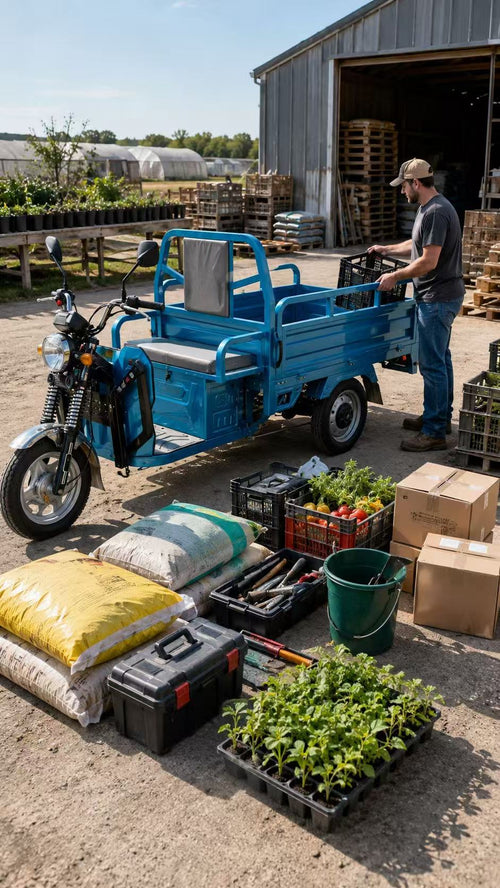
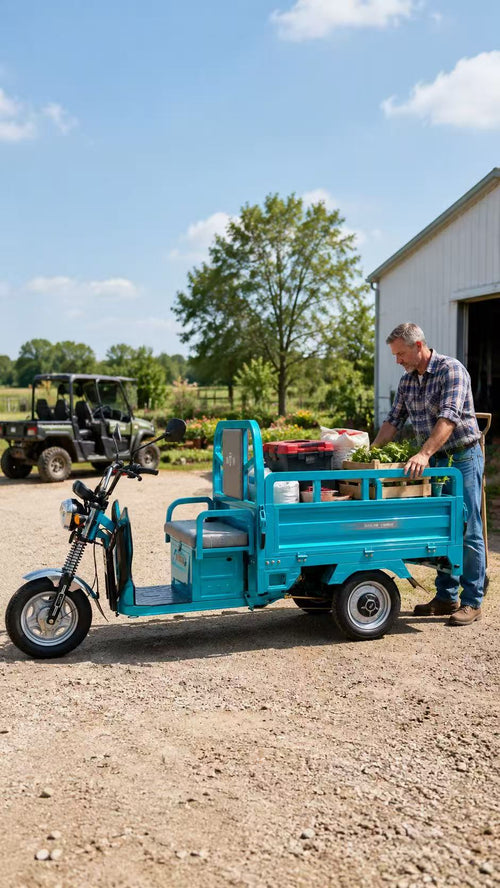
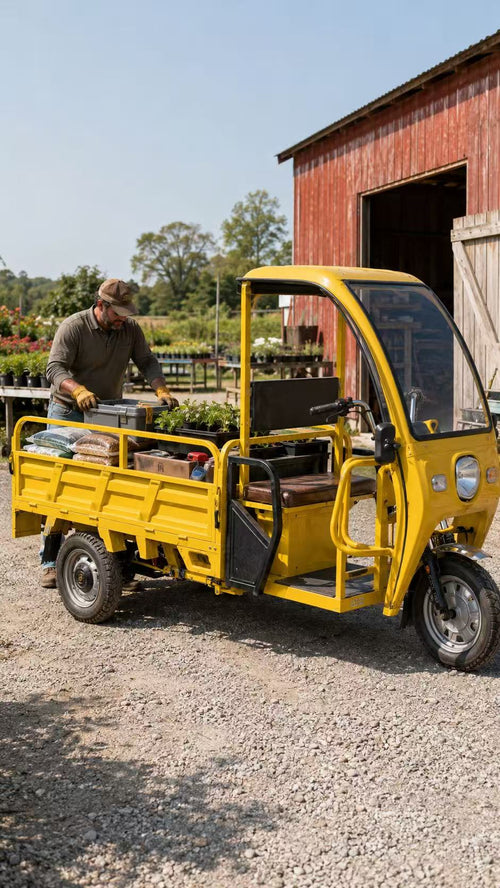
Is an Electric Farm Utility Trike Enough When You Do Not Need Heavy Towing?
Share
Many farm and homestead buyers start with one question:
Can it tow?
That question makes sense.
On a farm, ranch, homestead, nursery, greenhouse, warehouse yard, or private property, people often move materials from one place to another. Some buyers think they need a hitch, a trailer, a UTV, an ATV, or even a tractor before they can solve daily transport problems.
Sometimes they are right.
If the work requires pulling a loaded trailer, moving a sprayer, dragging equipment, towing heavy material, pulling implements, or working across rough land, then heavy towing capability matters.
But not every daily job is a towing job.
Many daily jobs are cargo bed jobs.
Feed bags need to move.
Tools need to move.
Small boxes need to move.
Nursery trays need to move.
Buckets need to move.
Garden supplies need to move.
Crates need to move.
Repair parts need to move.
For those jobs, the better question may not be:
Can this machine tow?
The better question may be:
Do I actually need heavy towing, or do I mainly need a large cargo bed?
That is where an electric farm utility trike can make sense.
Why Buyers Think About Towing First
Many buyers are used to thinking about farm work through tractors, ATVs, UTVs, pickups, trailers, and hitch systems.
That is normal.
A hitch gives a machine more flexibility. A trailer can carry larger items. A tractor can pull implements. A UTV can handle many private-property jobs. An ATV can pull smaller attachments in certain conditions.
For some buyers, this is the correct direction.
If the work involves spraying, spreading, harrowing, pulling a loaded trailer, moving firewood in large amounts, hauling heavy equipment, or crossing difficult ground, a simple electric cargo trike may not be the right machine.
A buyer should be honest about that.
An electric farm utility trike is not a tractor.
It is not a heavy towing machine.
It is not designed to replace every UTV or ATV job.
It is not the right answer for every farm.
But many buyers do not actually tow something every day.
They carry something every day.
That difference matters.
Towing Work and Cargo Bed Work Are Not the Same
Towing work means the machine must pull another load behind it.
That load may have its own wheels, tongue weight, turning radius, braking behavior, and ground resistance. Towing can become risky if the route is sloped, uneven, muddy, narrow, or overloaded.
Cargo bed work is different.
The load sits directly in the vehicle bed.
The operator can see the cargo.
The load is easier to organize.
The machine stays shorter than a vehicle plus trailer setup.
Turning is usually simpler.
Loading and unloading can be more direct.
For many daily private-site jobs, cargo bed work is enough.
If the buyer is mostly moving feed bags, tools, crates, boxes, buckets, nursery trays, and small supplies, a large practical cargo bed may solve the problem without adding trailer complexity.
This is why an electric utility trike with cargo bed should not be judged only by whether it can tow.
It should be judged by whether its cargo bed fits the daily work.
The Daily Job Is Usually Smaller Than the Imagined Job
A buyer may imagine the hardest future task.
Maybe one day they need to move a big load.
Maybe one day they need to pull a trailer.
Maybe one day they need to tow something heavy.
But daily work is usually more ordinary.
A person walks from the barn to the feed area.
Then from the shed to the garden.
Then from the greenhouse to the packing table.
Then from the storage area to the work zone.
Then back again.
The load may not be extremely heavy each time.
The problem is repetition.
One trip is not difficult.
Twenty trips become tiring.
One feed bag is manageable.
Many feed bags over a week become a labor cost.
One toolbox can be carried.
But carrying tools, parts, boxes, buckets, and supplies all day wastes time.
This is where a cargo-focused electric farm utility trike can help.
It does not need to pull a heavy trailer to be useful.
It needs to reduce daily walking, hand carrying, and repeated small transport trips.
When a Large Cargo Bed Matters More Than a Hitch
A hitch is useful when the buyer truly needs to pull something.
But a large cargo bed is useful every day when the buyer needs to carry loose daily items.
A large cargo bed can hold feed bags, crates, tools, boxes, buckets, small equipment, nursery trays, garden supplies, repair parts, and general work materials.
For small farms and private properties, this can be more practical than a trailer.
A trailer adds length.
A trailer needs space to turn.
A trailer must be hitched and unhitched.
A trailer may be harder to reverse.
A trailer can be inconvenient in tight barns, greenhouse paths, small yards, gates, market areas, or warehouse corners.
A cargo bed keeps the load with the machine.
That can be simpler.
This does not mean a cargo bed is better than towing in every situation.
It means the buyer should not pay for towing capacity if the daily work is mostly cargo bed transport.
A Farm Utility Trike Is a Cargo Tool, Not a Heavy Pulling Tool
An electric farm utility trike should be understood clearly.
It is a low-speed private-site cargo tool.
It is designed for moving daily materials across short routes.
It is suitable for private farms, homesteads, barns, nurseries, greenhouses, warehouse yards, market areas, and property maintenance zones when the work is cargo-focused.
It is not a public-road vehicle.
It is not built for highway travel.
It is not a replacement for a tractor.
It is not designed for heavy implement towing.
It is not the right machine for every rough-terrain or high-load job.
This clear boundary is important.
The value of an electric farm utility trike is not that it can do everything.
The value is that it may do one common job very well:
Move practical daily cargo without needing a larger machine.
For buyers who mainly need cargo bed work, this can be enough.
Where Heavy Towing Still Makes More Sense
Heavy towing makes more sense when the buyer needs to pull loaded trailers, sprayers, spreaders, small implements, large firewood loads, soil trailers, gravel trailers, or farm attachments.
It also makes more sense when the route includes soft ground, steep slopes, deep ruts, rough pasture, heavy mud, or long distances.
In those cases, a buyer should consider a UTV, ATV, tractor, compact tractor, or other towing-rated equipment.
Those machines are designed with towing, traction, and heavier work in mind.
A buyer should not force a cargo trike into work it was not designed to handle.
That creates risk, frustration, and possible damage.
The better approach is simple:
If the work is truly towing work, buy a towing machine.
If the work is daily cargo bed work, consider a cargo machine.
That difference protects the buyer from choosing the wrong equipment.
Where an Electric Farm Utility Trike Can Be Enough
An electric farm utility trike can be enough when the buyer’s work is mostly:
short-distance
low-speed
private-site
cargo-focused
moderate in load
repeated daily
not dependent on heavy towing
not dependent on public-road use
not dependent on high-speed travel
not dependent on deep off-road performance
This can fit many real situations.
A small farm may need to move feed bags from storage to animals.
A homestead may need to move garden supplies between sheds and growing areas.
A nursery may need to move trays, pots, soil bags, and tools.
A greenhouse may need to move boxes and supplies through controlled work routes.
A warehouse yard may need to move small parts and tools between buildings.
A market vendor may need to move crates through a private loading area.
A property maintenance worker may need to carry tools, small equipment, trash bags, and supplies.
In these cases, a cargo bed may matter more than a hitch.
The buyer does not need to ask whether the machine can pull everything.
The buyer needs to ask whether the bed can carry what they move most often.
Why the Cargo Bed Should Be Judged Carefully
Not every cargo bed is equally useful.
A buyer should look at the bed size, side rails, loading height, floor space, load balance, tie-down options, and how easy it is to load by hand.
A cargo bed that looks small may not solve daily transport problems.
A cargo bed that is long, open, and easy to access can be more useful for daily work.
The bed should be large enough to make each trip worthwhile.
If the buyer still has to make too many trips, the machine does not solve the problem.
For an electric cargo trike for farm work, the cargo bed is not just an accessory.
It is the main working area.
That is why cargo bed design is important.
A buyer should not only ask about motor power.
They should also ask:
Can the bed hold my common materials?
Can I load feed bags easily?
Can I place crates without awkward stacking?
Can I carry a toolbox and supplies together?
Can I keep the load low and balanced?
Can I unload without fighting the machine?
If the answer is yes, the trike may be useful even without heavy towing.
The Mistake of Buying for Rare Jobs
Many buyers overbuy because they focus on rare jobs.
They imagine the biggest load.
They imagine the longest route.
They imagine the heaviest towing task.
Then they buy a machine for that rare situation.
But the machine may be too expensive, too large, too complex, or too inconvenient for daily work.
This happens often with small farms and homesteads.
A buyer may think they need a large UTV or tractor because one or two jobs per year might require more power.
But the daily work may be much simpler.
Daily work is usually about small repeated loads.
If the buyer buys only for rare heavy jobs, the machine may be underused.
If the buyer buys for daily work, the machine may bring value every week.
That is why the right question is not only:
What is the hardest thing this machine could ever do?
The better question is:
What do I move every day?
If most daily loads can go directly into a cargo bed, an electric farm utility trike may be a practical choice.
The Role of a Canopy Cargo Model
A canopy cargo electric utility trike can be useful when the buyer wants some operator coverage while still keeping a large open cargo bed.
The canopy does not make the machine a full cab.
It does not turn the trike into a road vehicle.
It does not replace heavy equipment.
But it can make short private-site work more comfortable in sun or light weather conditions.
For many buyers, the canopy model may fit work areas such as barns, nurseries, greenhouses, farms, private lots, and warehouse yards.
The buyer still needs to focus on the cargo bed.
The canopy is useful for the operator.
The bed is what makes the vehicle a transport tool.
If the cargo bed is large and practical, the machine can support daily work without needing a trailer for every small task.
Why This Can Fit Small Farms and Homesteads
Small farms and homesteads often sit between two equipment needs.
They may not need a full tractor every day.
They may not need a large UTV every day.
But they still need to move things.
There may be a barn, a shed, a garden, a greenhouse, a small orchard, a chicken area, a feed storage area, a workshop, and a driveway.
The property may not be huge, but the work points are spread out.
Hand carrying becomes inefficient.
A wheelbarrow may be too slow or tiring.
A pickup may be too large for short internal trips.
A trailer may be unnecessary for small loads.
A cargo-focused electric farm utility trike can sit in this middle space.
It gives the buyer a simple way to move daily materials without starting every task with a larger machine.
That is its real value.
Questions to Ask Before Buying
Before buying, the buyer should answer a few practical questions.
Do I need heavy towing every week?
Do I need to pull implements or loaded trailers?
Do I need to work on steep, muddy, or rough ground?
Do I need high speed or long-distance travel?
Do I need passenger seats more than cargo space?
Do I need public-road use?
If the answer is yes, an electric farm utility trike may not be enough.
But if the buyer mainly needs to move feed bags, tools, crates, boxes, buckets, nursery trays, garden supplies, and small work materials across private routes, the answer may be different.
Then the buyer should ask:
Is the cargo bed large enough?
Is the route suitable for low-speed operation?
Is the load moderate and balanced?
Can I keep the work within private property or controlled areas?
Can this machine reduce repeated walking and hand carrying?
If the answer is yes, a cargo-focused electric utility trike may be a practical solution.
Final Thought
Heavy towing is important when the work truly requires it.
But many daily farm, homestead, nursery, greenhouse, warehouse yard, and private-property jobs are not heavy towing jobs.
They are cargo bed jobs.
They involve moving feed bags, tools, crates, boxes, buckets, trays, small supplies, and work materials from one place to another.
For those jobs, an electric farm utility trike can be enough when the buyer does not need heavy towing.
The point is not to buy the strongest machine.
The point is to buy the machine that matches the work.
If the work is towing, choose a towing machine.
If the work is daily cargo bed transport, a large-bed electric farm utility trike may be the smarter tool.