Electric Farm Utility Trike: When It Fits Between a Golf Cart, ATV, and Tractor
Share
An electric farm utility trike is not a golf cart, not a full ATV, and not a tractor. It sits in a practical middle space for farms, homesteads, nurseries, and private agricultural properties that need a small vehicle for daily hauling, uneven ground, and repeated short-distance work.
Many farm owners do not need to start a tractor for every small job. They may not need a full ATV or UTV for every feed run, produce load, tool trip, or barn-to-field movement. At the same time, a standard golf cart may not have enough cargo capacity, ground clearance, or utility structure for real farm work.
This is where an electric farm utility trike can make sense.
The purpose is not to replace every machine on the farm. The purpose is to provide a right-sized work vehicle for daily agricultural tasks: hauling tools, moving feed, carrying produce, transporting supplies, navigating farm lanes, and working around barns, greenhouses, packing areas, and storage sheds.
Why This Vehicle Category Exists
Farms often have more than one type of movement. Some jobs require a tractor. Some jobs require a UTV or ATV. Some jobs can be handled by hand, but doing them repeatedly wastes time and energy.
A farm utility trike fits into the space between these choices.
A tractor is powerful, but it is bulky for small transport jobs. A UTV or ATV is useful, but it may be more machine than necessary for simple hauling. A golf cart is comfortable, but it may not be designed for heavier cargo, uneven farm terrain, or agricultural materials. A hand cart or wheelbarrow is simple, but repeated trips can become tiring.
An electric farm utility trike gives the farm a low-speed hauling option for the daily jobs that happen again and again.
It is especially useful when the work involves moderate loads, private-property routes, and repeated movement between fixed points.
What Makes It Different from a Golf Cart
A golf cart is often used on farms because it is easy to drive and quiet. But a golf cart is mainly built for carrying people and light items. Its cargo platform may be limited, and it may not always fit dirty farm work.
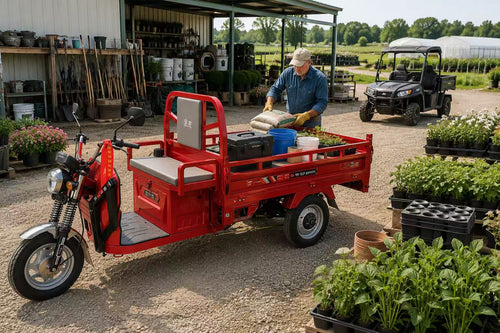
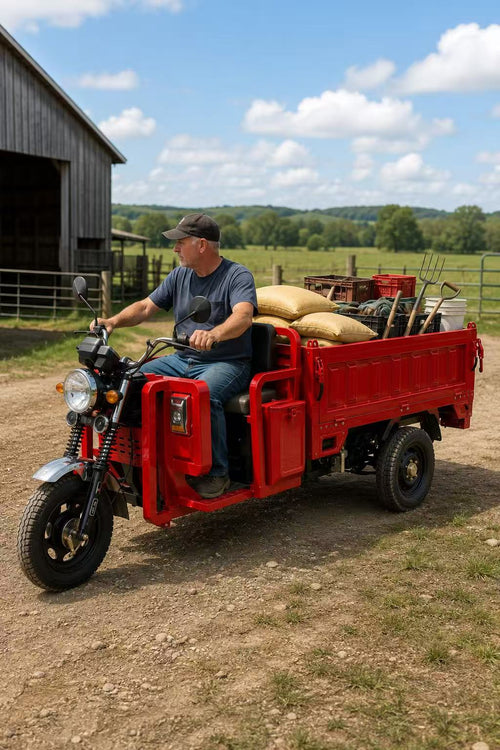
A farm utility trike is different because the cargo bed is central to the design. The rear bed can carry feed bags, crates, buckets, small tools, irrigation parts, fencing supplies, produce boxes, and general farm materials.
For farms that care more about cargo movement than passenger seating, a utility trike may be more practical than a golf cart.
The difference becomes clearer in daily work. If the task is driving around the property with one or two people, a golf cart may be enough. If the task is moving farm supplies several times a day, a cargo-focused trike may be more useful.
The buyer should ask: do I need a passenger vehicle, or do I need a small work hauler?
When It Makes Sense Instead of an ATV or UTV
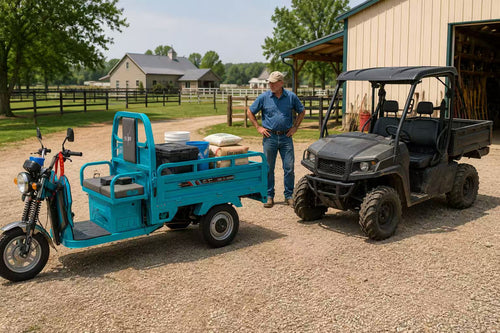
ATVs and UTVs are strong and useful on farms. They are often better for rough terrain, higher power, towing, long property routes, and more demanding off-road work. A farm utility trike should not be presented as a full replacement for those machines.
However, not every job needs an ATV or UTV.
If the work is moving feed bags from storage to the barn, carrying tools to a greenhouse, transporting produce crates to a packing area, or moving supplies around a homestead, a smaller electric utility trike can be enough. It can be quieter, simpler, and lower maintenance than a gas-powered vehicle.
The key question is not “Can this replace a UTV?” The better question is: “Which daily jobs do not really need the UTV?”
For repeated light and medium hauling, an electric farm utility trike can reduce unnecessary use of larger machines.
When a Tractor Is Still the Better Tool
A tractor is still the right choice for many farm jobs. Field work, heavy towing, loader work, deep mud, major material movement, large attachments, and demanding soil work usually require a tractor or heavier equipment.
An electric farm utility trike is not designed for those jobs.
Its strength is different. It is better suited to moving supplies across the property, helping with chores, and reducing small transport trips. It can support the daily workflow around barns, greenhouses, nurseries, orchards, livestock areas, and storage zones.
A farm may still need a tractor for heavy work. The trike simply helps with the smaller jobs that happen between the heavy work.
Daily Agricultural Tasks It Can Handle
A farm utility trike works best when the job is practical and repeated.
It can carry feed bags, seed bags, produce crates, hand tools, buckets, hoses, irrigation fittings, sprayers, small repair parts, fencing tools, gloves, ropes, and general supplies. It can help move items from a tool shed to a field edge, from a barn to a storage room, from a greenhouse to a packing area, or from a produce area to a wash station.
The pattern is usually the same: moderate cargo, short distance, frequent use.
This kind of work may not look dramatic, but it takes time every day. Reducing walking and repeated manual carrying can make the farm operation smoother.
That is why a utility trike should be judged by daily usefulness, not by whether it can do the hardest job on the property.
Terrain: Mud, Ruts, Paved Paths, and Farm Lanes
Before choosing an electric farm utility trike, the buyer should think about terrain.
Some farms have mostly paved paths, concrete barn areas, gravel lanes, packed soil, greenhouse floors, or relatively smooth farm roads. These routes can be a good fit for a small electric utility vehicle.
Other farms have deep mud, steep hills, large ruts, loose sand, rough pasture trails, or rocky ground. Those routes may require a UTV, ATV, tractor, or more specialized off-road vehicle.
The buyer should avoid judging only from a product photo. The real route matters.
A practical farm utility trike should be matched to the ground it will actually travel on most days. It may work well on moderate farm terrain, but it should not be expected to perform like a four-wheel off-road machine in extreme conditions.
How Much Weight Do You Need to Haul?
Payload is one of the most important questions.
A buyer should not only ask for the highest possible load rating. The better question is: how much weight will the trike carry in normal daily use?
This includes the driver, the cargo, and any tools or supplies loaded into the vehicle. A few feed bags, a toolbox, buckets, and small equipment can add up quickly. Produce crates can also become heavy when stacked.
The buyer should list the common loads:
Feed bags.
Produce crates.
Seed bags.
Buckets and hand tools.
Irrigation parts.
Fencing supplies.
Small repair equipment.
Greenhouse or nursery supplies.
Once the normal load is clear, it becomes easier to judge whether the motor, frame, tires, cargo bed, and brakes match the job.
Payload should always be connected to real work, not just a number on a listing.
Motor Power and Low-Speed Work
For farm use, motor power should support loaded low-speed movement. Many farm utility trikes are discussed around motors over 1000W, with stronger models using higher power depending on the load and route.
But the point is not simply to chase the biggest motor. The point is whether the motor can move the normal farm load at working speed.
On a farm, the vehicle may need to start with cargo, turn near a barn, move along a gravel lane, and stop near a gate or greenhouse. Low-speed control matters more than racing speed.
A farm utility trike should feel steady when loaded. It should be able to move tools, feed, produce, or supplies without struggling on the routes it is meant to handle.
If the route includes slopes, rougher paths, or heavier cargo, motor strength becomes more important. If the route is flat and the cargo is light, the buyer may not need the highest power model.
Cargo Bed Design Is the Key Difference
The cargo bed is what separates a farm utility trike from a simple electric tricycle.
A practical cargo bed should be easy to load, easy to unload, and large enough for the materials moved every day. For farm work, this may include bags, crates, tools, buckets, hoses, boxes, and loose supplies.
An open cargo bed is useful for general hauling. It is simple and flexible.
A drop-side gate can make loading easier from the side, especially in tight areas or packing spaces.
A dump bed can be useful for loose materials such as compost, manure, bedding, soil, mulch, or gravel.
A canopy can help the operator during sun or light weather exposure, but it should not be confused with payload or cargo bed function.
The buyer should choose the cargo bed by the job. If the farm mainly moves feed, tools, and produce, a standard open bed may be enough. If the farm moves loose materials often, a dump bed may be worth considering.
Street-Legal or Private-Property Use?
Another important question is whether the vehicle needs to be street-legal or used strictly on private property.
Many farm utility trikes are best understood as private-property work vehicles. They are used around farms, homesteads, greenhouses, nurseries, ranches, orchards, and internal work areas. They are not always intended for public roads, highways, or regulated street travel.
This matters because buyers sometimes compare vehicles without checking where they can legally be used. A vehicle that works well on private property may not be suitable for public road use without local compliance.
For OneClickChina-style farm utility vehicles, the clearest positioning is internal farm transport and private-property hauling. The buyer should confirm local rules if public road use is expected.
This keeps the purchase decision realistic and avoids confusion.
Maintenance and Operating Cost
One reason farm buyers consider electric utility trikes is lower daily maintenance compared with gas-powered equipment. Electric vehicles do not have the same engine maintenance needs as fuel-powered machines. They are quieter and can be easier to use for short repeated trips.
This does not mean there is no maintenance. Tires, brakes, batteries, wiring, suspension, cargo bed parts, and fasteners still need inspection. But for many daily hauling tasks, an electric trike can offer a simpler operating experience than a small gas vehicle.
The operating cost advantage matters most when the vehicle is used frequently. If it helps with repeated daily chores, the savings in fuel, noise, walking time, and small-trip effort can become meaningful.
Before choosing an electric farm utility trike, ask these questions:
Is the main need cargo movement or passenger movement?
Will the vehicle run on paved paths, gravel, packed soil, mud, hills, or rutted tracks?
How much weight will it carry at one time?
What are the most common loads: feed, tools, produce, buckets, or loose material?
Does the cargo bed match those loads?
Is an open bed enough, or is a dump bed needed?
Does the route require stronger tires or suspension?
Will it be used on private property or public roads?
Does the vehicle need to replace a golf cart, support a UTV, or reduce tractor use for small jobs?
These questions help the buyer choose by real farm use instead of by price or appearance alone.
Conclusion
An electric farm utility trike makes sense when a farm, homestead, nursery, greenhouse, orchard, or private agricultural property needs a small work vehicle for daily hauling. It fits between a golf cart, ATV, UTV, and tractor by handling the repeated light and medium transport tasks that larger machines may not need to do.
It is not the right tool for every job. A tractor is still better for heavy field work. A UTV or ATV may still be better for rough off-road routes and heavy towing. A golf cart may be enough for passenger movement.
But when the job is moving feed, produce, tools, supplies, buckets, and small equipment across private farm routes, an electric farm utility trike can be the right-sized tool.
The key is to match the vehicle to terrain, payload, cargo bed needs, and daily agricultural tasks. When those match, the trike can become a practical part of the farm’s everyday work system.