Is a 1500W Electric Farm Cargo Trike Enough for Your Daily Route?
Share
A 1500W electric farm cargo trike sounds strong.
For many buyers, the number is easy to understand. It feels more powerful than 1000W. It sounds more capable for farm work. It may look like a safer choice for hauling feed bags, tools, produce crates, supplies, and daily materials around a farm.
But motor watts alone do not answer the most important question.
The real question is this:
Is a 1500W electric farm cargo trike enough for your daily route?
That is where many buying decisions become more complicated.
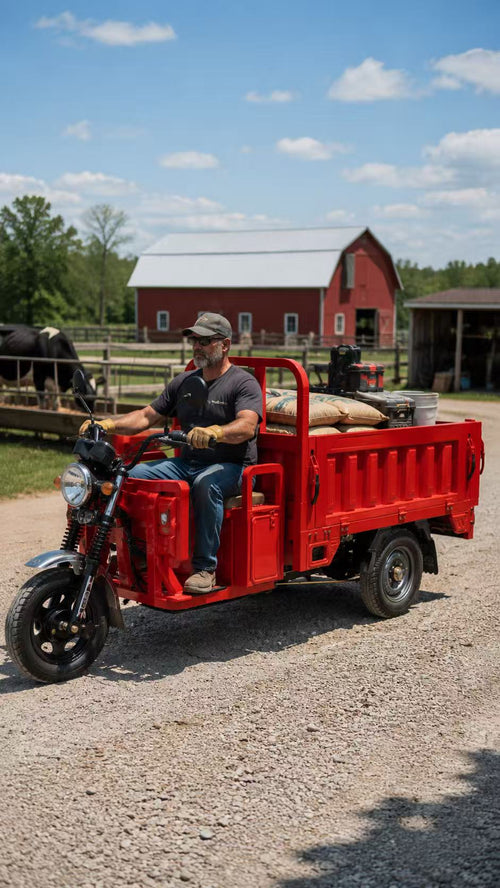
A farm route is not a product specification sheet. It has gravel, grass, packed dirt, wet ground, barn lanes, gates, turns, slopes, and repeated starts and stops. A trike that works well on one property may feel different on another property because the route is different.
So before choosing by motor watts alone, buyers should look at the real route, real load, and real daily work pattern.
Why Buyers Focus on 1500W First
Motor power is one of the first things buyers notice.
That makes sense.
A buyer may compare 1000W, 1500W, and 2000W options and think the higher number automatically means the better machine.
For some jobs, more power can help.
A stronger motor may be useful when the route has more load, more starts, more mild slopes, or more frequent daily work. It may give the operator more confidence when moving farm supplies across private property.
But motor power is only one part of the decision.
A 1500W electric farm cargo trike still needs the right route, the right load, and the right use pattern.
If the route is wrong, more watts do not solve every problem.
If the load is abused, more watts do not protect the machine from misuse.
If the buyer expects UTV-level performance, more watts do not change the real category of the equipment.
That is why buyers should not buy by watts alone.
A Farm Route Is Not a Smooth Test Track
Many product photos show equipment on clean flat ground.
Real farms are different.
A daily route may include gravel driveways, compact dirt paths, grass edges, barn entrances, greenhouse lanes, orchard rows, feed storage areas, and uneven work zones.
The route may be short, but it may repeat many times per day.
The surface may be dry in summer but softer after rain.
A small slope may feel easy when the trike is empty, but different when the cargo bed is loaded.
A turn near a barn may feel simple until the buyer carries crates, bags, or tools in the bed.
This is why route reality matters.
The buyer should ask:
Is the route mostly flat or sloped?
Is the surface gravel, grass, dirt, concrete, or mud?
Does the route stay firm after rain?
Are there tight turns near barns, gates, or worktables?
Does the trike need to start while loaded on a slope?
Is the path wide enough for safe movement?
Can the operator drive slowly and safely?
These questions are more useful than simply asking whether 1500W is enough.
When 1500W Can Make Sense
A 1500W electric farm cargo trike can make sense for many private-site farm tasks when the work is moderate and repeated.
It may be suitable for moving feed bags from storage to a barn.
It may help carry tools and repair parts across a private farm yard.
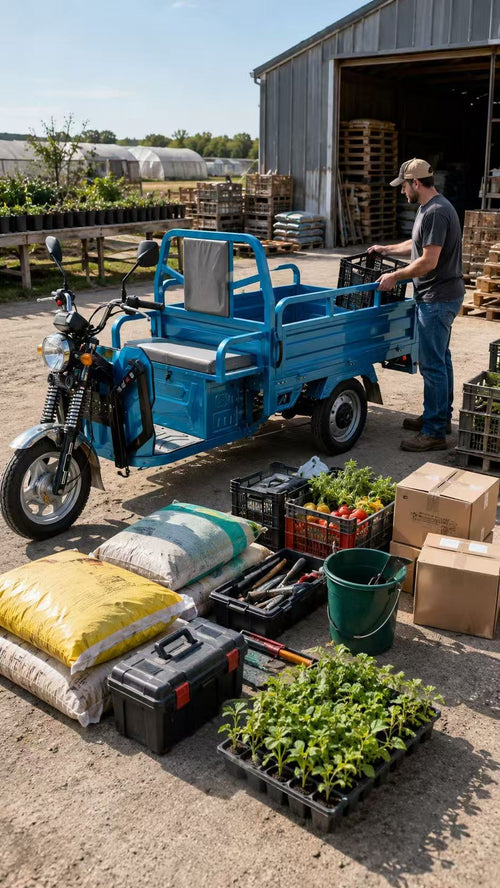
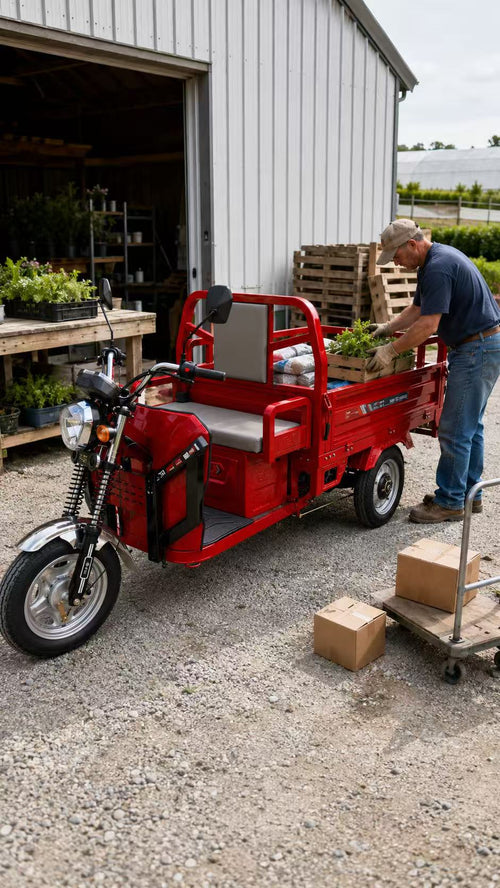
It may support produce crate movement between a field edge and a packing area.
It may help with nursery trays, soil bags, irrigation parts, greenhouse supplies, or small maintenance materials.
It may reduce repeated walking and hand carrying on short internal routes.
It may be useful for small farms, homesteads, orchards, nurseries, greenhouses, private lots, and work areas where the daily need is practical cargo movement, not high-speed travel.
In this type of use, the value of 1500W is not about racing or extreme terrain.
The value is steady low-speed support for repeated material movement.
The trike is not trying to become a full-size UTV, tractor, or pickup truck.
It is a compact electric cargo tool for daily farm work.
When 1500W Is Not Enough
A 1500W motor does not mean the equipment can do every job.
Buyers should be careful if the route includes deep mud, extreme slopes, loose sand, unstable ground, heavy towing, long-distance road travel, or repeated severe overloading.
In those situations, the problem is not just motor watts.
The whole machine category may be wrong.
An electric farm cargo trike should not be treated like a public-road vehicle, heavy construction machine, full-size UTV, or tractor replacement.
It is also not the best tool if the buyer needs regular passenger carrying, aggressive off-road riding, high ground clearance, long-range property travel, or dealer-backed UTV performance.
If the daily route is too demanding, choosing 1500W does not magically make the machine suitable.
The buyer may need a larger UTV, tractor, pickup, or other work equipment.
This is why honest limits matter.
The right question is not “How powerful is the motor?”
The right question is “Does the entire machine match the daily job?”
Load Matters as Much as Motor Power
Many buyers look at motor watts first, but load is just as important.
A farm cargo bed can carry many kinds of materials:
feed bags
produce crates
tools
boxes
buckets
fencing supplies
nursery trays
soil bags
maintenance parts
small farm materials
But different materials have very different weight.
A few light boxes are not the same as wet soil.
Feed bags are not the same as loose gravel.
Tools and fencing parts can become heavy quickly.
The cargo bed may have space, but space is not the same as safe working load.
A 1500W electric farm cargo trike should be loaded in a balanced and reasonable way. The load should stay low, stable, and within the rated working capacity.
Buyers should avoid:
long-term overloading
stacking cargo too high
uneven side loading
carrying loose heavy material in the wrong model
starting heavy loads on unsafe slopes
driving too fast with cargo
using the machine beyond its intended work category
The goal is not to carry everything at once.
The goal is to reduce repeated short trips with safe, practical loads.
Starting Under Load Is Different from Moving Empty
Some buyers test a machine empty and feel confident.
But real work often starts with cargo already in the bed.
Starting from a stop with feed bags, crates, tools, or supplies requires more practical power than moving empty on flat ground.
This is where route and load combine.
A short slope near a barn may matter.
A gravel turn near a gate may matter.
A soft patch after rain may matter.
A loaded start on uneven ground may matter.
A 1500W electric farm cargo trike may handle many normal private-site routes well, but buyers should still think about how the trike will actually be used.
The most important moment is not always top speed.
Sometimes the most important moment is slow controlled movement with a useful load.
That is why buyers should think less about maximum numbers and more about daily conditions.
Range Numbers Need Realistic Thinking
Range is another number buyers like to compare.
A product may show a max range number, but real use depends on many conditions.
Actual range can be affected by:
load weight
surface type
slope
stop-and-go use
battery condition
operator behavior
temperature
tire condition
route length
frequency of trips
A short daily route with moderate loads may be a good match.
A long route with repeated heavy loads and slopes may reduce actual performance.
This does not mean range numbers are useless.
It means they should be read carefully.
For farm use, buyers should ask:
How long is my daily route?
How many trips happen per day?
Can I charge near the work area?
Do I need all-day continuous use?
Are most trips short and repeated?
Will the machine usually carry moderate loads?
If the daily route is short, predictable, and private, the electric cargo trike may fit well.
If the route is long, rough, and constantly heavy, buyers should be more cautious.
The Wrong Route Can Make a Good Tool Look Bad
A machine can be useful in the correct environment and disappointing in the wrong environment.
That is true for UTVs, pickups, tractors, hand carts, and electric cargo trikes.
If a buyer uses a compact electric farm cargo trike on a suitable private route, it can be practical and efficient.
If the same buyer takes it into deep mud, rough off-road conditions, extreme slopes, or heavy-duty hauling, it may feel underpowered or unsuitable.
That does not always mean the machine is bad.
It may mean the route is wrong for the equipment.
This is an important buyer lesson.
Before asking whether 1500W is enough, ask whether the route belongs to this type of equipment.
Private-Site Work Is the Right Context
An electric farm cargo trike is best understood as private-site transport work equipment.
It is designed for low-speed, short-distance material movement inside private or controlled areas such as farms, nurseries, greenhouses, barns, warehouses, logistics parks, private lots, and similar work spaces.
It should not be judged like a public-road vehicle.
It should not be compared only to a highway pickup truck.
It should not be expected to replace a full-size farm UTV in every condition.
The better comparison is daily internal movement.
If workers currently move materials by hand, by wheelbarrow, by small carts, or by using a large machine for every small trip, a compact electric cargo trike may offer practical value.
It gives the operator a simple cargo bed and electric movement for repeated short trips.
This is where the equipment makes sense.
Why 1500W May Be the Middle Ground
For some buyers, 1000W may be enough for lighter, flatter, simpler routes.
For other buyers, 2000W may feel more comfortable if the route or load is more demanding.
A 1500W electric farm cargo trike can often be seen as a middle-ground option.
It may offer more confidence than a lower-power setup for daily farm hauling, while still staying within the practical category of compact electric transport equipment.
But buyers should not treat 1500W as a guarantee.
The right motor choice depends on the model, battery setup, route, load, and work pattern.
A buyer should look at the full setup, not just one number.
This is especially important when comparing product options such as 1000W, 1500W, and 2000W.
The best option is not always the biggest number.
The best option is the one that fits the daily route.
Questions Buyers Should Ask Before Choosing 1500W
Before choosing a 1500W electric farm cargo trike, a buyer should ask:
What route will I use every day?
Is the route mostly flat or does it include slopes?
Is the surface firm enough for safe daily use?
Will the trike start while loaded?
How heavy are my usual loads?
How often will the route repeat each day?
Do I need towing or only cargo movement?
Do I need passenger transport?
Is the work area private or controlled?
Do I need public-road use?
Can I charge conveniently?
Do I understand the rated load and warranty limits?
Can I avoid long-term overloading?
These questions help the buyer make a realistic decision.
They also prevent a common mistake:
buying by specification alone.
A good machine can still be a poor fit if the buyer ignores the route.
How This Applies to OneClickChina Buyers
OneClickChina electric cargo and utility trike models are designed for practical private-site material movement.
Depending on the model, buyers can choose open cargo, canopy cargo, cab utility cargo, or hydraulic dump utility versions. Motor and battery options may include 1000W, 1500W, 2000W, 60V, and 72V configurations.
That flexibility helps buyers match the equipment to the job.
But the buyer still needs to choose carefully.
An open cargo model may be better for simple daily hauling.
A canopy model may help with sun or light weather exposure.
A cab model may offer more operator coverage.
A hydraulic dump model may be better when loose materials need controlled rear unloading.
The motor choice is only one part of the decision.
The model type, route, load, and work pattern matter together.
Final Thought
A 1500W electric farm cargo trike may be enough for many daily farm routes.
But only if the route, load, and work pattern are suitable.
Do not buy by motor watts alone.
A farm is not a specification sheet.
Look at the gravel path, the barn lane, the slope, the grass edge, the daily load, the turning space, and the number of repeated trips.
If the job is private-site, low-speed, short-distance material movement with moderate loads, a 1500W electric farm cargo trike may be a practical choice.
If the job is extreme off-road work, heavy towing, public-road travel, deep mud, or repeated overloading, the buyer should choose a different machine.
The smartest purchase is not the highest number on the spec sheet.
It is the tool that fits the route you actually use every day.