Electric Cargo Trike for Farm Work: When It Makes Sense Instead of a UTV or ATV
Share
On many farms, not every job needs a full-size UTV or ATV. Some jobs are heavy, rough, and demanding. Others are smaller, repeated, and part of the normal daily routine. Moving feed bags from storage to the animal area, carrying tools from the shed to a repair point, hauling produce crates from a field edge to a packing area, or transporting irrigation parts across the property may not always require a large gas-powered utility vehicle.
This is where an electric cargo trike for farm work can make practical sense.
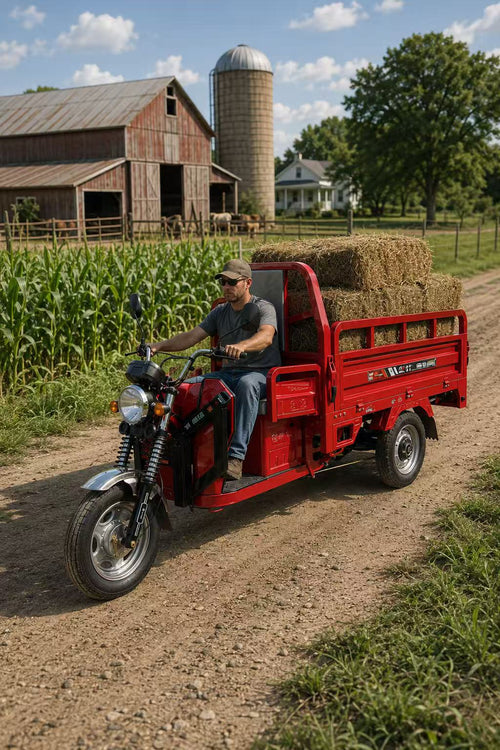
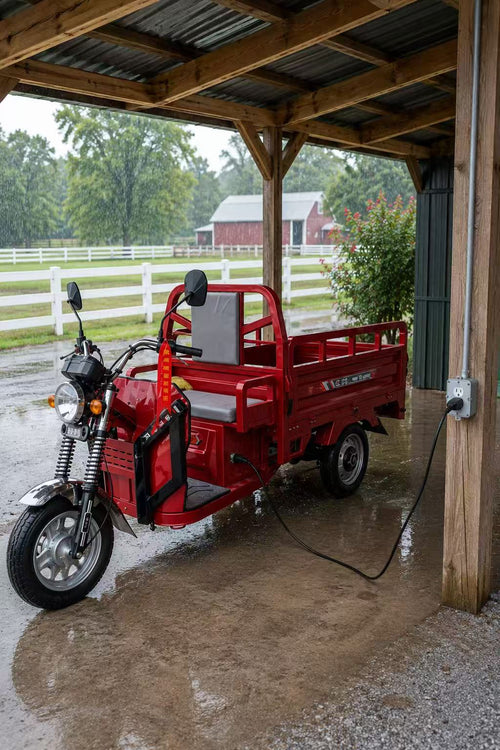
An electric cargo trike for farm use is a low-speed three-wheel work vehicle designed for short-distance hauling around private property. It is not meant to replace every UTV, tractor, pickup, or heavy-duty machine on a farm. Its value is different. It is designed for daily light hauling, property navigation, and repeated short internal routes where a larger machine may be more than the job requires.
For many farm owners, the real question is not “Can this replace my UTV?” The better question is: “Which daily jobs do not really need a full-size UTV or ATV?” When the work involves moderate cargo, short travel distances, and frequent stop-and-go movement, a farm cargo trike can become a useful tool.
Why Farmers Look at Electric Cargo Trikes
The search term electric cargo trike for farm shows a very clear buying intention. People are not just looking for a recreational electric tricycle. They are looking for a working vehicle that can move cargo around a farm, ranch, nursery, greenhouse, orchard, or private property.
The interest usually comes from several practical needs. Farm owners want a quiet vehicle. They want lower operating cost. They want something easier to maneuver than a larger utility vehicle. They want a rear cargo bed that can carry tools, feed, produce, small equipment, and maintenance supplies. They may also want a vehicle that can move through tighter spaces where a full-size UTV, ATV, pickup, or tractor is inconvenient.
This is why electric cargo trikes are often compared with gas-powered UTVs and ATVs. The comparison is not because they are the same machine. They are not. A UTV is usually stronger for towing, rough terrain, steep slopes, and heavy off-road work. But for smaller daily farm chores, an electric cargo trike can be a quieter, more cost-effective, and easier-to-use alternative.
The Key Difference: Light Hauling vs Heavy Utility Work
The most important point is to separate light hauling from heavy utility work.
Light hauling includes jobs such as carrying hand tools, small equipment, produce crates, feed bags, fencing supplies, greenhouse materials, irrigation parts, nursery trays, cleaning supplies, and repair parts. These jobs are common on many farms. They happen every day. They are not always heavy enough to justify using a larger gas vehicle.
Heavy utility work is different. That may include towing large trailers, hauling oversized loads, working in deep mud, climbing very steep rough hills, or carrying heavy bulky materials over difficult terrain. For those jobs, a larger UTV, tractor, or specialized machine may still be the better choice.
A good electric cargo trike for farm work should be understood as a daily support vehicle. It helps reduce small trips, manual carrying, and unnecessary use of larger machines. It is especially useful when the farm has many repeated short-distance tasks.
Where an Electric Cargo Trike Makes Sense
An electric cargo trike makes the most sense when the work route is predictable. For example, a farmer may need to move supplies from a storage shed to a barn every morning. A nursery worker may need to move trays between growing areas. A greenhouse operator may need to carry tools, fertilizer, and irrigation parts down narrow service lanes. A ranch worker may need to move feed bags, small tools, or cleaning supplies between fenced areas.
These are not highway jobs. They are not long-distance transportation jobs. They are internal property movement jobs.
This is why the phrase property navigation is important. On a farm, the ability to move through the right space matters as much as carrying capacity. A vehicle that is too large may be inconvenient in tight lanes, greenhouse paths, barn-side areas, livestock passages, packing zones, and storage corners. A smaller electric cargo trike can often move more naturally through these areas.
The Rear Cargo Bed Matters
One reason this category is different from ordinary electric tricycles or cargo bikes is the rear cargo bed.
For farm use, the cargo area should not be treated as a small basket. A farm-use cargo trike needs a real working cargo bed. The buyer should look at how easy it is to load from the side, whether the bed height is practical, how much space is available, and what type of cargo can be placed inside.
A rear cargo bed is useful because farm materials are often irregular. Tools, feed bags, produce crates, buckets, fencing parts, hoses, sprayers, small boxes, and maintenance parts do not always fit neatly into a small front box or bicycle basket. A rear cargo bed gives the user more flexibility for daily work.
For many farm buyers, this is the difference between a recreational electric trike and a real farm cargo tricycle. The vehicle must be judged by what it can carry during real daily work, not just by how it looks in a product photo.
Open Bed, Canopy, or Enclosed Cab?
Another buying question is whether the buyer needs an open-bed trike, a canopy model, or an enclosed cab.
An open cargo bed is usually the most practical choice when the main work is hauling tools, feed, produce, bags, crates, and supplies. It is simple, easy to load, and easy to clean. For many farms, this is enough.
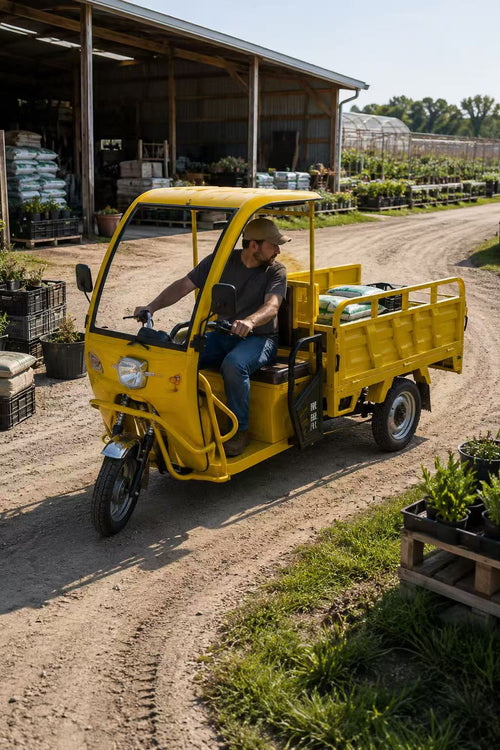
A canopy can be useful when the operator works under strong sun or light weather exposure. It does not turn the vehicle into a fully protected cab, but it can make daily use more comfortable. A canopy model can be a good fit for farms, nurseries, greenhouses, orchards, and private properties where the driver uses the vehicle repeatedly throughout the day.
An enclosed cab is more suitable when weather protection is a bigger concern. It may be useful for colder areas, windy work sites, or commercial environments where the operator spends longer time driving. But for many basic farm hauling jobs, a full enclosed cab is not always necessary.
The right choice depends on the route, climate, cargo type, and how often the vehicle is used.
Terrain Is One of the Most Important Questions
Before choosing an electric cargo trike for farm use, buyers should think carefully about terrain.
If the route is mostly packed soil, gravel, concrete, paved farm roads, greenhouse lanes, barn-side paths, or relatively level property roads, an electric cargo trike can be a strong fit. These routes match the vehicle’s main purpose: low-speed, repeated hauling on private property.
If the route is deeply muddy, extremely uneven, steep, rocky, or similar to heavy off-road trail conditions, the buyer should be more careful. A UTV or ATV may still be better for those jobs.
This is why a serious buying article should not claim that an electric cargo trike can replace every farm vehicle. That would not be realistic. The better claim is that it can reduce unnecessary use of larger vehicles for daily light hauling and routine property movement.
Cargo Weight Should Be Realistic
Another important question is average cargo weight.
Some buyers only ask for the maximum load rating. But for daily farm use, the better question is: what is the normal load most days?
If the daily cargo includes tools, boxes, produce crates, feed bags, small parts, buckets, plant trays, or similar materials, a farm cargo trike can be very useful. If the buyer constantly needs to move heavy bulky materials, tow large attachments, or carry oversized loads, then a different vehicle may be needed.
A practical buyer should list the top five things they move most often. This usually gives a clearer answer than only comparing motor size or top speed.
For example:
A nursery may move plant trays, soil bags, hoses, and tools.
A small farm may move produce crates, feed bags, buckets, and maintenance supplies.
A greenhouse may move fertilizer, irrigation parts, sprayers, and harvest containers.
A ranch may move tools, small feed loads, fencing parts, and cleaning supplies.
These are the kinds of jobs where an electric cargo trike can create daily value.
Why It Can Be More Cost-Effective Than Using a UTV for Every Job
A UTV is useful, but it is not always the most efficient tool for small repeated tasks. It may cost more to purchase, maintain, fuel, and operate. It may also be larger than necessary for narrow areas or short routes.
An electric cargo trike can reduce the need to start a larger gas-powered machine for every small job. It can be used for short trips, quick movement, and repeated hauling between work zones. Over time, that can save labor, reduce walking, and make daily operations smoother.
The cost-effectiveness does not only come from electricity. It also comes from using the right-size tool for the right-size job.
For some properties, the best setup is not choosing between a UTV and an electric cargo trike. The best setup may be using both: the UTV for rough, heavy, demanding work, and the electric cargo trike for routine light hauling.
This is a more realistic way to position the product.
Good Farm Use Cases
An electric cargo trike for farm work may be useful in many daily scenarios.
It can move feed bags from storage to livestock areas. It can carry tools to a fence repair point. It can transport produce crates from a picking area to a packing area. It can move plant trays in a nursery. It can carry irrigation parts along greenhouse rows. It can bring cleaning supplies to barns or animal areas. It can move small parts between storage, workshop, and work zones.
The common pattern is simple: moderate cargo, short route, repeated use.
This is exactly where a small electric cargo vehicle can help.
When It May Not Be the Right Choice
A good buying guide should also explain when the vehicle may not be the right fit.
If the buyer needs heavy towing, very high payload, deep mud performance, steep rough hill climbing, long road travel, or true off-road power, a cargo trike may not be enough. If the work is mainly heavy-duty ranch towing or rough field access after rain, a UTV, tractor, or specialized farm machine may still be the better choice.
This honest comparison can help buyers make a better decision. It also builds trust because the article does not pretend one vehicle can do every job.
What Buyers Should Check Before Choosing
Before buying an electric cargo trike for farm work, the buyer should check several things.
First, check the route. Is the vehicle mostly used on gravel, paved road, packed soil, barn-side path, greenhouse lane, or rough field? The more predictable and moderate the route, the better the fit.
Second, check the cargo. What is the normal daily load? Tools, feed, produce, crates, buckets, irrigation parts, and small supplies are good matches. Oversized or extremely heavy materials need more caution.
Third, check the cargo bed. Is it large enough? Can it be loaded easily? Is an open bed enough, or does the operator need a canopy or cab?
Fourth, check how often the vehicle will be used. If it is used many times per day for short internal trips, the value becomes stronger.
Fifth, check whether the vehicle is being used on private property. These vehicles are best positioned as low-speed utility vehicles for internal farm and property routes, not as public road vehicles.
The Best Fit: Daily Farm Chores and Internal Transport
The best fit for an electric cargo trike is not extreme heavy work. The best fit is daily movement.
Farm work often includes many small trips that add up over time. Walking back and forth with tools, carrying feed by hand, moving boxes manually, or using a large machine for every small trip can waste time and energy. A farm cargo tricycle can help organize that movement.
This is why the category has real value. It gives the farm a right-size vehicle for everyday tasks.
A practical electric cargo trike for farm work should be judged by how well it handles repeated routes, practical cargo, easy loading, operator comfort, and daily reliability. For many farms, those factors are more important than maximum speed or the look of the vehicle.
Conclusion
An electric cargo trike for farm work makes sense when the main need is light hauling, daily property navigation, and short-distance internal transport. It is not a full replacement for every UTV or ATV. But it can be a smart alternative when the job involves tools, feed, produce, small supplies, and repeated movement around the property.
For farms, nurseries, greenhouses, orchards, ranches, and private properties with regular hauling needs, a farm cargo trike can reduce manual carrying, lower unnecessary use of larger machines, and make daily work more efficient.
The key is to match the vehicle to the real job. If the work is moderate, frequent, and local, an electric cargo trike may be exactly the right tool. If the work is heavy, rough, and extreme, a larger UTV or farm machine may still be needed.
That honest difference is what makes the electric cargo trike category useful: it is not trying to be every vehicle on the farm. It is trying to solve the small daily hauling jobs that happen again and again.